
Can a Jump Starter Start a Completely Dead Battery?
When your car battery dies, your vehicle loses all electrical power — the engine won’t crank, the lights go dim or dark, and you’ll hear a clicking sound or nothing at all. You need a jump start, a battery charger, or a replacement depending on the battery’s condition. Most dead batteries result from leaving lights on, a failing alternator, extreme temperatures, or a battery older than five years.
I’m Alex Rahman, and the first time my battery died I was in a parking garage at 11 PM with a job interview the next morning. No jumper cables. No one nearby. Complete silence when I turned the key.
That moment taught me everything I now know about why car batteries die, what actually happens inside the car when they do, and exactly how to handle it — from the emergency fix to making sure it never happens again.
This guide covers everything: the symptoms, the science, the step-by-step recovery, and when your battery is truly beyond saving.
Key Takeaways
- A dead car battery drops below 12 volts and cannot deliver enough current to crank the starter motor — the car simply will not start.
- The three most common causes are lights left on overnight, parasitic electrical drain, and a failing alternator that stops recharging the battery while driving.
- You can jump start a dead battery in under 10 minutes using jumper cables or a portable jump starter pack — then drive at least 30 minutes to let the alternator recharge it.
- A battery that dies repeatedly, is more than five years old, or reads below 12 volts after a full charge needs replacement, not another jump start.
- Regular battery voltage checks every 12 months can prevent a dead battery from catching you off guard.
What Does a Dead Car Battery Actually Mean?
A car battery is a 12-volt lead-acid unit that stores chemical energy and converts it into electrical current. Every time you start the engine, the battery delivers a short, powerful burst of electricity to the starter motor. Without that burst, nothing in the car moves.
When mechanics and drivers say a battery is “dead,” they mean it no longer holds enough stored charge to deliver that starting current. The battery may read 10 volts, 8 volts, or even zero — well below the 12.6 volts a fully healthy battery shows at rest.
What voltage does a dead battery show?
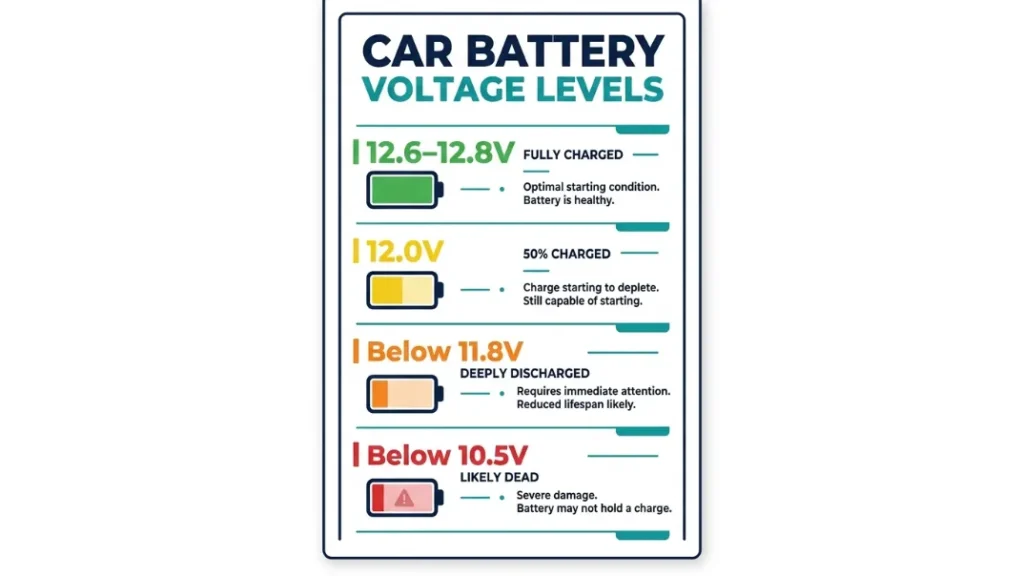
A fully charged 12-volt car battery reads between 12.6 and 12.8 volts when the engine is off. A battery reading 12.0 volts is roughly 50 percent discharged. Anything below 11.8 volts is considered deeply discharged, and a reading below 10.5 volts means the battery is likely damaged or fully dead.
You can check this in two minutes with an inexpensive digital multimeter. Set it to DC voltage, touch the red probe to the positive terminal and the black probe to the negative terminal, and read the result. This single test tells you more than any dashboard light ever will.
Dead battery vs. completely discharged — is there a difference?
Yes, and the difference matters when deciding whether to recharge or replace. A battery that discharged because you left the lights on overnight is not damaged — it just needs a recharge. A battery that has gone completely flat repeatedly, or has sat dead for weeks, has likely suffered sulfation damage. Sulfation is a chemical process where lead sulfate crystals form permanently on the battery plates, permanently reducing its capacity. A sulfated battery often cannot hold a full charge even after hours on a charger.
Tip:
Always recharge a dead battery within 24 hours of it dying. The longer a lead-acid battery sits fully discharged, the deeper the sulfation damage becomes — and the less likely a standard charger can recover it.
What Are the Warning Signs Your Car Battery Is Dying?
A dead battery rarely arrives without warning. Most batteries give clear signals in the days or weeks before they fail completely. Catching these signs early saves you from being stranded.
The most common warning is a slow, sluggish engine crank. The starter motor sounds labored, like it’s spinning through molasses instead of firing cleanly. Another early sign is electronic accessories behaving strangely — power windows moving slowly, interior lights dimmer than usual, or the radio resetting every time you start the car.
Why does your car make a clicking sound when the battery is dead?
The rapid clicking sound is the solenoid in your starter motor firing repeatedly but getting no power to actually spin. The battery has just enough charge to trigger the solenoid — a small magnetic switch — but not enough to run the full starter motor. A single loud click usually means the solenoid activated once but the motor never spun at all. Both sounds confirm the battery is too weak to start the engine.
Can dashboard warning lights tell you the battery is failing?
The battery warning light — a small red rectangle with a plus and minus symbol — illuminates when the charging system detects a problem. In most cases this light means the alternator is not charging the battery properly, not that the battery is already dead. By the time the battery is actually dead, most of your dashboard lights won’t turn on at all. The battery light is a pre-failure warning, not a post-failure announcement. Take it seriously the moment it appears.
Warning:
If your battery warning light turns on while you’re driving, do not ignore it. Drive directly to a mechanic or auto parts store. Your alternator may have stopped charging the battery, and you could have as little as 30 minutes of driving time before the battery drains completely and the car stalls.
What Causes a Car Battery to Die?
Understanding the cause of a dead battery helps you fix the right problem. Jump starting a car whose battery keeps dying due to a bad alternator will just leave you stranded again tomorrow. There are five primary causes worth knowing in detail.
Does leaving your lights on overnight kill the battery?
Yes — this is the single most common cause of a dead battery. A standard car headlight draws roughly 5 to 8 amperes. A fully charged battery holds about 48 amp-hours of capacity. Leave two headlights on overnight for eight hours and you’ve consumed 80 to 128 amp-hours — far more than the battery holds. The battery discharges completely. Interior dome lights, trunk lights, and phone chargers left plugged in all cause the same problem on a slower timeline.
What is parasitic drain and how does it drain your battery?
Parasitic drain is the electrical current your car draws from the battery even when the ignition is off. Every modern vehicle has some level of parasitic drain — the clock, the keyless entry module, and the alarm system all draw tiny amounts of current continuously. Normal parasitic drain runs between 20 and 50 milliamps. A faulty module, a stuck relay, or a malfunctioning aftermarket accessory can push that drain to 300 milliamps or higher. At that rate, a healthy battery goes flat in two to three days of sitting parked.
Mechanics diagnose parasitic drain with a multimeter set to measure milliamps, placed in series with the negative battery terminal. If your battery keeps dying and you haven’t left any lights on, parasitic drain is the first thing a technician should check.
Can a bad alternator kill your car battery?
Absolutely — and this is one of the most misdiagnosed battery problems. The alternator is a generator driven by the engine’s belt. It produces 13.5 to 14.7 volts while the engine runs, which both powers your car’s electronics and recharges the battery. If the alternator fails or its voltage regulator breaks down, the battery slowly drains while you drive. You might successfully jump start the car, drive for 20 minutes, and then stall at a traffic light as the battery hits zero again. Replacing the battery in this situation does nothing — the new battery dies just as fast. Always test the alternator output voltage before buying a replacement battery.
How to Diagnose Battery vs. Alternator
- Start the car successfully (via jump start if needed).
- Set a multimeter to DC voltage and measure across the battery terminals with the engine running.
- A reading of 13.5–14.7 volts means the alternator is charging normally — your problem is the battery.
- A reading at or below 12.6 volts with the engine running means the alternator is not charging — replace the alternator, not just the battery.
- Rev the engine to 2,000 RPM and recheck; voltage should rise slightly. A reading that stays flat confirms alternator failure.
Warning:
Extreme heat damages car batteries faster than cold weather does. High temperatures accelerate the evaporation of battery fluid and speed up internal corrosion. A battery in Phoenix, Arizona typically lasts two to three years. The same battery in Minnesota may last five to six years. If you live in a hot climate, inspect your battery annually starting at the two-year mark.
Quick Summary: Five Main Causes of a Dead Car Battery
Lights or accessories left on drain the battery in hours. Parasitic drain from a faulty module kills it over days. A failing alternator drains it while driving. Extreme heat or cold degrades battery chemistry. And a battery older than five years simply loses its ability to hold a charge — no external cause needed.
What Happens When Your Battery Dies While Driving?
If your battery dies completely while the engine is running, the alternator keeps the car moving for a short time. Modern cars run their electronics off the alternator directly when it is functioning. However, once the battery voltage drops too low, the car’s electronic control unit — the ECU — may reset or malfunction. Power steering, anti-lock brakes, and stability control can all drop out suddenly because they rely on battery-backed power circuits.
The engine will eventually stall as the ignition system loses stable voltage. Power-assisted brakes and steering become hard to operate manually. Pull safely to the side of the road, turn on your hazard lights immediately, and do not attempt to restart the car until you have a jump source ready. According to AAA’s battery safety guidance, a car stalling from electrical failure mid-road is a genuine safety hazard and should be treated as a roadside emergency.
If your car stalls while driving and you suspect the battery or alternator, engage your hazard lights, coast to the shoulder with your remaining momentum, and call roadside assistance. Do not try to restart and merge back into traffic without first testing your battery voltage.
How Do You Start a Car With a Dead Battery?
You have two main options: traditional jumper cables connected to another running vehicle, or a portable lithium jump starter pack you carry in your car. Both work — the jump starter pack is faster, safer, and requires no second vehicle.
How do you jump start a car safely step by step?
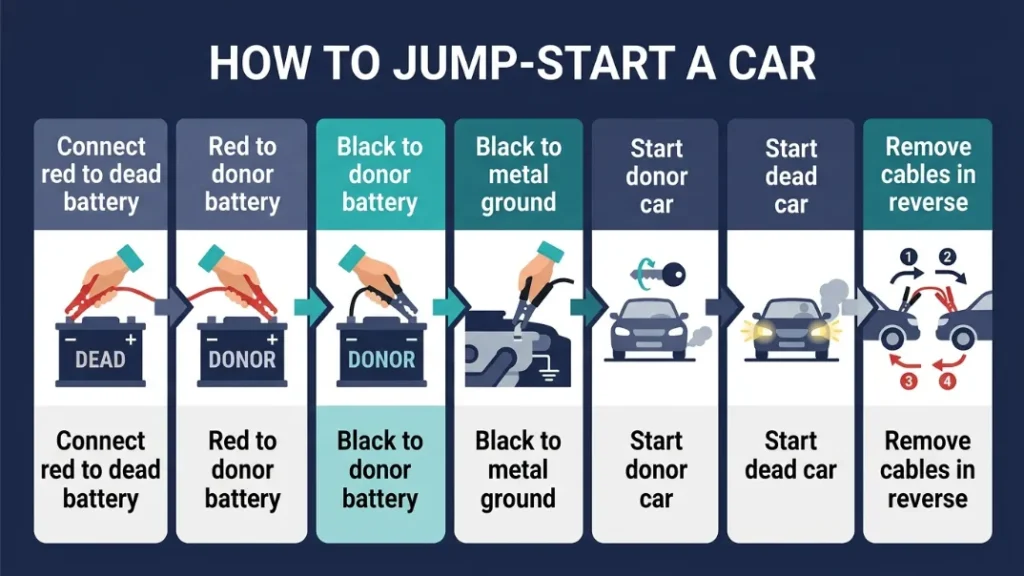
Jump starting with jumper cables takes two vehicles positioned close enough to connect. The process is straightforward but the connection sequence matters — connecting in the wrong order can arc electricity and damage both vehicles’ electronics.
Step-by-Step: Jump Start With Jumper Cables
- Park the working vehicle close to the dead vehicle — engines facing each other or side by side. Do not let the cars touch.
- Turn off both vehicles and set both parking brakes.
- Connect the red (positive) clamp to the positive terminal on the dead battery.
- Connect the other red clamp to the positive terminal on the good battery.
- Connect the black (negative) clamp to the negative terminal on the good battery.
- Connect the last black clamp to an unpainted metal surface on the dead car’s engine block — not the dead battery’s negative terminal. This reduces spark risk near the battery.
- Start the working vehicle and let it run for two to three minutes.
- Attempt to start the dead vehicle. If it starts, let it idle for two minutes before removing cables.
- Remove the cables in exact reverse order: black from engine block, black from good battery, red from good battery, red from now-started vehicle.
- Drive the jump-started car for at least 30 minutes to allow the alternator to recharge the battery.
What is a portable jump starter and how does it work?
A portable jump starter is a compact lithium-ion battery pack with built-in jumper clamps. You connect it directly to your dead battery and start the car without a second vehicle. Modern units like the NOCO Boost Plus GB40 deliver 1,000 amps of starting current — enough to start most cars, trucks, and SUVs. The entire process takes under five minutes. These devices cost between $80 and $150, weigh about 2.4 pounds, and fit in a glove compartment. For solo drivers or anyone who parks in isolated areas, a portable jump starter is one of the most practical safety tools available.
Tip:
Recharge your portable jump starter every three to six months even if you haven’t used it. Lithium-ion packs lose charge slowly in storage. A jump starter that sat in your trunk for a year may not have enough power to start your car when you need it most.
NOCO Boost Plus GB40 1000 Amp 12-Volt UltraSafe Portable Lithium Car Battery Jump Starter Pack
This compact 2.4-pound jump starter delivers 1,000 amps of starting power, handles engines up to 6 liters, provides up to 20 jump starts per charge, and includes spark-proof reverse-polarity protection so you can use it safely even under stress — no second car needed.👉 Check Price on Amazon
Should You Recharge or Replace a Dead Car Battery?
This is the decision most drivers get wrong. Not every dead battery needs replacement — and not every battery that accepts a charge is actually healthy enough to keep. The right answer depends on two factors: why the battery died, and how it performs after a full charge.
Can a completely dead car battery be recharged?
Yes — if the battery went flat due to an external cause like lights left on, and it hasn’t sat dead for more than a few days, a smart battery charger can fully recover it. Smart chargers from brands like NOCO Genius and Schumacher use multi-stage charging that conditions the battery, desulfates the plates, and restores full capacity. A deeply discharged battery may need 12 to 24 hours on a slow trickle charger — typically 2 amps — to fully recover without damaging the cells through heat. Standard fast chargers push current in too quickly and can warp battery plates in an already stressed battery.
If the battery was completely dead for two weeks or longer, or has had three or more deep discharge events, replacement is usually the more reliable choice. The chemical damage from prolonged sulfation is often irreversible.
How long does it take to fully charge a dead car battery?
The charge time depends entirely on the charger’s amperage output and how depleted the battery is. A 2-amp slow charger takes 24 to 48 hours to fully recharge a deeply discharged 48-amp-hour battery. A 10-amp charger takes 4 to 8 hours for the same battery. A 40-amp fast charger can deliver enough charge to start the car in 30 to 60 minutes, but it doesn’t fully restore battery health — use it only in emergencies. For long-term battery health, the Car and Driver battery charging guide recommends a smart charger at 10 amps or less for overnight restoration.
Recharge vs. Replace: The Quick Decision Guide
Recharge if: the battery died from an obvious external cause, it is less than four years old, and it holds above 12.4 volts after a full charge. Replace if: the battery is five or more years old, it has died more than twice in a year, it won’t hold a charge past 12.0 volts, or it shows visible corrosion, swelling, or a cracked case.
Is It the Battery or the Alternator? How to Tell the Difference
These two failures share nearly identical symptoms — both leave you with a car that won’t start or stalls unexpectedly. Misidentifying them wastes hundreds of dollars. Here is the clearest way to separate them.
If the car starts fine after a jump and runs for more than 30 minutes without dimming lights or strange behavior, the alternator is working and the battery was simply discharged. If the car stalls within 20 minutes after a jump start, or the lights dim noticeably as the engine runs, the alternator is almost certainly failing. Most major auto parts retailers — including AutoZone, O’Reilly Auto Parts, and Advance Auto Parts — will test both your battery and alternator output for free while you wait. Use this service before spending any money on parts.
Tip:
Ask the parts store to print the battery and alternator test results. These printed reports show exact voltage, cold cranking amp output, and charge acceptance — useful data if you need to justify a warranty replacement or get a second opinion from a mechanic.
How Do You Prevent Your Car Battery From Dying Again?
Prevention is significantly cheaper than roadside assistance, towing fees, and replacement parts. Most dead battery situations are avoidable with three habits: regular voltage checks, keeping the battery terminals clean, and driving the car regularly enough to keep the alternator doing its job.
Battery terminals corrode naturally over time. White or blue-green crust on the terminals increases electrical resistance, reduces charging efficiency, and can cause a fully charged battery to behave like a dead one. Clean terminals every 12 months with a baking soda and water solution and a wire brush. Dry completely before reconnecting. This five-minute task extends battery life measurably.
Cars that sit unused for more than two weeks lose charge steadily from parasitic drain. If you store a vehicle seasonally, connect it to a battery maintainer — a low-current smart charger designed to hold the battery at full charge indefinitely without overcharging. These devices draw less power than a night light and protect a $200 battery from dying silently in your garage.
How long does a car battery last before it needs replacing?
The average car battery lasts between three and five years under normal driving conditions. In hot climates like the American Southwest or Southeast Asia, heat shortens that lifespan to two to three years. In cold climates, batteries last longer but cold temperatures dramatically reduce their output — a battery at -18°C (0°F) delivers only 40 percent of its rated cold cranking amps. The Consumer Reports battery lifespan research recommends proactive replacement at the four-year mark in hot climates and the five-year mark in mild or cold climates, rather than waiting for a failure event.
The cheapest battery replacement is the one you plan for. A proactive replacement at four years costs the price of the battery. An emergency replacement on a Sunday evening after being towed costs the battery plus a tow truck, plus a service call fee — often three times as much total.
Final Thoughts
A dead car battery is frustrating, but it is rarely a mystery once you understand what drives it. The battery’s job is simple — store charge and deliver it on demand. When it fails, the cause is almost always one of five things: an external drain you caused, a parasitic drain you didn’t know about, a failing alternator, a battery too old to hold a charge, or extreme temperature damage. Identifying which one applies to your situation determines the right fix.
The difference between drivers who get stranded repeatedly and drivers who handle this once and move on is preparation. Check your battery voltage once a year. Keep your terminals clean. Carry a portable jump starter. Replace the battery proactively at four to five years instead of waiting for a failure at the worst possible moment. These steps take very little time and cost very little money compared to what a roadside emergency actually costs.
I’m Alex Rahman, and I hope this guide gives you exactly what you needed — whether you’re troubleshooting right now or just preparing for the future. A little knowledge and a $100 jump starter in your trunk turns a crisis into a five-minute inconvenience.
Frequently Asked Questions
How do I know if my car battery is completely dead or just weak?
A completely dead battery shows no response when you turn the key — no cranking, no clicking, and no interior lights. A weak battery usually produces a slow or labored crank, rapid clicking, or dim lights. Test the battery with a multimeter: below 11.8 volts at rest means deeply discharged; below 10 volts means likely dead. A load test at an auto parts store confirms whether the battery can still deliver adequate cold cranking amps under real starting conditions.
Can I damage my car by jump starting it incorrectly?
Yes — connecting jumper cables in the wrong order can create a voltage spike that damages sensitive electronics, including the ECU, infotainment system, and sensors. Always connect positive to positive first, then negative to a bare metal ground on the engine block — never to the dead battery’s negative terminal. Modern vehicles are particularly sensitive to voltage spikes. Using a portable jump starter with built-in reverse polarity protection and spark suppression eliminates most of this risk.
What drains a car battery when the car is off?
Normal cars draw 20 to 50 milliamps continuously from the battery when parked to power clocks, alarms, and keyless entry modules. Abnormal drain — called parasitic drain — comes from stuck relays, malfunctioning infotainment units, aftermarket accessories wired improperly, or interior lights that don’t fully switch off. A drain above 80 milliamps when the car is fully at rest will kill a healthy battery within three to seven days of parking.
Should I replace my car battery myself or go to a mechanic?
Replacing a car battery is a straightforward DIY task on most vehicles — it requires a wrench, 20 minutes, and the correct group size replacement battery. However, some modern vehicles require a technician to register the new battery with the car’s ECU using diagnostic software; without registration, the car’s charging system may not operate correctly. BMW, Mercedes-Benz, Audi, and several other European brands require this step. Check your owner’s manual or call a dealer before replacing the battery yourself on a vehicle newer than 2015.
How long should I drive after a jump start to recharge the battery?
Drive for at least 30 minutes at highway speeds — not city driving with frequent stops. Highway driving keeps engine RPM high enough for the alternator to push meaningful charge back into the battery. City driving with frequent idling and short trips barely keeps up with the car’s own electrical demands. If you only need to drive a short distance, consider using a battery charger at home for two to four hours after the jump start to ensure the battery is fully recovered before the next cold start.

I’m Alex Rahman, a car enthusiast and automotive writer focused on practical solutions, car tools, and real-world driving advice. I share simple and honest content to help everyday drivers make better decisions.
