Can a Jump Starter Replace Jumper Cables? Here Is the Honest Answer
Yes, a portable jump starter can replace jumper cables for most drivers in most situations. A jump starter works without a second vehicle, connects directly to your dead battery, and starts your car in seconds. It is safer, faster, and more independent than traditional jumper cables. For everyday drivers, a quality jump starter is the better long-term tool to keep in your car.
I still remember the morning my car died in a deserted parking garage at 6 AM. No other drivers were around, my jumper cables were useless, and I waited 45 minutes for roadside assistance. That experience changed how I think about emergency car tools. I’m Alex Rahman, and after testing both portable jump starters and traditional jumper cables across multiple vehicles, I can tell you exactly which one belongs in your trunk — and when one tool still cannot fully replace the other.
Key Takeaways
- A portable jump starter replaces jumper cables for most everyday drivers and emergency situations.
- Jump starters work without a second vehicle, making them ideal for remote areas, parking garages, and solo travel.
- Modern lithium-ion jump starters include reverse polarity protection and anti-spark technology that traditional cables lack.
- Jumper cables cost less upfront but require another car nearby — and another driver willing to help.
- For maximum preparedness, experts recommend carrying both tools, but a jump starter is the smarter primary choice.
What Is a Portable Jump Starter and How Does It Work?
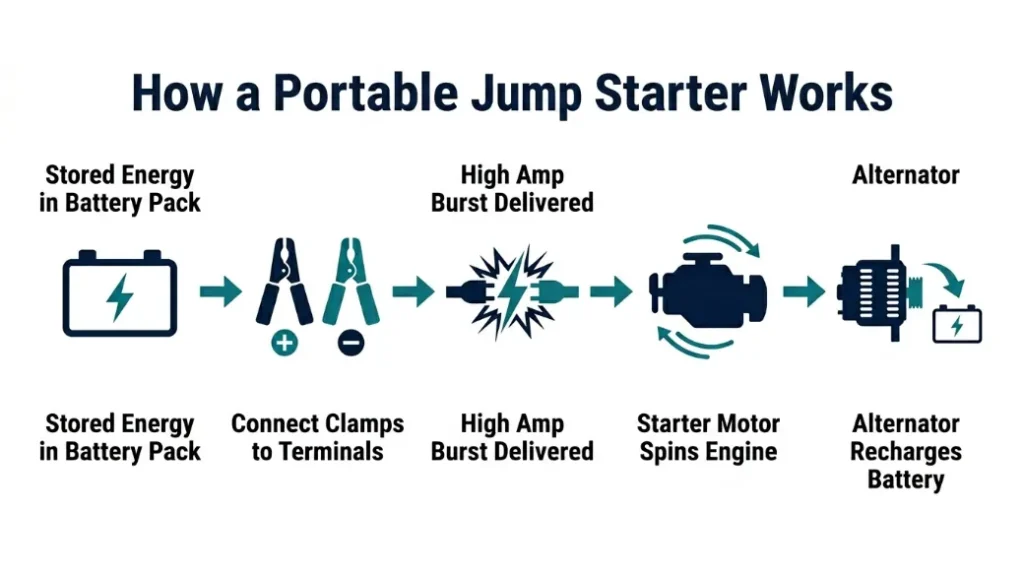
A portable jump starter is a self-contained battery pack that delivers a surge of electricity directly to a dead car battery. You connect its clamps to your battery terminals, press a button, and start your engine — all without another vehicle present.
According to Wikipedia’s automotive reference, lithium-ion jump starters began appearing in the market around 2013 and now represent the dominant category for consumer buyers. Most modern units weigh under 1.5 pounds and fit in a glove compartment.
The device stores a large amount of electrical energy in a compact lithium-ion or lithium-polymer cell. When you connect the clamps, it delivers a high-ampere burst — called peak amps or cold cranking amps (CCA) — that spins the engine’s starter motor. Once the engine fires, your car’s alternator takes over and begins recharging the main battery.
Tip:
Charge your jump starter every 2 to 3 months, even if you have not used it. Lithium-ion batteries lose charge over time, and a flat jump starter is useless in an emergency.
Understanding how jump starters work at a basic level helps you choose the right unit and use it safely — which brings us to the question most drivers actually want answered.
What Are Jumper Cables and What Are Their Limitations?
Jumper cables, also called booster cables or jump leads, are a pair of heavy insulated wires with alligator clips at each end. You connect them between a dead battery and a working battery in a second vehicle to transfer enough power for the dead car to start.
Jumper cables have been the standard roadside tool for decades because they are inexpensive, require no charging, and work on nearly any 12-volt vehicle. A decent set costs between $15 and $40, compared to $80 to $200 for a quality portable jump starter.
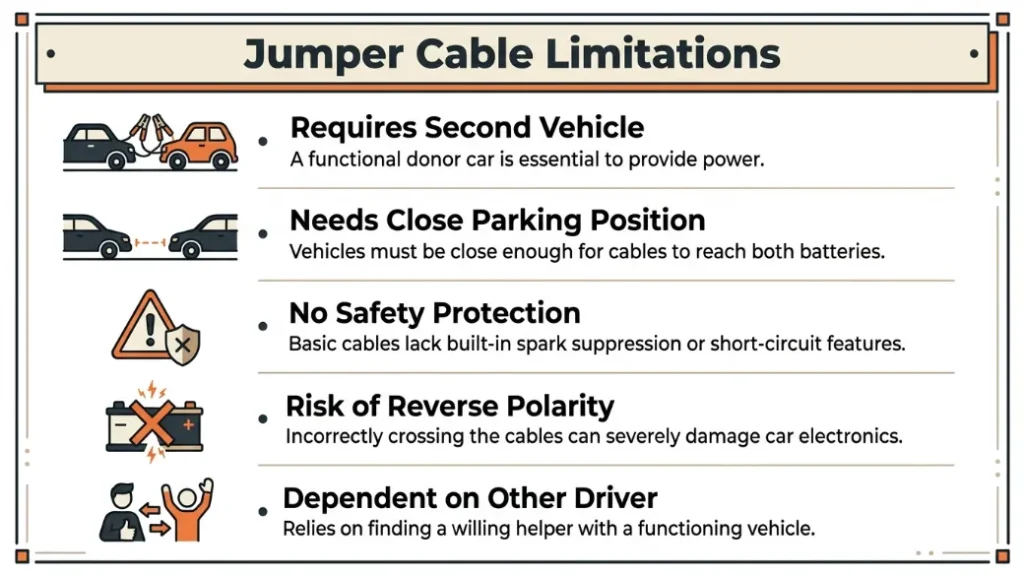
But jumper cables carry serious limitations that most buyers overlook at the time of purchase. They require a second vehicle to be parked close enough for the cables to reach. They depend on another driver’s willingness to help. And they offer zero protection against reversed polarity — the single most dangerous mistake in jump-starting a car.
Warning:
Reversing the polarity on jumper cables — connecting positive to negative — can blow computer modules, burn wiring and fuses, or in rare cases cause the battery to explode. Traditional jumper cables have no protection against this mistake. A 1994 NHTSA research note estimated that approximately 442 people were injured by exploding batteries during jump-start attempts in that year alone.
The physical positioning problem is also real: if your car is parked nose-first against a wall, or blocked in by other vehicles, another car may simply not be able to get close enough for the cables to reach your battery.
Can a Jump Starter Fully Replace Jumper Cables?
For most everyday drivers in most real-world situations, the answer is yes. A quality portable jump starter handles every scenario where you would normally reach for jumper cables — and handles several situations where jumper cables fail entirely.
Jump starters eliminate the need for a second vehicle, which is the single biggest limitation of traditional cables. They work in parking garages, on remote highways, in extreme cold, and at any time of day or night when no helpful stranger is nearby.
The NOCO Boost Plus GB40, one of the most popular jump starters on the market, delivers 1,000 amps and can provide up to 20 jump starts on a single charge. That single device handles more emergencies than a set of jumper cables ever could — because cables only work when another car is available.
However, two edge cases exist where jumper cables still hold an advantage. First, if your jump starter’s internal battery is depleted because you forgot to maintain it, the device is useless. Second, some very heavy-duty vehicles — large diesel trucks or farm equipment with massive engine displacement — may need the sustained cranking power that only a donor vehicle or a professional-grade lead-acid jump pack can provide.
Quick Summary: Jump Starter vs. Jumper Cables
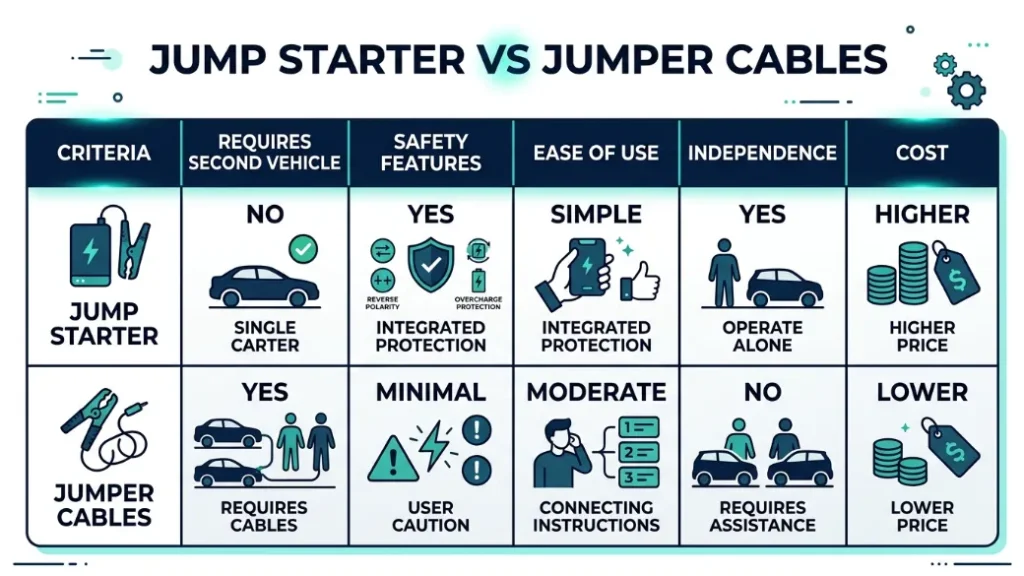
A jump starter wins on independence, safety, and ease of use. Jumper cables win on upfront cost and zero maintenance requirements. For most drivers with a small to midsize vehicle, a jump starter is the better primary tool. Carrying both gives you the ultimate backup plan.
Now let’s look at the specific advantages that make jump starters the safer, smarter choice for modern drivers.
5 Reasons a Jump Starter Beats Jumper Cables Every Time
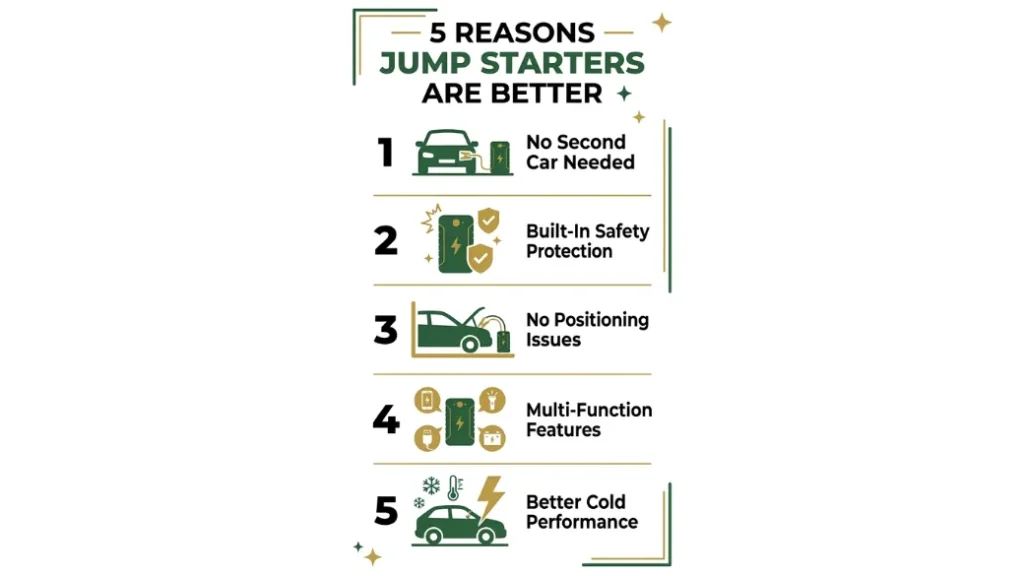
1. You Do Not Need Another Car or Driver
Jumper cables are completely useless if no second vehicle is nearby. A jump starter works entirely on its own. This single advantage makes it far more reliable in the real situations where batteries actually die — alone on a highway, in a quiet parking lot at night, or at a trailhead with no other vehicles for miles.
2. Built-In Safety Technology Protects You and Your Car
Modern jump starters from brands like NOCO (an American battery technology company), GOOLOO, and TOPDON include reverse polarity protection, anti-spark technology, short circuit protection, and overload protection. If you accidentally connect the clamps incorrectly, the device detects the problem and refuses to deliver power until the connection is fixed. Jumper cables have none of these protections.
3. No Positioning Problem
Jumper cables require the donor vehicle to park close enough for both sets of battery terminals to be within cable range. A jump starter eliminates this entirely. The unit itself — often smaller than a thick paperback book — sits anywhere on your engine bay and connects directly to your battery regardless of how your car is parked.
4. Multi-Functionality Beyond Just Jump Starting
Most quality jump starters also function as USB power banks, LED flashlights, and in some models, even tire inflators. A set of jumper cables can only do one thing. The NOCO GB40, for example, charges phones and tablets via its built-in USB port, making it a genuinely useful everyday carry item — not just an emergency tool you hope to never need.
5. Better Performance in Cold Weather
Cold temperatures dramatically reduce battery capacity. A lithium-ion jump starter rated for cold weather delivers strong cranking power precisely when batteries are most likely to fail. Jumper cables in the same situation still depend on a second vehicle that also has to start reliably in freezing conditions — far from guaranteed.
Tip:
If you live in a region with cold winters, choose a jump starter with an explicit cold-weather rating. Most standard lithium-ion units perform reliably down to about 15°F (-9°C). For temperatures below that, a lead-acid jump pack delivers better sustained cranking power.
When Should You Still Keep Jumper Cables?
Jumper cables remain useful in two specific situations. First, if your jump starter is not maintained and runs out of charge, a set of cables gives you a backup option as long as another vehicle is present. Second, jumper cables never degrade the way lithium-ion batteries do over time, so they stay ready for years of storage without maintenance.
Industry experts at Midtronics, an automotive battery diagnostics company, note that when it is possible to use a low-amperage battery charger instead of either cables or a jump starter, the battery’s long-term health is better preserved. A true jump start gets your car running but does not fully recharge the battery — that requires either extended driving or a dedicated charger.
The bottom line from most automotive experts: carry both if you can, but if you must choose one, a jump starter is the more modern, more versatile, and safer primary choice.
Warning:
Never attempt to jump-start a vehicle with a physically damaged, frozen, or visibly cracked battery. A frozen battery can explode when current is applied. If the battery looks swollen, leaking, or smells of sulfur, call a professional instead of attempting a jump start.
How to Use a Portable Jump Starter: Step-by-Step
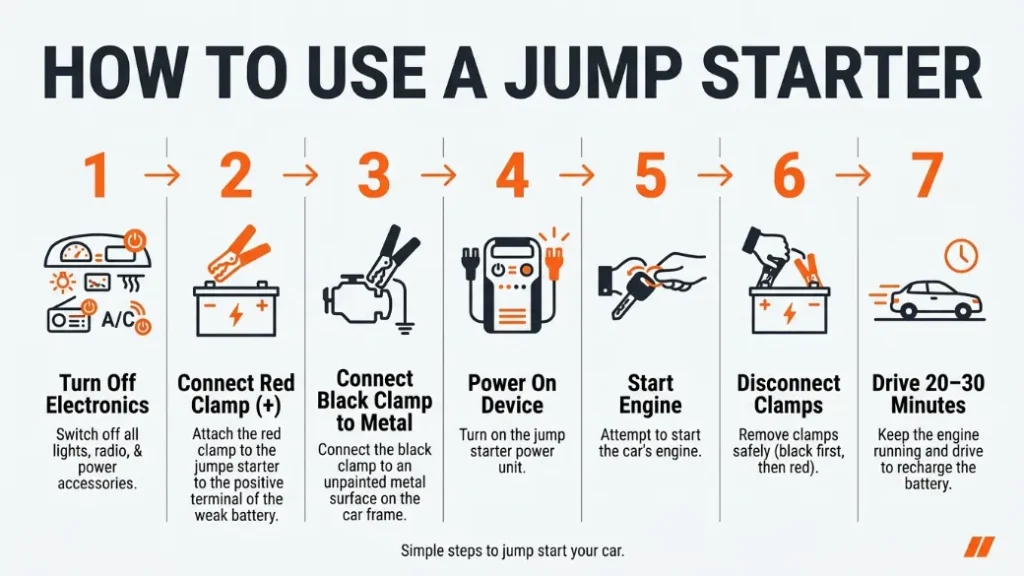
Using a jump starter correctly takes about two minutes. Follow this exact sequence to protect both yourself and your vehicle’s electronics.
Step-by-Step: How to Jump Start Your Car
- Turn off all vehicle electronics — radio, lights, AC, and ignition.
- Connect the red (positive) clamp to the positive terminal (+) on your dead battery.
- Connect the black (negative) clamp to an unpainted metal surface on the engine block — not the negative battery terminal — to avoid hydrogen gas ignition risk.
- Power on the jump starter and wait 30 seconds for it to assess the battery.
- Turn the vehicle ignition to start the engine. Hold for no more than 3 to 5 seconds per attempt.
- If the engine starts, disconnect the black clamp first, then the red clamp.
- Drive the vehicle for at least 20 to 30 minutes to allow the alternator to partially recharge the battery.
After a jump start, have your battery tested as soon as possible. A single dead-battery event can indicate an aging battery that needs replacement — catching it early prevents a repeat emergency at an even worse time.
Jump Starter vs. Jumper Cables: Side-by-Side Comparison
| Feature | Portable Jump Starter | Jumper Cables |
|---|---|---|
| Requires second vehicle | No | Yes |
| Reverse polarity protection | Yes (most models) | No |
| Average cost | $80–$200 | $15–$40 |
| Requires maintenance | Yes (recharge every 2-3 months) | No |
| Works in remote areas | Yes | Only if another vehicle is present |
| Multi-functional | Yes (USB power, flashlight, etc.) | No |
| Cold weather performance | Good (above 15°F for most lithium units) | Depends on donor vehicle battery |
| Ease of use for beginners | High | Moderate (more steps, more risk) |
This comparison shows clearly why most automotive experts now recommend a jump starter as the primary tool, with jumper cables as a low-cost backup option.
Which Jump Starter Should You Buy? What to Look For
Choosing the right jump starter depends on your engine size, climate, and how often you drive. Here are the key specifications to evaluate before buying.
Peak Amps: This measures the maximum burst of power the unit can deliver. For a 4-cylinder engine under 2.5 liters, 1,000 amps is sufficient. For a V6 or larger gas engine, choose 1,500 to 2,000 amps. For a diesel truck, look for 2,000 amps or more.
Cold Cranking Amps (CCA): This measures sustained power delivery in cold temperatures — a more practical number than peak amps for drivers in cold climates. Higher CCA means better cold-weather performance.
Battery Type: Lithium-ion units are compact, lightweight, and powerful enough for most passenger vehicles. Lead-acid jump packs are heavier but better for repeated use, very cold temperatures, and large diesel engines.
Safety Features: Look for reverse polarity protection, anti-spark technology, and overload protection as a minimum. Brands like NOCO, TOPDON, and GOOLOO include these features in most of their product lines as standard.
Tip:
Do not buy the cheapest lithium jump starter you can find. Low-quality lithium batteries carry fire risk and often fail to deliver their rated amperage under real-world conditions. Invest in a reputable brand with documented safety testing.
NOCO Boost Plus GB40 1000A UltraSafe Car Battery Jump Starter Pack, 12V Lithium Jump Starter Battery Booster Pack, Portable Power Bank Charger, And Jumper Cables For 6.0-Liter Gasoline And 3.0-Liter Diesel Engines
This is the jump starter I recommend for most drivers — compact, safety-rated, and trusted by automotive professionals for reliable starts on small to midsize vehicles without needing a second car. 👉 Check Price on Amazon
Can a Jump Starter Start a Completely Dead Battery?
In most cases, yes. A portable jump starter can start a car with a completely dead battery, as long as the battery is not physically damaged, frozen, or below the unit’s minimum voltage threshold.
One important technical note: many modern lithium jump starters with polarity protection need at least a small residual charge in the battery to detect which terminal is positive and which is negative. If the battery is completely dead — reading 0 volts — the safety system may not activate, and the unit will not deliver power. Some models include a “force start” or “override” mode for this exact situation.
Lead-acid jump packs, like those made by Clore Automotive (a Kansas-based professional equipment manufacturer), do not have this limitation and can crank a fully dead battery without needing to detect polarity first. For extremely discharged batteries, a lead-acid booster pack is more reliable than a lithium unit.
Does a Jump Starter Recharge Your Car Battery?
No. A jump starter provides enough power to start your engine, but it does not recharge your car battery. Once the engine fires, your vehicle’s alternator begins generating electricity and partially restores the battery — but only while the engine runs.
For a full recharge, you need a dedicated battery charger connected to a power outlet. If your battery dies repeatedly after jump starts, it is likely aging beyond its useful service life and needs replacement. Most car batteries last 3 to 5 years under normal driving conditions.
Quick Summary: What a Jump Starter Does and Does Not Do
A jump starter gets your engine running by delivering a temporary burst of electrical power. It does not repair a failing battery, recharge a depleted battery fully, or fix the underlying cause of a dead battery (such as a failing alternator or a parasitic drain). After any jump start, test your battery at an auto parts store — most offer free testing.
Final Thoughts
A portable jump starter can replace jumper cables for the vast majority of everyday drivers and real-world dead-battery situations. It works without a second vehicle, includes safety protections that cables lack, and handles remote locations, parking garages, and cold weather scenarios that leave traditional cables useless. For most people, it is the smarter, safer, and more capable tool to keep in the car.
Jumper cables are not obsolete. Their low cost and zero-maintenance requirements make them a worthy backup, especially if you regularly drive vehicles with large engines or spend time in extreme cold. But if you can only carry one tool, a quality jump starter from a trusted brand like NOCO, TOPDON, or GOOLOO outperforms cables in nearly every real-world scenario you will actually face. Keep it charged, and it will be there when you need it most.
Check your jump starter’s charge level today. A two-minute task now could save you hours of frustration the next time your battery decides to quit at the worst possible moment.
Frequently Asked Questions
Can a jump starter replace jumper cables completely?
For most drivers and most situations, yes. A jump starter starts your vehicle without a second car, works in remote locations, and includes safety features that cables do not have. The only edge cases where cables still have an advantage are if the jump starter runs out of charge, or if you are dealing with extremely large diesel engines that require sustained cranking power beyond what most portable lithium units deliver.
Is it safe to use a jump starter on a modern car with sensitive electronics?
Yes, provided you use a quality jump starter with reverse polarity protection and overload protection. These safety systems prevent power surges that could damage your vehicle’s ECU, sensors, or onboard computers. Traditional jumper cables without these protections carry a higher risk of electronics damage if connected incorrectly or if a voltage spike occurs during the jump-start process.
How long does a portable jump starter hold its charge?
Most lithium-ion jump starters retain a usable charge for 6 to 12 months when stored properly in a cool, dry location. However, manufacturers and automotive experts recommend recharging the unit every 2 to 3 months to keep it at peak readiness. Lead-acid jump packs discharge faster and typically need a recharge every 30 to 90 days.
What size jump starter do I need for my vehicle?
For most 4-cylinder gas engines up to 2.5 liters, a 1,000-amp unit is sufficient. For V6 engines up to 4.0 liters, choose a 1,250 to 1,500-amp model. For V8 gas engines or diesel engines, select a unit rated at 2,000 amps or higher. When in doubt, size up — a more powerful unit works on smaller engines with no risk of damage.
Can I use a jump starter on a motorcycle, boat, or lawn mower?
Yes, in most cases. Portable jump starters work on any 12-volt system, which includes motorcycles, personal watercraft, small boats, ATVs, snowmobiles, and lawn tractors. Traditional jumper cables cannot be used on marine vehicles at all, since you cannot connect a car to a boat. This multi-vehicle capability is one of the clearest advantages a jump starter holds over standard booster cables.

I’m Alex Rahman, a car enthusiast and automotive writer focused on practical solutions, car tools, and real-world driving advice. I share simple and honest content to help everyday drivers make better decisions.
