
Main Parts of a Car Battery: What Each Part Does and Why
Quick Answer
A car battery has six cells, lead plates, sulfuric acid electrolyte, separators, connectors, terminals, and a strong case. Each cell holds positive and negative plates in acid, and the cells join in series to make 12 volts. The plates drive the chemical reaction, the electrolyte carries ions, and the terminals send power to the car.
- Six cells join in series, and each cell adds about 2 volts.
- Positive plates use lead dioxide, and negative plates use sponge lead.
- Separators keep the plates apart and still let ions pass.
- Terminals, case, cover, and vents protect the parts and link the battery to the car.
You may see only a black box with two posts under the hood. The main parts of a car battery work as a team inside that box, and each part has one clear job. This guide names each part, explains what it does, and shows how the parts work together to start your car.
What Are the Main Parts of a Car Battery?

The main parts of a car battery are the case, cover, cells, plates, separators, electrolyte, connectors, terminals, and vents.
Most car batteries use the lead acid design. Lead acid means lead plates react with sulfuric acid to store and release energy. Other designs change how the acid is held, but the core parts stay close to this list.
This table names each part, its material, and its job.
| Part | Material | Job |
|---|---|---|
| Positive plates | Lead dioxide | Take part in the chemical reaction |
| Negative plates | Sponge lead | Release and take electrons in the reaction |
| Electrolyte | Sulfuric acid and water | Carry ions between the plates |
| Separators | Porous plastic or glass mat | Keep plates apart and stop short circuits |
| Cells and connectors | Lead straps and links | Join plates and cells into one battery |
| Terminals | Lead posts | Link the battery to the car circuits |
| Case and cover | Polypropylene | Hold the cells and protect them |
No part works alone. The plates make the reaction, the electrolyte carries it, and the case and terminals keep it safe and useful.
What Do the Plates Do Inside Each Cell?
The plates are the working surfaces where the battery stores and releases energy.
Each cell holds sets of positive and negative plates. Positive plates carry lead dioxide, and negative plates carry sponge lead. The plates sit on lead alloy grids, and the grids hold the active material and carry current.
More plate surface gives more area for the chemical reaction. Varta notes that more plates in a cell can raise cold start power, while thicker plates can raise cycle stability. That trade off shapes how a battery is built for starting or for repeated charging.
The Electrical A2Z cell guide shows how plate straps join plates into groups.
What Is the Electrolyte and What Does It Do?
The electrolyte is the liquid that lets ions move between the plates.
The electrolyte is a mix of sulfuric acid and distilled water. It fills each cell and covers the plates. Ions move through it during discharge and charging, and the acid strength falls as the battery discharges.
The electrolyte is not plain water. Plain water alone would not carry the reaction in the same way. The acid gives the liquid its chemical role, and that role is why the liquid needs care.
Warning
Sulfuric acid can burn skin and eyes. Keep the battery upright, wear eye protection, and wash splashes with plenty of water and seek help if pain or eye contact occurs.
What Do Separators Do Between the Plates?
Separators are thin porous sheets that keep positive and negative plates apart.
A separator sits between each pair of plates. It stops the plates from touching and causing a short circuit. Its pores still let electrolyte and ions pass, so the reaction can continue.
Separators are made from porous plastic or glass mat in some designs. A torn or damaged separator can let plates touch. That fault can drain a cell or kill the battery.
How Do Six Cells Join to Make 12 Volts?
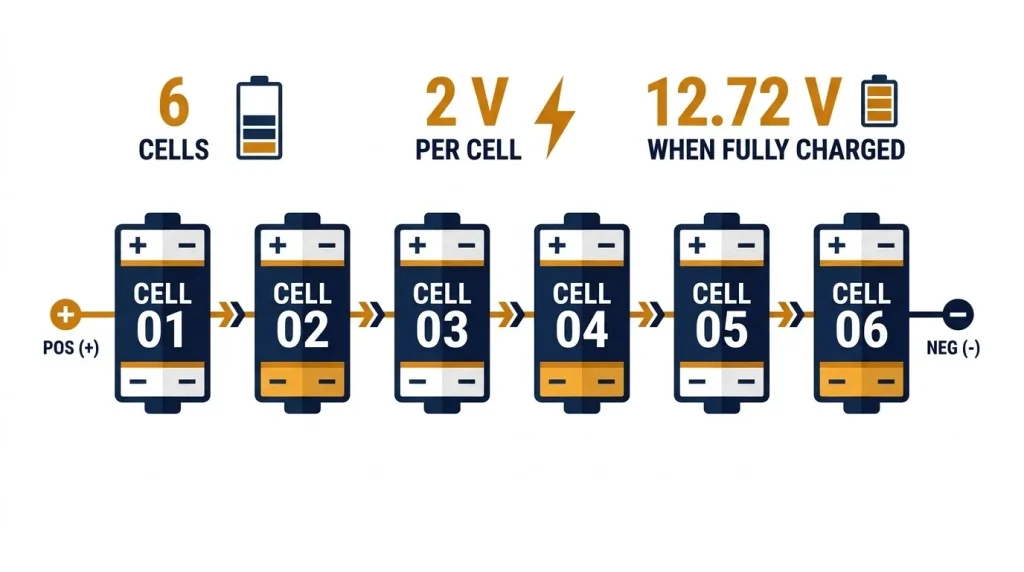
Six cells join in series to build the voltage a car needs.
Each cell is a small battery with its own plates and electrolyte. Plate straps join the plates in a cell, and connectors join one cell to the next. The chain adds the voltage of each cell to the next one.
Varta states that a standard starter battery has six cells, each with a nominal voltage of 2 volts, and a fully charged voltage of 12.72 volts.
6
Cells in a standard car battery
Source: Varta
2 V
Nominal voltage of each cell
Source: Varta
12.72 V
Voltage when fully charged
Source: Varta
That chain is why one weak cell can pull the whole battery down. The Varta guide to battery construction explains how plate sets form a cell.
Charging reverses the discharge reaction, and you can charge a car battery with a jump starter when it has lost charge.
What Do the Terminals, Case, Cover, and Vents Do?
Terminals, case, cover, and vents link the inside parts to the car and protect them.
Terminals are lead posts marked with plus and minus signs. The positive post is often larger than the negative post, and that size gap helps stop reversed cables. Top posts stick out of the cover, while side terminals sit on the side of the case.
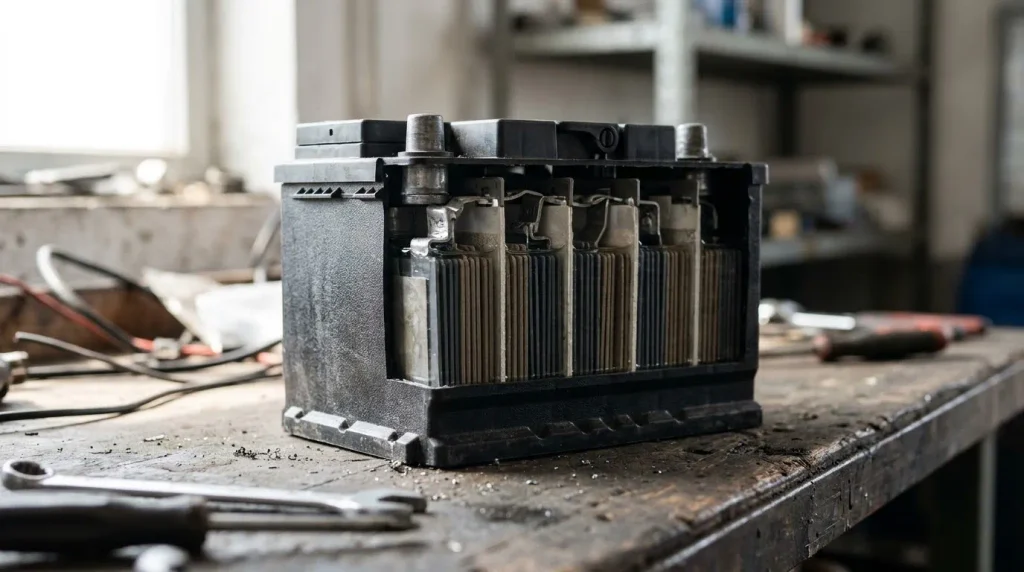
The case is a polypropylene box with walls that divide it into six cell compartments. The cover seals the top of the case and holds the terminals and vent openings. The case must resist acid, heat, cold, and vibration from the road.
Vents let gas escape during charging and keep pressure from building inside the case. Some sealed batteries use a labyrinth path in the cover to hold liquid in while gas leaves. Older batteries had caps that could be opened, and many sealed units have no caps to open.
A loose cable or a drain can leave the battery flat, so learn what drains a battery when the car is off.
How Do the Parts Differ in Flooded, AGM, and Gel Batteries?
Flooded, AGM, and gel batteries use the same core parts, but they hold the electrolyte in different ways.
A flooded battery holds liquid electrolyte around the plates. An AGM battery binds the acid in a glass mat, and a gel battery holds it in gel form. Varta notes that AGM acid is bound in a mat, which stops acid layering in that design.
Flooded
Best for: standard starting use
- Liquid electrolyte around plates
- Caps or vents on some units
- Simple design with free liquid acid
AGM
Best for: start stop cars with high demand
- Acid bound in a glass mat
- Better cycle stability for repeated charging
- No free liquid to layer
Gel
Best for: deep cycle use in some settings
- Acid held in gel form
- Sealed design with little free liquid
- Plates and separators still sit in the gel
The part names stay the same across the three types. The electrolyte holder is the main change, and it changes how the battery handles charging.
Which Part Fails First, and What Are the Signs?
Plates and electrolyte wear first in most weak batteries, and terminals fail next from loose or corroded connections.
Sulfation coats plates with hard lead sulfate crystals when a battery stays at a low charge. Varta links low charge and acid layering to sulfation, and sulfation cuts charge acceptance and cold start power. Sharp crystals can also damage separators or cause a short circuit in a cell.
Low electrolyte, a cracked case, or a blocked vent can also end a battery. A cracked case can leak acid, and a blocked vent can build pressure. Check the case and terminals for damage, leaks, and white or green crust.
A scan tool can help, and a guide on how to detect a bad battery explains what a code reader can and cannot show.
If the car will not start, see what happens when your battery dies and what to check next.
Car Battery
A car battery is the part this guide describes, and a search can help you find the size and type that fits your car.
Frequently Asked Questions
Can you open a car battery to see the plates?
A sealed car battery should stay closed, because opening it can spill sulfuric acid and void the seal. The plates sit inside six closed cells, so you cannot see them without cutting the case. Use the label, the terminals, and a voltage or load test to judge condition instead.
What is the small round window on top of some batteries?
The small round window is a charge indicator, and it is a small hydrometer that reads electrolyte strength. Electrical A2Z notes that the window may show green when the battery is charged, black when it is discharged, and yellow when it needs replacement. The window gives a rough guide only, so test voltage before you judge the battery.
Does a car battery need water added?
Most sealed car batteries need no water added, and the cover should stay closed. Varta states that water does not need to be topped up in sealed units, and AGM plugs must not be opened. If your battery has removable caps, follow the manual and use distilled water only.
Why does a battery have a positive and a negative terminal?
A car battery needs two terminals because current must leave by one post and return by the other. The positive terminal links to the starter and the car circuits, and the negative terminal links to ground on the engine or body. The plus and minus marks keep the cables on the right posts.
Can a loose terminal stop a car from starting?
A loose car battery terminal can stop a car from starting because the starter needs a firm, clean path for high current. The engine may click, crank slowly, or stay silent when the link is poor. Switch the car off, clean the post and clamp, and tighten the clamp until it does not move.
Is the liquid inside a car battery dangerous?
The liquid inside a car battery is dangerous because it is sulfuric acid mixed with water. It can burn skin, damage clothes, and harm eyes on contact. Wear eye protection, keep it away from skin, and wash any splash with plenty of water and seek help fast.
Conclusion
The main parts of a car battery are six cells, lead plates, electrolyte, separators, connectors, terminals, and a protective case. Each part has one job, and a fault in one part can weaken the whole battery. If your car cranks slowly, check the terminals first, then test the battery before you replace it.

I’m Alex Rahman, a car enthusiast and automotive writer focused on practical solutions, car tools, and real-world driving advice. I share simple and honest content to help everyday drivers make better decisions.
