
Are Car Batteries AC or DC? How the System Works Explained
Quick Answer
A car battery is DC, not AC. A car battery stores and supplies direct current, which flows in one direction at a nominal 12 volts. The alternator makes AC inside the car, but a rectifier changes that AC to DC before it charges the battery. An inverter can change battery DC back to AC for household devices.
- DC flows in one direction, while AC reverses direction.
- Lead-acid cells make DC through a chemical reaction.
- The alternator makes AC, then a rectifier converts it to DC.
- A charger changes household AC to DC, and an inverter does the reverse.
If you see AC and DC labels on a charger, a meter, or an inverter, the choice can feel confusing. This guide answers the question Are car batteries AC or DC in plain terms. You will learn what each type of current does, where AC hides in a car, and how to charge, test, and use battery power without damage.
What Is the Difference Between AC and DC?
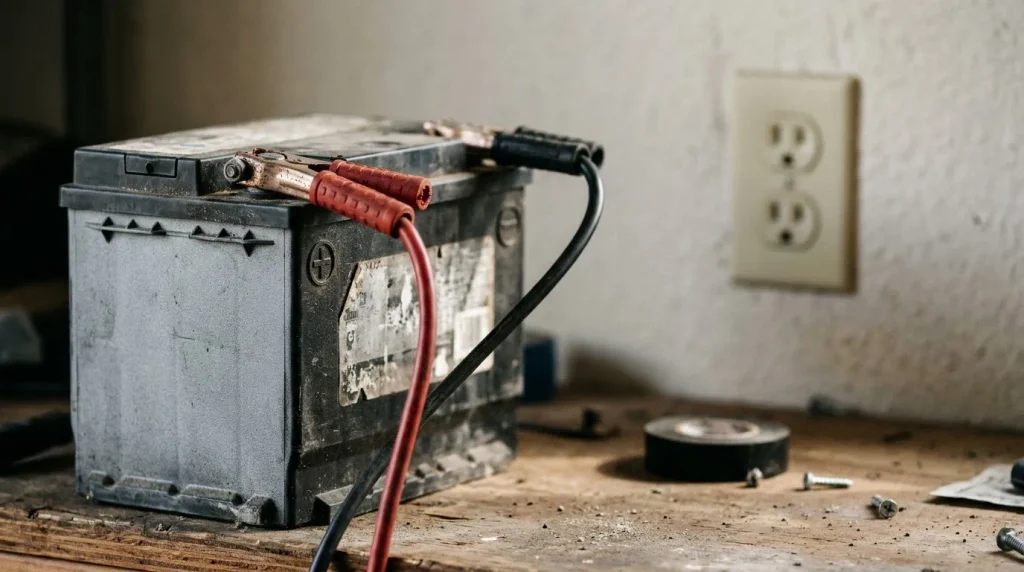
AC and DC describe the direction of electric current flow. DC, or direct current, flows in one direction at a steady voltage. AC, or alternating current, reverses direction in a repeating wave.
Household outlets supply AC, while batteries, solar panels, and USB ports supply DC. That split explains why a car battery and a wall outlet need different tools. The table below shows the split at a glance.
| Feature | AC | DC |
|---|---|---|
| Direction | Reverses in a wave | Flows in one direction |
| Main source | Grid, wall outlet, alternator | Battery, solar panel, USB port |
| Use in a car | Inside the alternator before conversion | Battery, starter, lights, modules |
| Storage | Cannot be stored in a battery | Stored as chemical energy |
The table shows why a car needs both forms at different points, even though the battery itself holds DC only.
Are Car Batteries AC or DC?
A car battery is DC, and it stores, receives, and supplies DC power only. A lead-acid battery makes DC when lead plates and sulfuric acid react inside its cells. That reaction moves electrons in one direction through the circuit.
Lights, modules, and the starter draw DC from the battery when the engine is off. A fault can keep drawing power after parking, so a parked car can go flat overnight. If that keeps happening, learn what drains a car battery when the car is off.
A standard car battery works at a nominal 12 volts. A car battery voltage reading at rest is about 12.6 volts when the battery is healthy and fully charged. That steady DC supply suits the starter and the control modules.
Why Do Car Batteries Store DC Power?
Car batteries store DC power because chemical reactions produce current in one direction. A battery holds energy as chemical potential, then releases it as a steady flow of electrons. AC reverses direction, so it cannot drive that chemical process in the same way.
DC also gives the car a stable supply for sensitive parts. The starter needs a strong surge, and modules need a steady voltage. AC would swing the voltage and the polarity, which would stress those parts. The three parts below show how each one handles current.
Battery
Best for: Starting and stored power
- Current: DC only
- Voltage: 12 volts nominal
- Role: Stores energy for engine-off use
Alternator
Best for: Charging while driving
- Current: AC inside, DC output
- Voltage: Above resting battery voltage
- Role: Powers systems and recharges the battery
Inverter
Best for: Running household devices
- Current: DC in, AC out
- Voltage: 12 volts DC to 120 volts AC
- Role: Converts battery power for AC devices
Each part has one job in the chain, and the battery sits at the DC end of that chain.
Where Does AC Appear in a Car?
AC appears inside the alternator, at an EV charger input, and at factory AC outlets. In a gas car, the alternator is the main source of AC. Alternators generate AC as a rotor spins inside a magnetic field, and the rectifier changes it before it leaves the part.
Some trucks and SUVs have a factory AC outlet in the cab or bed. A small inverter behind the dash changes the 12 volt DC supply into AC for that outlet. Those outlets often run at 150 to 400 watts, so they suit small devices and not large heaters or power tools.
Hybrids and electric cars add more conversion points. Grid power enters as AC, and power electronics change its form for charging and driving. The battery side still stays DC in each case.
How Does the Alternator Change AC to DC?
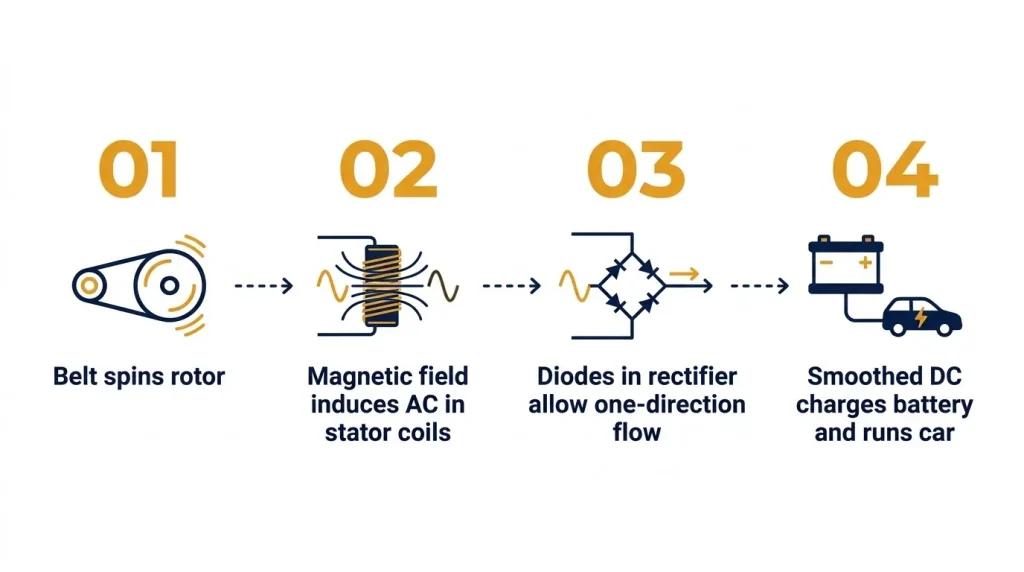
The alternator changes AC to DC with a rectifier made of diodes. A belt spins the rotor, and the spinning magnetic field induces AC in the stator coils. That AC reverses as the poles pass the coils.
Diodes in the rectifier let current pass in one direction and block it in the other direction. That step turns the reversing wave into DC that can charge the battery and run the car. The result is a smoothed DC supply, not raw AC at the battery terminals.
Older cars used a generator with a commutator and brushes to make the same change by mechanical means. An alternator is simpler and lighter, and the diode rectifier made it practical to use. It also keeps charging at low engine speed, where a generator often fell short.
How Do You Charge a Car Battery From AC Power?
You charge a car battery from AC power with a charger that converts AC to DC. A wall outlet supplies AC, and the charger changes it to DC before it reaches the battery terminals. That is why a charger, not a direct wall connection, is the safe path.
Connect the red clamp to the positive terminal and the black clamp to the negative terminal or a ground point. Pick the mode that matches the battery type when the charger offers a choice. A smart charger slows its output as the battery fills, then holds it at full charge.
Warning
Connecting a car battery directly to an AC outlet can cause overheating, short circuits, and damage to the battery and the car. Use a charger made for car batteries, and follow its connection order.
A charger suits a weak battery at home, while a jump starter suits a dead battery on the road. A jump starter gives a short burst to start the engine, and the alternator then takes over. Compare the two tools in this battery charger guide before you pick one for home use.
How Can You Get AC Power From a Car Battery?
You can get AC power from a car battery only with an inverter. An inverter converts DC to AC by switching the DC supply fast enough to form an AC wave. The output is 120 volts AC for household devices.
A 12 volt socket can feed a small inverter for a laptop or a phone charger. A larger inverter needs a direct battery connection and a clear watt limit. Running a large load with the engine off can drain the starter battery fast, so keep the engine running for heavy use.
Factory AC outlets use the same idea on a smaller scale. They suit low-watt devices, and they stop short of the power that a wall outlet can give. Check the outlet watt limit in the owner manual before you plug in a device.
How Do Hybrids and Electric Cars Handle AC and DC?
Hybrids and electric cars still store DC power, even when motors use AC. A traction battery holds DC energy, and the 12 volt system still runs lights, sensors, and control modules on DC. That low-voltage side works much like the system in a gas car.
An inverter changes DC from the traction battery to AC for the motor when the car needs to drive. The same electronics can change AC back to DC during regenerative braking. An onboard charger also changes grid AC to DC when the car plugs in to charge.
The rule stays simple across all three types. The battery stores DC, and conversion parts change the form only where a motor or a grid connection needs it.
How Do You Test a Car Battery for AC or DC?
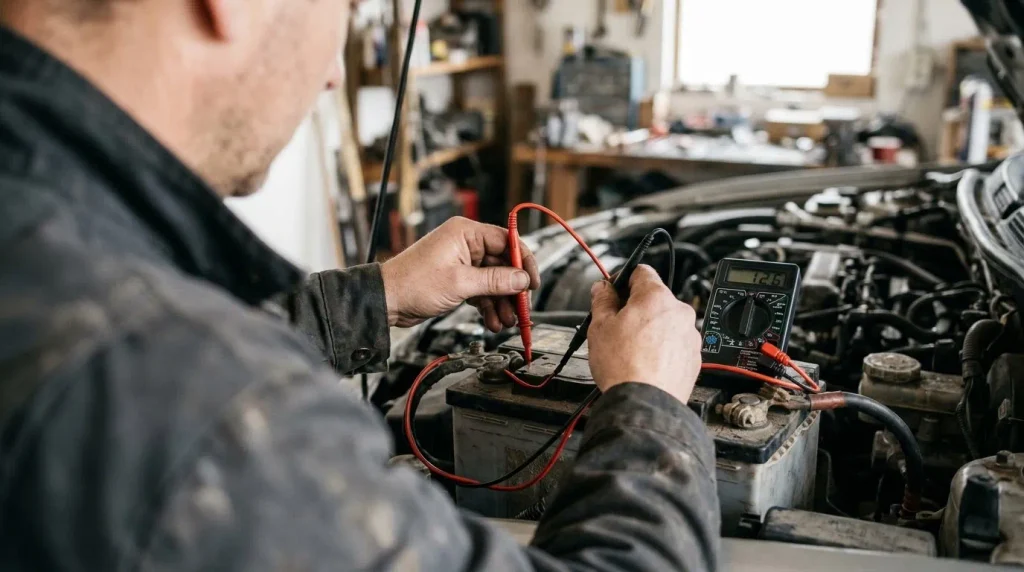
You test a car battery on the DC setting of a multimeter. Set the meter to DC volts, touch the red probe to the positive terminal, and touch the black probe to the negative terminal. A healthy battery at rest reads about 12.6 volts.
Do not trust an AC reading for battery health. The AC setting measures a reversing wave, and the battery gives a steady DC supply. If the meter shows a clear AC reading at the battery, ask a technician to check the charging system and the rectifier.
- Turn off lights and accessories, then let the car sit for a few minutes.
- Set the multimeter to DC volts and pick a range above 20 volts.
- Connect the red probe to the positive terminal and the black probe to the negative terminal.
- Read the voltage, then compare it with the 12.6 volt resting value.
A low reading points to a discharged or weak battery, while a normal reading points to another cause for a starting fault.
What Mistakes Should You Avoid With AC and DC?
The main mistakes are mixing AC and DC, using the wrong meter setting, and running AC devices without an inverter. Each mistake can damage a device, drain the battery, or give a false test result.
- Do not connect a battery directly to a wall outlet.
- Do not plug household AC devices straight into a 12 volt socket.
- Do not test battery voltage on the AC meter setting and trust that reading.
- Do not leave a large inverter load running with the engine off.
- Do not assume a factory AC outlet can run any household device; check its watt limit first.
Match the tool to the current type, and check the label before you connect a device. That habit protects the battery, the wiring, and the device.
Car Battery Charger
A car battery charger changes household AC power to DC so it can charge a 12 volt car battery at home.
Frequently Asked Questions
Is a car battery AC or DC power?
A car battery is DC power, so it stores and supplies direct current that flows in one direction. A standard car battery works at a nominal 12 volts. The alternator makes AC inside the car, but a rectifier changes it to DC before charging.
Can a car battery run AC appliances?
A car battery cannot run AC appliances directly, because it supplies DC power only. An inverter must change that DC into AC first. Check the inverter watt limit before you plug in a device.
Why does the alternator make AC if the car uses DC?
The alternator makes AC because spinning a magnetic field inside coils creates reversing current by nature. A rectifier then changes that AC to DC. That design is simpler and works well at low engine speed.
What voltage is a car battery?
A car battery has a nominal voltage of 12 volts DC. A healthy battery at rest measures about 12.6 volts. Voltage rises while the engine runs, because the alternator charges the battery.
Can you charge a car battery with AC power?
You can charge a car battery from AC power, but only through a charger that converts AC to DC. A wall outlet supplies AC, and the charger changes it before it reaches the battery. Never connect the battery straight to a wall outlet.
Do electric cars use AC or DC batteries?
Electric cars use DC batteries, because all batteries store direct current. A traction battery holds DC power, while an inverter can change it to AC for the motor. An onboard charger also changes grid AC to DC during charging.
Conclusion
The answer to Are car batteries AC or DC is DC, while AC appears only where a part makes or changes current. If you need household power, use an inverter with a watt limit that fits the device.

I’m Alex Rahman, a car enthusiast and automotive writer focused on practical solutions, car tools, and real-world driving advice. I share simple and honest content to help everyday drivers make better decisions.
