
Why Do Cars Use 12-Volt Batteries? The Real Reason
Quick Answer
Cars use 12-volt batteries because the number fits the job. Six lead-acid cells in series give about 12.6 volts at full charge, enough to crank an engine and run lights, ignition, and electronics. The voltage also keeps current low, so wiring can stay thin, light, and low cost.
- Six cells at about 2.1 volts each add up to 12 volts.
- Higher voltage than 6 volts gives more starter power with less current.
- Lower current allows thinner wiring and less heat loss.
- Trucks use 24 volts, while most cars stay at 12 volts for safety and parts supply.
If you have looked at a car battery, you have seen the 12-volt label. The number looks fixed, but it came from chemistry, starter power, and cost. This guide explains why 12 volts won, what it powers, and when a car uses a different voltage.
In this article
- What Does 12 Volts Mean in a Car?
- How Does a 12-Volt Battery Make 12 Volts?
- Why Did Cars Move From 6 Volts to 12 Volts?
- Why Do Cars Use 12-Volt Batteries Instead of 24 Volts?
- What Does a 12-Volt Battery Power?
- Do Electric and Hybrid Cars Still Use 12 Volts?
- How Can You Tell If a 12-Volt Battery Is Weak?
What Does 12 Volts Mean in a Car?
Voltage is the push that moves current through wires. A 12-volt system pushes current with more force than a 6-volt system, so it can do more work with the same wiring. The label 12 volts is a nominal value, which means it is a rounded name for the system, not a fixed reading at all times.
A charged battery at rest reads about 12.6 volts. The reading falls while the starter turns, then rises while the alternator charges the battery. The alternator holds system voltage between 13.5 and 14.5 volts, according to Wikipedia, while the engine runs.
Voltage and capacity are not the same thing. Capacity, in amp-hours, tells how much charge the battery can store. Voltage tells how hard that charge can push, and a car needs both in the right range.
That 12-volt supply also reaches the diagnostic port under the dash. The OBD2 pin 16 circuit carries battery voltage, so a scan tool can draw power from it. A low reading there can point to a wiring or battery fault, not a tool fault.
How Does a 12-Volt Battery Make 12 Volts?

A 12-volt car battery makes 12 volts from six lead-acid cells joined in series. Each cell holds lead plates in sulfuric acid, and the chemical reaction in each cell gives about 2.1 volts. Six cells in a row add their voltages, so the pack reads about 12.6 volts at full charge.
An automotive battery uses this layout in most passenger cars and light trucks. Plate size changes capacity and cranking power, but it does not change the voltage of one cell. That is why a small 12-volt battery and a large one share the same nominal voltage.
6
Lead-acid cells in series
Source: Wikipedia
2.1
Volts per cell at full charge
Source: Engineer Fix
12.6
Volts at rest when fully charged
Source: Wikipedia
Lead-acid chemistry suits starting because it can give a short, strong burst of current. The starter needs that burst for a few seconds to turn the engine. A battery built for deep, slow use would not suit that job as well.
The alternator and the battery work as a pair. The alternator feeds the car while the engine runs and tops up the charge used for starting. The battery takes over when the engine is off or when demand peaks.
Why Did Cars Move From 6 Volts to 12 Volts?
Cars moved from 6 volts to 12 volts because larger engines and more accessories outgrew the old system. Higher compression made starters work harder, and radios, heaters, and lights added load. A 6-volt system could not give reliable starts under those demands.
The change came after the Second World War, when engine size and compression rose. Jalopnik traces the switch from 6 volts to 12 volts to hot-start trouble and stronger starters. Makers in the United States had moved across within a few seasons of the first 12-volt models.
Power equals voltage times current, so doubling voltage halves current for the same power. Lower current means thinner copper wire, less heat, and less voltage drop at dirty joints. Lights, relays, and switches also last longer when current stays low.
Tip
Check the battery label before you jump-start a car. A 12-volt car needs a 12-volt source, and a mismatched source can harm parts.
A 6-volt battery was fine when cars had low compression and few electrical parts. The first electric starters used 6 volts, and the layout served drivers for decades. Growth in engine power and comfort parts ended that fit.
Why Do Cars Use 12-Volt Batteries Instead of 24 Volts?
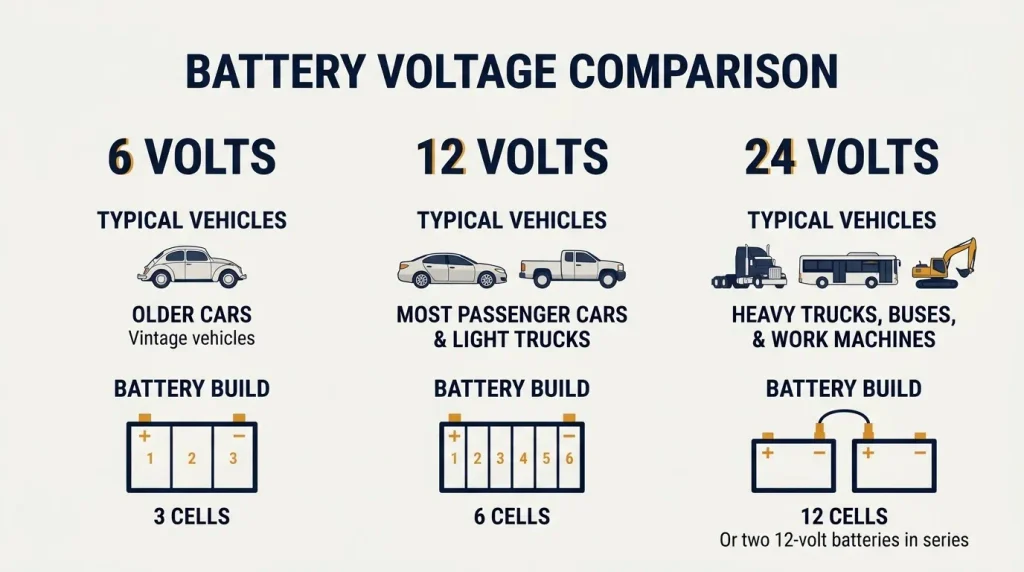
Cars stay at 12 volts instead of 24 volts because 12 volts already covers passenger-car needs at lower cost and risk. A move to 24 volts would force a change to starters, lights, motors, and controls across the car. The gain in wiring savings would not repay that change for a normal car.
The table below compares the three main voltage layouts by use and build.
| Voltage | Typical vehicles | How it is built |
|---|---|---|
| 6 volts | Older cars with low power needs | Three lead-acid cells in series |
| 12 volts | Most passenger cars and light trucks | Six lead-acid cells in series |
| 24 volts | Heavy trucks, buses, and work machines | Twelve cells, or two 12-volt batteries in series |
The table shows a match between load and voltage. Small loads suit 6 volts, normal cars suit 12 volts, and heavy loads suit 24 volts.
Higher voltage also brings more arc wear at switches and relays when a circuit opens. Insulation and parts must grow stronger as voltage rises, which adds cost. A 12-volt system stays below the level where those demands grow fast, while still giving strong starts.
A higher standard was once proposed for cars, with a 42-volt layout meant to feed stronger accessories and lighter wiring. The plan faded as motors grew more efficient and hybrid systems took a different path. The 12-volt base stayed, while new helpers joined it at higher voltage.
Parts supply locks the standard in place. Shops stock 12-volt batteries, bulbs, fuses, and starters in wide ranges. A change would strand owners and raise repair cost, so makers keep the shared system.
What Does a 12-Volt Battery Power?
A 12-volt battery powers starting, lighting, and ignition, plus the electronics that run when the engine is off. Its main job is a short, strong burst to the starter motor. Once the engine runs, the alternator takes over most of the load and recharges the battery.
- Starter motor for engine cranking
- Ignition and fuel-system controls
- Headlights, tail lights, and interior lights
- Infotainment, screens, and charging ports
- Control units, sensors, wipers, and fans
The battery also steadies voltage when demand jumps past alternator output. A fan, a heated screen, and lights can draw more than the charging system gives at idle. The battery fills that gap for a short time.
Control units need a steady supply, even when the engine is off. A door lock, an alarm, and a memory seat draw small currents for days. The battery must hold enough charge for those loads and still crank the engine.
When charge falls too low, cranking slows and electronics act oddly. Learn what happens when a car battery dies before you assume the starter has failed.
Do Electric and Hybrid Cars Still Use 12 Volts?
Electric and hybrid cars still use a 12-volt battery for low-voltage parts, even though drive power comes from a high-voltage pack. The 12-volt battery runs lights, screens, locks, and the controls that wake the high-voltage system. Drive motors use packs at far higher voltage, often in the hundreds of volts.
An electric car has no starter motor and no alternator in the old sense. A converter steps high voltage down to charge the 12-volt battery and feed low-voltage circuits. That step keeps normal parts, such as bulbs and wipers, on a shared 12-volt supply.
A dead 12-volt battery can stop an electric car from waking, even when the drive pack holds charge. The car needs the low-voltage system to close the main contactors. That is why a flat 12-volt battery can leave an electric car silent.
Some mild hybrids add a 48-volt battery for strong helpers, such as a starter-generator or an electric compressor. The 48-volt unit works beside the 12-volt system, not in place of it. The split lets makers add power where it helps, without rebuilding each low-voltage part.
How Can You Tell If a 12-Volt Battery Is Weak?

A weak 12-volt battery shows slow cranking, dim lights, and odd electronic faults. A voltmeter at rest gives a first clue, with about 12.6 volts for a full battery and a lower reading for a weak one. A load test gives a clearer verdict than a rest reading alone.
Cold weather makes a weak battery show up first. Thick oil and slow chemistry raise the load on the starter, while the battery gives less power. A battery that starts fine in mild weather can fail on a cold morning.
Warning
A battery can give off hydrogen gas while it charges. Keep sparks away, or the gas can ignite.
A scan tool can help you detect a bad battery by reading codes and live data, but a code alone does not prove the battery is dead. A charging-system check and a load test complete the picture. Corroded posts can also mimic a weak battery, so clean the posts first.
If the test shows a weak battery, replace it with the same voltage and group size. A scanner with battery tester can track voltage and cranking health after the swap. Keep the old battery for recycling, as lead and acid need safe handling.
Car Battery
A car battery is the part this guide explains, and a search can help you find the size and type that fits your car.
Frequently Asked Questions
Are all car batteries 12 volts?
Most passenger cars use a 12-volt battery, but trucks, vintage cars, and electric cars break that rule. Heavy trucks often use 24 volts, vintage cars may use 6 volts, and electric cars add a high-voltage pack. Check the label and the handbook before you buy a replacement.
Can I put a 24-volt battery in a 12-volt car?
A 24-volt battery does not suit a 12-volt car, because the starter, lights, and controls expect 12 volts. The higher voltage can burn bulbs, harm control units, and trip fuses. Use the voltage the maker lists for your car, and match the group size too.
Why does a charged 12-volt battery read 12.6 volts?
A charged 12-volt battery reads about 12.6 volts because six cells at about 2.1 volts each add to that total. The name 12 volts is a rounded label, not the exact rest reading. A reading near 12.6 volts points to a full charge, while a much lower reading points to discharge or age.
Is a 12-volt car battery safe to touch?
A 12-volt car battery is safe to touch on its posts in dry hands, because the voltage is too low to push a harmful current through skin. The risk comes from acid, sparks, and short circuits, not from a light touch. Wear eye cover and keep metal tools off both posts at once.
Can a 12-volt battery start a diesel engine?
A 12-volt battery can start many diesel cars, but large diesel engines often need more cranking power than a small 12-volt unit gives. Some heavy diesels use two 12-volt batteries in series for 24 volts. Check cranking amps and group size against the handbook for your engine.
Do electric cars have a 12-volt battery?
Most electric cars have a 12-volt battery beside the high-voltage drive pack that powers the motor. The 12-volt unit runs lights, locks, screens, and the controls that wake the drive system. The high-voltage pack drives the motor, while the 12-volt battery keeps normal parts working.
Conclusion
Cars use 12-volt batteries because six cells give the right mix of starter power, thin wiring, and low risk. If your car cranks slowly, check the rest voltage and test the battery before you replace the starter.

I’m Alex Rahman, a car enthusiast and automotive writer focused on practical solutions, car tools, and real-world driving advice. I share simple and honest content to help everyday drivers make better decisions.
