
How Does a Car Battery Store Electrical Energy? Explained
Quick Answer
How a car battery stores electrical energy is plain: it holds energy as chemical energy, not as loose electricity in a tank. Two unlike plates sit in sulfuric acid, and the gap between their chemical states holds the stored energy. When you close a circuit, a reaction frees electrons, and that flow is the current that starts your car.
- Energy sits in the plates and the acid as chemical energy.
- Discharge turns that chemical energy into electron flow.
- Charging reverses the reaction and rebuilds the plates.
- Six cells in series add their voltage to about 12 volts.
A car battery looks like a box of power, but it holds no pool of free current. It holds two materials that want to react, kept apart in acid until you ask them to work. Read on to see the parts, the reaction, the charging loop, and the faults that cut storage short.
What Does Store Mean for a Car Battery?
A car battery stores energy in the chemical gap between two unlike plates. The plates stay apart in acid, and that separation holds energy in a form that can change back into current.
The battery holds no pool of free electrons waiting for use. Electrons stay bound in the plate material until a circuit gives them a path to move. No circuit means no flow, and the stored energy stays put.
A wound spring gives a fair picture of the idea. The spring holds energy while it stays wound, then gives it back as it unwinds. A charged battery holds energy while its plates stay unlike, then gives it back as the plates grow alike.
What Parts Hold the Stored Energy?
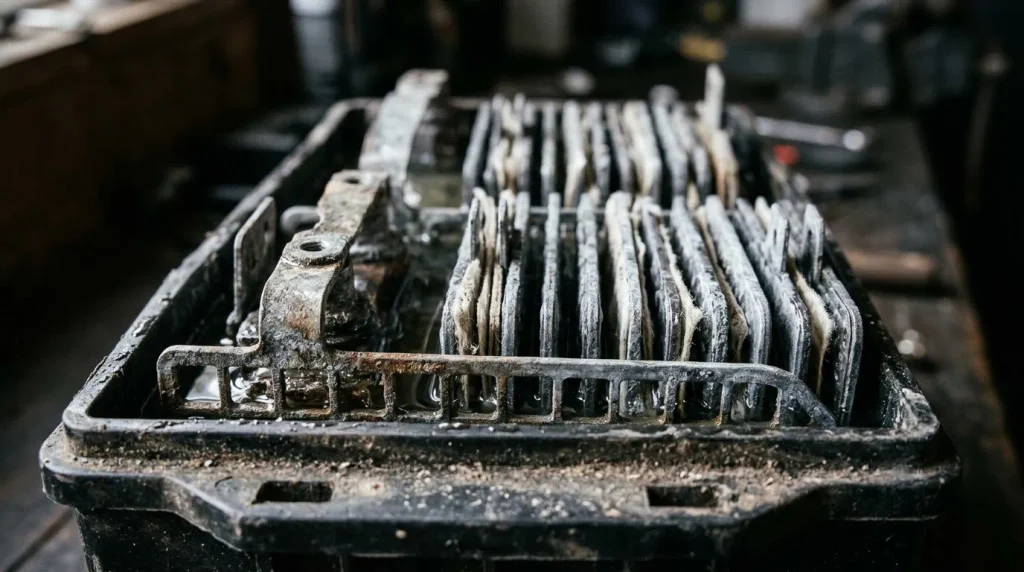
The stored energy lives in three parts: the positive plate, the negative plate, and the electrolyte. Each part plays a set role, and the reaction needs all three.
The positive plate holds lead dioxide, written as PbO2. The negative plate holds sponge lead, written as Pb. Both plates sit on lead alloy grids that hold the active paste in place and carry current out of the cell.
The electrolyte is a mix of sulfuric acid and distilled water. Ions move through this liquid while electrons move through the outside circuit. Separators sit between the plates as porous sheets. They let ions pass, yet they stop the plates from touching and shorting the cell.
Plates, grids, separators, and acid sit in a tough plastic case. The case splits into six cells, and each cell holds one set of plates. A weak cell can detect a bad battery problem long before the whole pack fails, so test one cell at a time when the car cranks slow.
How Does Discharge Turn Stored Energy Into Power?
Discharge turns stored chemical energy into electric current when a load closes the circuit. The reaction runs at both plates at once, and electrons leave the negative plate through the outside wire.
At the negative plate, lead reacts with sulfate ions from the acid and forms lead sulfate. That step frees electrons, and the electrons flow out of the negative terminal. At the positive plate, lead dioxide reacts with hydrogen and sulfate ions and also forms lead sulfate. Water forms at the same time, so the acid grows weaker as discharge goes on.
Electrons flow from negative to positive through the starter, the lights, or any other load. Inside the battery, ions move the other way to keep the charge in balance. As both plates turn to lead sulfate, the plates grow more alike and the reaction slows. Voltage falls, and the battery can no longer push enough current to crank the engine.
VARTA sums up the change in plain terms: a car battery stores energy in chemical form and converts it into electrical energy, with lead, sulfur, hydrogen, and oxygen taking part in the reaction. Read the full walkthrough at chemical energy becomes electrical energy for the step by step plate change.
How Do Six Cells Add Up to 12 Volts?
Six cells add up to 12 volts because each cell gives about 2 volts and the cells join in series. The negative of one cell joins the positive of the next, so each cell adds its push to the total.
Cell count sets the voltage, while plate size sets the current. More plate area gives more surface for the reaction, so the battery can push a larger burst to the starter. Thicker plates give less burst but stand up to more charge cycles.
Stored amount is a separate idea from voltage. An amp-hour rating states how much charge a battery can give over time. A higher amp-hour rating means the battery can feed a set current for longer, while a lower rating runs dry sooner. Voltage tells you the push, and amp-hours tell you the staying power.
2 volts
Nominal voltage of one cell
Source: VARTA
12.72 volts
Voltage of a fully charged six-cell battery
Source: VARTA
The table below shows how each part changes as the stored energy runs down.
| Part | Fully charged | Fully discharged |
|---|---|---|
| Positive plate | Lead dioxide (PbO2) | Mostly lead sulfate (PbSO4) |
| Negative plate | Sponge lead (Pb) | Mostly lead sulfate (PbSO4) |
| Electrolyte | Strong sulfuric acid | Weak acid, more water |
The takeaway is clear: a flat battery is not empty of parts, it is full of lead sulfate and weak acid. Charging must undo that change, not refill a tank. The Engineering Mindset guide gives the same cell picture, with each cell near 2.1 volts and six cells near 12.6 volts, at how a car battery works.
How Does Charging Put Energy Back In?
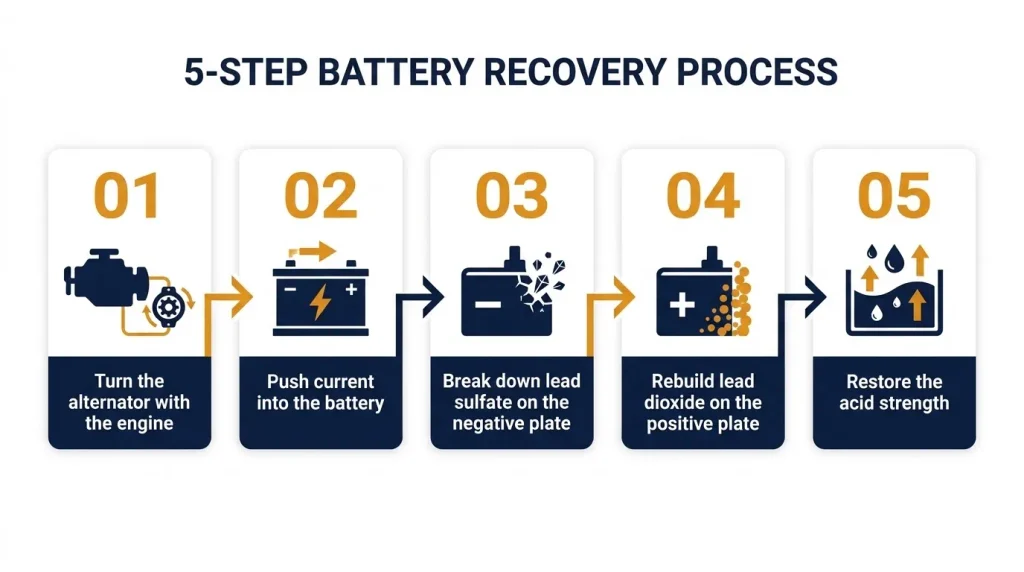
Charging puts energy back in by forcing the discharge reaction to run in reverse. The alternator feeds current into the battery, and the plates and the acid return to their charged states.
While the engine runs, the alternator powers the lights and the fans and sends spare current to the battery. That current drives electrons back into the negative terminal. The battery then stores the energy again as a chemical gap between unlike plates.
Step 1
Turn the alternator with the engine
The running engine spins the alternator, and the alternator makes electric current for the car.
Step 2
Push current into the battery
Current flows into the positive terminal and out of the negative terminal, the reverse of discharge.
Step 3
Break down lead sulfate on the negative plate
Sulfate leaves the negative plate and returns to the acid, which leaves sponge lead behind.
Step 4
Rebuild lead dioxide on the positive plate
Oxygen joins lead on the positive plate, and lead dioxide forms again.
Step 5
Restore the acid strength
Sulfate returns to the electrolyte, the acid grows strong again, and the plates stand unlike once more.
A full charge restores the chemical gap between the plates and leaves the battery ready to give full power. VARTA puts it in one line: a battery becomes charged when current flows back into it, restoring the chemical difference between the plates. See how a battery charges for that charge and discharge cycle.
Warning
Charging forms hydrogen gas, and hydrogen can catch fire from a spark. Keep flames and sparks away from the battery while it charges.
Short trips can break this loop. The starter takes a large burst, and the alternator needs drive time to put it back. If you only drive short hops with the lights and the heater on, you can charge a car battery with a jump starter as a stopgap, then take a longer drive or use a plug-in charger to finish the job.
Why Does a Battery Lose Its Ability to Store Energy?
A battery loses storage ability when lead sulfate hardens on the plates and stops reversing. Soft sulfate forms in normal discharge, but hard sulfate crystals block the reaction and cut capacity for good.
Acid layering adds a second fault. When a battery sits at a low charge, acid sinks and water floats, so only part of the electrolyte takes part in the reaction. Short trips with many loads on at once feed this fault, since the alternator gets too little time to recharge the pack.
Small drains also eat stored energy while the car sits parked. Clocks, alarms, and modules draw a small current all the time, and a light left on draws far more. Learn what drains a car battery when the car is off before you blame the battery itself for a flat morning start.
Deep discharge hurts the most. A battery left flat for a long spell grows hard sulfate that a normal charge cannot undo. At that point the pack may spin the starter once and then fade, which is what happens when your car battery dies in slow motion: voltage sags, the starter drags, and the lights dim.
Do Flooded, AGM, and Lithium Batteries Store Energy the Same Way?

Flooded and AGM batteries store energy the same way, through the lead-acid reaction. Lithium batteries store energy through a different chemistry, with lithium ions moving between electrodes.
A flooded battery holds liquid electrolyte that sloshes round the plates. An AGM battery binds the acid in a glass mat, so the acid cannot layer and the pack stands up to more charge cycles. Both types still use lead dioxide, sponge lead, and sulfuric acid.
Lithium packs swap that whole set for lithium compounds and a different electrolyte. They hold more energy for their weight and suit hybrid drive packs, while lead-acid packs still rule the starter job for their burst current and low cost. VARTA notes that a new class of micro-hybrid packs runs at 48 volts on lithium-ion cells, which shows how the two chemistries serve different jobs in one car.
Car Battery Charger
A car battery charger feeds current back into a flat battery so the plates and acid can return to their charged state.
Frequently Asked Questions
Can a car battery store AC power?
A car battery cannot store AC power, since it stores chemical energy and gives back DC power. AC current flips direction many times per second, while battery chemistry pushes electrons in one direction only. An inverter must change DC to AC for any AC load.
How long can a car battery hold its charge when parked?
A parked battery holds its charge for a span that shifts with drain, health, and temperature, so no single span fits all cars. Small module drains, an old pack, and cold air all shorten the span. Test resting voltage after a few hours parked to judge the true state.
Does a bigger battery store more energy?
A bigger battery often stores more energy, since larger plates and more acid give the reaction more material to work with. Size alone does not set the result, since plate design and cell count also shape capacity. Match the group size and the amp-hour rating to the car, not the case size alone.
Can storing a battery on concrete drain it?
Storing a battery on a concrete floor does not drain it, since concrete cannot pull current from a sealed plastic case. The pack loses charge through self-discharge and small surface leaks, not through the floor. Keep the top clean and dry, and the floor choice makes no difference.
What should you do if a battery will not hold a charge?
A battery that will not hold a charge needs a test before a swap, since a drain or a weak alternator can mimic a dead pack. Charge it fully, test resting voltage, and check for a drain with the car off. If voltage falls fast after a full charge, the plates are likely sulfated and the pack needs a swap.
Conclusion
A car battery stores electrical energy by holding lead dioxide and sponge lead apart in sulfuric acid until a circuit lets them react. If your car cranks slowly, test the resting voltage and charge the battery before you buy a new one.

I’m Alex Rahman, a car enthusiast and automotive writer focused on practical solutions, car tools, and real-world driving advice. I share simple and honest content to help everyday drivers make better decisions.
