
What Is a Car Jump Starter? The Complete Guide for Drivers in 2026
A car jump starter is a portable, self-contained battery pack that delivers a high-amp burst of power to a dead or discharged car battery — letting you start your vehicle without needing another car or a second person. Modern lithium-ion jump starters are compact enough to fit in a glove box, can jump start most gas and diesel engines, and often double as a USB power bank.
I’m Alex Rahman, and I’ve been stranded exactly once in a parking lot at 11 PM because my car battery died without warning. No one was around. Jumper cables were useless without a second car. That night cost me an hour, a tow truck fee, and a lot of frustration.
A few weeks later, a mechanic showed me something I’d never heard of — a portable car jump starter. It was roughly the size of a thick paperback book, and it started his dead test battery in under a minute. I bought one that same afternoon.
If you’ve ever wondered what a car jump starter actually is, how it works, and whether you really need one, this guide covers everything — from the basics to expert-level buying advice. Let me break it all down for you.
- A car jump starter is a portable lithium battery pack that can restart a dead car battery on its own — no second vehicle needed.
- Modern jump starters are small, safe, and loaded with features like USB charging ports and built-in flashlights.
- Peak amps and clamp quality are the two most important specs to compare when buying one.
- Lithium-ion jump starters outperform older lead-acid models in weight, shelf life, and cold-weather performance.
- Every driver should keep a jump starter in their vehicle — it’s one of the most practical emergency tools available today.
What Is a Car Jump Starter, Exactly?
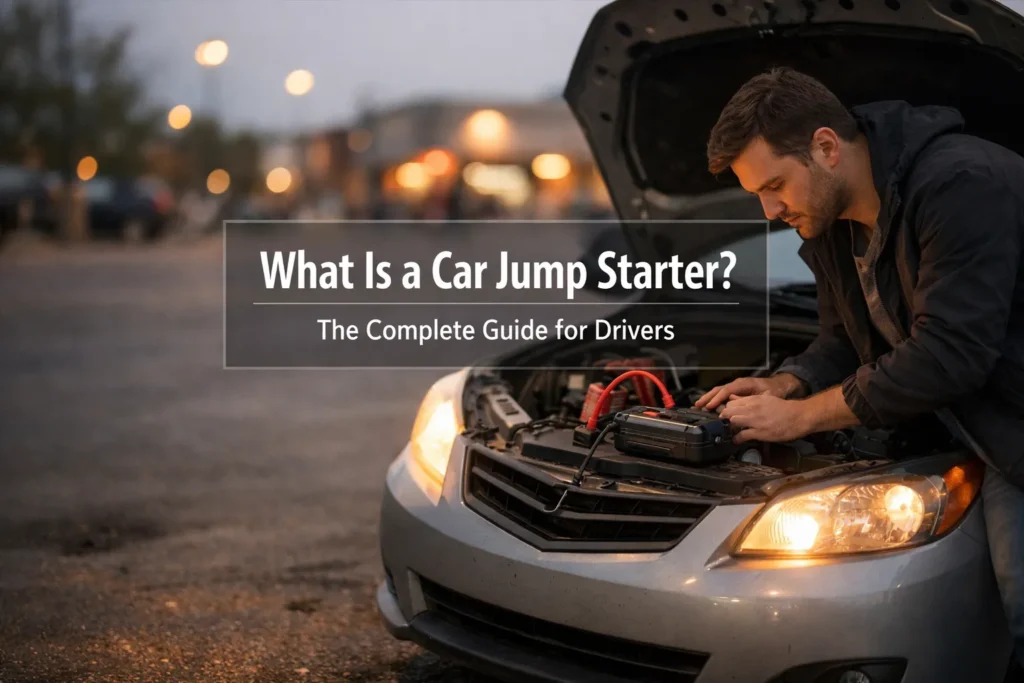
A car jump starter — also called a jump box, battery booster pack, or portable jump pack — is a compact battery device designed to deliver a short, powerful surge of electrical current to a dead or discharged 12V car battery. That surge is enough to crank the engine and get the car started.
The key difference between a jump starter and traditional jumper cables is this: a jump starter has its own built-in power source. You don’t need a second running vehicle. You simply connect the device to your battery terminals, press a button, and start your car.
Before lithium-powered jump starters became mainstream around 2015, most jump boxes used sealed lead-acid batteries. They worked, but they were heavy — sometimes 20 pounds or more — and they lost charge quickly during storage. Today’s lithium-ion models weigh as little as 1.5 to 2.5 pounds and can hold a usable charge for 6 to 12 months sitting untouched in your trunk.
Most lithium jump starters can also charge your phone, tablet, or laptop through their USB ports — so they double as an emergency power bank when you’re not jumping a battery.
How Does a Car Jump Starter Work?
A jump starter works by temporarily providing the high-amperage current that your car’s engine needs to fire up the starter motor. Here’s the short version of what happens electrically:
When you turn your ignition, the starter motor pulls a massive amount of current — often 150 to 400 amps — from the battery in a fraction of a second. If your battery is dead or too weak, it can’t deliver that surge. The jump starter steps in and provides it instead, giving the starter motor enough power to spin the engine over and ignite.
Once the engine starts, your car’s alternator takes over and begins recharging the battery from within. The jump starter’s job is done — you disconnect it and drive away.
- Make sure the jump starter is charged (check its indicator light or display).
- Turn off your car’s ignition completely.
- Connect the red (positive) clamp to the positive terminal on your battery.
- Connect the black (negative) clamp to an unpainted metal surface away from the battery — not the negative terminal itself.
- Turn on the jump starter device and wait for the “ready” signal (some models show a green light or display).
- Start your vehicle as normal.
- Once running, disconnect the black clamp first, then the red clamp.
- Drive for at least 15–20 minutes to let the alternator recharge your battery.
Portable Jump Starter vs. Traditional Jumper Cables: What’s the Real Difference?
Both methods get the job done, but they are very different experiences. Here’s a direct comparison so you know exactly what you’re choosing between:
| Feature | Portable Jump Starter | Traditional Jumper Cables |
|---|---|---|
| Requires a second vehicle? | No | Yes |
| Works when stranded alone? | Yes | No |
| Risk of improper connection? | Low (smart protection built in) | Higher (user dependent) |
| Cost | $50–$200+ | $15–$40 |
| Extra features | USB charging, flashlight, display | None |
| Ease of use | Very easy | Requires experience |
The verdict? If you want independence and safety, a portable jump starter wins every time. Jumper cables are still a smart backup to carry — but a jump starter is your primary emergency tool.
Types of Car Jump Starters: Which One Is Right for You?
Not all jump starters are built the same. There are three main categories, and choosing the right one depends on your vehicle and how you plan to use it.
1. Lithium-Ion Jump Starters (Most Popular)
These are the modern standard. Brands like NOCO (a Cleveland-based company known for precision battery products), HULKMAN, and GOOLOO lead this category. Lithium-ion jump starters are compact, lightweight, and can deliver 1,000 to 4,000+ peak amps despite fitting in the palm of your hand.
The NOCO Boost GB40, for instance, weighs just 2.4 pounds and handles gas engines up to 6.0L — which covers the vast majority of passenger cars on the road in the USA. It has earned over 120,000 customer ratings on Amazon at 4.6 stars, making it one of the most trusted automotive tools ever sold on the platform.
2. Lead-Acid Jump Starters (Legacy Models)
Older units like the Clore Automotive Jump-N-Carry JNC660 use lead-acid batteries — the same chemistry as your car battery. They’re powerful and extremely reliable in cold weather, but they weigh 10 to 20 pounds and need recharging every 30–90 days even when unused. Mechanics and professional shops often prefer these for sheer durability.
3. Ultracapacitor Jump Starters
A newer technology that stores energy in capacitors rather than a chemical battery. Brands like Fanttik have explored this design. These devices charge up from your car’s existing battery in 90 seconds — even a nearly dead one — then deliver that power back as a jump start. They have nearly unlimited cycle life and work well in extreme cold. The tradeoff: they only hold a charge for a few minutes, so they’re a “use it right now” tool rather than a long-term stored backup.
For most drivers: choose a lithium-ion jump starter in the 1,000–2,000A range. It covers everyday vehicles, is easy to store, and holds a charge for months. Go lead-acid if you need maximum reliability in extreme cold or have very large engines. Consider ultracapacitor models if you drive in arctic climates where lithium batteries can underperform.
Key Specs to Understand Before Buying a Jump Starter
Shopping for jump starters can feel overwhelming with numbers like “3,000A” and “12V” everywhere. Here’s what each spec actually means for you as a driver.
Peak Amps vs. Cranking Amps
Peak amps is the maximum current the jump starter can deliver for a fraction of a second — it’s the headline number you’ll see on the box. Cranking amps (CA) or cold cranking amps (CCA) reflect sustained output and is a more honest measure of real-world performance. Always look for both numbers. A unit advertising 3,000 peak amps but only 300 cranking amps will underperform when it counts.
Battery Capacity (Wh or mAh)
This tells you how much energy the jump starter stores. Higher capacity means more jumps per charge. A 15,000–20,000 mAh unit can typically deliver 20–40 jump starts before needing a recharge. It also means more power available for charging your phone and other devices.
Engine Compatibility
Always match the jump starter to your engine size. Manufacturers publish guidelines — for example, the NOCO GB40 is rated for up to 6.0L gas and 3.0L diesel. Larger engines like V8 trucks or diesel pickups may need units rated at 2,000A or higher. NOCO’s official support page includes an engine compatibility chart that’s worth checking.
Safety Protection Systems
Better jump starters include built-in protection against reverse polarity (connecting clamps backwards), overcharge, short circuits, and sparking. NOCO calls their system “UltraSafe.” These protections are not just marketing — they prevent expensive damage to your car’s electrical system and protect you from injury.
Never connect a jump starter to a frozen, cracked, or visibly leaking battery. A damaged battery can explode when current is applied. If you see corrosion or damage on your battery terminals, have the battery inspected or replaced before using a jump starter.
What Features Should a Good Jump Starter Have?
Beyond raw power, the best jump starters pack in features that make them genuinely useful in everyday situations — not just emergencies.
- Built-in LED flashlight: Essential for nighttime or low-visibility situations. Some models include SOS strobe modes.
- USB-A and USB-C output ports: Let you charge your phone, tablet, or even a laptop in a pinch.
- Digital battery display: Shows exact charge percentage rather than a vague 3-bar LED indicator.
- Carrying case: Keeps clamps, cables, and the unit organized and protected during storage.
- Waterproof rating (IP65 or higher): Protects the unit from rain and moisture — important for outdoor use.
- Boost Mode: Available on NOCO models, this delivers an immediate power surge when the battery is too low to even respond normally.
Charge your jump starter every 3–6 months even if you haven’t used it. Lithium-ion batteries self-discharge slowly over time, and a jump starter that’s dead in an emergency is no help at all. Set a phone reminder on the 1st of each quarter.
NOCO Boost GB40: 1000A UltraSafe Jump Starter – 12V Lithium Battery Booster Pack, Portable Jump Box, Power Bank & Jumper Cables – for 6.0L Gas and 3.0L Diesel Engines
With over 120,000 ratings averaging 4.6 stars on Amazon, the NOCO GB40 is the most proven compact jump starter available — it covers the vast majority of passenger cars and fits easily in a glove compartment.
When Should You Use a Car Jump Starter?
The obvious answer is: when your car battery dies. But there are several specific situations where having a jump starter makes a real difference.
Dead Battery After Leaving Lights On
This is the most common reason batteries drain completely. Interior lights, headlights left on overnight, or a door that didn’t fully close — all of these can drain a healthy battery to zero in a few hours. A jump starter gets you back on the road in under five minutes.
Old Battery That Struggles in Cold Weather
Cold temperatures reduce battery capacity significantly. According to battery research from Battery University, a battery at 0°F (−18°C) delivers only about 40% of its rated capacity compared to room temperature. If your battery is 3+ years old and you live in a cold climate, a jump starter is essential winter gear.
Jump Starting a Boat, Motorcycle, or Lawn Equipment
Most portable jump starters work on any 12V system — not just cars. This includes motorcycles, ATVs, boats, personal watercraft, riding mowers, and snowblowers. Check the amp rating matches the engine size, but otherwise the process is identical.
Helping a Stranded Stranger
With a jump starter in your car, you can help someone with a dead battery without needing to position vehicles bumper-to-bumper or worry about the reverse-polarity risk that traditional jumper cables carry. You become the roadside hero without any of the usual hassle.
According to AAA, dead batteries are the single most common reason for roadside assistance calls in the United States — accounting for roughly 1 in 4 calls annually. A $60–$100 jump starter can eliminate that call entirely.
How Long Does a Car Jump Starter Stay Charged?
This is one of the most common questions drivers ask — and it’s a smart one to consider before buying.
Most lithium-ion jump starters hold a usable charge for 6 to 12 months in standby storage, depending on the brand and storage conditions. NOCO recommends recharging their units every 3 months when not in use. HULKMAN’s Alpha85S uses a smart charging circuit that can extend standby life to up to 12 months per charge cycle.
Lead-acid jump starters, by comparison, self-discharge faster and typically need recharging every 30 to 90 days to stay ready. That’s a meaningful maintenance difference if you want a “set it and forget it” emergency tool.
Temperature also matters. Storing a lithium jump starter in a hot car (above 104°F/40°C) accelerates battery degradation over time. Ideally, store it in a cool, dry place — a trunk in moderate climates is fine, but extreme heat should be avoided long-term.
Are Car Jump Starters Safe to Use?
Yes — modern jump starters, especially lithium models from established brands, are designed with multiple layers of safety protection. The short answer is that using a quality jump starter is significantly safer than using traditional jumper cables incorrectly.
Here’s what premium safety systems protect against:
- Reverse polarity: The device won’t pass current if clamps are connected to the wrong terminals.
- Short circuit protection: Prevents damage if the clamps touch each other.
- Overcharge protection: Stops the device from overloading a weak or sensitive battery.
- Spark prevention: Smart clamps only activate when properly and safely connected.
- Over-temperature protection: Shuts down the unit if it overheats during use.
Avoid cheap, no-name jump starters that don’t list specific safety protections. Budget models without reverse polarity protection can send current through your car’s electronics in the wrong direction — potentially damaging your ECU, alternator, or other sensitive modules. Spend a little more for a unit from a recognized brand.
How to Choose the Right Jump Starter for Your Vehicle
The right jump starter depends on three things: your engine size, your climate, and how many vehicles you want to cover. Here’s a simple framework to follow.
For Small to Mid-Size Cars (4-cylinder engines up to 3.0L)
A 600–1,000A peak output jump starter handles this range easily. These are the most compact and affordable options on the market. Good for daily commuter cars, sedans, and smaller SUVs.
For Full-Size Cars and V6/V8 Trucks (up to 6.0L gas)
Target 1,000–2,000A peak amps. The NOCO GB40 (1,000A) and NOCO GB70 (2,000A) are the benchmark choices in this range and are used as reference points by most automotive reviewers.
For Diesel Trucks, Large SUVs, and Commercial Vehicles
Diesel engines require significantly more cranking power. Look for jump starters rated at 2,000A or higher, specifically with diesel engine ratings listed. Units like the NOCO GBX155 (4,250A) or GOOLOO A3 (3,000A) serve heavy-duty needs.
If you own multiple vehicles — or plan to help others — size up slightly. A 2,000A unit that’s a little more expensive gives you confidence across a wider range of engine types without needing a second device.
What Is the Difference Between a Jump Starter and a Battery Charger?
This is a question that trips up a lot of buyers. They sound similar but serve very different purposes.
A battery charger slowly replenishes a discharged battery over several hours using a steady, low-amperage current. It restores the battery to full health, but it’s not designed to start an engine immediately. You plug it into a wall outlet and leave it overnight.
A jump starter delivers a massive but brief surge of current — enough to start the engine right now — without actually recharging the battery. Once the engine is running, the alternator handles recharging from within the car.
Some devices, like the NOCO Genius series, are combination battery charger and maintainer units that plug into the wall. These are excellent for vehicles stored seasonally — RVs, motorcycles, classic cars. But they don’t function as portable jump starters. For on-the-go emergency use, you want a dedicated jump starter.
Jump starter = instant start, portable, no wall outlet needed. Battery charger = slow overnight restore, requires wall power. Both are useful tools — but for roadside emergencies, only a jump starter helps you right away.
Top Jump Starter Brands You Should Know
The market has a lot of options. These are the brands with the strongest reputations for quality, safety, and after-sales support in the USA.
NOCO — Founded in Cleveland, Ohio, NOCO is widely considered the gold standard for lithium jump starters. Their Boost series dominates best-seller charts and is a reference point in virtually every professional review. Their UltraSafe spark-proof clamp technology set the industry benchmark for safe jump-starting.
HULKMAN — A newer brand that rose quickly by focusing on performance and design. Their Alpha85S scored the highest voltage output in independent lab testing by TechGearLab (2025), with a larger battery capacity and faster self-charging than most competitors.
GOOLOO — Known for combining high amperage ratings with competitive pricing. The GOOLOO A3 (3,000A) sold over 30,000 units in a single month on Amazon in late 2025, making it one of the fastest-selling jump starters in recent memory.
Clore Automotive — The maker of the Jump-N-Carry line, Clore has been in the professional shop equipment space for decades. Their lead-acid units like the JNC660 are trusted by mechanics for heavy-duty reliability in demanding conditions.
TOPDON — A brand popular for combining jump starting with tire inflation in a single unit. Their combo jump starter/air compressor products appeal to drivers who want a one-tool emergency solution.
How Much Does a Car Jump Starter Cost?
Budget matters. Here’s a realistic breakdown of what different price points get you in 2025.
| Price Range | What to Expect | Best For |
|---|---|---|
| $30–$60 | Basic lithium, 800–1,200A, limited safety features | Small cars, occasional use |
| $60–$100 | 1,000–2,000A, full safety protection, USB power bank | Most passenger vehicles, best value |
| $100–$150 | 2,000A+, digital display, premium clamps, IP rating | Trucks, SUVs, frequent use |
| $150–$300+ | 4,000A+, diesel-rated, built-in air compressor, pro features | Heavy-duty trucks, commercial use, fleets |
For the average American driver with a standard gas-powered car or SUV, the $60–$100 range offers the best combination of power, safety, and usability. Spending under $30 is a false economy — the safety protections you lose are worth paying for.
Common Mistakes Drivers Make with Jump Starters
Even with a quality device, a few easy mistakes can cost you. Knowing them upfront makes you a safer, smarter user.
- Not charging the jump starter before storing it: A dead jump starter is useless in an emergency. Always charge it fully before putting it in your car.
- Connecting clamps to the wrong terminals: Red always goes to positive (+), black to an unpainted metal ground — not the negative terminal directly. Good jump starters protect against reverse polarity, but forming the right habit matters.
- Trying to jump a severely damaged battery: If your battery is physically damaged, leaking, or frozen, a jump starter won’t fix the underlying problem and can be dangerous. Replace the battery first.
- Attempting multiple jump starts without recharging: Each jump start draws significant power. If the car doesn’t start on the first or second attempt, recharge the jump starter before trying again.
- Using an undersized unit on a large engine: A 600A jump starter won’t reliably start an 8-cylinder diesel truck. Match the device to the engine — the specs are there for a reason.
Frequently Asked Questions
What is a car jump starter used for?
A car jump starter is used to restart a vehicle with a dead or discharged battery — without needing a second car. It delivers a high-amp surge of power to the battery terminals, giving the engine enough current to crank and start. Many jump starters also function as portable power banks for charging phones and other electronics.
How many amps do I need to jump start my car?
Most standard gas-powered cars with engines up to 4.0L need 400–600 cranking amps to start reliably. A jump starter rated at 1,000 peak amps covers the majority of passenger vehicles with a safety margin. Larger V8 gas engines and diesel motors may need 2,000A or more. Always check your vehicle owner’s manual for battery CCA requirements.
Can a jump starter damage my car’s electronics?
A quality jump starter with proper safety protections (reverse polarity, short circuit, and surge protection) will not damage your car’s electronics when used correctly. Cheap jump starters without these protections carry a higher risk. Always use a recognized brand and follow the connection sequence precisely — positive first, grounded metal last.
How long does a portable jump starter hold its charge?
Most lithium-ion jump starters hold a usable charge for 6 to 12 months in standby storage. NOCO recommends recharging their units every 3 months even when not used. Storing the device in extreme heat (above 104°F) shortens battery life and standby duration over time.
Can I use a car jump starter on a motorcycle or boat?
Yes. Most portable jump starters work on any 12V electrical system, which includes motorcycles, ATVs, boats, jet skis, riding lawnmowers, and snowblowers. The process is the same — connect positive to positive, ground to metal, and follow the same safety steps as with a car.
What is the difference between a jump starter and a battery tender?
A jump starter delivers a burst of power to start a dead engine immediately — it’s a portable emergency tool. A battery tender (or trickle charger) slowly maintains or restores a battery’s full charge over several hours and must be plugged into a wall outlet. They solve different problems: jump starters are for emergencies, battery tenders are for long-term storage maintenance.
Is it safe to leave a jump starter in my car during summer?
Lithium-ion jump starters can tolerate occasional heat exposure, but storing them in a car regularly exposed to temperatures above 104°F (40°C) will degrade the battery over time and shorten its lifespan. If you live in a very hot climate, consider keeping the jump starter indoors when not traveling and placing it in the car before long trips.
Conclusion
A car jump starter is one of those tools that feels unnecessary right up until the moment you desperately need it. At that point, it’s the most valuable thing in your trunk.
The core idea is simple: it’s a portable battery pack that lets you restart a dead car battery on your own, in minutes, without flagging down a stranger or calling a tow truck. Modern lithium-ion models from brands like NOCO, HULKMAN, and GOOLOO have made jump starters smaller, safer, and more capable than ever before.
For most drivers, a unit in the 1,000–2,000A range costing between $60 and $120 covers every realistic situation. Charge it every few months, store it somewhere accessible in your vehicle, and you’ll never be stranded by a dead battery again.
I’m Alex Rahman, and if this guide helped you understand what a jump starter is and whether you need one — grab one before you need it. You’ll thank yourself the first time it saves your day.
