
Why Do Car Batteries Contain Acid? Chemistry Explained
Quick Answer
Car batteries contain diluted sulfuric acid because the acid is the electrolyte in a lead-acid battery. It carries ions between the lead plates, takes part in the chemical reaction that makes current, and returns to full strength when the battery charges. Without acid, the plates cannot react, and the battery cannot store or release power.
- The acid is diluted sulfuric acid, mixed with water.
- It acts as both a carrier for ions and a reactant in the plates.
- Its strength falls as the battery discharges and rises as it charges.
- It is corrosive, so a cracked case or a leak needs care.
A car battery looks like a sealed box with two posts on top. Inside that box, lead plates sit in a liquid that makes the whole device work. This article explains what that liquid is, why the battery needs it, and what happens when it changes.
What Acid Is in a Car Battery?
The acid in a car battery is diluted sulfuric acid. Its chemical formula is H2SO4, and it is mixed with distilled water to form the electrolyte.
An electrolyte is a liquid that carries charged particles, called ions, between two plates. In a lead-acid battery, the plates are sponge lead on the negative side and lead dioxide on the positive side. The acid fills the space between them and lets ions move when a circuit is closed.
A fully charged battery holds a mix that is about 25 percent sulfuric acid and 75 percent water, according to the U.S. Department of Energy. That share is a guide for a charged battery, not a fixed value for every battery at every moment. The mix changes as the battery gives out power and as it charges again.
Why Do Car Batteries Contain Acid?
Car batteries contain acid because lead plates alone cannot make current. The acid supplies the ions and the sulfate that drive the reaction at both plates.
When you turn the key, the battery must send a large burst of current to the starter motor. Ions must move fast inside the battery for that burst to happen. Sulfuric acid splits into hydrogen ions and sulfate ions in water, and those ions move freely between the plates.
The acid also takes part in the reaction itself. It is not a passive filler that only carries ions. It reacts with the plate material, forms lead sulfate, and is rebuilt during charging. A battery with plain water in place of acid would have no sulfate to react and no ion flow to carry. The U.S. Department of Energy primer on lead-acid batteries describes dilute sulfuric acid as the electrolyte that completes the internal circuit by supplying ions to both electrodes.
How Does Sulfuric Acid Make Electricity?

Sulfuric acid makes electricity by letting a chemical reaction at the plates release electrons. Those electrons flow out through the terminals and through the car wiring.
At the negative plate, sponge lead reacts with sulfate ions from the acid. That reaction forms lead sulfate and releases electrons. At the positive plate, lead dioxide reacts with hydrogen ions and sulfate ions from the acid. That reaction also forms lead sulfate and takes in electrons from the circuit.
The two reactions together push electrons from one terminal to the other. The flow of electrons is the electric current that turns the starter motor and runs lights and electronics. When the acid is weak or the plates are coated with lead sulfate, the reaction slows and voltage falls. A scan tool can help detect a bad battery when voltage or charge readings point to a weak cell.
What Happens to the Acid During Discharge and Charging?
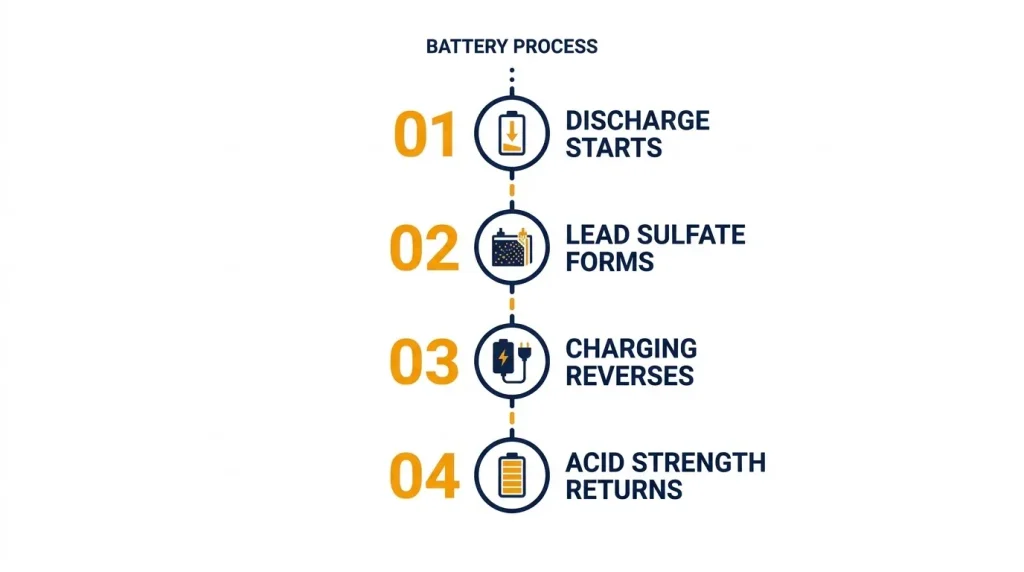
The acid is used up during discharge and rebuilt during charging. Its strength tracks the state of charge in a flooded battery.
As the battery powers a load, sulfuric acid reacts with both plates and turns into water and lead sulfate. The liquid grows weaker, and the plates grow coated with lead sulfate. A fully discharged battery holds an electrolyte that is close to water in strength, and it cannot deliver much power.
Small loads can also pull a battery down over time. A light left on, a phone charger, or a device that stays awake can drain a car battery while the car sits parked. The same chemical change takes place, only at a slower pace.
Step 1
Discharge starts the reaction
A load closes the circuit, and acid reacts with the lead and lead dioxide plates.
Step 2
Lead sulfate forms on both plates
Acid is used up, water forms, and the electrolyte grows weaker as power flows out.
Step 3
Charging reverses the reaction
Current from the alternator breaks down lead sulfate and drives sulfate back into the liquid.
Step 4
Acid strength returns at full charge
The plates return to lead and lead dioxide, and the acid mix returns to full strength.
Charging does not add new acid. It restores the acid that was used during discharge. If a battery stays discharged for a long time, soft lead sulfate can harden into crystals that resist charging. That change is called sulfation, and it cuts capacity and life. A jump pack that will not take a charge can point to the same fault, so check the guide for a jump starter not charging before you assume the car battery is the only fault.
Why Sulfuric Acid and Not Another Acid?
Sulfuric acid is used because it gives the lead-acid reaction three traits at once: strong ion flow, a reversible reaction, and low cost at scale.
First, sulfuric acid splits into ions in water with ease. That ion flow lets the battery send a short, strong burst of current to start an engine. Second, the reaction with lead and lead dioxide runs in both directions. Discharge forms lead sulfate, and charging turns it back into lead, lead dioxide, and acid. That loop lets the same battery charge and discharge through many cycles.
Third, sulfuric acid is cheap to make in large amounts and stays stable across the voltage range of a 12 volt system. Other strong acids fail one of those tests. Hydrochloric acid can release chlorine gas and attack parts too fast. Nitric acid breaks down with ease and gives a poor recharge loop. Sulfuric acid gives the mix of flow, reversibility, and cost that a starter battery needs.
Do All Car Batteries Hold Liquid Acid?
All lead-acid car batteries use sulfuric acid, but they do not all hold it as free liquid. The design changes how the acid is held, not the chemistry itself.
Flooded batteries hold liquid acid that covers the plates. They may need water top-ups and they can spill if tipped. Absorbent glass mat batteries, called AGM, hold the acid in fine glass fibre mats packed between the plates. Gel batteries mix the acid with silica to form a thick gel. Both sealed types resist spills and vibration, and they suit cars with stop-start systems or heavy electrical loads.
The table below compares the three main types by how the acid is held.
| Battery type | How the acid is held | What it means for you |
|---|---|---|
| Flooded | Free liquid acid around the plates | Low cost, may need water checks, can spill |
| AGM | Acid held in glass fibre mats | Spill resistant, strong vibration resistance |
| Gel | Acid mixed with silica into a gel | Sealed and spill resistant, needs gentle charging |
Lithium starter packs and lithium car batteries are a separate case. They use a different chemistry and a different electrolyte, so they hold no sulfuric acid. A standard 12 volt car battery in most petrol and diesel cars is still a lead-acid unit, with six cells joined in series and each cell giving about 2.1 volts at full charge.
Is Car Battery Acid Dangerous?
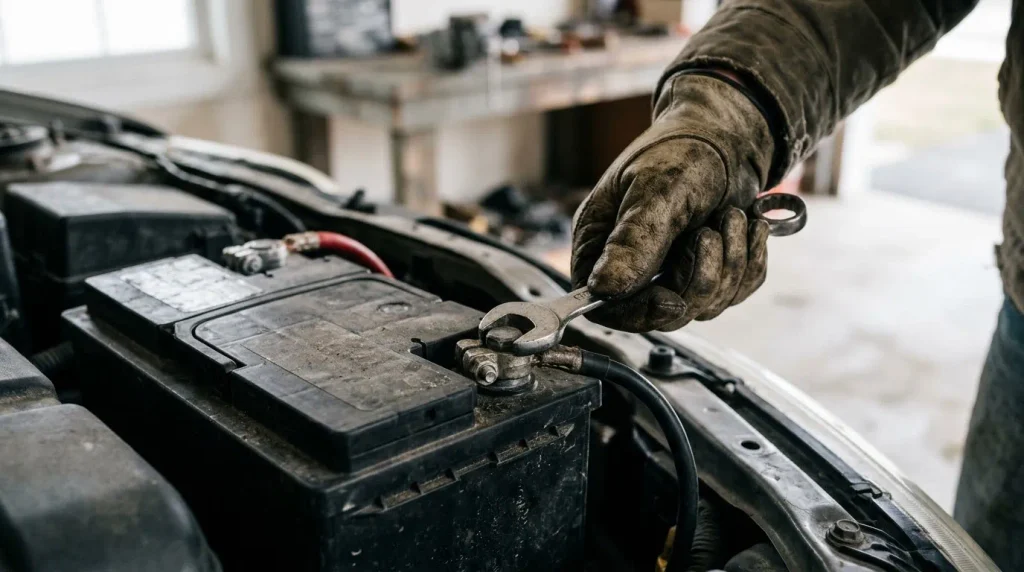
Car battery acid is dangerous on contact because diluted sulfuric acid is corrosive. It can burn skin and eyes, eat through cloth, and corrode metal.
The risk is highest when a case cracks, a vent cap leaks, or a battery is opened or tipped. Acid mist can also sit as a film on the outside of an old battery, so wash your hands after you touch one. Keep sparks and flames away from a battery while it charges, since charging can release hydrogen gas from the cells.
Warning
Acid in the eyes can cause lasting harm. Flush eyes with running water for at least 30 minutes and seek medical care at once.
If acid touches skin, wash the area at once with plenty of water. Wear gloves and eye protection when you handle a lead-acid battery, and work in fresh air. The Ohio State University battery safety guide gives the same flush time for eyes and warns that acid can cause painful burns that damage tissue. Store batteries upright in a cool, dry place, and keep them away from children.
What Happens When Acid Runs Low or Leaks?
Low acid or a leak cuts the reaction at the plates and leaves part of the plate dry. The battery then gives less current and may fail to crank the engine.
In a flooded battery, water is lost as gas during charging, and the level can fall below the top of the plates. Only distilled water is used to top up a flooded battery, since tap water adds minerals that harm the cells. Never add acid to top up a battery, and never open a sealed AGM or gel battery to add liquid.
A leak shows as wetness around the case, white or green crust on the terminals, or a sharp smell near the battery. Clean a spill with care, keep it off skin and paint, and wash the area with a water and baking soda mix after you remove the source. A cracked case, a swollen case, or a leak that keeps coming back means the battery needs testing and likely replacement, not another top-up.
Car Battery
A car battery is the lead-acid unit this article describes, and a fresh one restores the acid and plate reaction when the old unit can no longer hold a charge.
Frequently Asked Questions
What type of acid is in a car battery?
Diluted sulfuric acid is the acid in a standard car battery. It is mixed with distilled water to form the electrolyte, and it reacts with lead and lead dioxide plates to make current.
Why does a car battery need acid to start a car?
A car battery needs acid because the acid carries ions and reacts with the plates to release electrons. That electron flow is the current that turns the starter motor and runs the car electrics.
Can you add water to a car battery?
You can add distilled water to a flooded car battery when the level falls below the plates. Use only distilled water, add it with care, and never open or top up a sealed AGM or gel battery.
Is car battery acid the same as vinegar?
Car battery acid is not the same as vinegar. Vinegar holds weak acetic acid, while a car battery holds diluted sulfuric acid, which is far more corrosive and can burn skin and eyes.
What happens if battery acid touches your skin?
Battery acid on skin can cause a chemical burn. Wash the area at once with plenty of water, remove stained clothing with care, and seek medical care if pain or redness stays.
Do electric cars use sulfuric acid batteries?
Most electric cars use lithium packs for drive power, not sulfuric acid for the main pack. Some still use a small 12 volt lead-acid battery for lights and controls, and that unit holds sulfuric acid.
Conclusion
Car batteries contain acid because diluted sulfuric acid is the working heart of the lead-acid reaction. If your battery is slow to crank, check its charge and look for leaks or low fluid before you replace it.

I’m Alex Rahman, a car enthusiast and automotive writer focused on practical solutions, car tools, and real-world driving advice. I share simple and honest content to help everyday drivers make better decisions.
