
How Does a Car Battery Recharge Itself? Simple Guide
Quick Answer
A car battery does not recharge itself. It stores energy, and it needs an outside source to restore that energy. While the engine runs, the alternator makes electricity and sends charge back to the battery. A plug-in charger can do the same job when the car is parked.
- The battery stores charge. It cannot make new charge.
- The alternator is the main source of charge while you drive.
- A short rest can lift voltage a little, but it adds no real charge.
- A plug-in charger is the fix when driving cannot restore a flat battery.
How does a car battery recharge itself? You may have left lights on, then found the car would start after a rest. That moment can make a battery look like it healed itself. This guide explains what fills a battery again, what slows that process, and what to do when driving is not enough.
Can a car battery recharge itself on its own?
A car battery cannot recharge itself on its own. A battery is a store of chemical energy, not a generator. It can give power out, but it cannot put power back in without an outside source.
The outside source is the alternator while the engine runs, or a charger while the car is parked. Without one of those sources, a flat battery stays flat. A battery that seems to recover after a rest has not gained charge. Its voltage can rise a little as the chemicals inside settle and spread out. That small rise can be enough for one weak start, but it does not replace the energy that was used.
Think of the battery as a water tank. The tank can hold water and send it out through a tap. It cannot refill itself. The alternator is the pump that refills the tank while the engine runs.
How does the alternator recharge a car battery?
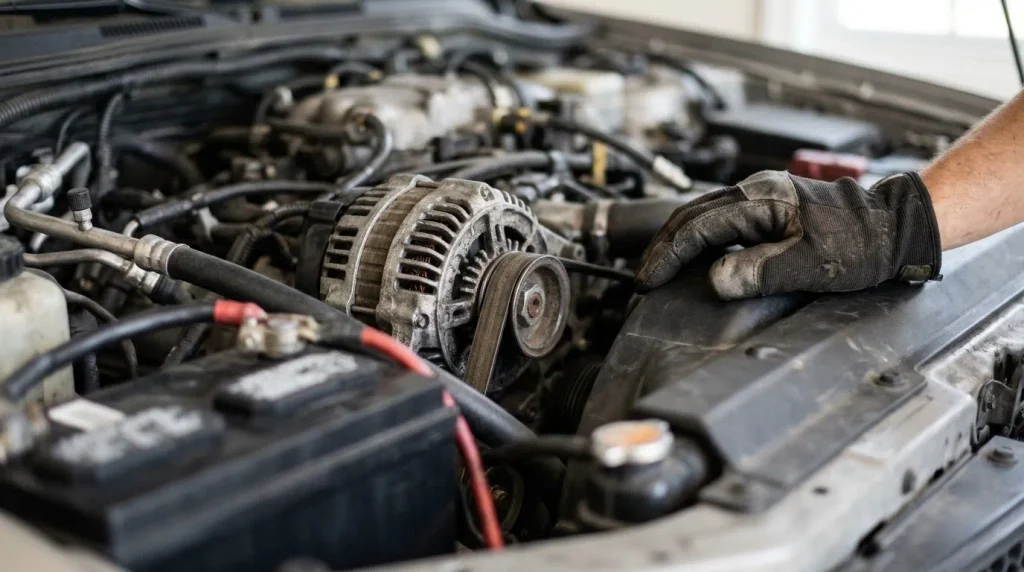
The alternator recharges a car battery by turning engine power into electrical power. The engine spins the alternator, the alternator makes current, and that current flows back to the battery. The battery then stores that energy for the next start.
The battery starts the cycle. It sends a strong burst of power to the starter motor, and the starter turns the engine. Once the engine runs, the battery stops doing the main work. The alternator takes over the job of powering lights, fans, and controls, and it also tops up the battery.
Step 1
Start the engine
The battery sends power to the starter motor. The starter turns the engine until it runs on its own.
Step 2
Spin the alternator
A belt links the engine crankshaft to the alternator pulley. The running engine spins the alternator at high speed.
Step 3
Make alternating current
A spinning magnet, called the rotor, moves past fixed wire coils, called the stator. That motion makes alternating current, or AC.
Step 4
Change it to direct current
The rectifier changes AC into direct current, or DC. A car battery and most car parts run on DC.
Step 5
Send charge to the battery
The regulated DC power runs the car systems first. Spare power flows into the battery and restores the charge used at startup.
A jump start can get the engine running when the battery is flat, but it does not charge the battery by itself. Learn how jump starter charging works before you rely on a jump pack to restore charge.
What do the rectifier and voltage regulator do?
The rectifier and the voltage regulator turn raw alternator output into safe charging power. The rectifier changes the current type, and the regulator holds the voltage in a safe range. Without them, the battery would get the wrong type of power or too much power.
The rectifier uses diodes, which act as one-way gates for current. AC changes direction as it flows, but a battery needs current that flows in one direction. The diodes force the current into one direction, so the output becomes DC.
The voltage regulator watches system voltage and adjusts alternator output to match the load. AAA lists the range as about 13.5 to 14.5 volts for a healthy vehicle charging system. That level sits above the resting voltage of a full battery, so current flows into the battery. If the voltage stayed too low, the battery would not fill. If it rose too high, the battery could overheat and suffer damage.
Some cars use smart charging, where a control module sets the target voltage. The module can ask for more charge after a cold start, or less charge when the battery is full. The goal stays the same in each case: give the battery the charge it needs, and no more.
How long does driving take to recharge a car battery?
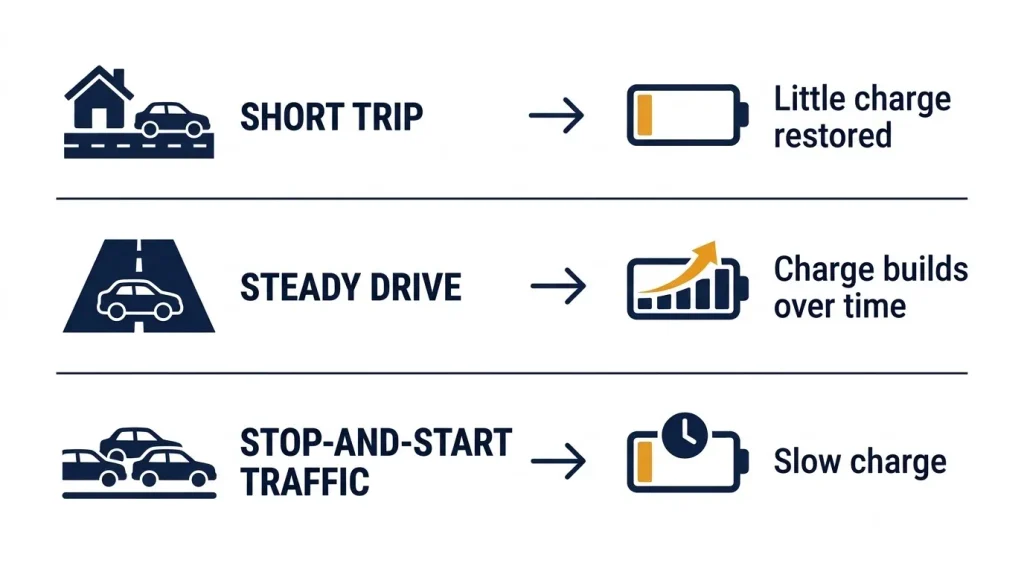
Driving takes time to recharge a car battery, and the time depends on how flat the battery was and how you drive. A normal start uses a small share of the battery charge, so a steady drive can replace it. A deep drain needs a much longer drive, and driving alone may not finish the job.
Short trips are the weak point. The start uses energy, and a trip of a few minutes gives the alternator little time to replace it. A string of short trips can leave the battery a little lower after each trip. A steady drive at road speed gives the alternator time and speed to work, so charge builds.
The table below compares common driving patterns and what each one does for charge.
| Driving pattern | Charge result | Why it happens |
|---|---|---|
| Short trip | Little charge restored | The start used more energy than the short drive replaced. |
| Steady drive | Charge builds over time | The alternator spins faster and has time to work. |
| Stop-and-start traffic | Slow charge | Low speed and high accessory use leave less spare power. |
A steady drive is the most useful pattern for charging. It keeps engine speed up, and it gives the system time to send spare power to the battery.
Tip
Switch off heated seats and rear defrosters for part of a long drive when the battery is low, so more alternator output can go to the battery.
Do not judge charge by how the car sounds on one start. A battery can crank once and still be far from full. A voltmeter check at rest, or a charge test at a shop, gives a clearer read than one good start.
Does idling recharge a car battery?
Idling can recharge a car battery, but the charge is slow. At idle, the engine turns slowly, so the alternator spins slowly and makes less power. That power must run the car systems first, and only the spare power reaches the battery.
Idling with lights, heat, and fans on can leave almost no spare power. In that case, the battery may gain little charge, or it may even lose charge while the engine runs. A drive at road speed works far better than a long idle for charging.
Idling still has a use after a jump start. It keeps the engine running while you check for loose cables or a warning light. For charge, though, a steady drive is the stronger choice. If you cannot drive, a plug-in charger is the stronger choice still.
Why does a battery still go flat while driving?
A battery can still go flat while driving when the charging system cannot keep up with the load, or when the battery itself cannot hold charge. The alternator may be weak, the belt may slip, or the battery may be old and worn. A drain that runs while the car is parked can also leave the battery low before the drive starts.
A failing alternator is a common cause. It may make some power, but not enough to run the car and charge the battery. The battery then fills the gap, and its charge falls over the drive. A battery warning light, dim lights, or slow cranking can point to this fault.
Age and damage matter too. A battery that has been drained flat more than once can lose capacity, and its plates can suffer lasting harm. A code reader battery check can show voltage clues, but a load test gives a clearer verdict on battery health. Small drains also add up, and an OBD device drain from a device left plugged in can pull charge while the car sits.
Heat and cold change how a battery behaves. Cold slows the chemical reaction inside the battery, so it gives less power for a start. Heat speeds up wear inside the battery, so life falls over time. Neither one changes the basic rule: the battery needs an outside source to gain charge.
What recharges a dead battery when driving will not?
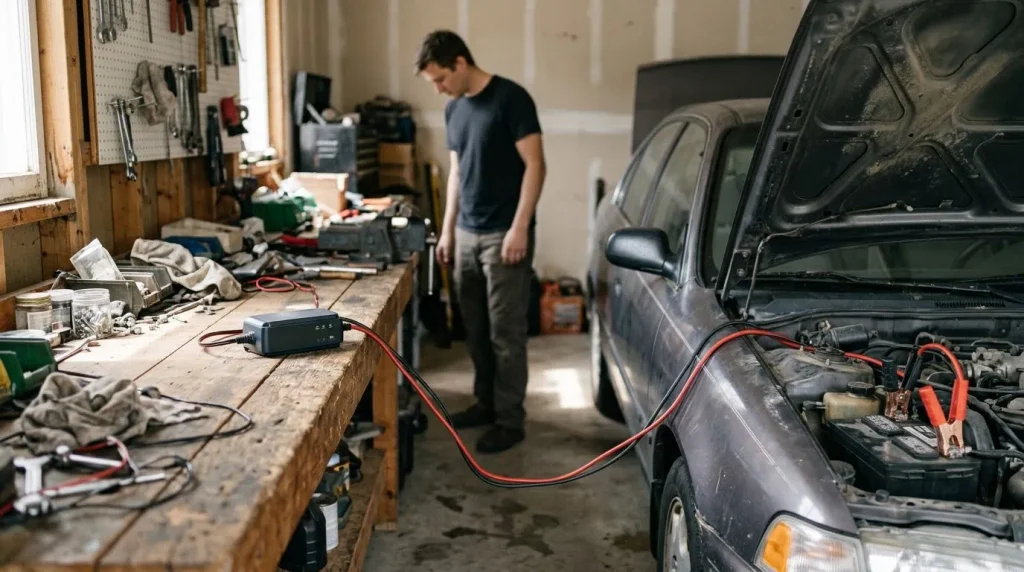
A plug-in charger recharges a dead battery when driving will not. A charger sends a controlled current into the battery over hours, and it can restore a battery that a drive left half full. A jump start only starts the engine, so it cannot replace a full charge on its own.
Use an automatic charger when you can. It slows down or stops as the battery fills, which lowers the risk of overcharge. A manual charger needs closer watch, because it keeps charging until you switch it off. AAA gives steps to charge a car battery with a plug-in charger, including safe clamp order and monitoring.
Connect the charger with the power off, and keep the charger as far from the battery as the cables allow. Work in fresh air, and follow the charger manual for your exact model. If the battery smells of rotten eggs, feels hot, or shows a swollen case, stop and seek help. Those signs can point to damage that charging will not fix.
If a battery will not hold charge after a full charge, the fault may sit in the battery or the alternator. Have both tested before you buy a new part. A new battery will go flat again if the alternator is the real fault.
Car Battery Charger
A car battery charger restores a flat battery at home when driving cannot finish the job.
Frequently Asked Questions
Does a car battery recharge while driving?
A car battery recharges while driving when the engine runs and the alternator works as it should. The alternator powers the car systems and sends spare current to the battery. Short trips may not replace the energy used at startup, so a longer steady drive helps more.
How long should I drive after a jump start?
A drive after a jump start should be a steady drive of some length, not a quick trip around the block. A steady drive gives the alternator time to replace the start energy. If the battery was deeply drained, a plug-in charger is the safer way to finish the charge.
Can a car battery recharge overnight by resting?
A resting car battery cannot gain new charge overnight, though its voltage may rise a little as the chemistry settles. That rise is voltage recovery, not charging. The battery still holds the same stored energy, and it still needs the alternator or a charger to fill again.
Does turning off accessories help a battery charge faster?
Turning off accessories can help a battery charge faster by leaving more alternator output for the battery. Lights, heat, fans, and heated seats all draw power. With less load, more spare current can flow into the battery during the same drive.
Can a dead battery be recharged, or must it be replaced?
A dead battery can often be recharged when the drain was brief and the battery is still in sound shape. A full charge on a plug-in charger, followed by a test, shows if it holds charge. A battery that fails the test, or dies again soon after, needs replacement.
Does idling charge a car battery?
Idling can charge a car battery, but the charge is slow because the alternator spins at low speed. The car systems use most of the power made at idle. A steady drive, or a plug-in charger, restores charge far faster than idling.
Conclusion
A car battery recharges itself only with help from the alternator or a charger, not on its own. If you drive short trips, take a longer steady drive after a jump start. If the battery still fails to hold charge, have the battery and charging system tested.

I’m Alex Rahman, a car enthusiast and automotive writer focused on practical solutions, car tools, and real-world driving advice. I share simple and honest content to help everyday drivers make better decisions.
