What OBD2 Scanner Is Good for SRS? Complete Guide
Quick Answer
A good OBD2 scanner for SRS is one that can communicate directly with your vehicle’s airbag control module, read and clear SRS diagnostic trouble codes, and identify relevant faults. The Autel AutoLink AL629 is a practical example with manufacturer-documented SRS support. The Autel MD808 offers broader diagnostic capabilities. However, neither scanner is guaranteed to support every vehicle. Always confirm SRS compatibility for your exact make, model, and year before choosing a tool.
An illuminated airbag warning light can indicate a problem with your vehicle’s Supplemental Restraint System (SRS). The issue might involve an electrical connection, an occupant-detection component, a seat belt pretensioner, or another part of the restraint system.
A standard OBD2 reader may report that no trouble codes are stored, even while the airbag warning light remains on. That does not necessarily mean the system is working properly.
The difference is whether the diagnostic tool can access the separate SRS control module. Understanding that distinction will help you choose a suitable scanner and avoid confusing basic engine diagnostics with airbag-system diagnostics.
What Makes an OBD2 Scanner Good for SRS?
An effective SRS scanner must support enhanced, vehicle-specific diagnostics rather than only standard emissions-related OBD2 functions.
The most useful capabilities are:
- SRS code reading: Retrieves diagnostic trouble codes from the airbag or restraint-system control module.
- Code descriptions: Helps identify the affected circuit, component, or monitored condition.
- Vehicle-specific compatibility: Supports the actual restraint-system electronics installed in your vehicle.
- Code clearing: Allows eligible SRS fault information to be erased after appropriate diagnosis and repair.
- System status: Displays available current, stored, or historical fault information.
- Software updates: Helps maintain diagnostic coverage where the manufacturer provides updates.
Some advanced tools also support module identification, selected live parameters, or special service functions. These capabilities depend on the vehicle and should not be assumed merely because a scanner advertises airbag diagnostics.
For most car owners investigating an airbag warning light, reliable SRS code retrieval and accurate vehicle coverage matter more than having the largest number of advertised features.
Which OBD2 Scanners Can Read SRS Codes?
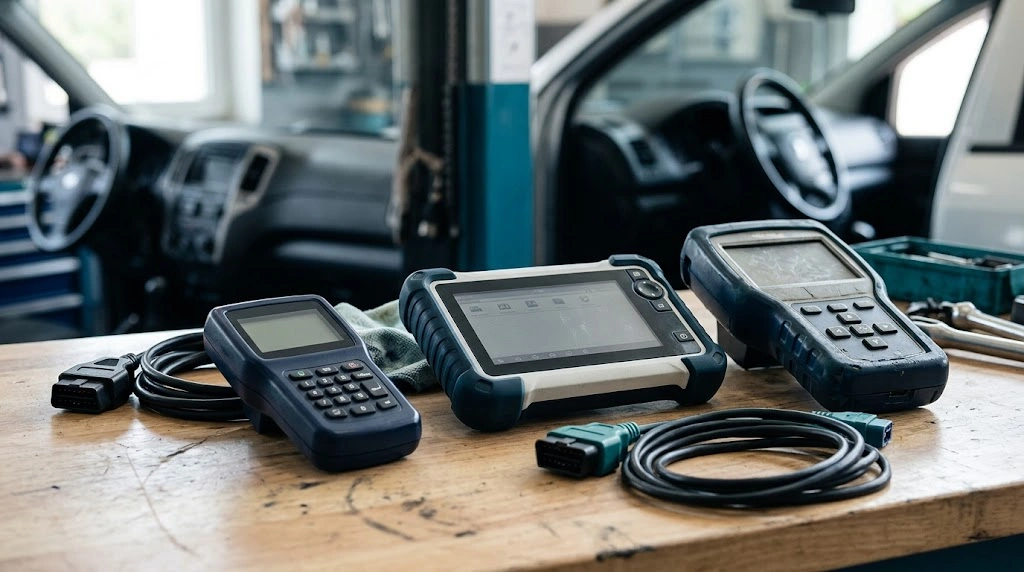
Several diagnostic tools have documented SRS capabilities. The following examples illustrate different levels of scanner functionality rather than a laboratory-tested product ranking.
Autel AutoLink AL629 — Four-System Diagnostics
The Autel AutoLink AL629 supports diagnostic trouble-code reading and clearing for engine, transmission, ABS, and SRS systems on compatible vehicles.
Its handheld design makes it relevant to drivers who want to investigate multiple dashboard warning lights without relying on a smartphone application.
According to Autel’s official AL629 specifications, the scanner offers four-system code diagnostics, standard OBD2 functions, and selected powertrain data features.
Suitable for: Owners who need basic SRS fault-code access alongside engine, ABS, and transmission diagnostics.
Important limitation: Four-system code reading is not the same as full SRS programming, module replacement setup, or occupant-classification calibration.
Autel MaxiDIAG MD808 — Broader Diagnostic Coverage
The Autel MaxiDIAG MD808 is another manufacturer-documented option that can access airbag-related diagnostics on supported vehicles.
Autel describes SRS access alongside engine, transmission, and ABS diagnostics, plus several additional service functions.
This makes the MD808 relevant to someone who expects to investigate multiple electronic systems rather than using a scanner solely for an occasional airbag warning light.
Suitable for: DIY mechanics who want broader vehicle diagnostics and additional supported maintenance functions.
Important limitation: The presence of service functions does not establish that the scanner can perform specialized airbag programming or calibration on a particular vehicle.
Autel AutoLink AL619 — Basic ABS and Airbag Diagnostics
The AutoLink AL619 was designed to retrieve ABS and SRS fault information in addition to performing ordinary OBD2 diagnostics.
Its documented functions include reading and clearing supported ABS/SRS trouble codes and providing diagnostic code descriptions.
However, Autel’s US product listing identifies the AL619 as discontinued. Existing units may still be encountered, but buyers should carefully verify coverage, software support, and product condition.
Suitable for: Owners who already have access to a compatible AL619 and need basic SRS code diagnostics.
Important limitation: Do not assume that a legacy scanner supports every newer vehicle or advanced restraint-system procedure.
SRS Scanner Comparison: Which Capability Do You Need?
The most useful comparison is based on the diagnostic task rather than an unsupported claim that one scanner is universally better.
| Scanner | Documented SRS Support | Additional Coverage | Main Consideration |
|---|---|---|---|
| Autel AL629 | Read and clear supported SRS codes | Engine, ABS, transmission | Four-system diagnosis |
| Autel MD808 | SRS code diagnostics | Multiple systems and service features | Broader diagnostic needs |
| Autel AL619 | Read and clear supported SRS codes | ABS and engine diagnostics | Legacy/discontinued model |
Every capability listed above remains subject to specific vehicle coverage. A scanner that communicates with one manufacturer’s airbag control module may not support the same functions on another vehicle.
Can a Regular OBD2 Scanner Read Airbag Codes?
Usually not. A basic OBD2 scanner is primarily designed to access standardized emissions-related powertrain diagnostics.
The airbag system operates through a separate control module. Accessing its fault memory generally requires manufacturer-specific diagnostic communication supported by the scanner’s software.
For example, a basic reader might successfully retrieve an engine trouble code while displaying no information about an illuminated SRS warning light.
This happens because a successful connection to the engine computer does not establish that the tool can communicate with the airbag module.
Our guide to what OBD2 scanners cannot detect explains more limitations of standard diagnostic tools.
An OBD2 connector provides access to vehicle diagnostic communication, but it does not guarantee that every connected scanner can read every electronic control system.
How to Check SRS Scanner Compatibility Before Choosing One
The most important step is confirming that the scanner can access your particular vehicle’s restraint-system controller.
- Identify the vehicle: Record its model year, manufacturer, model, trim, and relevant market or region.
- Check official coverage: Use the scanner manufacturer’s vehicle compatibility information.
- Verify SRS specifically: Look for airbag or Supplemental Restraint System code-reading support rather than generic OBD2 compatibility.
- Confirm the required operation: Reading codes, erasing codes, viewing data, and performing calibrations are separate capabilities.
- Review software requirements: Determine whether updates, registration, or additional diagnostic software are needed.
- Ask for written confirmation: If the coverage information is unclear, contact the manufacturer with the exact vehicle details.
Practical Tip
Ask whether the scanner can read codes from your exact vehicle’s airbag module, not simply whether it supports your vehicle’s brand. Module-level compatibility is more useful than a broad list of supported manufacturers.
Compatibility can also differ between vehicles sold in different markets. A tool’s advertised support for a manufacturer does not automatically cover every regional model, configuration, or production year.
How to Read SRS Codes With a Compatible Scanner
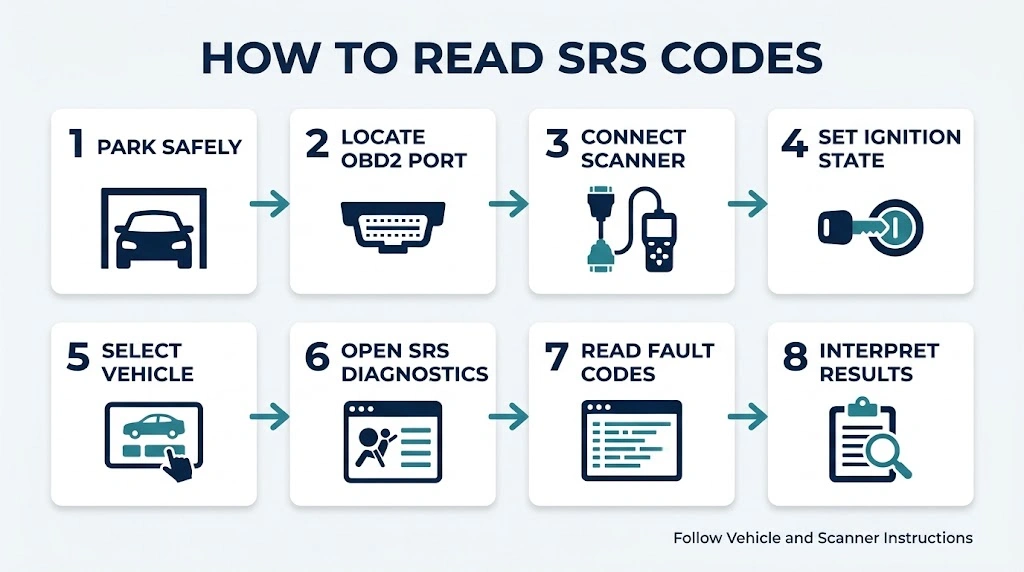
Reading diagnostic codes is usually straightforward when the scanner supports the vehicle. However, the connection sequence and menu names can differ.
- Park safely: Stop on a level surface, secure the vehicle, and follow the scanner’s preparation instructions.
- Locate the diagnostic connector: Find the vehicle’s OBD2 port, commonly located beneath the dashboard.
- Connect the scanner: Insert the diagnostic plug securely without forcing it.
- Set the required ignition state: Many tools request ignition ON with the engine OFF. Follow the scanner and vehicle instructions.
- Select the vehicle: Enter the make, model, year, and other requested information.
- Open SRS diagnostics: Select Airbag, SRS, Restraints, or the appropriate control module.
- Read fault information: Save the full code numbers, descriptions, and available fault status details.
- Interpret the results: Compare the findings with the vehicle manufacturer’s service information before deciding what needs repair.
If you need help with basic scanner connection and navigation, see our step-by-step guide to using an OBD2 scanner.
Reading codes is a diagnostic starting point. It does not require dismantling airbag components or carrying out electrical tests on restraint-system wiring.
What SRS Problems Can a Scanner Help Identify?
An SRS scanner can identify fault information associated with several monitored restraint-system components. However, a code generally indicates a circuit or system problem, not necessarily one defective part.
Airbag Circuit Faults
The SRS controller monitors electrical conditions associated with airbag deployment circuits.
A relevant fault code may identify a monitored circuit experiencing an abnormal condition. The underlying cause could involve the circuit, its connections, or associated components.
Replacing an airbag solely because its circuit appears in a trouble-code description can lead to unnecessary repairs.
Seat Belt Pretensioner Faults
Many vehicles include pretensioners that work with the restraint system during certain collisions.
Diagnostic information may indicate a problem in a pretensioner circuit. Determining the actual cause requires the vehicle’s service documentation and appropriate safety procedures.
Occupant Detection System Problems
Some vehicles use passenger occupant-classification components to help determine airbag operation.
A compatible scanner may identify related stored faults, but not every tool can perform the calibration or initialization procedures required after particular repairs.
Sensor and Communication Faults
SRS diagnostic codes may also relate to monitored crash sensors, control-module communication, or electrical supply conditions.
These faults require careful interpretation because multiple underlying problems can produce similar symptoms.
Safety Warning
Airbags and seat belt pretensioners contain components designed to activate rapidly during a crash. Do not probe deployment circuits, disconnect airbag components, substitute resistors, or attempt repairs without the vehicle manufacturer’s safety procedures and suitable qualifications.
The National Highway Traffic Safety Administration’s airbag safety guidance explains the protective role of airbags and why deployed airbags require authorized replacement.
Why Might an SRS Scanner Show No Codes?
A scanner displaying no faults does not necessarily prove that the restraint system is operating correctly.
Possible explanations include:
- The tool is scanning the engine module instead of the airbag controller.
- The scanner does not support the vehicle’s SRS system.
- The selected vehicle profile is incorrect.
- The diagnostic software requires an applicable update.
- The airbag module has a power, ground, or communication problem.
- The tool cannot display the relevant historical or manufacturer-specific information.
Start by confirming that the correct SRS diagnostic menu and vehicle profile have been selected.
If a properly configured and verified compatible tool still cannot communicate with the module, further professional diagnosis may be needed.
Do not assume the airbag control module has failed simply because one scanner cannot establish communication.
Can an OBD2 Scanner Reset the SRS Warning Light?
Yes, some SRS-capable scanners can erase supported airbag diagnostic codes. However, clearing fault memory does not repair the underlying problem.
If the issue remains active, the warning light may stay illuminated or return when the control module detects the fault again.
In other circumstances, certain collision-related information, configuration requirements, or module faults may not be resolved through an ordinary code-clearing function.
The correct sequence is to save the original diagnostic information, identify the problem, complete the appropriate repair, and verify system operation using the manufacturer’s procedure.
Clearing codes before documenting them can also remove information that would have helped diagnose an intermittent fault.
When Is a Professional SRS Diagnostic Necessary?

Professional evaluation is appropriate when a restraint-system fault involves component replacement, post-collision repair, communication failures, or a procedure requiring specialized equipment.
It is particularly important when the airbag warning light remains illuminated, the vehicle has been involved in a collision, or repairs involve deployment components and occupant-detection systems.
Airbag control-module programming, component initialization, and calibration may require vehicle-specific manufacturer tools or approved service procedures.
A scanner that reads SRS trouble codes is not automatically qualified to perform those operations.
For a related comparison of safety-system diagnostics, our guide to choosing an OBD2 scanner for ABS explains the different capabilities needed for brake-system diagnosis.
How Much SRS Scanner Capability Do You Actually Need?
The appropriate diagnostic tool depends on the work you intend to perform.
| Your Situation | Capability to Prioritize |
|---|---|
| Investigating an airbag warning light | Compatible SRS code reading |
| Diagnosing several dashboard warning lights | Multi-system diagnostic coverage |
| Investigating an intermittent restraint fault | Stored fault status and supported diagnostic data |
| Replacing or calibrating SRS components | Manufacturer-approved service functions and procedures |
For ordinary code investigation, a compatible SRS reader may be sufficient. Advanced repair work can require capabilities far beyond basic fault-code retrieval.
Related Product
SRS-Capable OBD2 Diagnostic Scanner
A compatible ABS/SRS scanner can help retrieve airbag-system trouble codes. Verify your vehicle’s supported functions before selecting a model.
As an Amazon Associate, we earn from qualifying purchases.
Frequently Asked Questions
Does every car have an SRS diagnostic module?
Modern airbag-equipped vehicles generally use electronic restraint-system control modules, but diagnostic architecture varies by manufacturer and model year. Older vehicles may require specialized tools or connections rather than current OBD2 diagnostic equipment.
Can a Bluetooth OBD2 scanner read airbag codes?
Yes, but only when the adapter, diagnostic application, and vehicle-specific software support SRS module access. A generic Bluetooth adapter paired with a basic engine-code application should not be assumed to read airbag faults.
Are SRS codes the same as engine codes?
No. SRS faults belong to the vehicle’s restraint-system diagnostics. Ordinary engine codes primarily concern powertrain and emissions systems. An SRS fault may use manufacturer-specific identifiers and require enhanced diagnostic access.
Will disconnecting the battery reset an airbag light?
Not reliably. Some restraint-system faults remain stored or return when the controller detects the problem again. Battery disconnection is not a substitute for proper diagnosis and should not be treated as an airbag repair.
Can I drive with the SRS warning light on?
An illuminated SRS warning light indicates that the restraint system requires attention and may not provide its intended protection. Consult the vehicle owner’s manual and arrange prompt qualified diagnosis. After a collision or when the manufacturer advises against driving, follow that instruction.
Can an SRS scanner tell me exactly which airbag to replace?
Not necessarily. A trouble code may identify an affected circuit or system but cannot, by itself, prove that an airbag assembly is defective. Proper diagnosis requires the manufacturer’s fault-finding procedure before any replacement decision.
Conclusion
A good OBD2 scanner for SRS must provide verified access to your vehicle’s airbag control module. The Autel AL629 and MD808 are documented examples, while the older AL619 offers basic SRS diagnostics on supported vehicles.
The most important consideration is not the scanner’s feature count but whether it can perform the exact diagnostic task on your vehicle. Start by confirming compatibility, record the fault information, and use the results to guide proper diagnosis rather than simply erasing the warning light.
Because SRS components are essential to occupant protection, advanced repairs and post-collision procedures should follow manufacturer-approved safety and service instructions.

I’m Alex Rahman, a car enthusiast and automotive writer focused on practical solutions, car tools, and real-world driving advice. I share simple and honest content to help everyday drivers make better decisions.
