What OBD2 Data Is Used for Emissions Testing? Complete Guide
Quick Answer
Emissions testing using the OBD2 (On-Board Diagnostics II) system relies primarily on permanent and readiness monitor status, Diagnostic Trouble Codes (DTCs), and freeze-frame data. Instead of sniffing tailpipe exhaust for most modern light-duty vehicles, state and local inspection programs plug directly into the vehicle’s computer port to verify that internal emission control monitors have successfully run their self-tests and that no active fault codes are triggering the Check Engine Light.
How OBD2 Emissions Testing Replaced Traditional Tailpipe Tests
For decades, vehicle emissions inspections required a probe stuck directly into the exhaust pipe while the car ran on a dynamometer. While effective for older cars, this method became less necessary as engine management computers advanced.
Modern OBD2 systems continuously monitor the efficiency and performance of emission-related components. During an emissions check, testing stations bypass the tailpipe entirely in most jurisdictions, connecting directly to the vehicle’s data link connector (DLC) under the dashboard.
This digital connection queries the Powertrain Control Module (PCM) to read the exact operational status of the emissions architecture. If the computer reports that all systems are functioning properly and no trouble codes are stored, the vehicle passes.
Core OBD2 Data Elements Used During Inspections
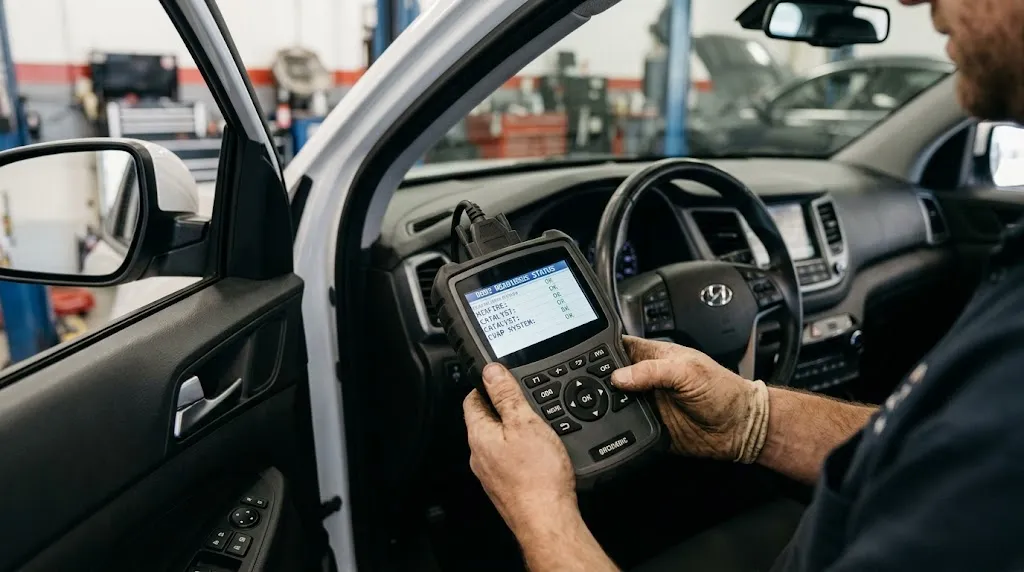
The data pulled during an inspection falls into distinct categories managed by the vehicle’s computer. Each data point serves a specific function in determining whether a vehicle meets environmental standards.
Readiness Monitors
Readiness monitors are internal self-tests performed by the PCM to verify that specific emission control subsystems are operating correctly. There are two primary types of monitors:
- Continuous monitors: These run constantly while the engine is running, tracking misfires, fuel system health, and comprehensive components.
- Non-continuous monitors: These run during specific driving conditions and evaluate hardware like the catalytic converter, oxygen sensors, EVAP (evaporative emission) system, and EGR valve.
For a vehicle to pass inspection, a designated number of these monitors must show a “Ready” or “Complete” status. If a battery has been recently disconnected or codes were cleared, these monitors reset to “Not Ready,” causing an automatic test failure until the vehicle undergoes specific drive cycles.
Diagnostic Trouble Codes (DTCs)
When an emission-related component fails or falls out of calibration, the PCM generates a Diagnostic Trouble Code and illuminates the Malfunction Indicator Lamp (MIL), commonly known as the Check Engine Light. During testing, the OBD2 scan checks for active, stored, or pending DTCs. Any active emission-related code results in an immediate test failure.
Freeze-Frame Data
Freeze-frame data is a snapshot of engine operating conditions at the exact moment a fault code was triggered. While inspectors rarely look at freeze-frame data manually during routine passing tests, advanced diagnostic programs or state referee stations use it to verify when and under what engine load an emission fault occurred.
What Specific Subsystems Are Evaluated?
The OBD2 system tracks several hardware subsystems directly tied to vehicle emissions. The inspection computer queries the status of each individual component monitor:
- Catalytic Converter Monitor: Evaluates how effectively the catalytic converter reduces harmful exhaust gases like nitrogen oxides and carbon monoxide.
- Oxygen (O2) Sensor Monitor: Checks the response time and heater circuit performance of sensors measuring exhaust oxygen levels.
- Evaporative (EVAP) System Monitor: Tests for leaks in the fuel tank, lines, and vapor canister to prevent unburned fuel vapors from escaping into the atmosphere.
- Secondary Air System Monitor: Verifies that fresh air is properly injected into the exhaust stream during cold starts to lower emissions.
Warning
Simply clearing fault codes with an inexpensive OBD2 scanner right before an inspection will not work. Clearing codes resets all readiness monitors to “Not Ready,” which guarantees an inspection failure.
Why “Not Ready” Status Causes Inspection Failures
Many drivers are surprised to fail emissions testing even when their Check Engine Light is off. This happens because internal monitors have not completed their self-testing routine.
To set monitors to a “Ready” state, the vehicle must be driven through a specific sequence of operating conditions known as a drive cycle. This typically involves a mix of cold starts, steady-state highway driving, and deceleration periods. Modern vehicles require varying amounts of mixed city and highway driving over several days to clear all monitor requirements naturally.
Vehicle Age and Inspection Exemptions

The role of OBD2 data in emissions testing varies depending on vehicle age, fuel type, and regional laws:
- Pre-1996 Vehicles: Vehicles built before the OBD2 mandate took effect in the United States generally require traditional tailpipe testing or are exempt entirely due to vintage status.
- 1996 to 2000 Vehicles: These early OBD2 systems require a simpler monitor check, and states frequently allow one or two non-continuous monitors to remain in a “Not Ready” state.
- 2001 and Newer Gasoline Vehicles: These vehicles must show all applicable monitors in a “Ready” state, with zero tolerance for incomplete evaporative monitors in many strict emissions districts.
- Diesel Vehicles: Modern diesel engines use specialized aftertreatment systems like Diesel Particulate Filters (DPF) and Selective Catalytic Reduction (SCR), which are monitored via distinct OBD2 parameters.
Tip
Before driving to an emissions testing facility after a battery replacement or repair, connect a basic code reader or scan tool to verify that all readiness monitors show complete status.
What Happens When the Test Fails?
When an OBD2 emissions test fails, the testing center provides a vehicle inspection report listing the exact cause. Common failure codes include catalytic converter efficiency issues (explore related diagnostic guides on Leadfoot Automotive), oxygen sensor degradation, or small EVAP leaks.
Once repairs are completed, the vehicle must be driven long enough to satisfy the drive cycle requirements for the specific monitors that were reset during repairs before returning for a retest.
Related Product
OBD2 Scanner Code Reader
Check readiness monitor status and read fault codes at home before heading to an official emissions inspection station.
As an Amazon Associate, we earn from qualifying purchases.
Frequently Asked Questions
Can I pass an emissions test with a pending fault code?
In most jurisdictions, a pending code will not automatically fail an inspection if the Check Engine Light is not illuminated and all readiness monitors are complete. However, pending codes often mature into active codes after a few more drive cycles.
How long does it take for readiness monitors to reset after a battery change?
The time required varies significantly by vehicle manufacturer. Some cars set all monitors within 20 minutes of mixed highway and city driving, while others require specific multi-day drive cycles involving cold starts and sustained highway cruising.
Do electric or hybrid vehicles undergo OBD2 emissions testing?
Fully electric vehicles (EVs) have no tailpipe emissions and produce no internal combustion OBD2 emission data, making them exempt from emissions testing in most regions. Hybrids still feature internal combustion engines and may be subject to OBD2 testing depending on local state regulations.
What is a permanent diagnostic trouble code?
Permanent DTCs are specific fault codes stored in non-volatile memory that cannot be cleared by simply disconnecting the battery or using a standard OBD2 scanner. They clear automatically only after the vehicle’s computer runs its internal self-tests several times and confirms the underlying problem is completely resolved.
Why do some states still use tailpipe probes alongside OBD2?
States with severe air quality challenges or areas targeting heavy-duty commercial vehicles sometimes combine OBD2 data checks with tailpipe tests to catch gross emitters that might manipulate electronic sensors or operate older legacy equipment.
Does a blown fuse prevent the emissions station from reading my OBD2 port?
Yes. The diagnostic link connector shares a fuse with other interior electronics, such as the cigarette lighter or auxiliary power outlet. If that fuse blows, the testing station’s computer cannot communicate with your vehicle, resulting in an immediate communication failure.
Conclusion
Understanding what OBD2 data is used for emissions testing helps vehicle owners prepare effectively for inspections. By monitoring readiness monitor status, keeping trouble codes cleared of active faults, and ensuring all electrical systems communicate properly through the diagnostic port, motorists can avoid unexpected test failures and maintain compliant, well-running vehicles.

I’m Alex Rahman, a car enthusiast and automotive writer focused on practical solutions, car tools, and real-world driving advice. I share simple and honest content to help everyday drivers make better decisions.
