What Does OBD2 Stand For? On-Board Diagnostics Explained
Quick Answer
OBD2 stands for On-Board Diagnostics, Second Generation. It is the standardized computer system in vehicles that monitors engine and emissions components, stores diagnostic trouble codes, and provides a common 16-pin port for scanners. Full compliance became mandatory for new gasoline light-duty vehicles in the United States starting with the 1996 model year.
What “Second Generation” Actually Changed
The original OBD systems, often retroactively called OBD-I, began appearing in the early 1980s. They were manufacturer-specific: a scan tool for one brand often would not work on another, and code definitions varied widely.
OBD2 was created to fix that fragmentation. The California Air Resources Board and the U.S. Environmental Protection Agency pushed for a standardized system that could monitor emissions-related components more thoroughly and communicate consistently across all makes and models [citation:6].
The practical result is a uniform diagnostic language. A P0300 code means “random or multiple cylinder misfire” whether the vehicle is a Ford, Honda, or BMW. The connector shape is the same, and the basic communication protocols are shared.
When OBD2 Became Required
Federal OBD2 requirements began with the 1994 model year, but manufacturers could request waivers for 1994 and 1995. Most did. Full compliance without waivers took effect for the 1996 model year on gasoline light-duty vehicles and trucks under 8,500 pounds gross vehicle weight rating [citation:2].
Diesel vehicles followed a slightly different schedule, with full compliance arriving later. Heavy-duty vehicles phased in over subsequent years. For most drivers, the practical rule is simple: if the vehicle is a gasoline car or light truck sold in the U.S. from 1996 onward, it has OBD2.
What the System Monitors and Why
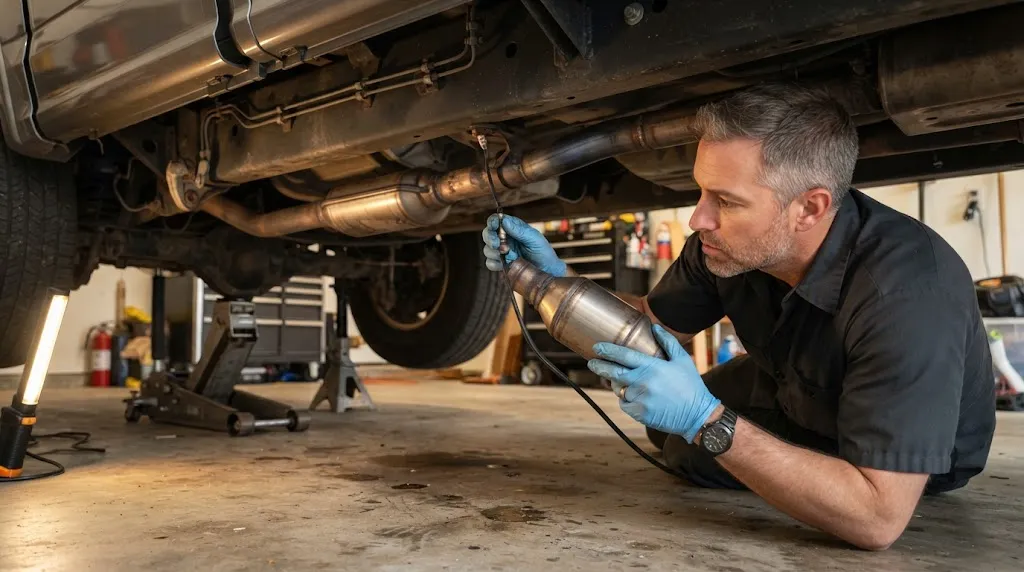
OBD2 is fundamentally an emissions compliance system. It runs a series of computer-controlled tests called monitors on components that affect exhaust emissions. If a monitored system degrades or fails, the powertrain control module stores a diagnostic trouble code and usually illuminates the check engine light.
Continuous monitors run constantly while the engine is operating. These typically include misfire detection, fuel system monitoring, and comprehensive component monitoring. Non-continuous monitors run under specific conditions—often requiring a certain engine temperature, speed, or runtime—and include catalyst efficiency, oxygen sensor response, evaporative emissions system integrity, and EGR flow.
The system’s sensitivity is deliberate. Federal regulations require OBD2 to detect emissions-related faults before tailpipe emissions exceed 1.5 times the applicable standard [citation:6]. That means a relatively small failure, such as a slightly degraded catalytic converter or a pinhole leak in the fuel vapor system, can trigger a code.
Key Insight
A trouble code identifies the system where the fault was detected, not necessarily the failed part. Replacing the component named in a code without testing is a common and expensive mistake. The code is a starting point for diagnosis, not a parts order.
The OBD2 Port and What a Scanner Can See
The standardized 16-pin diagnostic link connector is typically located under the driver’s side of the dashboard, within reach of the steering wheel. This port provides power, ground, and communication lines to the vehicle’s control modules.
A basic OBD2 code reader retrieves P-codes—powertrain codes—that the engine computer has stored when a fault triggers the check engine light. It can also show pending codes (faults detected but not yet confirmed) and freeze-frame data, which is a snapshot of operating conditions at the moment the fault was recorded.
A more capable scanner may access additional modules, but that depends on the tool’s software and the vehicle’s architecture. The physical OBD2 connector does not guarantee access to every computer on the car. Transmission codes, ABS codes, and airbag codes often require enhanced or manufacturer-specific diagnostic capability beyond basic generic OBD2 functions.
How to Read the Code Structure
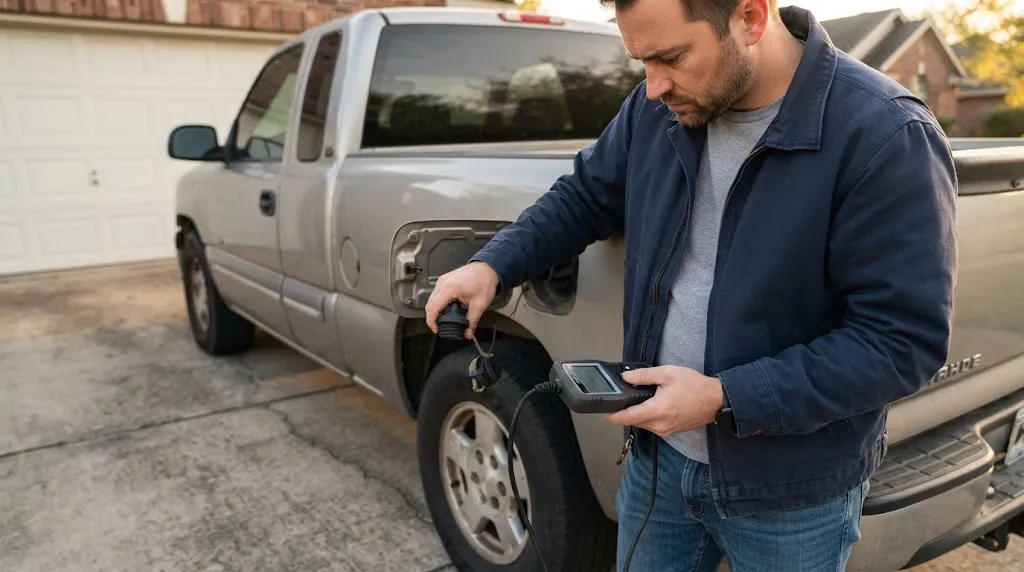
OBD2 trouble codes follow a five-character format. The first character identifies the main system: P for powertrain, B for body, C for chassis, and U for network or communication [citation:1].
The second character distinguishes generic from manufacturer-specific codes. A 0 in the second position indicates a generic code defined by the Society of Automotive Engineers and shared across all manufacturers. A 1 indicates a manufacturer-specific code.
The remaining characters narrow down the specific system and component. For example, P0201 points to an injector circuit malfunction on cylinder 1. P0455 indicates a gross leak in the evaporative emissions system—often, but not always, a loose gas cap.
| Code Prefix | System | What It Typically Covers |
|---|---|---|
| P | Powertrain | Engine, transmission, fuel system, emissions controls |
| B | Body | Airbags, seatbelts, interior electronics (often manufacturer-specific) |
| C | Chassis | ABS, steering, suspension (often manufacturer-specific) |
| U | Network | Communication between control modules |
The P-code range is the one most DIYers encounter because it is the most standardized and most directly tied to the check engine light. B, C, and U codes often require enhanced diagnostic access to retrieve and interpret reliably.
Why OBD2 Matters Beyond the Repair Shop
Many U.S. states use OBD2 checks as part of their vehicle emissions inspection programs. Instead of running a tailpipe sniffer test, inspectors plug into the OBD2 port and verify two things: that the vehicle’s readiness monitors have completed, and that no emissions-related fault codes are stored.
This inspection method is faster and often more accurate than tailpipe testing. The EPA notes that OBD checks can be completed in five minutes or less at centralized stations, and the system is sensitive enough to detect pinhole-sized leaks in the fuel system or gas cap [citation:15].
For drivers, the inspection angle creates a practical incentive to address check engine lights promptly. A vehicle with an active emissions-related code will typically fail an OBD2 inspection, and a vehicle whose battery was recently disconnected may fail because the monitors have not completed their self-tests.
What OBD2 Does Not Do
OBD2 does not diagnose mechanical problems that fall outside its monitored systems. A worn clutch, a failing wheel bearing, or a suspension issue will not set an OBD2 code unless it indirectly affects a monitored emissions or powertrain component.
It also does not replace proper diagnostic testing. A code like P0171 (system too lean) tells you the engine is receiving too much air or too little fuel. It does not tell you whether the cause is a vacuum leak, a dirty mass airflow sensor, a weak fuel pump, or a clogged injector. A technician—or a DIYer with a scan tool and service information—must test the relevant circuits and components to isolate the root cause.
Understanding what OBD2 is and what it is not keeps expectations realistic. It is a monitoring and communication standard, not a crystal ball.
Frequently Asked Questions
Is OBD2 the same thing as a check engine light?
No. The check engine light is the dashboard warning. OBD2 is the system that detects the fault and stores the code that caused the light to come on. You need a scanner plugged into the OBD2 port to retrieve that code.
Can I use any OBD2 scanner on any car?
A basic OBD2 scanner will connect to any compliant vehicle’s port and read generic emissions-related P-codes. However, reading manufacturer-specific codes, transmission codes, ABS codes, or airbag codes often requires a more capable tool with vehicle-specific coverage.
Does OBD2 work on diesel vehicles?
Yes, but the implementation timeline differed. Diesel light-duty vehicles were not fully compliant until later than gasoline vehicles, and the monitored components differ because diesel emissions control systems use different hardware, such as diesel particulate filters and selective catalytic reduction systems.
Why does my car fail inspection if there is no check engine light on?
An inspection can fail if the OBD2 readiness monitors have not completed. This commonly happens after a battery disconnect or a code clear. The vehicle needs to be driven through a specific drive cycle to let the monitors run and report readiness.
Can OBD2 tell me exactly which part to replace?
No. A trouble code identifies the circuit or system where a fault was detected, not the failed component. Proper diagnosis involves testing the circuit and related components according to the manufacturer’s service procedure before replacing parts.
Does clearing a code fix the problem?
No. Clearing a code erases the stored fault information and resets the readiness monitors. If the underlying problem has not been repaired, the code will typically return once the monitor runs again and detects the same condition.
Conclusion
OBD2 is a standardized diagnostic layer that every gasoline car and light truck sold in the U.S. since 1996 carries. It exists primarily to keep emissions systems in check, but its practical value extends to any driver who wants a straight answer about why a warning light is on.
The next time you see a check engine light, remember what the system actually provides: a code that points to a system, not a part. Use that code as a starting point for testing, not as a shopping list. That distinction is the difference between a targeted repair and an expensive guessing game.

I’m Alex Rahman, a car enthusiast and automotive writer focused on practical solutions, car tools, and real-world driving advice. I share simple and honest content to help everyday drivers make better decisions.
