What Does a Stored Fault Code Mean? Explained
Quick Answer
A stored fault code means your vehicle has confirmed a fault and saved it in memory. It is not a guess or a first warning: the system saw the fault meet its test criteria, recorded a diagnostic trouble code, and usually turned on the check engine light. It does not by itself name the failed part or prove the fault is still happening right now.
That distinction matters more than the code number itself. A stored code is a record of a confirmed event, not a live measurement. Note what was stored, check the conditions around it, and test the system it points to, rather than replacing the part named in the description.
What a Stored Code Actually Is

A stored code, often called a confirmed code, is a diagnostic trouble code (DTC) that the powertrain control module has verified and kept in memory. Generic emission-related stored codes are the ones a basic scanner reads through Mode 03, the service that requests stored codes. The code is a five-character label, such as P0300 or P0171, with P for powertrain and the rest narrowing it to a system and fault type.
Think of it as a filed report. The vehicle ran a monitor, a self-test for a system such as misfire detection, fuel trim, the oxygen sensors, or the evaporative system. When the result failed in the way the system requires for confirmation, the computer stored the code and, for most emission-related faults, turned on the check engine light.
The code therefore carries two facts at once: a particular monitor failed, and the failure was strong or repeated enough to move from suspicion to confirmation. That is why a stored code deserves more attention than an early warning, even when the car feels normal.
How a Code Becomes Stored
Most stored codes do not appear on the first sign of trouble. The usual path has three stages, and the middle stage is where many readers get confused.
- First detection. A monitor finds a reading outside its expected range. The computer records a pending code, without turning on the light for most faults.
- Confirmation. On a later trip, under similar conditions, the same fault is found again. The pending code becomes a stored code, and the light is normally turned on.
- Retention. The stored code stays until cleared with a scan tool or erased by the system after enough fault-free operation.
This two-trip pattern is the common case, not a universal rule. Some faults are confirmed on a single trip because they are severe or clear-cut, such as a serious misfire. Other monitors have their own timing, and manufacturer-specific codes can follow different rules.
For the earlier stage, what a pending fault code means explains why a first-trip result is held back. In short: pending says “seen once, not yet confirmed,” while stored says “confirmed under the system’s rules.” That change in status is why the light usually changes with it.
Stored, Pending, Permanent, and History: What Changes
Scanner menus use several status words for different stages or records. Mixing them up leads to wrong decisions, especially before an emissions test.
| Status | What it means | Light usually |
|---|---|---|
| Pending | Fault seen, but not yet confirmed | Off |
| Stored / confirmed | Fault confirmed and saved in memory | On, or was on |
| Current / active | Fault detected at the time of the scan, on some tools | On, if confirmed |
| Permanent | Emissions record that a scan tool cannot erase | Off after clearing, but record remains |
| History | Past fault kept for reference, wording varies by maker and tool | Off |
Read that table as a timeline. Pending comes first, stored is the confirmed step, and permanent is a separate emissions record that can survive a normal clear-codes command until the vehicle’s own monitor passes. History, where a tool uses that word, is closer to a past record than a live fault.
Clearing a stored code does not automatically clear a permanent code, and clearing either one does not repair the fault. A permanent OBD2 code is worth checking separately before an inspection, because the inspection system may still see that record.
Why Scanner Wording Varies
Different scanners label the same stored code in different ways. One tool may show “Stored,” another “Confirmed,” and a third may simply list it under “Trouble Codes” with no status word. Some add “Current” or “Active” when the fault is present during that scan, while others use “History” for a code that is stored but no longer active.
Look for the status column, not just the code list, and check every list your tool shows. A code that appears only under pending is not yet stored. A code under stored has already passed confirmation, even if another menu calls it something slightly different.
A generic scanner reads standard emission codes well, but it may not show every code in transmission, airbag, or body modules. That is a tool limit, not proof no other code exists.
What a Stored Code Does Not Tell You
A stored code narrows the search. It does not finish it. Three limits cause the most wasted parts and misdiagnosis.
It does not name the failed part. An oxygen sensor code can mean the sensor failed, but it can also mean the sensor is correctly reporting a lean or rich condition caused by a vacuum leak, fuel-delivery problem, or exhaust leak. The code points to the circuit that failed its test, not to a single part to replace.
It does not prove the fault is still happening. The fault may still be present, it may be intermittent, or it may have stopped because the condition changed. The light going off does not erase the record immediately, and the record staying does not prove the fault is active now. Why the light can be off while a code is still stored covers that mismatch in detail.
It does not rank severity by itself. A loose fuel cap can store an evaporative-system code, while a misfire code can point to a fault that risks catalyst damage. Severity comes from the code type and the symptoms, not from the fact that a code is stored.
Key Insight
A stored code answers “was this fault confirmed?” It does not answer “which part failed, is it failing now, or how urgent is it?”
How to Read a Stored Code Usefully
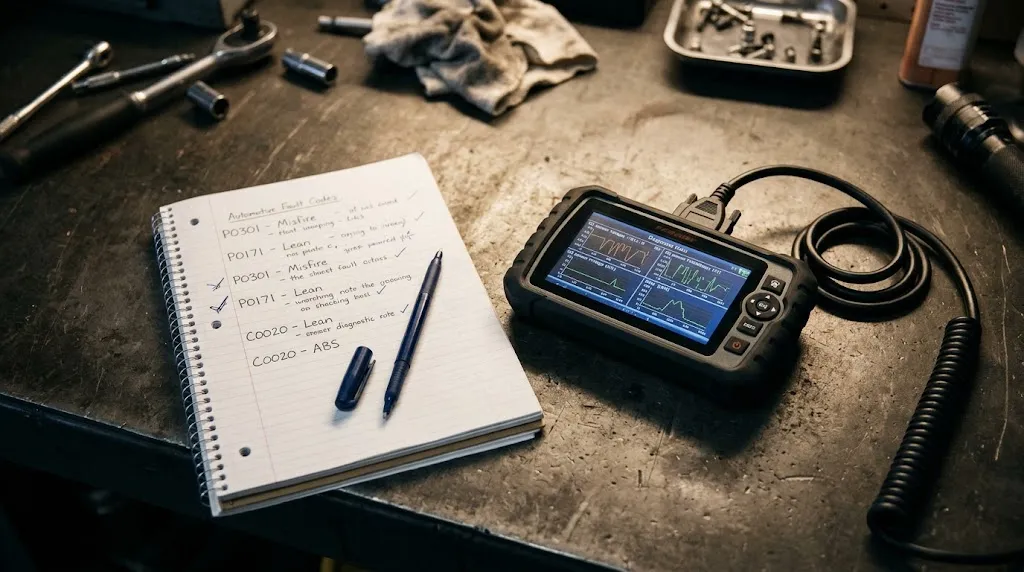
Work through a stored code in this order. Clearing first destroys the evidence you need for the later steps.
- Write down the full code and its status. Note whether it is stored, pending, permanent, or current, and any other codes stored at the same time. Multiple codes often share a cause.
- Read the freeze frame. Freeze frame data is captured when a fault is confirmed, and it shows engine speed, load, coolant temperature, and fuel trim at that moment.
- Match the code to symptoms. Note rough running, poor fuel economy, hard starting, hesitation, or no symptom at all.
- Check simple causes first. For an evaporative code, that can mean the fuel cap. For others, it can mean a loose connector or a condition already fixed but not yet cleared.
- Test before replacing. Use live data, a visual inspection, and system-specific tests for the circuit the code points to.
Take a stored P0171, a lean code for bank 1. It tells you the system ran lean enough to confirm the fault, not whether the cause is unmetered air, low fuel pressure, a faulty mass airflow reading, or a tired oxygen sensor. Freeze frame load and fuel trim, plus vacuum-leak and fuel-pressure checks, narrow that list.
When a Stored Code Needs Urgent Attention
Most stored codes mean “diagnose soon,” not “stop immediately.” A flashing check engine light is the exception: it usually signals a severe misfire that can damage the catalytic converter, so reduce load and stop as soon as it is safe if the car is shaking badly or losing power.
Other red flags are symptoms: a strong fuel smell, overheating, loss of power, stalling, unusual smoke, or an oil-pressure or temperature warning alongside the stored code. In those cases, the symptom matters more than the code. Do not keep driving to finish a scan or see whether the code clears on its own.
When the car feels normal, a stored code still should not be ignored for weeks. It can worsen fuel economy, mask a second fault, or leave the car unready for an inspection. Urgent symptoms mean act now; a steady light with normal driving means diagnose promptly; no symptom means record and check it, not dismiss it.
What Happens to a Stored Code After a Repair
A stored code can leave memory two ways: manually, when a scan tool’s clear-codes command erases it and its freeze frame and turns the light off; or automatically, when the monitor passes on enough consecutive trips and, after a longer fault-free period, the system erases it itself.
Exact counts vary by fault type and manufacturer. As a guide from US OBD requirements, the DieselNet summary of US OBD rules notes that, except for misfire and fuel-system faults, the light can go off after the fault is absent for three driving cycles, while the code itself can remain stored for at least 40 engine warm-up cycles. That gap explains a common surprise: the light is off, yet the code is still there.
Clearing after a repair is reasonable, but clearing before a repair is usually a mistake. It erases freeze frame data and resets readiness monitors. Whether a code will come back after clearing depends on whether the cause was fixed and whether the monitor has had a fair chance to run again.
Warning
Do not clear a stored code just before an emissions test to hide it. Clearing resets readiness monitors, and a permanent record may still be visible. Repair the cause, then let the monitor pass.
Related Product
OBD2 Scanner
A basic OBD2 scanner lets you read stored, pending, and permanent codes and check freeze frame data before you clear anything.
As an Amazon Associate, we earn from qualifying purchases.
Frequently Asked Questions
Does a stored fault code mean the problem is still happening?
Not necessarily. It proves the fault was confirmed when recorded, but not that it is active now. Check live data, symptoms, and whether it returns after clearing and driving under similar conditions.
Is a stored code the same as an active code?
Not exactly. Stored means confirmed and saved, while active or current means detected during that scan. A code can be stored without being active, especially if the fault was intermittent.
Can a stored code be present with the check engine light off?
Yes. The light can go off after enough fault-free trips while the stored code remains longer. That is why a scan can still show a code after the dashboard looks normal.
How long does a stored code stay in memory?
It depends on the fault and vehicle. It can be cleared with a scan tool, or erased automatically after enough fault-free trips and warm-up cycles, often dozens of warm-up cycles for emission-related codes.
Should I clear a stored code before I fix the car?
Usually no. Clearing first erases freeze frame data and resets readiness monitors. Record the code, diagnose, repair, and then clear it.
Will a stored code fail an emissions test?
Not always by itself, because test rules vary. A lit light, incomplete readiness monitors after clearing, or an unverified permanent code can each cause a failure, so check readiness and permanent-code status before testing.
Conclusion
A stored fault code is best read as a confirmed report, not a diagnosis. Use it to find the right system, check the freeze frame and symptoms, and test before replacing anything. Record the code before clearing, repair the cause, and let the monitor confirm the fix.

I’m Alex Rahman, a car enthusiast and automotive writer focused on practical solutions, car tools, and real-world driving advice. I share simple and honest content to help everyday drivers make better decisions.
