What Can OBD2 Detect? Complete Guide to Scanner Capabilities and Limits
Quick Answer
What can OBD2 detect? A standard OBD2 scanner detects many engine and emissions-related problems, including misfires, fuel-system faults, oxygen sensor issues, and catalytic converter efficiency problems. It can also display trouble codes, selected live sensor readings, and emissions readiness status. Advanced scanners can access additional vehicle systems, but coverage varies by model. For a closer look at scanner data, see our guide to OBD2 live data scanners.
Common problems OBD2 can detect
- Engine misfires: Detects monitored combustion irregularities and may identify an affected cylinder.
- Fuel-system faults: Reports fuel-mixture problems and fuel-trim information where supported.
- Sensor problems: Identifies certain oxygen sensor, airflow sensor, and temperature sensor faults.
- Emissions issues: Reports catalyst efficiency and evaporative emissions system faults.
- Transmission-related faults: Retrieves certain emissions-related powertrain codes, with additional coverage on compatible enhanced scanners.
- Brake and airbag faults: Accessible through enhanced scanners that support the vehicle’s ABS and SRS modules.
How to confirm a problem
- Read stored and pending codes before clearing anything.
- Compare freeze-frame and live data with the vehicle’s service specifications.
- Confirm the suspected fault through appropriate physical or electrical testing.
When your check engine light appears, an OBD2 scanner can help explain what your car’s computer has noticed. But knowing what it can detect is just as important as understanding what it cannot.
I’m Alex Rahman, and I approach OBD2 diagnosis by separating diagnostic clues from confirmed mechanical failures. This guide explains what each scanner level can reveal and how to avoid costly assumptions.
What Is OBD2 and How Does It Detect Problems?
OBD2 stands for On-Board Diagnostics, Second Generation. It’s a standardized vehicle diagnostic system primarily designed to monitor emissions-related performance and report detected faults.
In the United States, OBD2 became standard for cars and light-duty trucks beginning with the 1996 model year. Other markets adopted related standards under different schedules.
How the detection process works
- Sensors collect information: Engine sensors measure conditions such as temperature, airflow, speed, and exhaust oxygen content.
- Control modules evaluate data: The engine computer compares operating conditions and diagnostic test results against programmed criteria.
- Diagnostic monitors identify faults: A failed test can generate a diagnostic trouble code, commonly called a DTC.
- Warning lights may activate: Certain confirmed faults trigger the check engine light.
- The scanner retrieves information: A compatible OBD2 reader communicates with the vehicle through its diagnostic connector.
The scanner usually doesn’t detect a malfunction independently. Instead, it retrieves information that the vehicle’s own computers have recorded or made available.
That distinction matters because a code identifies a monitored condition, not necessarily the defective component.
What Engine Problems Can OBD2 Detect?
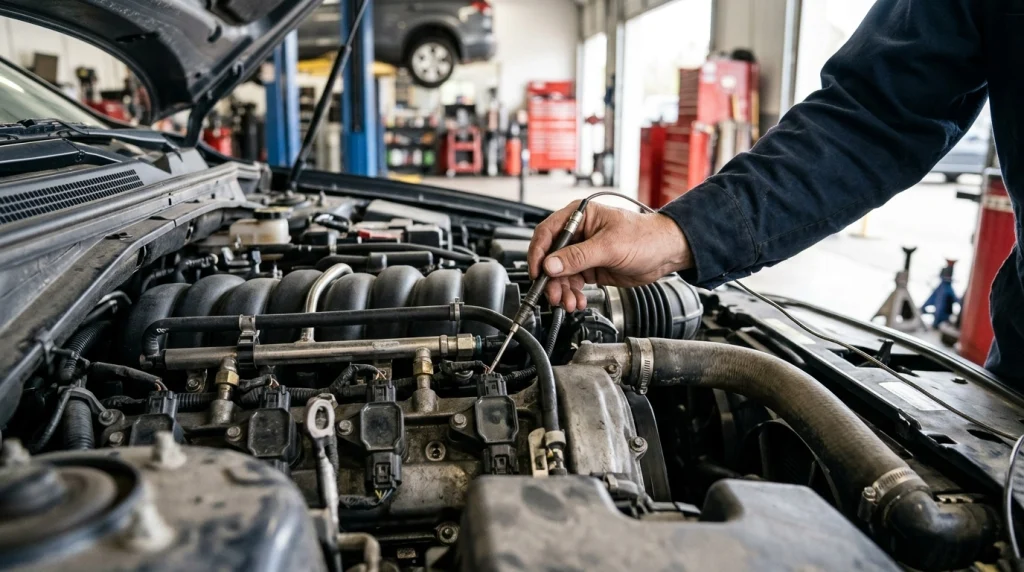
OBD2 can detect many engine problems that affect combustion, fuel control, and emissions. However, detection depends on the vehicle’s monitoring strategy and whether the fault meets the required conditions.
Engine misfires
Misfire monitoring helps identify cylinders that aren’t producing normal combustion events. A scanner may retrieve codes such as P0300 or P0301.
- P0300: Random or multiple-cylinder misfire detected.
- P0301: Cylinder 1 misfire detected.
- P0302: Cylinder 2 misfire detected.
- P0303: Cylinder 3 misfire detected.
These codes don’t automatically prove that a spark plug or ignition coil has failed. Fuel delivery, compression problems, and air leaks can also contribute to misfires.
Safety tip: A flashing check engine light can indicate a severe misfire that risks catalytic converter damage. Reduce load, stop safely, and arrange diagnosis rather than continuing normal driving.
Fuel mixture problems
The engine computer monitors fuel control to keep combustion within its intended operating range. When correction exceeds programmed limits, it may record lean or rich mixture faults.
- P0171: System too lean, Bank 1.
- P0174: System too lean, Bank 2.
- P0172: System too rich, Bank 1.
- P0175: System too rich, Bank 2.
A lean code can result from unmetered air, incorrect airflow measurements, or insufficient fuel delivery. A rich code may involve excess fuel, inaccurate sensor readings, or other control problems.
Cooling system and temperature faults
Some OBD2 systems monitor whether engine coolant reaches expected operating temperatures. For example, P0128 commonly indicates that coolant temperature remains below the thermostat regulating temperature.
Live coolant temperature readings can help investigate a thermostat problem or unexpected engine temperature. However, a scan tool cannot directly measure coolant level or confirm every internal cooling-system failure.
Can OBD2 Detect Sensor Problems?
Yes. OBD2 monitors many sensors involved in emissions and engine management, including oxygen sensors, airflow sensors, and certain temperature sensors.
Some problems generate specific codes, while others require examining live sensor data and comparing it with known operating conditions.
Common sensors monitored through OBD2
- Oxygen sensors: Help the engine computer evaluate exhaust oxygen and fuel control.
- Mass airflow sensor: Measures incoming air on vehicles equipped with this sensor.
- Manifold absolute pressure sensor: Reports intake manifold pressure where equipped.
- Engine coolant temperature sensor: Provides information about engine operating temperature.
- Throttle position sensor: Reports throttle opening or related electronic throttle information.
- Intake air temperature sensor: Measures the temperature of air entering the engine.
For example, a P0101 code indicates a mass airflow circuit range or performance concern. It doesn’t prove the airflow sensor itself needs replacing.
My preferred diagnostic approach is to compare related measurements before selecting a replacement part. A code and one unusual reading rarely tell the whole story.
What Emissions Problems Can an OBD2 Scanner Detect?
OBD2 was developed around emissions monitoring, making this one of its strongest diagnostic areas. It can identify monitored faults involving catalytic converters, oxygen sensors, fuel control, and evaporative emissions systems.
Catalytic converter efficiency
A P0420 code indicates that catalyst system efficiency is below the required threshold on Bank 1. The computer generally determines this through its emissions monitoring strategy.
That code does not guarantee the catalytic converter itself is defective. Exhaust leaks, sensor problems, and combustion faults may affect the diagnosis.
Evaporative emissions leaks
The evaporative emissions system, or EVAP system, helps control fuel vapors. OBD2 may detect certain leaks or purge-flow faults within that system.
- P0442: Small evaporative emissions leak detected.
- P0455: Large evaporative emissions leak detected.
- P0456: Very small evaporative emissions leak detected.
- P0441: Incorrect evaporative emissions purge flow.
A loose fuel cap may cause some EVAP faults, but leaks can also develop in hoses, valves, or other components. Not every vehicle uses the same diagnostic strategy.
For a deeper explanation, read our guide to diagnosing EVAP system leaks with OBD2.
Emissions readiness monitors
An OBD2 scanner can also show whether supported emissions monitors have completed their self-tests. This information is especially useful before an inspection.
According to the Ohio Environmental Protection Agency’s OBD readiness guidance, clearing diagnostic information can return monitors to an incomplete state. A vehicle may then need additional driving before it is ready for inspection.
Can OBD2 Detect Transmission Problems?
Yes, but the scanner’s capabilities determine how much transmission information you can retrieve. Standard OBD2 covers certain emissions-related powertrain faults, while enhanced tools may access dedicated transmission modules.
Some scanners can report transmission-related trouble codes and selected operating information. Vehicle-specific software may provide transmission temperature, shift data, and additional diagnostic functions.
Transmission faults a scanner may reveal
- P0700: Transmission control system malfunction indicator request.
- P0715: Input or turbine speed sensor circuit fault.
- P0720: Output speed sensor circuit fault.
- P0730: Incorrect gear ratio detected.
- P0740: Torque converter clutch circuit fault.
Availability varies, and manufacturer-specific transmission codes may require enhanced access. A scanner also cannot directly confirm worn clutch material, fluid condition, or internal mechanical damage.
Can OBD2 Detect ABS, Airbag, and Brake Problems?
A basic OBD2 code reader generally cannot access dedicated ABS or airbag fault information. An enhanced diagnostic scanner may retrieve these codes if it supports the vehicle’s specific modules.
The OBDLink explanation of standard and enhanced diagnostics identifies ABS, supplemental restraint systems, and tire pressure monitoring as examples of manufacturer-specific diagnostic access.
Enhanced systems may include
- ABS: Anti-lock brake fault codes and selected wheel-speed sensor data.
- SRS: Airbag and seat belt pretensioner system fault information.
- TPMS: Tire pressure monitoring diagnostics on supported vehicles.
- Electronic parking brake: Fault information and selected service operations.
- Body control: Some electrical, lighting, and control-module faults.
Reading a module’s fault codes is different from performing service resets or controlling components. Those operations require additional software support.
Never treat an empty code list from a basic reader as proof that an illuminated ABS or airbag warning is harmless.
What Can OBD2 Detect Through Live Data?
Live data displays information reported by vehicle control modules while the vehicle operates. It helps investigate developing or intermittent problems that a stored code might not fully explain.
Common measurements include engine speed, coolant temperature, fuel trims, throttle position, and oxygen sensor activity. Exact parameter availability varies by vehicle.
Useful live data parameters
- Engine RPM: Helps evaluate idle stability and engine speed changes.
- Short-term fuel trim: Displays immediate fuel correction where supported.
- Long-term fuel trim: Shows learned fuel corrections over time.
- Coolant temperature: Helps investigate warm-up and temperature-control behavior.
- Oxygen sensor data: Provides information about exhaust monitoring and fuel control.
- Throttle position: Helps examine throttle response and related signals.
- Engine load: Reports a calculated representation of engine operating demand.
Consider a hypothetical engine that idles roughly and reports high positive fuel trims at idle. If those corrections decrease significantly at higher engine speed, an intake air leak becomes one possibility worth testing.
That pattern isn’t conclusive by itself. Fuel pressure, airflow measurement, and other conditions must still be considered.
Basic vs. Advanced OBD2 Scanners: What Can Each Detect?
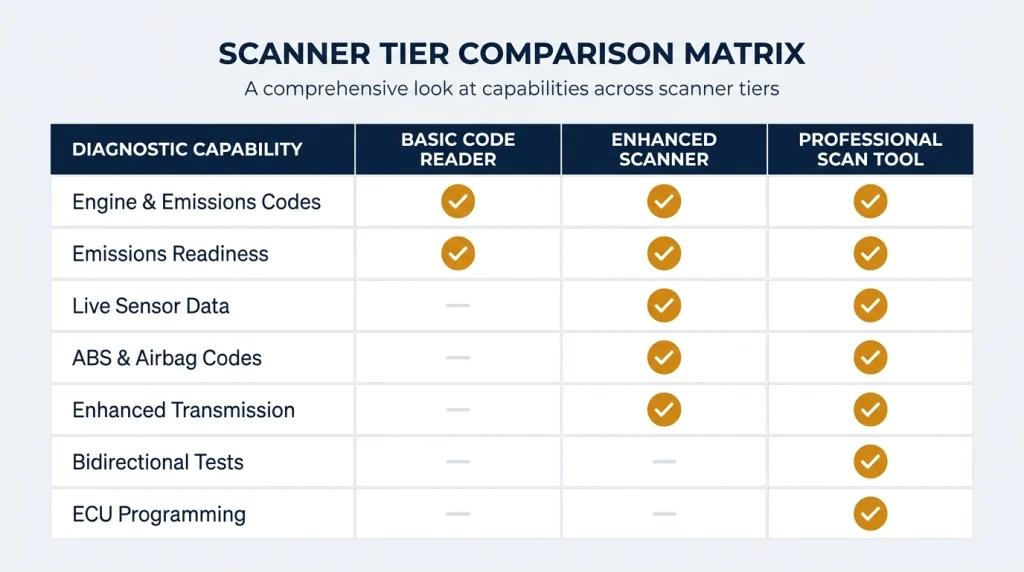
Not every OBD2 scanner provides the same access. A basic reader focuses on standardized emissions diagnostics, while enhanced scanners communicate with additional vehicle modules.
| Diagnostic capability | Basic code reader | Enhanced scanner | Professional scan tool |
|---|---|---|---|
| Engine and emissions codes | Yes | Yes | Yes |
| Emissions readiness | Usually | Usually | Usually |
| Live engine sensor data | Model-dependent | Common | Common |
| ABS and airbag codes | Generally no | Where supported | Broad, not universal |
| Enhanced transmission diagnostics | Generally no | Where supported | Broad, not universal |
| Bidirectional component tests | No | Some models | Common |
| Programming and coding | No | Limited specialized tools | Selected tools and vehicles |
Important: These are general capability categories, not guarantees. Always check the manufacturer’s coverage list for your vehicle’s year, make, model, and required diagnostic function.
Can OBD2 Detect Problems Without a Check Engine Light?
Yes. OBD2 can sometimes reveal a developing emissions-related fault before the check engine light illuminates.
Pending diagnostic trouble codes are especially useful in this situation. They represent detected conditions that may not yet have satisfied the rules for a confirmed fault.
Stored, pending, and permanent codes
- Stored codes: Confirmed fault records that have met the applicable diagnostic criteria.
- Pending codes: Faults detected during relevant monitoring that may not yet be confirmed.
- Permanent codes: Certain emissions-related records that remain until the vehicle completes the required verification conditions.
A useful place to start is our explanation of OBD2 Mode 07 and pending trouble codes. It explains why an early fault can appear without an illuminated warning light.
A scanner may also show unusual live measurements without storing a code. Such readings require careful interpretation because unusual values aren’t always evidence of a malfunction.
What Problems Can OBD2 Not Detect?

OBD2 cannot detect every problem in a vehicle. Its usefulness depends on what the vehicle monitors electronically and which systems the scanner can access.
Many mechanical, structural, and visual defects still require physical inspection.
Common limitations
- Tire tread wear: OBD2 does not directly measure remaining tread depth.
- Brake pad thickness: Ordinary OBD2 cannot measure friction material, although some vehicles have electronic wear sensors.
- Suspension wear: Worn bushings, ball joints, and many shock absorber problems require mechanical inspection.
- Oil condition: Standard OBD2 cannot directly determine oil contamination or remaining lubricant quality.
- Physical fluid leaks: Many coolant, oil, and transmission fluid leaks cannot be identified directly.
- Body damage: Rust, collision repairs, and structural defects aren’t revealed by ordinary OBD2 diagnostics.
- Internal engine wear: Compression loss and worn bearings generally require specialized tests.
A vehicle can also have serious problems without generating a code. Diagnostic monitoring only covers defined conditions and thresholds.
For used vehicles, combine scanner results with a visual inspection, road test, service-history review, and mechanical evaluation. Our used-car OBD2 diagnostic guide explains these limits in more detail.
How Do You Use OBD2 to Identify a Car Problem?
Start with a complete diagnostic scan and preserve the results. Then use codes, live data, service information, and appropriate testing to narrow down the cause.
Step-by-step diagnostic process
- Park safely: Turn off the engine, apply the parking brake, and locate the diagnostic connector.
- Connect the scanner: Plug the compatible scan tool into the vehicle’s OBD2 port without forcing it.
- Switch on the ignition: Follow the scanner’s instructions to establish communication.
- Read all available codes: Record stored, pending, and permanent emissions-related codes where supported.
- Check freeze-frame information: Review the recorded conditions associated with the relevant fault.
- Inspect live data: Compare supported sensor readings against manufacturer specifications and expected operating behavior.
- Perform confirmation tests: Check the relevant wiring, components, mechanical systems, or operating conditions.
- Verify the repair: Confirm that symptoms have improved and required diagnostic monitors complete successfully.
Don’t erase fault codes merely to switch off a warning light. Clearing codes can remove valuable diagnostic information and reset emissions readiness monitors.
For information about vehicle diagnostics and emissions, consult the U.S. Environmental Protection Agency and your vehicle manufacturer’s service documentation.
How Accurate Is an OBD2 Scanner?
An OBD2 scanner can accurately retrieve diagnostic information that the vehicle makes available through supported protocols. However, a correctly retrieved fault code doesn’t guarantee a correct diagnosis.
Imagine a scanner displays P0171, indicating a lean condition on Bank 1. Replacing an oxygen sensor immediately could waste money if the underlying problem is an intake leak.
Factors that affect diagnostic reliability
- Vehicle compatibility: The tool must support the vehicle’s diagnostic protocol and requested functions.
- Monitoring conditions: Some tests only run at specific temperatures, speeds, or engine loads.
- Scanner capabilities: Basic readers cannot access every manufacturer-specific diagnostic module.
- Data interpretation: Accurate readings still require proper context and service specifications.
- Intermittent faults: Some problems appear only under particular conditions and may not immediately generate codes.
The best diagnostic method combines electronic evidence with hands-on testing. Treating every fault code as a replacement instruction is one of the easiest ways to overspend.
Which OBD2 Scanner Should You Choose in 2026?
Choose a scanner based on the faults you need to investigate, not simply the number of advertised features. For check engine lights, a dependable basic reader may be enough.
If you need more detailed live data or manufacturer-specific diagnostics, consider a compatible enhanced tool. Here are three models worth comparing.
💰 Best budget option
ANCEL AD310 OBD2 Scanner
★★★★☆ 4.2/5 editorial assessment
This wired handheld reader supports standard trouble-code retrieval, live data, freeze-frame information, and readiness checks. I’d shortlist it for occasional check engine light diagnosis because it doesn’t require a phone or separate app.
📱 Best phone-based diagnostics
BlueDriver Bluetooth Pro OBD2 Scanner
★★★★☆ 4.4/5 editorial assessment
BlueDriver connects to a compatible smartphone and provides code information, live data, and supported enhanced diagnostic functions. I’d consider it for owners who prefer reviewing diagnostic results on their phone rather than a small scanner screen.
🏆 Best for advanced enthusiasts
OBDLink MX+ Bluetooth Scanner
★★★★☆ 4.6/5 editorial assessment
OBDLink MX+ supports generic OBD2 diagnostics and enhanced manufacturer-specific functions on compatible vehicles. I’d prioritize it for enthusiasts who want configurable live-data dashboards and broader app compatibility.
Disclosure: As an Amazon Associate, we may earn from qualifying purchases. Editorial scores reflect feature-based assessments, not verified customer review averages. Check vehicle compatibility and current product specifications before purchasing.
Frequently Asked Questions
Can OBD2 detect all car problems?
No. Standard OBD2 primarily monitors emissions-related engine and powertrain conditions. Enhanced scanners may access additional electronic systems, but mechanical wear, fluid leaks, structural damage, and many other faults still require physical inspection or specialized testing.
Can an OBD2 scanner detect a bad battery?
Some scanners display vehicle electrical-system voltage or retrieve charging-related fault codes. However, voltage alone cannot reliably determine battery health, cold-cranking performance, or remaining capacity. A dedicated battery tester provides more appropriate information for evaluating battery condition.
Can OBD2 detect a bad fuel injector?
OBD2 may reveal misfire codes, fuel-trim abnormalities, or injector circuit faults that suggest an injector problem. It cannot always distinguish a clogged injector from ignition, compression, or fuel-pressure issues. Additional testing is necessary to confirm the actual cause.
Can OBD2 detect transmission slipping?
Sometimes. Certain vehicles monitor gear ratios and transmission performance closely enough to record related fault codes. However, slipping may occur without a code, and generic scanners cannot access every transmission module. Mechanical inspection and suitable transmission diagnostics may still be required.
Can OBD2 detect problems before the check engine light comes on?
Yes. Pending fault codes, live sensor readings, and some onboard test results may reveal developing problems before a warning light appears. However, not every fault creates an early diagnostic record, so a clean scan cannot guarantee that a vehicle is problem-free.
Final Takeaway: What Can OBD2 Really Tell You?
OBD2 is one of the most useful starting points for diagnosing modern vehicle problems. It can reveal engine and emissions faults, report diagnostic codes, display supported sensor information, and help evaluate repair results.
Its limits are equally important. An advanced scanner can provide deeper access, but no scanner replaces proper testing and mechanical inspection.
Start with the fault codes, review the supporting data, and confirm the underlying cause before buying parts. That’s how an OBD2 scanner becomes a practical diagnostic tool instead of an expensive guessing device.

I’m Alex Rahman, a car enthusiast and automotive writer focused on practical solutions, car tools, and real-world driving advice. I share simple and honest content to help everyday drivers make better decisions.
