Should You Use an OBD2 Scanner Before Buying a Used Car?
Quick Answer
Yes. Using an OBD2 scanner when buying a used car is a smart preliminary check because it can reveal stored or pending diagnostic trouble codes and incomplete readiness monitors. However, a clean scan does not guarantee a mechanically sound vehicle. Combine the scan with a road test, vehicle-history checks, and an independent pre-purchase inspection.
Buying a used car involves more than checking its appearance, mileage, and how smoothly it drives. Some engine and emissions problems may not be obvious during a short test drive, especially if a warning light is temporarily off.
An OBD2 scanner gives you another source of information before you commit to the purchase. It reads diagnostic information available from the vehicle’s onboard computer, helping you identify issues that deserve further investigation.
Why Should You Scan a Used Car Before Buying It?
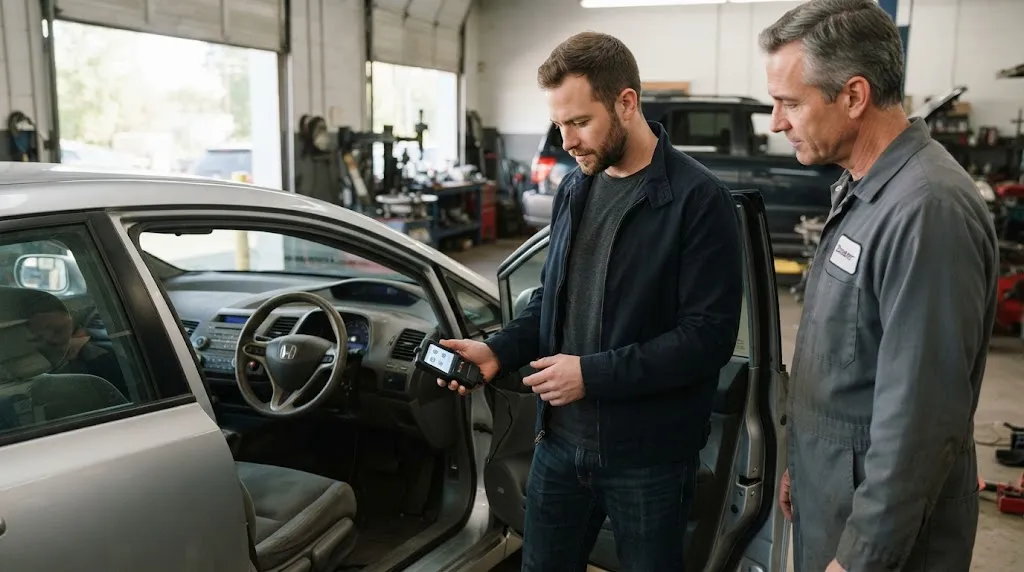
You should scan a used car before buying it because the results can reveal electronic faults that are not immediately apparent from the dashboard or a visual inspection. A scanner can also show whether supported emissions readiness tests have been completed.
These findings help you decide whether to proceed, request additional diagnostics, negotiate based on documented repairs, or walk away.
A pre-purchase scan is particularly useful when:
- The seller says the car has no mechanical problems, but you want supporting evidence.
- The check engine light is off, yet the engine runs roughly or hesitates.
- You are considering an older, high-mileage vehicle with limited service records.
- You want to check for stored or pending faults before arranging a professional inspection.
- You need to identify questions to ask about recent repairs or a battery replacement.
The main benefit is better information before payment. The scanner does not determine whether a car is worth buying on its own, but it can help you avoid relying entirely on appearances or the seller’s assurances.
What Can an OBD2 Scanner Tell You About a Used Car?
An OBD2 scanner can retrieve supported diagnostic trouble codes, display emissions readiness information, and, depending on the tool and vehicle, provide freeze-frame data and live sensor readings. The information available varies by vehicle and scanner capability.
Stored and pending trouble codes
Stored diagnostic trouble codes indicate that the vehicle’s computer has recorded a fault according to its monitoring criteria. Pending codes can indicate a problem detected during an initial or incomplete monitoring process that has not yet met the conditions for confirmation.
For a used-car buyer, both deserve attention. A pending emissions-related code may reveal a developing issue even when the dashboard warning light is not illuminated.
For example, a scanner might display a code associated with an oxygen sensor or an engine misfire. That code identifies a condition the system detected; it does not automatically prove which component needs replacement. Wiring, connectors, fuel delivery, ignition components, or other underlying problems may require investigation.
Readiness monitors
Readiness monitors indicate whether supported onboard emissions self-tests have completed. If several monitors are incomplete, the vehicle’s diagnostic picture may be unfinished.
This matters because clearing certain diagnostic codes or disconnecting the battery can reset readiness information. The monitors then need appropriate operating conditions to complete their tests again.
Incomplete monitors do not prove that a seller concealed a defect. A recent battery replacement, repairs, limited driving, or vehicle-specific operating conditions can explain the result. Ask questions and investigate the context before making a decision.
Freeze-frame data and live readings
When supported, freeze-frame data records selected operating conditions associated with a detected fault. Live data can show information such as engine coolant temperature, engine speed, and supported fuel or sensor readings.
These details can help a technician reproduce or investigate a problem. However, a single reading is not necessarily evidence of a failed part. Values must be interpreted according to the vehicle’s specifications and operating conditions.
Additional vehicle systems
A basic OBD2 reader usually focuses on standard emissions-related diagnostics. More capable scanners may access additional modules, including supported transmission, anti-lock braking system (ABS), and supplemental restraint system (SRS) diagnostics.
Do not assume that a device can check every system simply because it is advertised as an OBD2 scanner. Verify coverage for the exact make, model, year, and powertrain. If airbag, ABS, or transmission faults are a concern, use a scanner with the appropriate system coverage or arrange professional diagnostics.
How to Use an OBD2 Scanner When Inspecting a Used Car
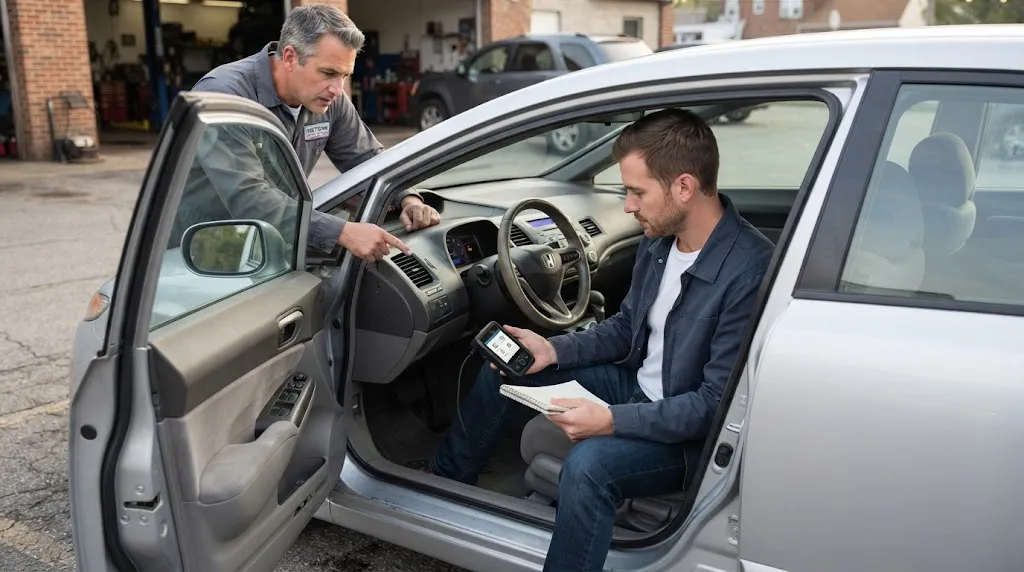
Follow a consistent process so you can interpret the scan alongside the vehicle’s condition, service history, and road-test behavior.
- Get the seller’s permission. Explain that you want to read diagnostic information before buying. Use a compatible scanner and follow its instructions and the vehicle manufacturer’s guidance.
- Check the dashboard warning lights. Switch the ignition on as appropriate and observe the warning-light self-check. Confirm that relevant lights illuminate during the check and behave normally after starting, according to the owner’s manual.
- Connect the scanner. Locate the diagnostic connector, commonly under the dashboard. Follow the scanner instructions and select the correct vehicle information when prompted.
- Read and save the initial results. Record available stored, pending, and permanent emissions-related codes, readiness status, freeze-frame information, and any other supported diagnostic data. Do not clear codes before documenting them.
- Review incomplete monitors. Ask whether the battery was recently disconnected, the vehicle was repaired, or diagnostic codes were cleared. Treat unexplained incomplete readiness as a reason for further investigation rather than proof of dishonesty.
- Inspect and test-drive the vehicle. If the seller permits it and the car is safe to drive, assess starting, idle quality, acceleration, braking, steering, transmission behavior, and unusual noises. Do not continue driving if a serious warning or unsafe condition appears.
- Scan again when appropriate. A post-drive scan may reveal a new pending code or a change in diagnostic status. Some faults require specific operating conditions or more than one drive cycle to appear, so a short drive cannot rule out every intermittent problem.
- Investigate concerning findings. Look up the exact code for the vehicle and have a qualified mechanic assess important or unexplained results before agreeing to purchase.
Practical Tip
Save the original scan report before anyone clears codes or resets the vehicle. Keeping the initial results makes it easier to discuss faults with a mechanic and compare them with a later scan.
Can an OBD2 Scanner Reveal If Codes Were Recently Cleared?
An OBD2 scanner can sometimes provide clues that diagnostic codes were recently cleared, but it generally cannot prove exactly when or why this happened.
Several incomplete readiness monitors may indicate that the vehicle has not completed its required self-tests since a reset. Some vehicles and scanners also support information about distance or time since codes were cleared.
Interpret these clues carefully. A battery replacement, legitimate repair, or insufficient driving can also produce incomplete monitors. Not every vehicle supports the same data, and a basic reader may not display it.
Ask the seller about recent maintenance and compare the explanation with available service records. If important monitors remain incomplete and the reason is unclear, consider postponing the purchase until the vehicle has been driven under suitable conditions and scanned again.
Warning
Do not clear diagnostic codes just to make a used car appear fault-free. Clearing codes does not repair the underlying problem and can erase useful diagnostic evidence or reset readiness information.
What Does a Clean OBD2 Scan Actually Mean?
A clean scan means the scanner did not report certain faults within the systems and data it could access at that time. It does not mean the vehicle has no problems.
Some faults are intermittent, have not yet met the conditions needed to trigger a code, or are outside the scanner’s coverage. Mechanical wear and damage may not generate any diagnostic code at all.
A clean engine scan cannot establish that the following components or conditions are healthy:
- Engine and transmission: Internal wear, fluid problems, or mechanical damage may require additional testing.
- Brakes and tires: Pad wear, tire damage, uneven wear, and other defects require physical inspection.
- Suspension and steering: Worn joints, damaged bushings, and steering problems may not produce an engine code.
- Body and chassis: Rust, poor accident repairs, flood damage, and structural defects need visual and physical assessment.
- Electrical equipment: Some electrical faults require circuit testing or access to specific control modules.
Also check that the dashboard warning lights behave normally. A missing warning light is not conclusive evidence that the related system is functioning correctly.
Should You Buy a Used Car If the Scanner Finds a Code?
Not necessarily. A trouble code is a reason to investigate, not an automatic reason to reject the vehicle. The decision depends on the fault, its likely cause, the cost and availability of repairs, and whether the seller allows proper verification.
- If the code is minor and understood: Obtain a reliable diagnosis and repair estimate, then decide whether the asking price reflects the vehicle’s condition.
- If the code points to a potentially expensive problem: Arrange specialist diagnostics before committing. Do not assume the cheapest possible cause is the correct one.
- If the code returns after a test drive: Treat recurrence as important evidence and investigate the cause before purchasing.
- If the scan is inconclusive: Ask for a professional inspection instead of treating uncertainty as reassurance.
- If the seller refuses reasonable independent testing: Consider walking away and looking for a vehicle that can be inspected properly.
For additional consumer guidance, the Federal Trade Commission’s used-car buying guide explains why an independent mechanical inspection remains valuable even when a dealer has inspected or certified a vehicle.
Do You Still Need a Professional Pre-Purchase Inspection?
Yes. An independent pre-purchase inspection is advisable even when the OBD2 scan shows no obvious problems. A scanner and a mechanical inspection answer different questions, so using both gives you a more complete assessment.
A qualified mechanic can examine the vehicle’s mechanical condition, inspect for leaks and structural damage, evaluate braking and suspension components, and perform additional diagnostic tests where needed.
The FTC’s guidance on buying a used car recommends an independent inspection and notes that a vehicle-history report is not a substitute for checking the vehicle itself. Request a written report that identifies concerns and estimates necessary repairs.
Before the inspection, provide the mechanic with any scan results, warning-light observations, service records, and symptoms noticed during the road test. This helps focus the investigation on specific concerns without overlooking the rest of the vehicle.
If you are shopping for a scanner, a compatible device that reads standard trouble codes and displays readiness monitors is a useful starting point. Additional features are worthwhile only if they support the systems and information you need to check.
Related Product
OBD2 Scanner for Used-Car Inspections
Look for a scanner that supports your vehicle and can read trouble codes and readiness monitors. Confirm any additional system coverage before relying on it for a pre-purchase inspection.
As an Amazon Associate, we earn from qualifying purchases.
Frequently Asked Questions
1. Is it worth bringing an OBD2 scanner when buying a used car?
Yes. It can reveal supported diagnostic trouble codes and incomplete readiness monitors, helping you identify concerns before purchase. Use it alongside a test drive and an independent mechanical inspection.
2. Can a basic OBD2 scanner check the entire car?
No. Basic readers generally focus on standard emissions-related diagnostics. Checking ABS, airbag, transmission, and other modules requires a scanner with the appropriate vehicle-specific coverage.
3. Does a car with no check engine light have no problems?
No. Some faults do not trigger the light immediately, some problems are outside the monitored systems, and mechanical defects may not generate codes. A dark dashboard is not proof of a healthy vehicle.
4. What if the readiness monitors show not ready?
Ask about recent repairs, battery disconnection, or code clearing. Incomplete monitors mean certain self-tests have not finished; they do not automatically prove that a fault was concealed. Consider a later scan after appropriate driving conditions.
5. Can an OBD2 scanner tell me exactly what part is faulty?
Usually not. A diagnostic code identifies a detected condition or system concern, but the underlying cause may involve a component, wiring, connections, or another problem. Further testing is often needed to confirm the repair.
6. Should I pay for a mechanic if my scanner finds no codes?
Yes. A clean scan cannot assess every mechanical, structural, or safety-related condition. An independent pre-purchase inspection can identify problems that electronic diagnostics alone may miss.
Conclusion
You should use an OBD2 scanner when buying a used car because it provides useful diagnostic information before you commit to the purchase. Check stored and pending codes, review readiness monitors, preserve the original results, and investigate anything unexplained.
Most importantly, do not let a clean scan replace a proper inspection. Combining electronic diagnostics with a road test, service-history checks, and an independent mechanic’s assessment gives you a stronger basis for deciding whether the car is worth buying.

I’m Alex Rahman, a car enthusiast and automotive writer focused on practical solutions, car tools, and real-world driving advice. I share simple and honest content to help everyday drivers make better decisions.
