What Is the Most Common OBD2 Code? P0420 Explained
Quick Answer
P0420, meaning “Catalyst System Efficiency Below Threshold (Bank 1),” is one of the most common OBD2 trouble codes. CarMD identified P0420 as the most common diagnostic trouble code in its historical vehicle data. However, rankings vary by vehicle, year, and dataset. The code indicates that your engine computer has detected poor catalytic converter efficiency, but it does not automatically mean the converter needs replacement. Start by diagnosing the check engine light with an OBD2 scanner.
Other Frequently Encountered OBD2 Codes
- P0420 – Catalyst efficiency: The Bank 1 catalytic converter system isn’t meeting the expected efficiency threshold.
- P0300 – Random misfire: The computer detects misfires across one or more cylinders.
- P0171 – Lean mixture: The Bank 1 fuel system is running too lean.
- P0455 – Large EVAP leak: The evaporative emissions system has detected a large leak.
- P0442 – Small EVAP leak: A smaller leak has been detected in the fuel vapor system.
- P0128 – Coolant temperature: The engine isn’t reaching its expected operating temperature quickly enough.
What Should You Do First?
- Read the codes: Connect a compatible OBD2 scanner and record every stored or pending code.
- Check the symptoms: Look for misfires, poor acceleration, unusual smells, or reduced fuel economy.
- Confirm the cause: Check related components before replacing expensive parts or erasing codes.
If you’ve connected an OBD2 scanner and found P0420, you’re looking at a fault code that has appeared frequently in large vehicle datasets. But knowing the code’s popularity won’t tell you which component is failing on your car.
I’m going to explain why P0420 is so common, how it compares with other trouble codes, and which checks make sense before spending money. You’ll also learn when you can continue driving and when the warning needs immediate attention.
What Is the Most Common OBD2 Trouble Code?
P0420 is a strong historical candidate for the most common generic OBD2 code. It identifies a catalyst efficiency problem on Bank 1 of the engine.
CarMD’s historical Vehicle Health Index reports identified P0420 as the most frequently encountered diagnostic trouble code. That finding gives us a useful reference, although it shouldn’t be treated as a universal ranking for every vehicle in 2026.
The CarMD Vehicle Health Index also tracks common check engine repairs and vehicle health trends.
Why Does P0420 Appear So Often?
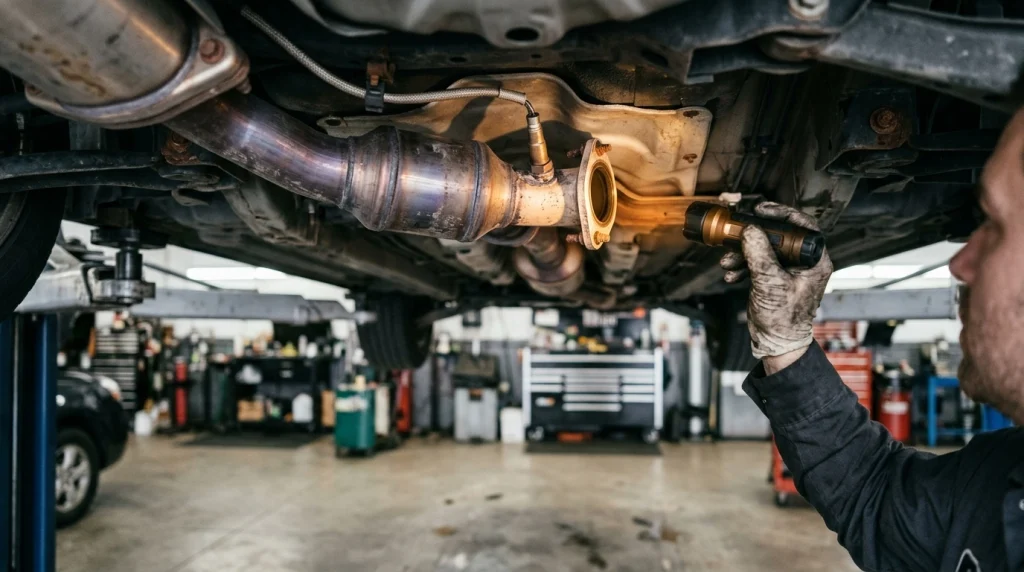
A catalytic converter processes harmful exhaust gases through chemical reactions. Your vehicle monitors its performance using exhaust oxygen sensor readings and other operating information.
Over time, the converter’s efficiency can decline. Engine problems, exhaust leaks, and incorrect sensor readings can also trigger the same code.
- Converter deterioration: The catalyst becomes less effective after age, mileage, or contamination.
- Exhaust leaks: Leaks can introduce extra oxygen and distort sensor readings.
- Oxygen sensor problems: Incorrect or sluggish sensor signals can affect the catalyst monitor.
- Engine misfires: Unburned fuel can overheat and damage the converter.
- Air-fuel problems: A rich or lean engine condition may interfere with catalyst operation.
Here’s the important distinction: P0420 describes a failed efficiency test, not a confirmed failed catalytic converter. The correct repair depends on the underlying cause.
What Does OBD2 Code P0420 Actually Mean?
P0420 stands for Catalyst System Efficiency Below Threshold (Bank 1). Your engine computer determined that the monitored catalytic converter isn’t performing within its expected limits.
Bank 1 refers to the side of the engine containing cylinder number one. On most inline engines, there’s only one cylinder bank.
How Does the Car Detect P0420?
The engine control module monitors exhaust system behavior under specific operating conditions. It uses signals from oxygen or air-fuel sensors to evaluate catalyst performance.
When those signals indicate insufficient conversion efficiency, the computer may record P0420. The exact monitor strategy depends on the manufacturer and vehicle model.
- The engine reaches the conditions required for catalyst monitoring.
- The computer evaluates sensor behavior before and after the converter.
- The catalyst monitor estimates whether efficiency meets its programmed threshold.
- If the failure meets the required criteria, P0420 becomes a confirmed trouble code.
- The check engine light may illuminate to alert the driver.
A code alone can’t reveal whether the issue comes from the converter, its sensors, or another engine problem. That’s why the next diagnostic step matters.
What Are the 10 Most Common OBD2 Codes?
Several generic powertrain codes regularly appear in diagnostic guides and automotive repair discussions. The table below compares ten familiar examples.
This is a practical reference list, not a statistically ranked top ten. The actual frequency depends on the vehicles and reporting period being studied.
| Code | Meaning | Possible Causes | Priority |
|---|---|---|---|
| P0420 | Catalyst efficiency below threshold, Bank 1 | Converter, exhaust leak, sensor, engine issue | Diagnose soon |
| P0300 | Random/multiple cylinder misfire | Spark plugs, coils, fuel, compression | High urgency if active |
| P0171 | System too lean, Bank 1 | Vacuum leak, fuel supply, airflow sensor | Diagnose soon |
| P0174 | System too lean, Bank 2 | Air leak, low fuel pressure, sensor issue | Diagnose soon |
| P0442 | Small EVAP system leak | Fuel cap, hose, vapor system leak | Schedule diagnosis |
| P0455 | Large EVAP system leak | Loose cap, disconnected hose, valve problem | Schedule diagnosis |
| P0128 | Coolant temperature below thermostat regulating temperature | Thermostat, sensor, cooling issue | Diagnose soon |
| P0135 | Oxygen sensor heater circuit, Bank 1 Sensor 1 | Heater, wiring, fuse | Diagnose soon |
| P0430 | Catalyst efficiency below threshold, Bank 2 | Converter, exhaust leak, engine issue | Diagnose soon |
| P0401 | Insufficient EGR flow | EGR restriction, valve, control problem | Schedule diagnosis |
Notice how different codes can point toward related engine systems. A misfire or fuel mixture problem may also affect catalyst performance.
I would always review all stored codes together before choosing a repair. Focusing on P0420 alone can hide the original problem.
What Is the Difference Between P0420, P0300, and P0171?
These three codes describe different problems: catalyst efficiency, engine misfires, and a lean fuel mixture. They can also appear together.
P0420: Catalytic Converter Efficiency
P0420 means the catalyst monitor identified inadequate conversion efficiency. Your car may still drive normally, especially during the early stages of the problem.
However, the check engine light can remain illuminated, and an emissions inspection may fail. The converter shouldn’t be replaced without checking related systems.
P0300: Random or Multiple Cylinder Misfire
P0300 means the engine computer detected random or multiple cylinder misfires. You might experience shaking, hesitation, rough idle, or reduced power.
A persistent misfire deserves fast attention because unburned fuel can damage the catalytic converter. A flashing check engine light makes the situation more urgent.
P0171: Fuel System Too Lean
P0171 means the Bank 1 fuel-control system has reached a lean-condition fault threshold. Common suspects include unmetered air, insufficient fuel delivery, and incorrect airflow measurements.
For example, a cracked intake hose may allow extra air into the engine. That can affect combustion and, in some cases, contribute to other trouble codes.
How Do You Diagnose the Most Common OBD2 Codes?
Start with the trouble code, then confirm the failed system through symptoms and measurements. Replacing a part solely because its name appears in the code description is a risky shortcut.
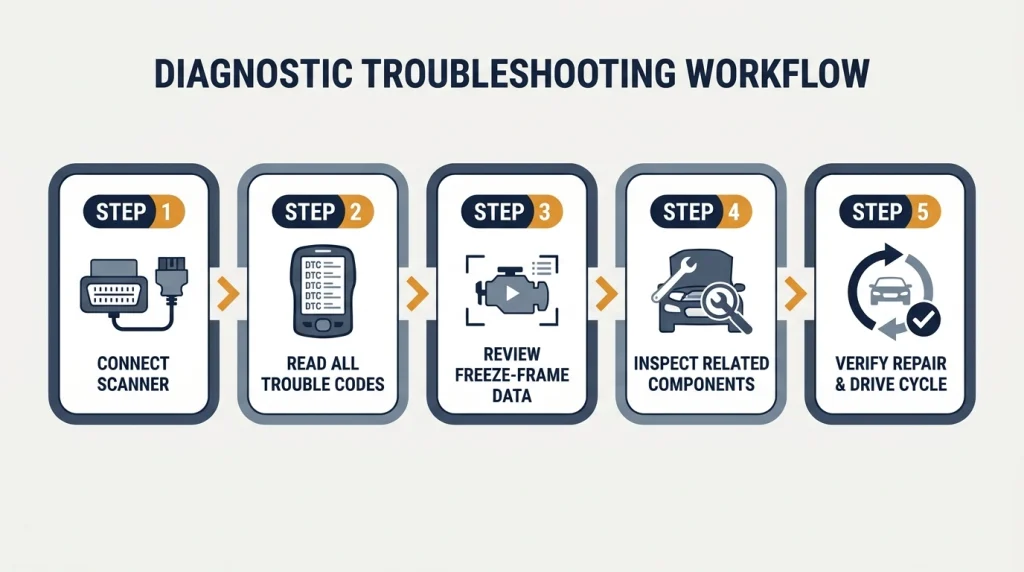
My preferred approach is to preserve the evidence before changing anything. A scanner displaying freeze-frame and live data makes that easier.
Step 1: Connect an OBD2 Scanner
Park safely and switch off the ignition before connecting the scanner. Locate the 16-pin diagnostic connector, usually beneath the dashboard.
Turn the ignition on as instructed by your scanner. Most standard code-reading functions don’t require the engine to run.
Step 2: Read Every Trouble Code
Open the scanner’s trouble-code menu and record all available codes. Check stored, pending, and permanent categories if supported.
A stored code records a confirmed fault rather than necessarily proving the problem is active right now. Learn more about what a stored fault code means before interpreting your results.
Step 3: Review Freeze-Frame Information
Freeze-frame data records certain operating conditions around the time a fault was detected. Available measurements may include engine speed, coolant temperature, vehicle speed, and fuel trims.
For a hypothetical P0420 case, I would first check whether misfire or fuel mixture codes appeared alongside it. That detail can change the diagnostic direction.
Step 4: Check Related Components
Use the code and vehicle symptoms to choose sensible tests. Start with accessible visual inspections before moving toward specialized equipment.
- For P0420: Inspect for exhaust leaks, other engine codes, and abnormal sensor behavior.
- For P0300: Investigate ignition, fuel delivery, intake leaks, and engine mechanical condition.
- For P0171: Examine vacuum hoses, intake plumbing, fuel trims, and fuel supply.
- For P0455: Check the fuel cap and visible EVAP hoses before considering a smoke test.
- For P0128: Review coolant temperatures and thermostat performance.
Some tests require a qualified technician and specialized equipment. Don’t work around hot exhaust parts or pressurized fuel systems without appropriate training.
Step 5: Verify the Repair
After repairing the confirmed fault, check whether the warning returns under normal driving conditions. Recheck stored codes and readiness monitors where appropriate.
A cleared code isn’t proof of a successful repair. The diagnostic system may need another drive cycle before it can evaluate the affected component again.
Can You Drive With a P0420 Code?
You may be able to drive a short distance with P0420 if the engine runs normally and no other serious warnings are present. However, arrange a diagnosis rather than ignoring it indefinitely.
The code itself doesn’t measure how severely the vehicle’s drivability has been affected. Symptoms and additional fault codes determine the urgency.
When Is Driving Usually Less Urgent?
- The check engine light is steady rather than flashing.
- The engine starts, idles, and accelerates normally.
- There is no overheating or significant power loss.
- No abnormal exhaust noises or strong fuel smells are present.
- No other urgent dashboard warning lights are illuminated.
When Should You Stop Driving?
Stop in a safe location if the check engine light flashes and the engine runs poorly. An active misfire can quickly overheat the catalytic converter.
Severe shaking, overheating, major power loss, or a red oil-pressure warning also requires immediate attention. Shut the engine off when safe and arrange assistance.
The Delaware DMV’s OBD-II guidance similarly discourages vehicle operation when the malfunction indicator lamp is flashing.
How Much Does It Cost to Fix P0420?

The cost depends on which component actually caused the efficiency fault. A minor exhaust leak and a failed catalytic converter require completely different repairs.
CarMD’s 2026 Vehicle Health Index reported an average catalytic converter replacement cost of approximately $1,511 in its 2025 U.S. repair data. That figure is a historical repair average, not a quote for your vehicle.
According to the same report, oxygen sensor replacement averaged about $287. Neither part should be replaced until diagnosis supports the decision.
What Can Affect the Repair Price?
- Vehicle design: Converter location and exhaust-system layout affect labor time.
- Parts selection: Original-equipment and compliant aftermarket converters can differ significantly in price.
- Location: Labor rates and emissions regulations vary by region.
- Related damage: Misfires, leaks, or fuel-control problems may require separate repairs.
- Diagnostic time: Intermittent faults sometimes require extended testing.
Before approving converter replacement, ask the shop which tests confirmed its failure. That question can help prevent an expensive repair that doesn’t solve the problem.
Can You Clear an OBD2 Code Without Fixing the Problem?
Yes, many OBD2 scanners can erase stored diagnostic trouble codes. However, clearing the code doesn’t repair the fault that triggered it.
If the same malfunction remains, the code may return when the monitor runs again. Erasing codes can also remove useful diagnostic information.
Our guide to turning off the check engine light with an OBD2 scanner explains what happens when codes are cleared.
Why Does Clearing Codes Affect Emissions Testing?
OBD2 readiness monitors indicate whether the vehicle has completed its required emissions-system self-tests. Clearing diagnostic codes generally resets applicable monitors to an incomplete state.
That can prevent an otherwise repaired vehicle from passing its inspection immediately. It may need additional driving under the manufacturer’s specified conditions.
The Ohio EPA’s OBD-II readiness guidance explains how incomplete monitors can affect testing and how driving cycles restore their status.
This matters especially when you’re preparing for an inspection or evaluating a used car. Learn how to check OBD2 readiness when buying a used car before relying on a dashboard with no warning lights.
Which OBD2 Codes Are Most Serious?
The most common code isn’t necessarily the most dangerous code. A moderate emissions fault can be less urgent than an active misfire or an engine condition causing overheating.
Always evaluate the dashboard warning, symptoms, and diagnostic data together. A trouble code’s severity depends on what is happening in the vehicle.
- P0300–P0308: Active misfires can damage the catalytic converter, especially when the check engine light flashes.
- P0217: Engine overtemperature conditions require prompt action to avoid severe damage.
- P0016: Crankshaft and camshaft position correlation faults can indicate timing or sensor problems requiring diagnosis.
- P0420: Usually calls for timely diagnosis, but urgency increases with misfires or other symptoms.
- P0442: Often relates to an emissions vapor leak and may be less urgent when no other symptoms exist.
Don’t assume a code is harmless simply because the vehicle seems driveable. Likewise, a severe symptom can require immediate attention even before a scanner identifies the cause.
What Should You Look for When Buying an OBD2 Scanner?
For common engine codes, start with a scanner that reads generic powertrain faults reliably. More advanced features help when the fault description alone doesn’t identify the cause.
I would prioritize clear code definitions and access to freeze-frame information over a long list of rarely used functions. Compatibility with your specific vehicle matters most.
- Stored and pending codes: Essential for identifying confirmed and developing faults.
- Freeze-frame data: Helps reconstruct the conditions when a code appeared.
- Live data: Useful for evaluating sensor readings and fuel-control behavior.
- Readiness monitors: Important when preparing for emissions inspection.
- Vehicle compatibility: Check the supported model years, protocols, and available features.
Recommended OBD2 Scanners for Common Trouble Codes
If you’re choosing your first scanner, I would focus on three practical options. Each serves a different type of driver, from occasional check engine checks to more detailed troubleshooting.
Disclosure: As an Amazon Associate, we earn from qualifying purchases. The suitability scores below are editorial assessments, not verified customer-review averages.
🏆 Best for Basic Diagnostics
ANCEL AD310 OBD2 Scanner
★★★★☆ 4.0/5 editorial fit
A compact wired scanner designed for basic engine fault-code reading, clearing, and emissions readiness checks. I would consider it a sensible starting point for owners who want to inspect P0420 or P0300 without using a phone app.
📱 Best for Smartphone Diagnostics
BlueDriver Bluetooth Pro OBD2 Scan Tool
★★★★½ 4.5/5 editorial fit
A Bluetooth scanner with app-based code information, live data, and supported enhanced diagnostics. I would prioritize this option if you prefer reviewing diagnostic information on your phone. Check vehicle-specific coverage before buying.
🔧 Best for Standalone Live Data
Autel AutoLink AL519
★★★★☆ 4.0/5 editorial fit
A handheld scan tool offering engine-code functions, freeze-frame information, live data, and readiness checks. I would consider it for drivers who want more diagnostic information without depending on a smartphone.
Frequently Asked Questions
Is P0420 the most common check engine light code?
P0420 has been identified as the most common diagnostic trouble code in historical CarMD reporting. It indicates insufficient catalytic converter efficiency on Bank 1. However, the most frequent code can vary by vehicle make, age, geography, and dataset. It isn’t possible to confirm a universal 2026 ranking from historical results alone.
What is the most common OBD2 code on older cars?
P0420 is a common code on aging gasoline vehicles because catalytic converters and related components can deteriorate over time. However, older cars also frequently develop misfire, fuel-trim, and EVAP faults. The most common code for a specific model depends on its engine design, maintenance history, and operating conditions.
Can a bad oxygen sensor cause P0420?
Yes, an oxygen sensor problem can sometimes contribute to P0420. However, the code does not automatically prove that the sensor has failed. Exhaust leaks, engine performance issues, and reduced catalyst efficiency can produce similar results. Diagnostic testing should confirm which component needs attention.
Will P0420 go away after replacing the gas cap?
Usually not. P0420 concerns catalytic converter efficiency, while a loose or defective gas cap typically causes EVAP-related trouble codes. If both faults are present, tightening or replacing the cap may address the EVAP issue but won’t necessarily resolve P0420. Read all stored codes before replacing anything.
Can a cheap OBD2 scanner read P0420 and P0300?
Yes. A compatible basic OBD2 scanner can generally read standard emissions-related powertrain trouble codes such as P0420 and P0300. However, reading a code is only the beginning of diagnosis. Freeze-frame data, live sensor readings, and additional testing may be needed to identify the actual malfunction.
Final Takeaway: Understand the Code Before Replacing Parts
P0420 remains one of the best-known and historically most frequently reported OBD2 trouble codes. It indicates that the Bank 1 catalyst system isn’t meeting its expected efficiency threshold.
But no trouble code should be treated as a guaranteed parts-replacement instruction. A failed test tells you where to investigate, not always what to buy.
Start by scanning the vehicle, recording every code, reviewing freeze-frame information, and checking related engine conditions. If the engine runs poorly or the check engine light flashes, prioritize safety and professional diagnosis.
With the right diagnostic approach, you can avoid unnecessary repairs and make a more informed decision about your next step.

I’m Alex Rahman, a car enthusiast and automotive writer focused on practical solutions, car tools, and real-world driving advice. I share simple and honest content to help everyday drivers make better decisions.
