Is an OBD2 Scanner Worth Buying? Honest Answer
Quick Answer
Yes, for most owners of a 1996 or newer car who want a fast first check when a warning light appears. A basic scanner is worth buying if you will use it to identify the fault area, decide whether driving is urgent, and talk more clearly with a repairer. It is less worth buying if you have free, convenient code reads nearby, a new car under warranty, or no interest in doing even a first check yourself.
The real question is not whether scanners work. It is whether owning one changes your next decision enough to justify keeping it in the glove box.
The Short Answer, by Driver
Your driving pattern matters more than the scanner itself. A commuter with an older car faces a different calculation from a driver with a new leased car and a dealer nearby.
| Situation | Likely verdict |
|---|---|
| Older car, regular driving, occasional warning lights | Yes, usually worth it |
| Buying a used car, or helping family buy one | Yes, for a pre-purchase check |
| New car under warranty, dealer or free check nearby | Probably not urgent |
| Pre-1996 car, or a car without a standard port | No, unless you confirm compatibility first |
| You want diagnosis, not just a code, for complex faults | A basic scanner alone may not be enough |
What a Scanner Actually Gives You
An OBD2 scanner reads information your car already records. When the check engine light comes on, the car usually stores a diagnostic trouble code, or DTC, that points to a system or circuit that behaved outside its expected range.
A basic scanner can show that code, often with a short description, and can clear it after a repair. Many also show live data, such as coolant temperature, and freeze-frame data from the moment a fault was stored. Those details help separate a one-off glitch from a repeating fault.
What a scanner does not do is name the failed part with certainty. An oxygen sensor circuit code, for example, can point to the sensor, its wiring, a connector, or an exhaust leak. People expect a part name, but they receive a starting point for diagnosis.
Coverage also varies. Generic access normally covers engine and emissions information. Access to ABS, airbags, or transmission modules depends on the scanner, the app, and the vehicle, so check that coverage before you buy.
For a fuller picture of the information a scan can and cannot reveal, see what an OBD2 scanner can tell you.
When Buying One Pays Off

The clearest payoff is speed. When a light appears at night, before a long drive, or far from a shop, a scanner lets you check the code immediately instead of guessing whether the car is safe to drive home.
That first check helps you sort urgency. A loose fuel cap code and a misfire code are not the same kind of problem. The second may need prompt attention, especially if the light is flashing, power is reduced, or the engine runs roughly.
A scanner also pays off when you buy a used car. A quick scan can reveal stored or pending codes and incomplete readiness monitors, even when the dashboard light is off. Our guide to scanning a car before buying it explains what that check covers and what it misses.
Regular drivers gain a record. If the same code returns after a repair, you have evidence that the original fault was not fully resolved.
When It Probably Does Not Pay Off
Ownership is not the only way to get a code read. Some auto parts stores offer free basic code reads, and some repairers include a scan as part of an inspection or repair visit. If that service is close and available when you need it, a personal scanner adds less value.
A new car under warranty is another weak case. Warranty work usually goes through a dealer, which will scan the car as part of that process. Owning a scanner can still satisfy curiosity, but it rarely changes the repair path.
The same logic applies if you never want to look at a code yourself. A scanner only helps if you will plug it in and use the result to decide your next step.
There is also a different choice to consider: paying for a professional scan when a fault is complex. That is not the same decision as buying a basic scanner for everyday checks. Our article on whether a professional OBD scan is worth it covers that shop-visit decision separately.
How the Value Adds Up
Think in terms of avoided trips and better decisions, not a guaranteed saving. A basic scanner can prevent an unnecessary urgent visit when a fault is minor, and prevent delay when a fault is serious.
That value disappears if you treat a code as a final diagnosis. A code is a clue, not a repair order. Use it to ask better questions, not to skip inspection or professional help when a fault is unclear or safety-related.
Prices vary by type, features, and whether an app charges a subscription. Compare the total cost against how often you expect to use the tool in a year.
Basic Reader, Bluetooth Adapter, or Advanced Scanner?
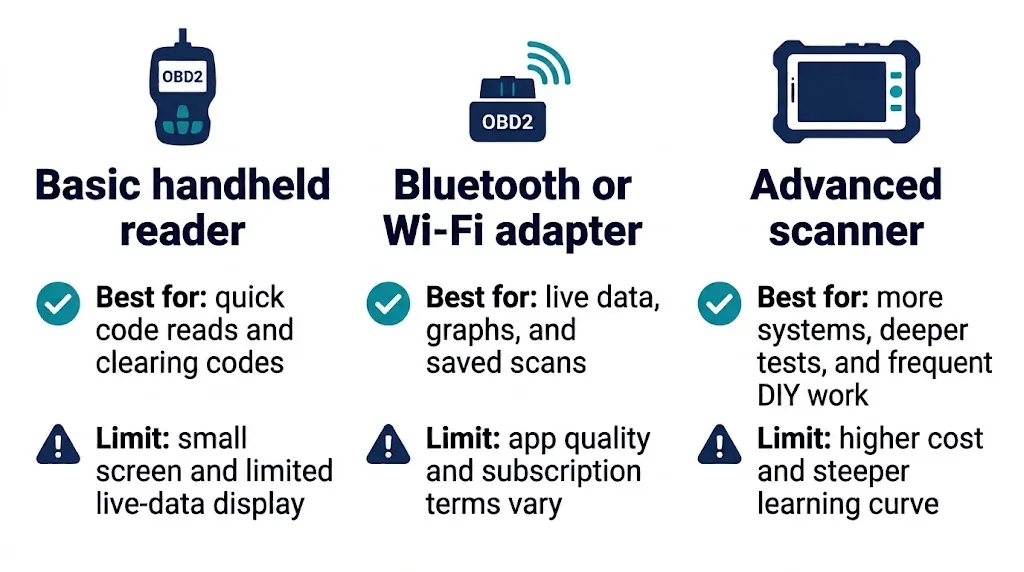
Most buyers do not need to start with the most advanced tool. They need the tool that matches how they will actually use it.
| Type | Best for | Main limit |
|---|---|---|
| Basic handheld reader | Quick code reads and clearing codes | Small screen, limited live-data display |
| Bluetooth or Wi-Fi adapter with a phone app | Live data, graphs, and saved scans | App quality and subscription terms vary |
| Advanced scanner | More systems, deeper tests, frequent DIY work | Higher cost and a steeper learning curve |
A basic reader is often enough for the core job: read the code, understand the fault area, and decide whether to drive, monitor, or book a repair. A phone-based adapter is a better fit if you want live data or a scan history. An advanced scanner is mainly for drivers who already need broader system coverage.
Tip
Start with the job, not the feature list. If your main need is a fast code check, a simple reader that connects reliably to your car is more useful than an advanced tool whose extra systems you never open.
What to Check Before You Buy

Compatibility comes first. In the United States, OBD2 became standard for gasoline cars and light trucks from model year 1996, with later timing for some diesels and other markets. The standard 16-pin port is usually under the dashboard near the driver.
Our guide to checking vehicle OBD2 compatibility walks through the model-year and port checks that settle this question.
Next, check what the scanner covers for your vehicle, whether that coverage requires a paid app tier, and whether the app needs an internet connection for key features.
Warning
Do not buy on the promise of a feature alone. Confirm whether enhanced system coverage, live data, or repair guidance is included in the base price or locked behind a subscription, and check the return terms before you rely on it for a used-car check.
Finally, remember the safety boundary. A flashing check engine light, loss of power, overheating, unusual smoke, or a brake or airbag warning needs prompt professional attention. A home scan can inform that decision, but it does not make an unsafe car safe to drive.
Mistakes That Waste the Purchase
The most common mistake is clearing a code and assuming the problem is fixed. Clearing removes the stored code and turns the light off, but if the fault remains, the code usually returns. Clearing also resets readiness monitors, which can affect an emissions test until the car completes its drive cycles.
The second mistake is replacing the part named in a code description without checking wiring, connectors, or related conditions. That approach can waste money and leave the real fault untouched.
The third mistake is ignoring context. A code that appears once after a loose fuel cap, a low battery, or a refuelling error may not mean the same thing as a code that returns repeatedly under normal driving. Note when the code appeared, whether it returned, and what changed just before it.
For a step-by-step approach to that first check, see how to diagnose a check engine light with OBD2. It keeps the focus on working from code to cause, rather than jumping to a part.
The U.S. Environmental Protection Agency also lists OBD resources used in vehicle inspection programs.
Related Product
OBD2 Scanner
A basic OBD2 scanner gives you that first code check at home, so you can judge urgency before booking a repair.
As an Amazon Associate, we earn from qualifying purchases.
Frequently Asked Questions
Will an OBD2 scanner work on my car?
It should work on most gasoline cars and light trucks sold in the United States from model year 1996, because those cars use the standard port and generic codes. Check your model year, port, and any diesel or import exceptions before buying, since older or non-standard cars may need a different tool.
Can a scanner tell me exactly which part to replace?
No, not by itself. A scanner points to a system, circuit, or condition that failed a test. The failed part, wiring, connector, or related fault still needs checking, especially when several causes can produce the same code.
Is a free code reading at a parts store enough?
Often, yes, for a single simple code. A free read gives you the same starting point as a basic scanner. Owning a scanner is more useful when you need repeated checks, checks at odd hours, live data, or a scan before buying a used car.
Do I need a scanner if my car is new or under warranty?
Usually not urgently. Warranty repairs normally go through the dealer, which will scan the car as part of the work. A scanner can still be useful for curiosity or for a second car, but it rarely changes the warranty repair path.
Can I use one scanner on more than one car?
Yes, in most cases, as long as each car is OBD2 compliant and the scanner supports its protocol. Keep in mind that enhanced coverage for ABS, airbags, or other systems can vary by make and model, even with the same scanner.
Will clearing a code fix the problem or help pass an inspection?
No. Clearing only removes the stored code and turns the light off. If the fault remains, the code usually returns, and readiness monitors may show as incomplete until the car completes its normal drive cycles, which can cause an emissions test to fail.
Conclusion
An OBD2 scanner is worth buying when it helps you make a faster, clearer decision: whether to drive, monitor, check a used car, or book a repair with a specific code in hand. It is not worth buying as a promise of an exact part name, and it is less urgent when free checks are easy, warranty cover handles the work, or your car is not OBD2 compliant. Buy the simplest tool that reliably covers your car and your real use, check subscription terms before you pay, and use the code as a starting point for diagnosis, not as the diagnosis itself.

I’m Alex Rahman, a car enthusiast and automotive writer focused on practical solutions, car tools, and real-world driving advice. I share simple and honest content to help everyday drivers make better decisions.
