What Engine Malfunctions Can’t Be Detected by an OBD Scanner?
Quick Answer
An OBD2 scanner cannot directly detect many mechanical engine problems, including worn bearings, low cylinder compression, small oil leaks, timing chain wear, and early head gasket damage. It may also miss intermittent fuel pressure problems, minor vacuum leaks, and cooling system faults until they affect monitored engine performance. A scanner reads information from the vehicle’s computers rather than physically inspecting components. Understanding what OBD2 live data reveals helps separate electronic clues from mechanical problems.
Common problems an OBD scanner may miss
- Internal engine wear: Worn bearings, piston rings, and cylinder walls may cause damage without producing a code.
- Mechanical timing issues: Early timing chain stretch or tensioner wear may remain undetected.
- Fluid leaks: Oil and coolant leaks are not directly measured by standard OBD2 diagnostics.
- Compression problems: An engine can lose compression before its computer recognizes a misfire.
- Fuel delivery problems: Low fuel pressure can exist without a dedicated diagnostic code.
- Small air leaks: Minor intake leaks may not exceed the computer’s diagnostic thresholds.
How to confirm a hidden engine problem
- Combine testing methods: Use compression testing, fuel pressure measurements, visual inspections, and live sensor data instead of relying on trouble codes alone.
I’ve always considered an OBD2 scanner the starting point of an engine diagnosis, not the final answer. A vehicle can sound unhealthy, lose power, or consume oil while displaying no trouble codes.
That doesn’t automatically mean the scanner is defective. This guide explains what scanners miss, why those blind spots exist, and which tests can reveal the actual problem.
What Can an OBD2 Scanner Actually Detect?
An OBD2 scanner retrieves diagnostic information that a vehicle’s electronic control modules make available. Its primary standardized functions focus on emissions-related engine and powertrain operation.
The scanner doesn’t independently examine internal engine parts. Instead, it communicates with onboard computers that process information from sensors and diagnostic monitors.
What Is an OBD2 Diagnostic Trouble Code?
A diagnostic trouble code, or DTC, is a stored identifier for a malfunction recognized by the vehicle’s diagnostic system. For example, P0301 indicates a detected misfire involving cylinder one.
However, P0301 doesn’t identify the exact failed part. The underlying cause could involve ignition, fuel delivery, compression, wiring, or another mechanical condition.
Typical information available through a compatible scanner includes:
- Stored trouble codes: Confirmed faults recorded by the engine computer.
- Pending codes: Potential faults that haven’t necessarily met confirmation requirements.
- Permanent codes: Certain emissions-related codes retained until specified clearing conditions are satisfied.
- Live sensor readings: Supported values such as engine temperature, fuel trims, and oxygen sensor information.
- Freeze-frame data: Operating conditions captured when certain faults were detected.
- Readiness monitors: Information about whether applicable emissions-related self-tests have completed.
In the United States, federal onboard diagnostic regulations establish requirements for monitoring emissions-related malfunctions. They don’t turn the vehicle’s computer into a complete mechanical inspection system.
What Engine Malfunctions Can’t an OBD Scanner Detect?

The most important blind spots involve physical engine damage and faults that lack direct sensor monitoring. Some eventually produce secondary trouble codes, but the scanner may never identify their precise cause.
1. Worn Engine Bearings and Internal Damage
Connecting rod bearings and crankshaft main bearings support rotating engine components. When their surfaces wear, the engine may produce knocking sounds or develop excessive internal clearance.
A standard OBD2 scanner doesn’t measure bearing clearance. It also cannot directly inspect crankshaft journals or determine whether internal metal surfaces are damaged.
Warning signs may include:
- Deep knocking noises that change with engine speed or load.
- Metal particles discovered during oil inspection.
- Low oil pressure, particularly when the engine is hot.
- Increasing mechanical vibration.
Some vehicles monitor oil pressure electronically, but available warnings and scan data vary. A mechanic may need a mechanical oil pressure gauge and further inspection to confirm the problem.
2. Low Cylinder Compression
Low compression occurs when a cylinder cannot retain enough pressure during the compression stroke. Common causes include worn piston rings, leaking valves, cylinder damage, and head gasket failure.
An OBD2 scanner generally cannot measure cylinder compression directly. It may detect a misfire if the compression loss becomes severe enough to affect crankshaft acceleration.
Possible symptoms include:
- Hard starting or extended cranking.
- Rough idling and engine shaking.
- Reduced acceleration and power.
- Excessive oil consumption in some cases.
A compression tester measures each cylinder’s cranking pressure. A cylinder leak-down tester then helps identify where compressed air escapes.
For example, air heard escaping through the intake may indicate an intake valve sealing problem. Air entering the crankcase can suggest leakage past the piston rings.
3. Early Timing Chain or Timing Belt Problems
Timing chains and belts synchronize crankshaft and camshaft movement. Wear, incorrect tension, or damage can disrupt valve timing and eventually cause major engine damage.
A scanner may identify camshaft-to-crankshaft correlation errors on supported vehicles. However, early mechanical wear doesn’t always create an observable correlation fault.
Look for these possible warnings:
- Rattling during cold starts.
- Unusual sounds near the timing cover.
- Poor engine response.
- Rough idle or starting difficulty.
A technician may compare camshaft and crankshaft signals using an oscilloscope. Mechanical inspection may also be necessary to evaluate tensioners, guides, and timing components.
Important: If a timing belt or chain appears close to failure, avoid continuing to operate the engine. Certain engine designs can suffer serious valve damage when valve timing is lost.
4. Small Oil Leaks and Oil Consumption
An OBD2 scanner doesn’t normally detect oil escaping through a valve cover gasket or oil pan seal. It also cannot directly calculate how much engine oil has leaked onto the ground.
Some modern vehicles provide electronic oil level or pressure information through enhanced diagnostics. That information still doesn’t identify every leak or determine its physical location.
Inspect these common areas:
- Valve cover gasket and surrounding cylinder head.
- Oil filter and oil filter housing.
- Oil pan gasket and drain plug.
- Front and rear crankshaft seal areas.
- Turbocharger oil lines, when fitted.
An ultraviolet dye and inspection light can help locate difficult leaks. Oil consumption may require a controlled consumption test and additional mechanical diagnosis.
5. Early Head Gasket Failure
A head gasket seals the joint between the engine block and cylinder head. When it fails, combustion gases, coolant, or oil may cross passages that should remain separate.
The scanner may eventually show misfire codes or abnormal engine temperature. However, these clues don’t independently prove that the head gasket has failed.
Potential signs include:
- Unexplained coolant loss.
- Repeated cooling system pressurization.
- White exhaust vapor that persists after warm-up.
- Engine overheating.
- Combustion gases entering the cooling system.
A cooling system pressure test can reveal external or internal leakage. A combustion gas test and cylinder leak-down test may help narrow the diagnosis.
Don’t open a hot, pressurized cooling system. Escaping coolant can cause severe burns.
6. Minor Vacuum Leaks
A vacuum leak lets unmetered air enter the intake system on many gasoline engines. It can change the air-fuel mixture and cause unstable idling.
Large leaks often trigger lean-condition codes such as P0171 or P0174. Smaller leaks may remain within the engine computer’s correction range.
Common sources include:
- Cracked vacuum hoses.
- Damaged intake manifold gaskets.
- Leaking positive crankcase ventilation connections.
- Loose intake connections.
- Brake booster vacuum leaks.
A professional smoke test introduces visible smoke into a suitable intake system to help identify escaping air. Fuel trim readings may also provide useful clues.
Never use an uncontrolled flame to search for intake leaks. Follow approved diagnostic procedures instead.
7. Fuel Pressure Problems Without Codes
Fuel pressure problems can cause hesitation, weak acceleration, or difficult starting. However, a basic scanner may not have access to a dedicated fuel pressure measurement.
Some modern engines have pressure sensors and diagnostic monitors. Others require an external gauge or manufacturer-specific testing equipment.
Potential causes include:
- A weakening fuel pump.
- A restricted fuel filter or strainer.
- A faulty pressure regulator.
- Fuel supply restrictions.
- Electrical problems affecting pump operation.
Fuel pressure must be compared against the manufacturer’s specifications under the correct operating conditions. Direct-injection systems can operate at dangerously high pressures and require specialized procedures.
8. Restricted Exhaust Systems
A restricted catalytic converter, damaged internal exhaust component, or crushed exhaust pipe can reduce engine breathing. The vehicle may feel increasingly weak during acceleration.
A scanner may reveal unusual load, fuel trim, or sensor readings. Yet it generally cannot directly measure exhaust backpressure without appropriate sensors or equipment.
A technician might use exhaust backpressure testing or another manufacturer-approved diagnostic method. A catalyst efficiency code alone does not prove the converter is physically blocked.
Which Engine Problems Can an OBD2 Scanner Miss? Comparison Table
The following table separates direct mechanical measurements from possible computer-generated clues. Actual diagnostic coverage depends on the vehicle and scanner.
| Engine problem | Possible OBD2 clue | Better confirmation method |
|---|---|---|
| Worn bearings | Oil pressure warning on some vehicles | Oil pressure test and mechanical inspection |
| Low compression | P0300–P0308 misfire codes, if detected | Compression and leak-down testing |
| Timing chain wear | Possible cam/crank correlation codes | Timing verification and mechanical inspection |
| External oil leak | Often none | Visual inspection and UV dye |
| Head gasket leak | Misfire or temperature-related codes | Pressure and combustion gas testing |
| Small vacuum leak | Positive fuel trims or lean codes | Smoke testing |
| Low fuel pressure | Lean codes or pressure codes, if supported | Fuel pressure and volume testing |
| Exhaust restriction | Indirect performance or sensor clues | Exhaust backpressure testing |
Key distinction: A scanner can sometimes detect the consequences of a mechanical failure without revealing the damaged component itself.
Why Does an OBD2 Scanner Show No Codes When Something Is Wrong?
A scanner may report no codes because the fault hasn’t crossed the vehicle’s diagnostic threshold. Other possibilities include incomplete monitoring, intermittent conditions, or limited scanner coverage.
Diagnostic Monitors Have Operating Conditions
Vehicle computers don’t perform every diagnostic test continuously. Some monitors require specific engine temperatures, speeds, loads, or driving conditions.
If those conditions haven’t occurred, the computer may not have completed the relevant check. The Ohio EPA’s OBD readiness guidance explains why incomplete monitors matter.
Small Problems May Remain Below Detection Thresholds
An engine can develop minor wear before its behavior exceeds programmed limits. A weak component may still function adequately during the diagnostic test.
This is why a developing mechanical problem can exist for some time without illuminating the check engine light.
Basic Scanners Have Limited Coverage
A generic OBD2 reader primarily accesses standardized emissions-related information. It doesn’t necessarily support every manufacturer-specific parameter or control module.
For guidance on choosing appropriate diagnostic functions, read what to look for in an OBD2 scanner.
Intermittent Problems Can Be Difficult to Capture
Some symptoms appear only during cold starts, heavy acceleration, or particular temperatures. A stationary scan may show completely normal operating values.
Recording live data under the conditions that reproduce the symptom can provide better evidence. Always prioritize safe driving and avoid handling diagnostic equipment while driving.
Can an OBD2 Scanner Detect Mechanical Engine Problems Indirectly?
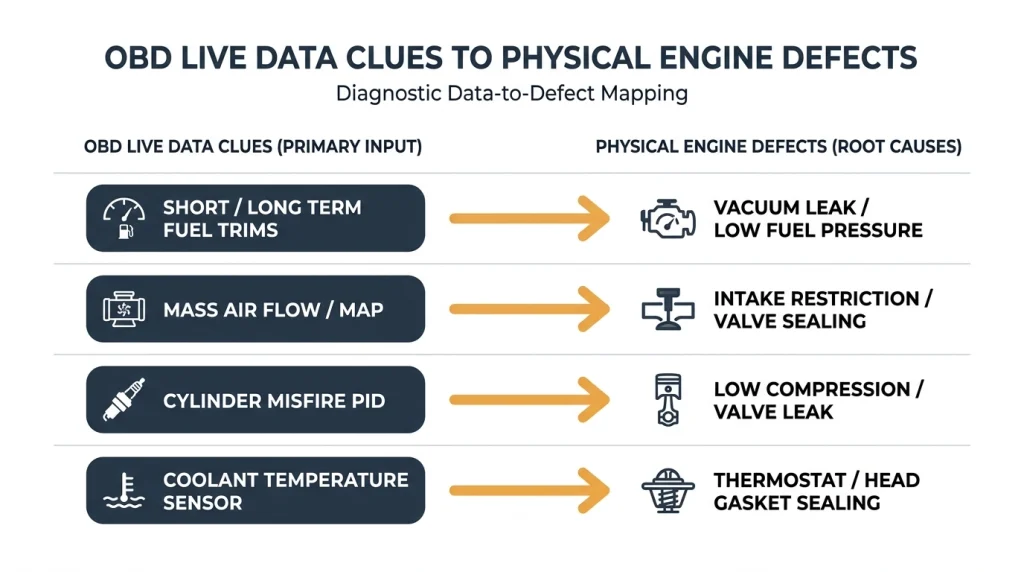
Yes, an OBD2 scanner can sometimes expose mechanical problems through their effects on monitored engine operation. It still cannot confirm most physical failures without additional testing.
Consider an engine with a leaking intake valve. Poor combustion may eventually trigger a cylinder misfire code, but the computer cannot directly see the valve’s sealing surface.
Likewise, a weak fuel pump may produce lean readings under heavy load. Those readings identify a fueling problem, not necessarily the defective pump.
Useful Live Data Parameters
- Short-term fuel trim: Shows immediate fuel correction where supported.
- Long-term fuel trim: Shows learned fuel correction over time.
- Engine coolant temperature: Helps evaluate temperature sensor readings and warm-up behavior.
- Manifold absolute pressure: Provides intake pressure information on supported vehicles.
- Mass air flow: Helps evaluate measured intake airflow.
- Misfire information: May show cylinder-specific misfire activity where available.
No single live-data number proves a particular component has failed. Values must be interpreted alongside operating conditions, vehicle specifications, and other measurements.
For a deeper explanation, see the guide to active tests and bidirectional diagnostics. Supported active tests can help separate electronic control problems from mechanical failures.
How Do You Diagnose Engine Problems When an OBD Scanner Finds Nothing?
Start with the symptom, not a replacement part. Then combine visual inspection, computer data, and targeted mechanical testing.
Step 1: Document the Symptoms
Record when the problem occurs and whether it changes with temperature, speed, or engine load. Useful details often narrow the investigation before any testing begins.
- Does the engine knock when cold or hot?
- Does rough idling disappear during acceleration?
- Is coolant or engine oil disappearing?
- Does the engine lose power climbing hills?
- Is the problem constant or intermittent?
Step 2: Perform a Visual Inspection
Check fluid levels, hoses, belts, connectors, and obvious leaks according to the manufacturer’s instructions. Inspect under the hood only when conditions are safe.
Look for damaged intake tubing, wet gasket areas, loose wiring, and unusual residue. These observations may reveal faults that never generated a code.
Step 3: Check All Available Diagnostic Information
Read stored and pending codes before clearing anything. Review available freeze-frame information, readiness monitor status, and relevant live parameters.
A no-code result is useful evidence, but not proof of engine health. The U.S. Environmental Protection Agency provides broader information about vehicle emissions and diagnostic requirements.
Step 4: Select a Test That Matches the Symptom
- Persistent rough running: Consider compression and leak-down testing.
- Suspected intake leakage: Consider an appropriate smoke test.
- Power loss under load: Evaluate fuel delivery and exhaust restriction.
- Mechanical knocking: Stop driving and arrange professional inspection.
- Unexplained coolant loss: Perform cooling system testing.
- Low oil pressure: Verify pressure using approved equipment before further operation.
Step 5: Compare Results With Vehicle Specifications
Don’t diagnose a faulty component simply because a reading seems unusual. Use the correct service information for the engine, test procedure, and operating conditions.
Fuel pressure, compression, and sensor expectations can vary substantially between engine designs.
What Other Tools Detect Problems That OBD Scanners Miss?

Mechanical diagnostic tools answer questions that a computer code reader cannot. Each tool measures a different physical condition.
| Diagnostic tool | Main purpose | Typical application |
|---|---|---|
| Compression tester | Measures cranking cylinder pressure | Investigating weak cylinders |
| Cylinder leak-down tester | Evaluates cylinder sealing | Finding possible valve or ring leakage |
| Fuel pressure gauge | Measures compatible fuel system pressure | Investigating fuel supply issues |
| Automotive smoke machine | Reveals suitable system leaks | Finding intake leaks |
| Mechanical oil pressure gauge | Measures oil pressure directly | Checking lubrication concerns |
| Automotive oscilloscope | Displays electrical waveforms | Checking sensor and timing relationships |
Not every tool is safe or suitable for every engine. High-pressure fuel systems, hot components, and rotating machinery require appropriate training and precautions.
Is a More Expensive OBD2 Scanner Better at Finding Hidden Engine Problems?
A more advanced scanner can provide additional diagnostic information, but it cannot overcome every physical monitoring limitation. Even professional scan tools need supporting mechanical tests.
Entry-level scanners usually focus on standardized codes and basic diagnostic information. Higher-end tools may add manufacturer-specific data, expanded modules, graphing, and bidirectional controls.
As of 2026, I would prioritize these practical capabilities over a large advertised feature count:
- Reliable vehicle compatibility.
- Access to pending and stored codes.
- Live engine sensor data.
- Freeze-frame information.
- Readiness monitor status.
- Manufacturer-specific support when necessary.
Remember that enhanced coverage varies by vehicle. Confirm the exact supported functions before purchasing a scanner.
When Should You Stop Driving and See a Mechanic?
Some problems need urgent attention even if the scanner reports no faults. Continuing to drive with serious mechanical symptoms can cause additional damage or create safety risks.
Stop operating the vehicle when you notice:
- Severe knocking or grinding sounds from the engine.
- A low oil pressure warning.
- Rapid engine overheating.
- Heavy smoke accompanied by poor running.
- Sudden major power loss.
- A flashing check engine light, particularly with rough running.
If the engine overheats or displays a low oil pressure warning, shut it down when safe. Arrange professional assistance rather than repeatedly restarting it to check for codes.
You can also review general vehicle safety guidance from the National Highway Traffic Safety Administration.
Useful Diagnostic Tools for Finding Engine Problems
If you’re building a basic diagnostic toolkit, I would start with a capable code reader and then add mechanical tools based on actual symptoms. These three options serve different needs.
Affiliate disclosure: Some links below are affiliate links. Qualifying purchases may earn a commission at no additional cost to you.
🏆 Best for basic code reading
ANCEL AD310 OBD2 Scanner
★★★★☆ 4/5
The ANCEL AD310 is a handheld code reader designed for basic OBD2 diagnostics, including trouble codes and emissions readiness information. I’d consider it for drivers who want straightforward fault-code access without purchasing an advanced scan tool.
Best use: Basic engine warning light investigation. Verify compatibility and available functions.
🔍 Best for live-data investigation
Autel AutoLink AL519
★★★★☆ 4/5
The Autel AL519 provides OBD2 diagnostic functions including codes, live data, and readiness checks. I’d favor this type of tool when interpreting engine sensor readings matters more than simply clearing warning lights.
Best use: Investigating fuel trims and monitored engine performance. Confirm current model specifications.
🛠️ Best for deeper vehicle diagnostics
Innova 5610 Scan Tool
★★★★½ 4.5/5
The Innova 5610 offers enhanced diagnostic features and supported bidirectional functions beyond a basic code reader. I’d consider this category for owners who maintain multiple vehicles and need deeper electronic testing capabilities.
Best use: Expanded module diagnostics and supported active tests. Confirm vehicle-specific coverage and any service requirements.
The star ratings above are editorial suitability assessments for the described use cases, not verified customer-review averages or hands-on test scores. Product capabilities and availability should be confirmed before buying.
Frequently Asked Questions
Can an OBD2 scanner detect a blown head gasket?
An OBD2 scanner cannot directly confirm a blown head gasket. It may display misfire codes, abnormal coolant temperature readings, or other related clues. Confirmation usually requires additional testing, such as cooling system pressure testing, combustion gas testing, or cylinder leak-down testing.
Can an engine have serious damage without a check engine light?
Yes. Internal bearing damage, low oil pressure, severe oil leaks, and early mechanical failures may exist without a check engine light. The vehicle’s computer primarily responds to monitored conditions, so serious physical damage doesn’t always generate an emissions-related diagnostic trouble code.
Can an OBD2 scanner detect low engine compression?
A standard OBD2 scanner cannot directly measure cylinder compression. It may detect misfires caused by poor compression, and some advanced manufacturer-specific systems offer relative compression functions. A conventional compression test or cylinder leak-down test provides more direct evidence of cylinder sealing problems.
Why is my engine running rough with no OBD2 codes?
Rough running without codes can result from small vacuum leaks, mechanical wear, fuel delivery problems, or intermittent ignition faults. Some problems haven’t met diagnostic thresholds. Inspect the engine, examine live data, and perform targeted mechanical tests rather than assuming the absence of codes means everything is normal.
Can an expensive OBD2 scanner detect every engine problem?
No. Advanced scanners can access more modules, additional sensor data, and supported active tests. However, they cannot directly inspect worn bearings, measure every mechanical clearance, or locate all fluid leaks. Physical measurements and careful inspections remain necessary for a complete engine diagnosis.
Final Takeaway: Don’t Rely on Trouble Codes Alone
An OBD2 scanner is valuable because it reveals what your vehicle’s computers know about monitored faults. But a clean scan does not guarantee a mechanically healthy engine.
Problems involving compression, internal wear, oil leakage, cooling system integrity, and fuel delivery may require tests beyond electronic diagnostics.
My preferred approach is simple: start with the scan, examine the symptoms, and select a physical test that directly measures the suspected failure. That method is more reliable than replacing parts based on guesses.
Next step: If your engine shows symptoms but no codes, document the conditions and arrange the appropriate test. When serious knocking, overheating, or low oil pressure appears, stop driving and seek professional help.

I’m Alex Rahman, a car enthusiast and automotive writer focused on practical solutions, car tools, and real-world driving advice. I share simple and honest content to help everyday drivers make better decisions.
