
Can You Clear Permanent OBD2 Codes? No, Only the Car Can
Quick Answer
No, you cannot clear a permanent OBD2 code with a scan tool or by disconnecting the battery. You can clear the stored code and turn off the check engine light, but the permanent code stays until the fault is repaired and the vehicle runs the related monitor and passes it. Only the vehicle itself removes it.
That answer frustrates many drivers. The clear button works on most codes, the light goes out, and the car feels fixed. Then a scan before an emissions test still shows the same code, sometimes with no light at all. A permanent code follows a different rule on purpose.
What a Permanent Code Actually Is
A permanent diagnostic trouble code, often shortened to PDTC, is an emissions-related fault record kept in non-volatile memory. That memory keeps its contents when power is removed, which is why a dead battery or a disconnected terminal does not wipe it. The code is a copy of a confirmed emissions fault, stored so the vehicle can show that the fault was real and has since been checked again.
Permanent codes became part of the emissions system for 2010 and later model year vehicles, with some 2010 vehicles not supporting them. The idea was simple: a driver should not erase the evidence of an emissions fault just before an inspection. The stored code can be erased and the light can go out, but the permanent record remains until the vehicle itself is satisfied that the fault is gone.
The three code types behave differently. A pending code means a monitor saw a possible fault but has not confirmed it yet. A stored code means the fault met the conditions to set a code and usually turn on the light. A permanent code is that confirmed fault recorded in a form a normal clear command cannot remove. The guide to what a permanent OBD2 code is explains those categories, while the comparison of stored versus pending trouble codes covers the earlier stages. A permanent code is usually read through Mode $0A, and not every basic reader displays it.
Can a Scan Tool Clear a Permanent Code?
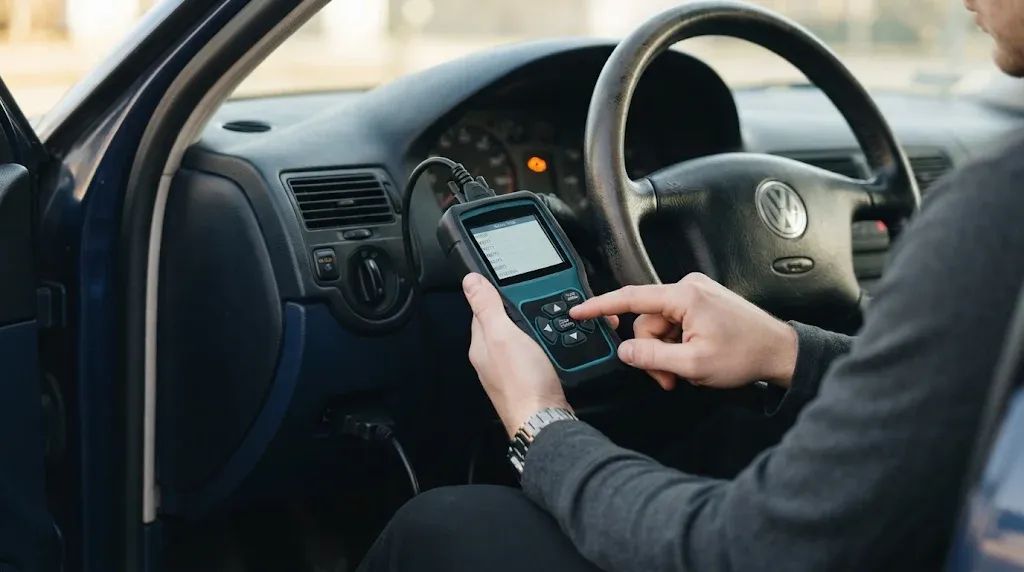
No. Pressing Clear Codes or Erase Codes sends a normal erase command, and that command removes stored codes, pending codes in many cases, freeze-frame data, and readiness results. It does not remove a supported permanent code. A more expensive scanner does not change that rule. The limit is in the vehicle software and the emissions standard, not in the price or brand of the tool.
If a tool claims to force a permanent code away without the vehicle running its monitor and passing, treat the claim with care. At best, it cleared the stored copy and the light while the permanent record remained. At worst, it reset the readiness monitors, delaying the process that would have removed the code.
The California Bureau of Automotive Repair states the rule in its On-Board Diagnostic Test Reference: permanent codes cannot be erased by clearing codes with a scan tool or by disconnecting the battery, and they can only be cleared by the OBD II system once it has verified that the defects are no longer present. Clearing the stored code is still useful after a repair. The mistake is expecting that step to finish the job.
Can Disconnecting the Battery Clear It?
No. Disconnecting the battery, removing a fuse, or letting the battery go flat will not clear a permanent code on a vehicle that supports it. The code lives in memory designed to survive power loss, so removing power does not remove the record.
A battery disconnect can still change what you see on a scan. It usually clears stored codes and freeze-frame data, resets readiness monitors to not ready, and wipes learned values such as idle trim and fuel trim. The car may then need time to relearn idle and to rerun its monitors. None of that helps a permanent code, and it can make things worse before an emissions test because the monitors now have to start again. The guide to whether clearing codes resets readiness monitors explains that reset in more detail.
What Actually Clears a Permanent Code
Only two things together clear a permanent code: a genuine repair and a successful monitor run by the vehicle. Neither step works on its own, and the order matters.
First, the condition that set the code has to be fixed. That means diagnosing the fault properly, not just replacing the part named in the code description. A code for a catalyst, oxygen sensor, misfire, or evaporative leak points to a system, not always to a single failed part. A loose fuel cap, a cracked hose, a wiring fault, or a sensor reading out of range can all sit behind the same code family. If the underlying fault is still present, the monitor will fail again when it runs, and the permanent code will stay.
Second, the vehicle has to run the monitor that owns that code and pass it. A monitor is a self-test run when conditions such as engine temperature, speed, load, and fuel level are met. The catalyst monitor needs the engine at operating temperature and steady driving. The evaporative monitor is stricter: it often needs a cold start and a fuel tank that is neither nearly empty nor nearly full. Until those conditions are met, the monitor does not run, and the code cannot clear. Some vehicles need more than one fault-free run.
How to Give the Monitor Its Best Chance
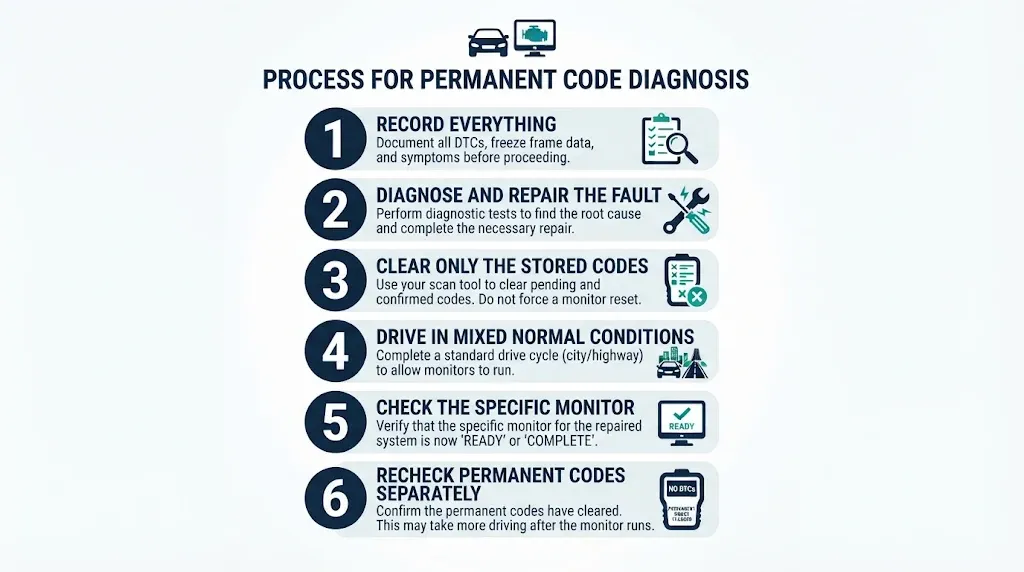
You do not need a special drive-cycle ritual for every code, but you do need to give the vehicle the conditions its monitor is waiting for.
- Record everything before you clear anything. Write down the code numbers, their type, and the readiness status. Once you clear the stored codes, that detail is gone.
- Diagnose and repair the fault. Use the code and freeze-frame conditions to find the cause, then fix it.
- Clear only the stored codes after the repair. Do not keep pressing clear after that. Repeated clearing resets readiness and restarts the waiting period.
- Drive in mixed, normal conditions. Include a cold start and steady cruising. Avoid only short trips, because some monitors need sustained driving.
- Check the specific monitor, not just the light. Use a scan tool that shows Mode $0A permanent codes and individual readiness monitors.
- Recheck permanent codes separately. A light that stays off does not prove the permanent code is gone.
How Long Does It Take?
There is no universal time or mileage for a permanent code to clear. The answer depends on the fault, the monitor, the vehicle, and the driving you actually do. A misfire monitor can pass relatively quickly. A catalyst monitor needs sustained steady driving. An evaporative monitor can take much longer, waiting for a cold start and the right fuel level.
As a practical guide, many repaired cars clear a permanent code after a few days to about two weeks of normal mixed driving, including at least one longer drive. Short trips alone can stretch that out, because the monitor may never reach its enable conditions. That range is a guide, not a promise. If the fault is not fully repaired, no amount of driving will clear the code.
Do not confuse that waiting period with the California inspection rule often quoted alongside it. In California, a permanent code is ignored for the inspection check if the vehicle has completed at least 15 warm-up cycles and been driven at least 200 miles since its OBD information was last cleared. That is an inspection exception, not a statement that every car clears its code at 200 miles. The guide to whether clearing codes can affect an emissions test explains that interaction. If a code is still present after two weeks of varied driving and the monitor shows complete, the next step is diagnosis, not more driving.
Why the Code Is Still There After a Repair
One cause is that the monitor has not run yet, so the vehicle has nothing to verify. Another is that the monitor ran and failed, which means the fault is still present or the repair missed the cause. Re-diagnose rather than clearing again. A new sensor does not fix a wiring fault or a vacuum leak. The monitor may also have passed but the code remains, because the vehicle needs another fault-free run, or a second fault may be blocking the monitor. If the stored code comes back and the light returns, the fault is still present. That return pattern is explained in the article on whether an OBD2 code will come back after clearing.
What to Check Before an Emissions Test
Before you book a test, check three separate facts. Each one can cause a failure on its own, and passing one does not guarantee the others. First, check the permanent-code list. If a permanent code is present, an inspection programme that checks for it can fail the vehicle even with the light off. Read Mode $0A and confirm the list is empty.
Second, check readiness monitors and the light. Most programmes allow only a small number of incomplete monitors, and the allowance depends on model year, fuel type, and local rules. The light should come on with the key on and engine off, and go out when the engine is running. A vehicle can have a permanent code with the light off, which is why the inspection scan matters more than the dashboard.
Related Product
OBD2 Scanner That Reads Permanent Codes and Readiness Monitors
A scanner that shows Mode $0A permanent codes and each readiness monitor by name makes it possible to check whether the monitor has actually run, instead of guessing from the check engine light.
As an Amazon Associate, we earn from qualifying purchases.
Frequently Asked Questions
Can a scan tool clear a permanent OBD2 code?
No. A normal clear command removes stored codes and readiness results, but not a supported permanent code. The vehicle removes it after the fault is repaired and the related monitor runs and passes.
Will disconnecting the battery clear a permanent code?
No. Permanent codes are stored in non-volatile memory that survives power loss. A battery disconnect can clear stored codes and reset readiness monitors, but the permanent code remains until the vehicle verifies the repair.
How many drive cycles does it take to clear a permanent code?
There is no universal number. The monitor tied to the fault has to run and pass, and some vehicles need more than one fault-free run. A few days to about two weeks of mixed driving is a common guide, not a fixed rule.
Can I pass an emissions test with a permanent code?
In programmes that check for permanent codes, usually not. In California, a 2010 and newer vehicle fails when a code is present, even if the check engine light is off. Other programmes have their own rules.
Why is my permanent code still there after the repair?
The most likely reasons are that the monitor has not run yet, the repair did not fix the root cause, another fault is blocking the monitor, or the vehicle needs another fault-free run. Check the monitor status and the permanent-code list together.
Does a permanent code mean the part is permanently broken?
No. Permanent describes how the code is stored, not how serious the fault is. Once the fault is repaired and the monitor passes, the vehicle can clear the code.
Conclusion
A permanent OBD2 code cannot be cleared by a scan tool or a battery disconnect, and that limit is deliberate. The code stays until the fault is genuinely repaired and the vehicle runs the related monitor and passes it. Clear the stored codes once after the repair, drive in the conditions the monitor needs, and check the permanent-code list and the monitor status together. If the monitor has not run, give it more of the right kind of driving. If it has run and failed, the repair needs another look.

I’m Alex Rahman, a car enthusiast and automotive writer focused on practical solutions, car tools, and real-world driving advice. I share simple and honest content to help everyday drivers make better decisions.
