Can OBD2 Reveal Hidden Engine Problems? Yes, With Limits
Quick Answer
Yes, often — but only for problems the car’s computer is designed to watch. OBD2 can reveal a fault before the check engine light comes on through pending codes, stored codes, freeze-frame snapshots, live sensor data, and monitor test results. It cannot reliably reveal mechanical wear, a failing part with no sensor, or a fault that has not yet crossed the computer’s threshold.
A clean dashboard is not a clean bill of health. The check engine light usually waits until a fault has repeated or crossed an emissions-related limit. OBD2, used properly, lets you look underneath that threshold — if you know which layer to check.
What “Hidden” Actually Means Here
“Hidden” covers three situations. First, a fault detected once but not yet repeated enough to turn on the light. Second, a sensor value drifting out of range without yet triggering a code. Third, a problem in a system the generic scan does not cover at all.
Only the first two are hidden problems OBD2 can expose. The third is a coverage gap, not a hidden clue.
That is why one driver can get a pending code days before the light appears, while another feels a stumble yet sees nothing: the computer reports what its monitors observed, not what a driver felt.
The Five Data Layers That Reveal Problems Early
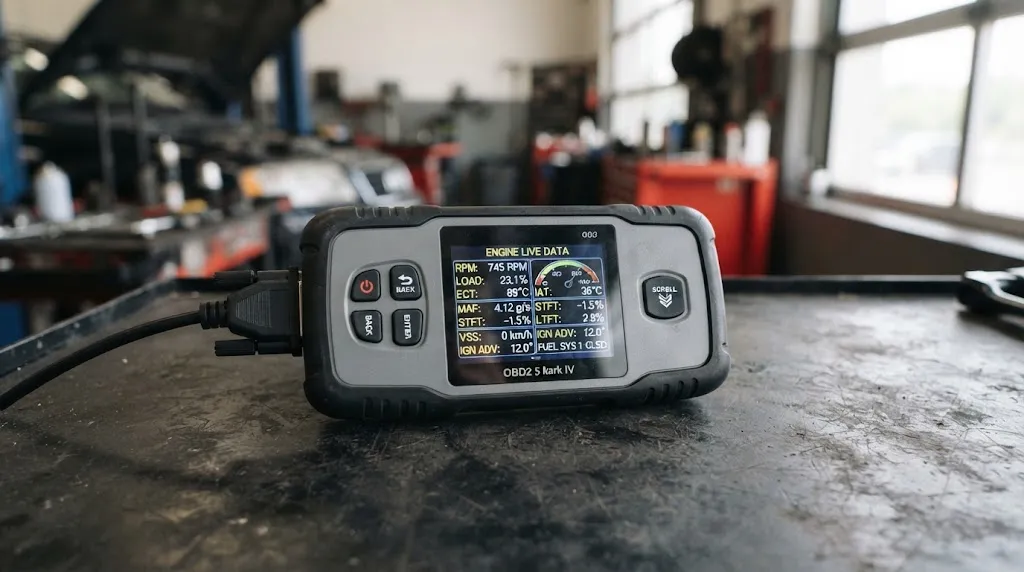
A basic code read is only the surface. Check several layers together, because no single layer tells the full story.
1. Pending codes: the earliest formal warning
A pending code means the system detected a fault during the current or last driving cycle, but it has not yet met the conditions for a confirmed code and a light. Think of it as a first failed test, not a final verdict.
A pending code deserves attention, not panic. Note it, rescan after a normal drive, and watch whether it returns or becomes stored. For the full lifecycle of a first-trip fault, see what a pending fault code means.
2. Stored codes with no light: the quiet record
A stored, or confirmed, code can exist even when the light is off, for example when the fault did not repeat and the light later turned off. In that moment, the scanner record matters more than the dashboard.
Do not clear it just to see if it returns without recording it first. Clearing erases the evidence and resets the monitors. See why a code can be stored while the check engine light is off.
3. Freeze-frame data: the moment the fault happened
Freeze frame is a snapshot captured when a fault was set: engine speed, load, coolant temperature, fuel trim, and vehicle speed at that moment. It does not prove the cause, but it narrows the search.
A fault at cold start points in a different direction from the same code at highway load, and high fuel trim at capture points toward air, fuel, or measurement issues. Read it before clearing anything; if no frame appears, not every code carries one.
4. Live data: drift before failure
Live data shows what sensors report right now, where a hidden problem often appears first as drift. High long-term fuel trim on one bank, a slow oxygen sensor, coolant temperature that never reaches normal, or a climbing misfire counter can all suggest a developing issue.
Live data needs comparison, not one snapshot. Watch the same values at idle, steady cruise, and light acceleration, and look for a pattern that follows the symptom. A single odd reading is a clue; a repeatable pattern is stronger evidence. See how accurate OBD2 live data is.
5. Monitor and Mode 06 test results: tests that have not finished or are near a limit
Readiness monitors show whether self-tests have run since codes were last cleared. A monitor stuck at “not ready” after normal driving can mean the test conditions were never met, or a fault is blocking the test.
Mode 06 results on many cars show on-board tests with limits, so a component can pass while sitting close to its limit. Test names and units vary by maker, so treat this as supporting evidence, not a prediction.
Key Insight
A code tells you the computer detected a fault. Live data and test results tell you how the system is behaving. Hidden problems are usually found in the second kind of evidence, before they become the first.
A Practical Hidden-Problem Check
Use this order when the car feels off, when checking a car you may buy, or when you want an early warning. Record results before clearing anything.
- Read stored, pending, and permanent codes separately. A pending code is an early warning; a permanent code usually needs the fault fixed and monitors passed before it clears.
- Check freeze frame for any code found. Note load, temperature, speed, and fuel trim at the moment of the fault, and whether the conditions match when you notice a symptom.
- Check readiness monitors. If several monitors are not ready, a clean code list is incomplete. The car may have been cleared recently, or a test may be blocked.
- Watch live data under different conditions. Focus on fuel trims, oxygen sensor behaviour, coolant temperature, engine load, and misfire counters. Look for a pattern, not one odd number.
- Rescan after a normal drive. Intermittent faults often need warm-up, cruise, and a restart to reappear.
If the same code or pattern returns across drives, you have a consistent lead. If it stays clear after varied driving, note it anyway: a borderline fault that returns in different conditions is not the same as one that never returns.
What a Clean Scan Does Not Prove

A scan with no codes is useful, but it has hard limits. Understanding them prevents both false reassurance and unnecessary worry.
First, generic OBD2 is centred on emissions-related powertrain data. A basic scanner may not reach transmission, braking, airbag, body, or other modules, or show maker-specific codes. See the overview of what an OBD2 scanner can tell you, and an EPA evaluation of OBD scan tools distinguishing generic from enhanced data.
Second, OBD2 reports sensor results, not direct mechanical condition. It cannot measure worn bearings, a weakening timing chain, low compression on its own, or a leak no sensor monitors. Noise, vibration, fluid loss, or a smell with no code still needs mechanical inspection.
Third, a fault below the detection threshold stays invisible by design. A low misfire rate, a slowly drifting sensor, or a leak too small for the monitor will not set a code until conditions change, so symptoms still matter.
Fourth, a recent clear hides history: it resets monitors and freeze frame, so no codes may simply mean the tests have not run yet.
Warning
Do not clear codes before a purchase inspection, an emissions test, or a repair diagnosis. Clearing removes the evidence a technician or buyer needs, resets the monitors, and can make a returning fault look like a new one.
When a Hidden Finding Matters, and When to Watch It
Not every hidden finding needs immediate repair. Use the pattern, not the label alone.
Act sooner when a pending code becomes stored, a live-data pattern repeats, a misfire counter climbs on one cylinder, or fuel trim is far from normal on one bank. A flashing light, loss of power, overheating, or a strong fuel smell means stop and get help, regardless of the scan.
Watch and recheck when a single pending code does not return, a test result sits near but inside its limit, or a monitor is not ready only for lack of a varied drive. Record the date, mileage, code or value, and conditions, then rescan after a few normal trips.
If no codes appear but the symptom persists, the next step may be a maker-specific or module scan, a mechanical check, or professional diagnosis. See why a scanner can return zero codes.
Common Mistakes That Hide the Hidden Problem
- Only reading the first screen. Pending codes, freeze frame, and readiness often sit on separate screens.
- Clearing first and asking questions later. Clearing before recording destroys freeze frame and monitor history.
- Judging live data from one idle reading. Compare idle, cruise, and acceleration.
- Treating a code as a part name. A code names a detected condition, not necessarily the failed part.
- Assuming a generic scanner sees everything. If the problem is outside generic powertrain coverage, a clean generic scan is expected, not reassuring.
Tip
Before any repair, save or photograph the code list, freeze frame, monitor status, and any unusual live-data values. That snapshot is often more useful than a remembered code number alone.
Related Product
OBD2 Scanner
A scanner that shows pending codes, freeze frame, live data, and readiness monitors makes the hidden-problem check above possible without guessing from the dashboard alone.
As an Amazon Associate, we earn from qualifying purchases.
Frequently Asked Questions
Can OBD2 find a problem with no check engine light?
Yes, in many cases. Pending codes, stored codes with the light off, freeze-frame data, and drifting live-data values can all appear before the light turns on. A scan that checks all of those layers is much more useful than a stored-code-only read.
Does no codes mean my engine is healthy?
No. It means no monitored fault crossed the computer’s threshold at the time of the scan. Mechanical wear, problems outside generic powertrain coverage, faults below the threshold, and tests that have not yet run can all exist with no codes.
Can OBD2 predict that a part will fail soon?
Not reliably as a prediction. It can show a trend, such as a test result near its limit or a sensor responding more slowly, but that is not a forecast of when failure will happen. Treat it as a reason to monitor and inspect, not as a certain failure date.
Why would a problem show in live data but not as a code?
Because codes usually require a fault to repeat or cross a defined limit. Live data can show drift, a slow sensor, or an imbalance before that limit is reached. That is why a repeatable live-data pattern matters even when the code list is empty.
Can a basic code reader find hidden problems, or do I need an enhanced scanner?
A basic reader can find many hidden problems if it shows pending codes, freeze frame, live data, and readiness. An enhanced, maker-specific scanner adds coverage for other modules and maker-specific codes, which matters when the problem is outside generic powertrain data.
Should I clear a pending code I just found?
No, not before recording it. Note the code, freeze frame, and monitor status first, then drive normally and rescan. Clearing too early removes the evidence and resets the monitors, making it harder to tell whether the fault is returning or was a one-off event.
Conclusion
OBD2 is most useful as a set of layers, not just a light reader. Pending and stored codes catch faults before or without a light, freeze frame places a fault in its driving conditions, live data shows drift before failure, and monitor results warn when a clean list is incomplete. None of that replaces a mechanical inspection or predicts failure, but used in order, recorded before clearing, and rechecked after a normal drive, it gives you a chance to act while a pattern is still small.

I’m Alex Rahman, a car enthusiast and automotive writer focused on practical solutions, car tools, and real-world driving advice. I share simple and honest content to help everyday drivers make better decisions.
