Can OBD2 Diagnose Transmission Solenoid Problems?
Quick Answer
Yes, an OBD2 scanner can help diagnose transmission solenoid problems by retrieving fault codes such as P0750 and P0755. However, basic scanners may not access all transmission control module (TCM) codes or live data. Even when a solenoid-related code appears, it does not prove the solenoid itself has failed. Wiring, connectors, fluid pressure, and mechanical issues may require additional testing.
A transmission that shifts harshly, hesitates between gears, or becomes stuck in one gear can leave you wondering whether a faulty solenoid is responsible. Connecting an OBD2 scanner seems like a logical first step, but what can the scanner actually tell you?
The useful distinction is between detecting a solenoid-related fault and confirming a defective solenoid. The first is often possible with OBD2. The second may require electrical testing, transmission-specific data, and checks of the hydraulic system.
Understanding that difference can prevent unnecessary parts replacement and help you decide whether your existing scanner is enough.
How Does OBD2 Detect Transmission Solenoid Problems?
OBD2 detects transmission solenoid problems by retrieving diagnostic trouble codes generated when the vehicle’s control system identifies abnormal electrical or transmission operating conditions.
In a typical electronically controlled automatic transmission, the transmission control module (TCM) or powertrain control module (PCM) manages solenoids that help regulate hydraulic fluid flow and gear changes.
These solenoids respond to electrical commands from the controller. Depending on the transmission design, they may control shift timing, pressure regulation, torque converter clutch operation, or related functions.
The control system may detect a problem when:
- A solenoid circuit has an open or short circuit.
- Electrical current or voltage differs from the expected range.
- A commanded gear change does not produce the expected transmission response.
- Pressure control or shift performance falls outside monitored limits.
When the relevant diagnostic criteria are met, the controller may store a fault code. A compatible scanner can retrieve that code through the vehicle’s diagnostic connector.
For example, Nissan transmission service documentation describes how the control module can detect an improper voltage drop while operating a shift solenoid. Possible causes include the solenoid itself and its wiring or connectors.
This is why an electrical solenoid code is best treated as evidence of a circuit or control problem, rather than automatic confirmation that an internal transmission component needs replacement.
Which OBD2 Codes Indicate Transmission Solenoid Problems?
Several diagnostic trouble codes can point toward shift solenoids, pressure-control solenoids, or related transmission systems. Their exact interpretation depends on the vehicle and the diagnostic definition.
| OBD2 Code | General Description | Diagnostic Direction |
|---|---|---|
| P0750 | Shift Solenoid A Malfunction | Check solenoid operation and associated electrical circuit. |
| P0751 | Shift Solenoid A Performance or Stuck Off | Investigate shift performance, solenoid operation, and possible hydraulic restrictions. |
| P0752 | Shift Solenoid A Stuck On | Check whether solenoid or hydraulic operation matches the command. |
| P0753 | Shift Solenoid A Electrical | Inspect wiring, connectors, solenoid coil, and control circuit. |
| P0755 | Shift Solenoid B Malfunction | Investigate the B solenoid circuit and operation. |
| P0756 | Shift Solenoid B Performance or Stuck Off | Evaluate operating response and possible hydraulic or electrical causes. |
| P0758 | Shift Solenoid B Electrical | Check the B solenoid’s electrical circuit. |
| P0745 | Pressure Control Solenoid A Malfunction | Check the pressure-control circuit and hydraulic regulation. |
| P0700 | Transmission Control System Malfunction | Retrieve additional transmission control codes; this is not a specific solenoid diagnosis. |
The distinction between performance and electrical codes matters. An electrical code may make wiring or coil testing a higher priority, while a performance code may require closer examination of hydraulic pressure, valve-body operation, and gear engagement.
Also, some transmissions use additional solenoids identified as C, D, or other designations. Manufacturer-specific codes may provide more precise information than a generic code reader displays.
What if Your Scanner Only Shows P0700?
P0700 is a general transmission control system warning. It does not identify which solenoid, sensor, circuit, or mechanical component is responsible.
On vehicles that use this code, it commonly indicates that the transmission controller has requested illumination of the check engine light.
For example, a basic scanner might show P0700 while a more capable scanner reveals an additional solenoid-related fault stored in the TCM.
For a deeper explanation of code coverage, see our guide to which transmission codes OBD2 scanners can read.
Can a Basic OBD2 Scanner Diagnose a Bad Shift Solenoid?
A basic OBD2 scanner can sometimes detect a shift solenoid fault, but it usually cannot perform a complete diagnosis.
Generic OBD2 diagnostics primarily cover standardized emissions-related powertrain information. Some transmission faults are available through that system, while other codes and parameters require manufacturer-specific access.
According to Snap-on’s OBD-II diagnostic documentation, accessing additional vehicle-specific control-module data requires enhanced scanner functions rather than generic OBD2 alone.
The practical differences are:
| Capability | Basic OBD2 Reader | Enhanced Scanner |
|---|---|---|
| Read generic transmission-related P-codes | Often | Yes, when supported |
| Read manufacturer-specific TCM codes | Usually unavailable | Vehicle-dependent |
| View transmission live data | Limited or unavailable | Often supported |
| Command solenoids during testing | No | Some bidirectional tools |
| Measure actual coil resistance | No | No; separate electrical testing is needed |
An enhanced scanner does not automatically support every transmission function. Coverage depends on the scanner software, vehicle manufacturer, model year, transmission design, and available diagnostic protocols.
Before relying on a particular tool, confirm that it supports the exact vehicle and provides access to the required transmission module and functions.
How to Check Transmission Solenoid Problems With an OBD2 Scanner

The most useful first approach is to collect diagnostic evidence before clearing codes or replacing components.
- Park safely. Place the vehicle on level ground, apply the parking brake, and follow the scanner manufacturer’s connection instructions.
- Connect the OBD2 scanner. Locate the diagnostic connector, generally beneath the dashboard on OBD2-equipped passenger vehicles, and connect the scanner securely.
- Switch on the ignition. Use the ignition state specified by the scan tool. Many code-reading procedures use ignition on with the engine off.
- Read stored, pending, and available history codes. Record the exact code numbers and descriptions rather than relying only on a simplified scanner explanation.
- Check the transmission module. If the tool supports enhanced diagnostics, select the TCM, transmission, or appropriate powertrain control system.
- Review freeze-frame or failure-record information. Where supported, note operating conditions such as vehicle speed, engine speed, transmission temperature, and the circumstances under which the fault occurred.
- Inspect available transmission live data. Check whether relevant shift commands and transmission responses appear consistent.
- Compare the results with manufacturer diagnostic procedures. Use the exact vehicle’s service information to decide whether electrical, hydraulic, or mechanical checks are appropriate.
For step-by-step instructions on accessing the relevant control module, see our guide to scanning the transmission control module.
Diagnostic Tip
Save the codes and available failure data before clearing anything. An intermittent solenoid or wiring problem may be difficult to reproduce, and clearing stored information can remove evidence needed for diagnosis.
Which Transmission Live Data Can Help Confirm a Solenoid Fault?
Transmission live data can help determine whether the control module’s requested operation matches the transmission’s measured response.
Not all vehicles expose the same parameters. Depending on scanner coverage and transmission design, useful information may include:
- Commanded gear: The gear or operating state requested by the transmission controller.
- Actual or calculated gear: The operating gear inferred from available sensors.
- Input or turbine speed: A measurement related to transmission input rotation.
- Output shaft speed: A measurement of transmission output rotation.
- Solenoid command or duty cycle: The controller’s requested electrical operation, where available.
- Transmission fluid temperature: Helps establish the operating conditions under which a fault occurs.
- Pressure-related data: May show commanded pressure or sensor feedback on compatible transmissions.
Suppose a vehicle’s TCM commands a gear change, but transmission speed readings suggest the expected gear ratio was not achieved. That mismatch could support further investigation of solenoid operation, hydraulic pressure, or internal transmission components.
However, it would not identify a defective solenoid by itself.
Likewise, a displayed solenoid command confirms what the controller requested, not necessarily that the solenoid physically moved or that the required hydraulic pressure developed.
Our explanation of how OBD2 live data works provides useful background on interpreting changing scanner readings.
What Can Cause a Solenoid Trouble Code Besides a Failed Solenoid?
A solenoid code can result from several electrical or transmission operating problems. The likely causes depend heavily on whether the code describes an electrical circuit fault or an operating performance fault.
Damaged Wiring or Corroded Connectors
Broken conductors, damaged insulation, loose terminals, and corroded connectors can interrupt the electrical circuit between the controller and solenoid.
For circuit-related faults, inspecting accessible wiring and connectors is often an appropriate early check.
Where transmission wiring passes through an external connector into an internal harness, a fault can exist on either side of that connection.
Contaminated or Incorrect Transmission Fluid
Automatic transmission fluid supports hydraulic operation, lubrication, and cooling. Incorrect fluid, inadequate fluid quantity, or contamination can interfere with normal shifting.
Such conditions may contribute to pressure or shift performance problems, but they do not necessarily explain a code specifically reporting an open or shorted solenoid circuit.
Fluid checks must follow the manufacturer’s procedure because many modern transmissions have temperature-dependent level requirements or no conventional dipstick.
Valve Body or Hydraulic Problems
Shift solenoids interact with hydraulic passages and valves. Even when a solenoid’s electrical circuit is functioning, a sticking valve, restricted passage, or pressure loss may prevent the expected transmission response.
In these cases, replacing a solenoid without investigating the hydraulic system may not correct the problem.
Control Module or Power Supply Faults
Power supply, ground, or controller driver problems can also affect solenoid operation. However, a faulty TCM should not be assumed merely because a transmission fault code appears.
Control-module diagnosis generally requires checking supply voltage, ground integrity, electrical circuits, communication, and the manufacturer’s diagnostic test results.
Key Insight
A solenoid electrical code and a solenoid performance code are not interchangeable. Electrical faults direct attention toward the circuit, while performance faults may require additional hydraulic and mechanical investigation. Both need vehicle-specific confirmation before a repair decision.
How Do You Confirm Whether a Transmission Solenoid Is Actually Bad?
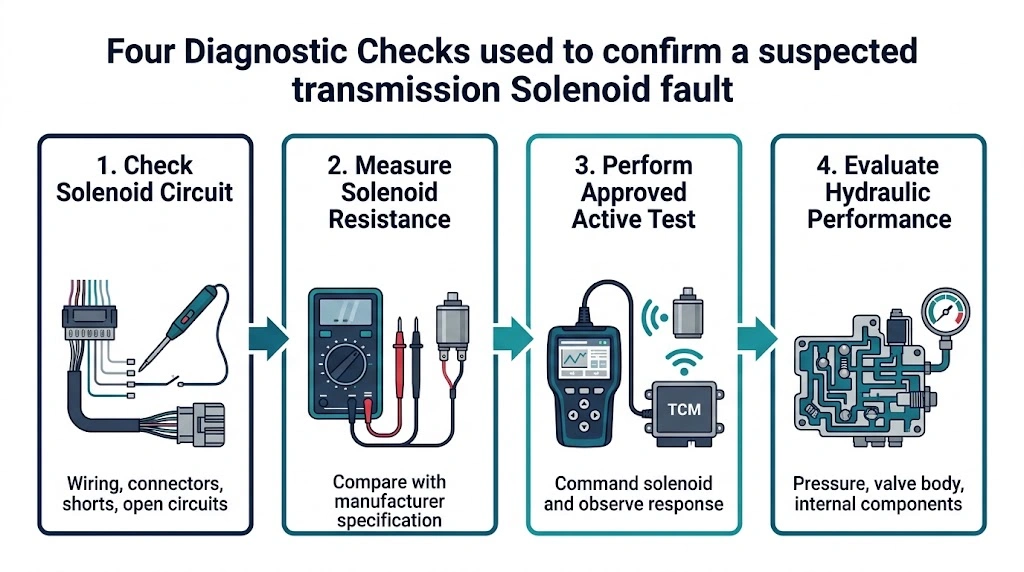
Confirmation usually involves comparing OBD2 results with physical and electrical tests specified by the vehicle manufacturer.
1. Check the Solenoid Circuit
A technician may inspect connector condition and test the electrical circuit for open circuits, shorts, excessive resistance, or supply and ground problems.
The exact test points depend on whether the solenoid is controlled through a dedicated TCM, integrated PCM, or another arrangement.
2. Measure Solenoid Resistance When Applicable
Some solenoids can be checked using a digital multimeter and a manufacturer-provided resistance specification.
An out-of-specification measurement can indicate an electrical fault. However, normal resistance does not guarantee that the solenoid moves correctly or regulates hydraulic flow.
Resistance values vary significantly by solenoid type and vehicle. Do not use a generic resistance number as a universal pass-or-fail threshold.
3. Perform a Manufacturer-Approved Active Test
On supported vehicles, a bidirectional diagnostic scanner can command selected solenoids or transmission functions under controlled conditions.
This may help determine whether an electrical command produces the expected response.
However, some active tests require specific fluid temperatures, engine conditions, transmission positions, or other safety prerequisites. They should only be performed according to the manufacturer’s service procedure.
4. Evaluate Hydraulic Performance When Needed
If the electrical circuit checks out but the transmission does not respond correctly, further diagnosis may involve hydraulic pressure tests, valve-body inspection, or evaluation of internal mechanical components.
These procedures commonly require specialist equipment and vehicle-specific service information.
A useful example of the diagnostic distinction appears in Nissan automatic transmission service documentation, which identifies solenoid wiring and the solenoid itself as potential causes of certain electrical fault codes.
Can a Transmission Solenoid Be Bad Without an OBD2 Code?
Yes. A transmission solenoid can malfunction without producing a code that your scanner can retrieve.
This can happen for several reasons:
- The scanner does not support the necessary manufacturer-specific diagnostic information.
- The malfunction is intermittent and has not met the controller’s fault-detection conditions.
- The solenoid has a mechanical or hydraulic problem that is not detected by the applicable monitor.
- The vehicle’s control system does not monitor the particular failure mode directly.
- The fault exists in a transmission that has limited electronic monitoring.
For example, a solenoid may have an electrically functional coil but still fail to control fluid flow correctly because of mechanical sticking or contamination.
In such a situation, a resistance test or basic code scan may appear normal even though transmission operation remains abnormal.
Therefore, a scanner showing no codes does not automatically rule out a transmission solenoid problem.
Which Symptoms Suggest a Transmission Solenoid Problem?
Solenoid-related problems can produce noticeable changes in automatic transmission operation, although none of these symptoms is exclusive to a solenoid fault.
- Harsh shifting: Gear changes feel unusually abrupt or forceful.
- Delayed engagement: The transmission takes longer than expected to engage Drive or Reverse.
- Missing or incorrect shifts: The transmission does not change gears as expected.
- Stuck in a gear: The vehicle may operate in a restricted gear range or protective mode.
- Slipping or engine flare: Engine speed rises without the expected increase in vehicle speed.
- Warning lights: A check engine light or transmission warning indicator may appear.
These symptoms can also result from low hydraulic pressure, clutch wear, speed sensor faults, transmission fluid problems, or other control-system failures.
The most useful approach is to combine the symptoms with diagnostic codes, operating data, and appropriate physical tests instead of identifying a solenoid as the cause from symptoms alone.
When Should You Stop Driving With a Suspected Solenoid Problem?
Driving should be avoided when the transmission is slipping severely, losing drive, engaging unpredictably, or producing other symptoms that make vehicle control unreliable.
Continued operation with abnormal hydraulic pressure or significant slipping may contribute to further transmission damage, depending on the underlying fault.
Pay particular attention to these conditions:
- The vehicle unexpectedly loses acceleration or drive.
- Gears engage with severe impacts or unpredictable behavior.
- The transmission repeatedly slips under light acceleration.
- There is an obvious burning smell or evidence of significant fluid leakage.
- A transmission temperature warning appears or overheating is suspected.
Warning
If the transmission is severely slipping, overheating, losing drive, or shifting unpredictably, avoid further driving and arrange professional assessment or towing. Do not attempt road testing or scanner-controlled solenoid activation under unsafe conditions.
Should You Replace a Solenoid Based Only on an OBD2 Code?

No. Replacing a transmission solenoid based only on a diagnostic trouble code can result in an unnecessary repair if the actual problem lies elsewhere.
Consider a hypothetical vehicle with code P0753, which indicates an electrical problem involving Shift Solenoid A.
Possible diagnostic outcomes include:
- Damaged external wiring: Repairing the harness may resolve the fault without opening the transmission.
- Corroded connector: Correcting the connection may restore proper circuit operation.
- Failed solenoid coil: Replacement may be appropriate if vehicle-specific testing confirms the defect.
- Controller or internal harness problem: Further electrical diagnosis may be required before replacing any solenoid.
The code provides a diagnostic starting point. The test results determine which repair is justified.
After a confirmed repair, follow the manufacturer’s procedure for verifying the fix. This may involve clearing codes, monitoring live data, completing a prescribed drive cycle, or performing a transmission relearn when required.
Frequently Asked Questions
Can OBD2 tell which transmission solenoid is bad?
Sometimes. A code such as P0750 or P0755 can identify a particular solenoid-related system or circuit. However, it does not prove that the named solenoid has failed. Wiring and other causes must still be considered.
Do I need a special OBD2 scanner for transmission solenoids?
A basic OBD2 reader may retrieve some generic transmission-related codes. For detailed TCM codes, transmission live data, and active testing, an enhanced scanner with confirmed vehicle-specific coverage is usually more useful.
Will a bad transmission solenoid trigger the check engine light?
It can, particularly when a monitored electrical or transmission fault meets the conditions for requesting the malfunction indicator light. However, not every solenoid failure illuminates the check engine light.
Can a cheap Bluetooth OBD2 scanner detect shift solenoid faults?
A Bluetooth adapter paired with suitable software may retrieve generic solenoid-related powertrain codes. Access to manufacturer-specific TCM faults and live data depends on the adapter, software, vehicle, and supported diagnostic functions.
Can I clear a transmission solenoid code and keep driving?
Clearing a code does not fix the underlying problem. If the fault remains, the code or symptoms may return. Preserve diagnostic information first, and avoid driving when transmission behavior makes operation unsafe.
Can OBD2 test a transmission solenoid directly?
Some enhanced bidirectional scan tools can command specific transmission solenoids during manufacturer-approved active tests. A basic generic OBD2 reader generally cannot perform these tests, and even an active test may need supporting electrical or hydraulic checks.
Final Verdict: How Reliable Is OBD2 for Solenoid Diagnosis?
OBD2 is a valuable starting point for diagnosing transmission solenoid problems. It can reveal relevant trouble codes, identify the affected control circuit, and, with compatible enhanced diagnostics, provide operating data that helps narrow the possibilities.
Its main limitation is that a detected fault is not the same as a confirmed failed component.
If your basic scanner shows a solenoid code or a general transmission fault such as P0700, record the results and determine whether more detailed TCM access is needed. If the vehicle shows severe shifting problems, avoid continued driving until the cause is assessed.
The most reliable diagnosis combines OBD2 evidence with vehicle-specific service procedures, electrical inspection, and hydraulic or mechanical testing when appropriate. This helps identify the actual fault before deciding which component, if any, needs replacement.

I’m Alex Rahman, a car enthusiast and automotive writer focused on practical solutions, car tools, and real-world driving advice. I share simple and honest content to help everyday drivers make better decisions.
