Can OBD2 Detect an EGR Problem? Signs, Codes & Limits
Quick Answer
Yes, in most cases. OBD2 can detect an EGR problem when the system’s flow, position, or control circuit moves outside what the engine computer expects, and it usually stores an EGR-related code such as P0401. It does not, however, prove which part failed, and an early or intermittent fault can exist before any code appears.
A check engine light with an EGR code is a starting point, not a finished diagnosis. The code tells you which system behaved abnormally, not whether the valve is stuck, a passage is blocked, a sensor is reading wrong, or a wire has failed. Replacing the valve first can therefore miss the real cause.
This guide explains what OBD2 watches, which codes point to the EGR system, what live data adds, and where OBD2 reaches its limit.
What the EGR system does, in plain terms
EGR sends a measured amount of exhaust gas back into the intake. Because that gas does not burn like fresh air and fuel, it lowers peak combustion temperature and generally reduces nitrogen oxide (NOx) formation.
The engine computer controls when and how much EGR flows. Some flow is normal at idle and light cruising, but it is usually reduced or stopped during cold starts, wide-open throttle, and high load. EGR flow is therefore a controlled amount that should change with speed, load, and temperature.
That control is why OBD2 can check the system: the computer knows what it commanded, and can compare it with pressure, position, or airflow signals that should change when EGR opens and closes.
What OBD2 actually watches
OBD2 does not look inside the valve. It watches valve position, the control circuit, changes in manifold pressure when EGR opens, and related readings such as fuel trim and airflow.
If the computer commands EGR open but manifold pressure does not change as expected, it may judge flow too low. If flow continues when the valve should be closed, it may judge flow too high. A missing or stuck position signal may set a circuit or performance code instead.
Some vehicles also run a dedicated EGR monitor. It usually needs the right warm-up, speed, and load conditions before it can complete, which is why a fault can take more than one drive to set a code.
If you want the broader picture first, what OBD2 can detect explains the systems it monitors and its general limits. For the emissions side specifically, how OBD2 monitors vehicle emissions puts the EGR monitor in context with the other emissions checks.
Which OBD2 codes point to an EGR problem
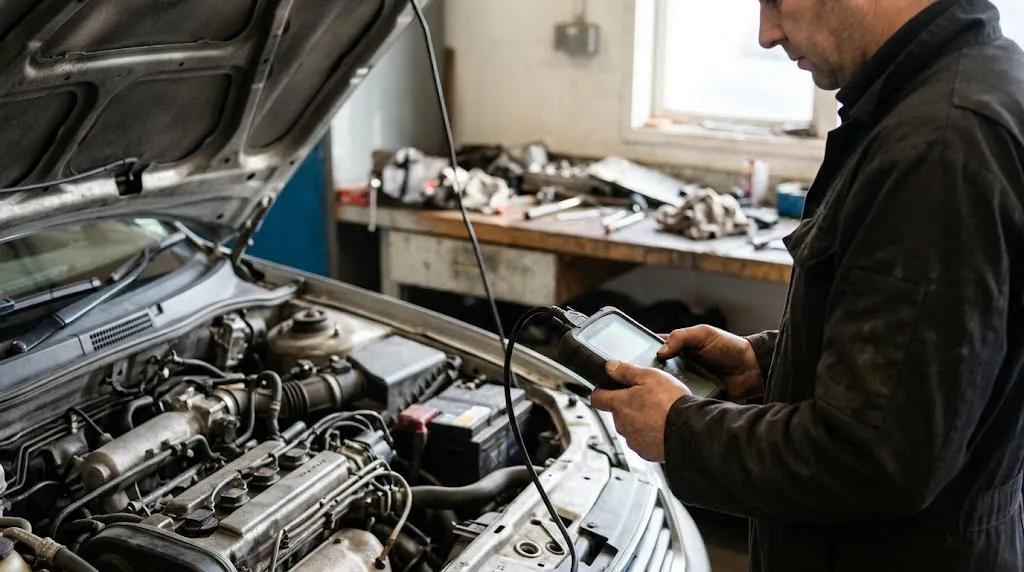
Generic EGR codes start with P04. They are a strong clue, not a parts list. Manufacturer-specific codes can add detail for a particular make, so always read the exact code and freeze-frame data before deciding what to check.
| Code | Usual meaning | What it often suggests |
|---|---|---|
| P0400 | EGR flow malfunction | General flow fault, not yet narrowed down |
| P0401 | Insufficient EGR flow detected | Blocked passage, valve not opening, or weak control |
| P0402 | Excessive EGR flow detected | Valve stuck open, leaking, or closing late |
| P0403 | EGR control circuit malfunction | Electrical fault in the control circuit |
| P0404 | EGR range or performance problem | Valve moves, but not as commanded |
| P0405 / P0406 | EGR position sensor circuit low / high | Sensor signal or wiring problem |
P0401 is the code most drivers meet first. Carbon buildup is a common cause, because the valve may still move while gas cannot pass freely. A vacuum leak, faulty solenoid, or failed differential-pressure sensor can produce a similar result. P0402 points the other way: a valve stuck open can cause rough idle, stalling, and hesitation, but the code identifies excessive flow, not its exact mechanical reason.
EGR codes can also appear with lean, misfire, or airflow codes when incorrect flow disturbs combustion. Treat the EGR code as one part of that pattern.
What a basic scanner shows, and what a better scan adds
A basic code reader answers one question well: is there a stored, pending, or permanent EGR code? That alone is often enough to stop guessing about whether the check engine light is EGR-related at all.
A scanner with live data answers a second question: does the EGR system respond when commanded? Watch commanded and actual EGR position, manifold pressure, and fuel trim where supported. If the command changes but position and pressure do not, the valve or passage is a stronger suspect. If position follows the command but flow still looks wrong, a blocked passage or sensor error becomes more likely.
Freeze-frame data records speed, load, and temperature at the moment the fault was set. That helps explain why a fault appears under load but not on a short town drive.
How to use OBD2 live data explains how to read those values without chasing every number on the screen. The key habit is simple: compare the command with the response, and compare the same reading before and after EGR changes state.
Key Insight
A code points to a system and a behaviour. Live data points to whether the valve moved, whether flow followed, and whether the sensor signal makes sense. That combination is what turns an EGR code into a diagnosis.
A practical check order for an EGR code
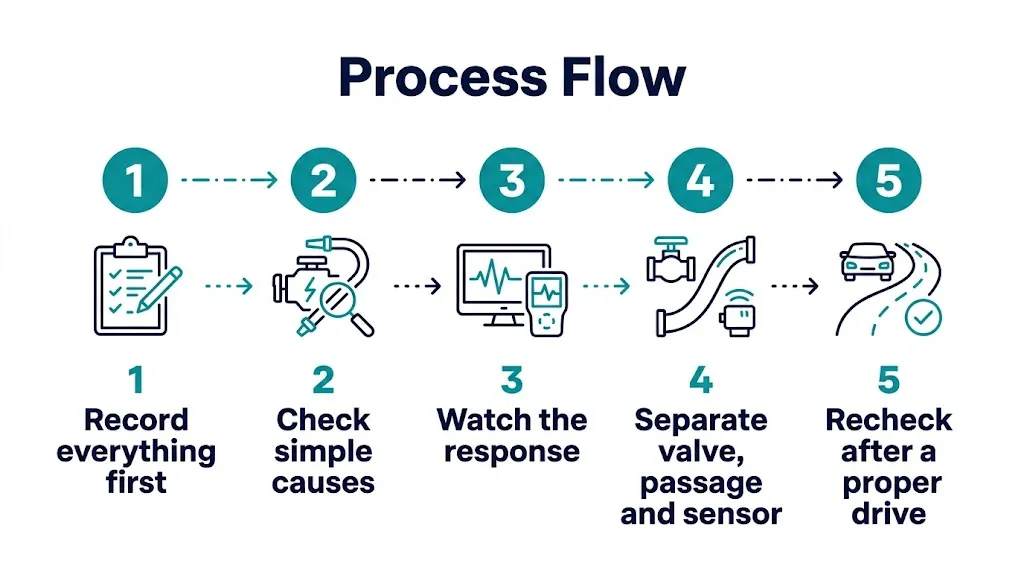
Work from the least invasive check outward, so parts are not replaced before the evidence narrows the fault.
- Record everything first. Note all codes, pending codes, freeze-frame data, and monitor status before clearing anything. Clearing codes also resets readiness monitors.
- Check the simple causes. Look for loose or damaged vacuum hoses, disconnected connectors, cracked pipes, and obvious carbon or soot around the EGR area, where it is safe and accessible to do so.
- Watch the response. With live data running, see whether commanded and actual EGR position move together, and whether manifold pressure or fuel trim changes when EGR activates.
- Separate valve, passage, and sensor. A valve that moves but gives no flow change points more toward a blocked passage. A frozen position signal points more toward the sensor or its wiring. A missing control signal points more toward the circuit.
- Recheck after a proper drive. After a repair, confirm the code does not return and the EGR monitor completes. A light staying off for one short trip is not the same as a completed monitor.
Some scanners can command the EGR valve open and closed for testing, but not all vehicles support this. A basic scanner can still be useful by watching normal driving data instead.
For a general diagnostic routine, how to diagnose a check engine light with OBD2 covers the same record-first approach for other faults too.
Can OBD2 detect an EGR problem with no code?
Sometimes, yes, but only indirectly. An early fault may show as a sluggish position signal, a small flow change, or unusual fuel trim before it crosses the threshold for a code. A pending code is another early sign: the system has seen a fault, but has not yet confirmed it enough times to turn on the light.
At other times, no. A partially blocked passage, small leak, or intermittent fault may stay inside the computer’s tolerance, especially if the monitor has not yet run. Symptoms such as rough idle, knocking under load, or poor fuel economy can exist without an EGR code, and they also overlap with ignition, fuel, and vacuum faults.
So “no code” does not mean “EGR is fine.” It means OBD2 has not confirmed a fault yet. If symptoms persist, live data and a visual check are more useful than repeated code-only scans.
What “EGR monitor not ready” means
An incomplete EGR monitor is not a fault code. It means the self-check has not finished, often after a cleared code, disconnected battery, recent repair, or driving that has not yet met the monitor’s conditions.
This matters for emissions testing: a vehicle can fail for incomplete monitors even with the light off. The fix is usually a proper drive cycle, not a new part, unless a fault keeps preventing completion.
To check that status before a test, see how to check OBD2 readiness monitors. If the monitor stays incomplete after varied driving, that pattern itself is worth investigating, rather than assuming the scanner is wrong.
Warning
Do not clear an EGR code just before an emissions test to hide the light. Clearing codes resets readiness monitors, and an incomplete monitor can itself cause a failed or rejected test. Record the code, fix the cause, then let the monitor complete.
What OBD2 cannot prove about an EGR fault
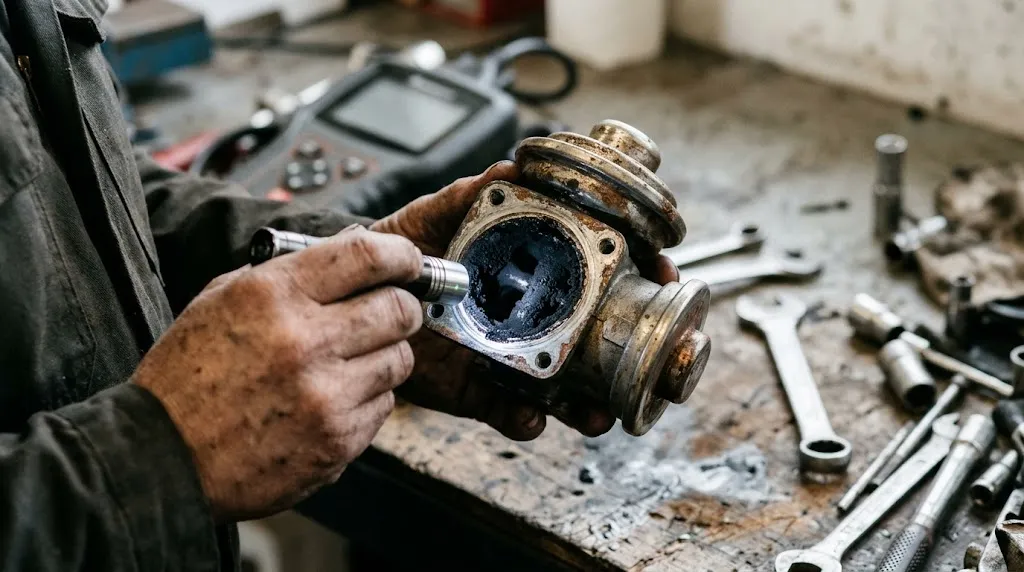
OBD2 cannot measure carbon thickness inside a passage or confirm that a replacement valve will fix the fault. A faulty differential-pressure sensor can make flow look wrong even when the valve works, and a vacuum problem can mimic a valve problem.
Vehicle design also changes the checks. Some systems use a vacuum valve, others an electric valve, and diesel systems often add an EGR cooler. The same generic code can therefore mean different checks on different vehicles.
The Tomorrow’s Technician guide to EGR operation and diagnostics explains how OBD2 monitors low and high flow faults. The Innova guide to confirming EGR issues with live data makes the same point: a code is a direction, and live data tests it.
Related Product
OBD2 Scanner with Live Data
A scanner that shows EGR position, manifold pressure, and readiness status makes an EGR code much easier to test, because you can watch the valve respond instead of guessing from the code alone.
As an Amazon Associate, we earn from qualifying purchases.
Frequently Asked Questions
Can OBD2 detect a bad EGR valve?
Yes, when the fault changes flow, position, or the control circuit enough to cross the computer’s threshold. It will usually store a P0400-series code, but the code alone does not prove the valve itself is the failed part.
What is the most common EGR code?
P0401, for insufficient EGR flow, is commonly seen. Carbon buildup in the passage, a valve that does not open fully, or a control or sensor fault can all lead to it, so further checks are still needed.
Will an EGR problem always turn on the check engine light?
No. A fault may first appear as a pending code, or as unusual live data, before it is confirmed. A monitor that has not run yet can also delay the light, even when symptoms are present.
Can I drive with an EGR code?
Short, careful driving to a repairer is often possible, but it depends on the symptoms. Rough idle, stalling, severe hesitation, overheating, or a flashing check engine light should not be ignored, and continued driving can risk further damage or an emissions failure.
Does clearing the code fix an EGR problem?
No. Clearing removes the stored code and resets readiness monitors, but it does not clean a passage, repair a valve, or fix a sensor. If the cause remains, the code will usually return after the monitor runs again.
Why is my EGR monitor not ready after a repair?
The monitor needs specific warm-up, speed, and load conditions to complete. After a code clear, battery disconnect, or repair, varied driving is usually needed. If it stays incomplete after that, an underlying fault may still be preventing completion.
Conclusion
OBD2 is a strong first test for an EGR problem. It can detect abnormal flow, a position or circuit fault, and an incomplete monitor, and it usually gives a clear code to work from. Its limit is just as clear: it reports behaviour, not the failed part. Record the code and freeze-frame data, watch commanded versus actual behaviour in live data, and let the monitor complete after any repair.

I’m Alex Rahman, a car enthusiast and automotive writer focused on practical solutions, car tools, and real-world driving advice. I share simple and honest content to help everyday drivers make better decisions.
