Can an OBD2 Scanner Work on Motorcycles?
Quick Answer
Sometimes, but not by simply plugging a car scanner straight in. Many newer, Euro 5 motorcycles can be read with a standard OBD2 scanner once you have the right adapter and a scanner that speaks the bike’s protocol, while many older or brand-specific bikes need a motorcycle-specific tool instead.
A motorcycle can have a fault code, a warning light, and an electronic control unit, yet still refuse to talk to the car scanner in your garage. It usually means one of three things is mismatched: the plug, the protocol, or the software that interprets the codes.
Cars in the United States have used a standard 16-pin OBD2 connector since 1996. Motorcycles were not brought under that same nationwide rule, so manufacturers kept more freedom over the port and software. The result is a patchwork, not a single yes-or-no answer.
Why a car scanner often does not just plug in
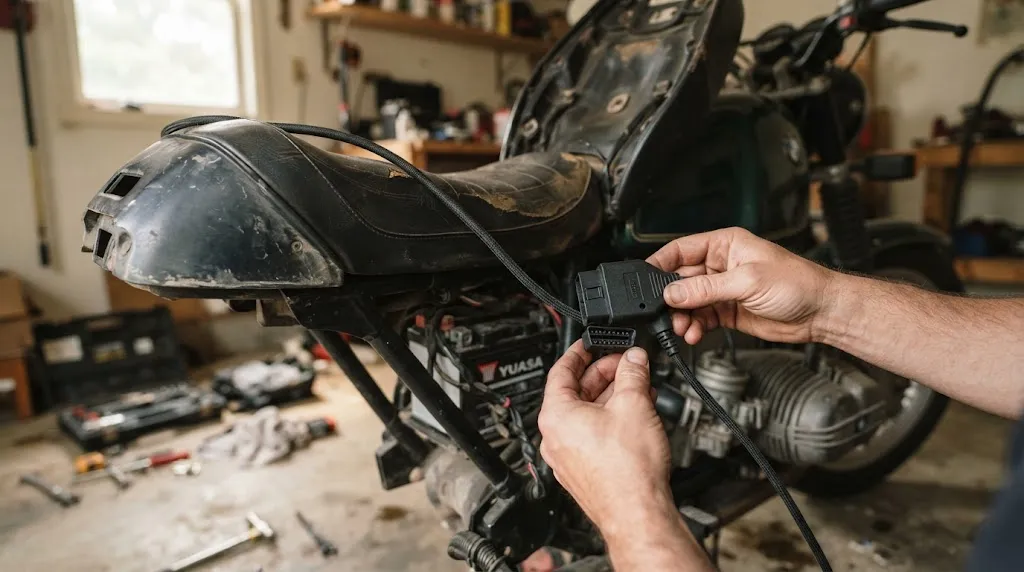
The first barrier is physical. A car OBD2 scanner expects a trapezoidal 16-pin socket. Many motorcycles use a much smaller connector, commonly with four or six pins, tucked under the seat, near the battery, or behind a side panel. Without an adapter, there is simply nowhere to plug the car tool in.
The second barrier is language. Even when an adapter makes the physical connection, the scanner and the bike still need a shared protocol. Modern Euro 5 bikes commonly use CAN bus or K-Line, which many car scanners can handle. Older bikes and some brand-specific systems may use a different protocol or manufacturer-specific codes that a generic scanner cannot interpret.
The third barrier is coverage. A generic scan can often read basic powertrain codes, but it may not reach ABS, traction control, or other brand-specific systems. A successful connection is not the same as a complete diagnosis, as which vehicles use OBD2 shows for car coverage.
What actually decides compatibility
Compatibility comes down to three checks, in this order. If any one fails, the scan will fail or give only partial results.
1. The connector
Find the bike’s diagnostic port first and identify its shape and pin count. Do not guess from the brand alone, because the same manufacturer can change connectors across models and model years. An adapter that fits physically does not guarantee that the wiring matches.
Connector size alone is a weak clue. Are OBD2 connectors standardized worldwide shows how even car connectors vary in practice, and motorcycles vary more. Check the owner’s manual for your exact model, and match the adapter to that port, not to a general claim that a scanner “works on motorcycles.”
2. The protocol
Next, check whether the scanner supports the bike’s protocol. CAN bus is the most useful starting point for newer bikes, and K-Line still appears on many models. If a scanner lists only car protocols without CAN or K-Line support, assume it will struggle on a motorcycle, even with the right adapter.
CAN is also where a common mix-up happens. On a car 16-pin connector, CAN High and CAN Low sit on pins 6 and 14, but that numbering does not transfer to a motorcycle’s 6-pin socket. What CAN pins are on an OBD2 connector explains the car layout, while a motorcycle adapter has its own pin mapping. Follow the adapter and bike documentation for your model.
What ISO 15765 means for OBD2 defines the CAN-based diagnostic communication used in many modern vehicles, but it does not prove that a particular motorcycle exposes every generic code.
3. The software and code coverage
Finally, check whether the scanner or app lists your make and model, or at least your bike’s diagnostic system, as supported. Generic powertrain codes, often called P0xxx codes, are the most likely to transfer. Manufacturer-specific codes, service resets, and system-specific tests are far less certain.
A dedicated motorcycle scanner is usually the safer choice when the bike is older, uses a proprietary system, or needs more than basic engine codes. The right choice depends on the bike, not on the scanner’s headline claim.
Key Insight
“OBD2-compatible” on a motorcycle usually means the diagnostic language is similar to car OBD2, not that the plug is the same. Adapter, protocol, and software must all line up before a car scanner is useful.
Euro 5 and the 6-pin connector: what changed, and what did not
European emissions rules pushed motorcycle diagnostics toward greater standardisation. Euro 4 requirements began to apply from 2017, and Euro 5 expanded diagnostic requirements from 2020. For many bikes sold under those rules, the practical result is a standardised motorcycle diagnostic connector defined by ISO 19689, commonly a small red 6-pin connector, often under the seat.
That connector typically carries battery power, ground, CAN High, CAN Low, and K-Line, which is why a 6-pin to 16-pin adapter can let a CAN-capable OBD2 scanner read many Euro 5 bikes. The AiM Euro 5 motorcycle OBD document describes that 6-pin layout and notes that manufacturers can still choose which data channels a standard tool can see. Standardisation improved access, but it did not make every bike expose the same data.
Euro 5 did not rewrite the whole world at once. A bike’s market, model year, and manufacturer still matter, and a bike sold outside Europe may not follow the same setup as an otherwise identical European model. In the United States, there is still no nationwide motorcycle equivalent of the 1996 car mandate, so the manufacturer often decides the port and software support.
How to check your own bike, in order
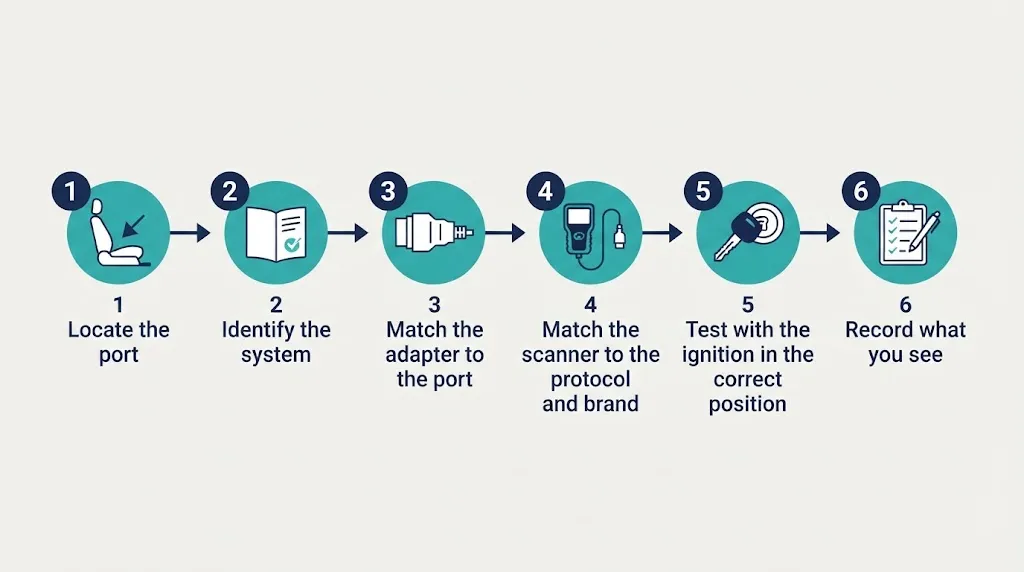
Use this sequence before buying a scanner or an adapter. It avoids the most common waste: a tool that fits, powers up, and then reports no communication.
- Locate the port. Check under the seat, near the battery, and behind side panels. Your owner’s manual is the fastest reliable source.
- Identify the system. Look for Euro 5 compliance, a 6-pin ISO 19689 connector, or a brand-specific diagnostic name in the manual. A model-year guess is not enough.
- Match the adapter to the port. Buy the adapter for your exact port type, and confirm that it covers CAN and K-Line if your bike uses both.
- Match the scanner to the protocol and brand. Confirm CAN support, and ideally your make and model, in the scanner’s compatibility list. A vague list is a warning, not a promise.
- Test with the ignition in the correct position. Many bikes need the ignition on, but not necessarily the engine running, for a scan.
- Record what you see. Note the codes, any live data that appears, and any systems the tool says it cannot reach.
What a working scan can and cannot show
When the three compatibility checks line up, a scan is genuinely useful for engine-related fault codes, basic live data where the bike exposes it, and checking whether a code returns after a repair.
Do not expect the same breadth as a car scan. A generic tool may miss manufacturer-specific codes, show no ABS or chassis data, or display a code without the brand-specific description. In that case, the code is a starting point for testing, not a part to replace on its own.
The same boundary applies elsewhere. Can an OBD2 scanner work on electric vehicles makes a similar point: a tool can connect and still cover only part of the vehicle. On a motorcycle, that partial coverage is often the engine and emissions-related systems, while other systems stay behind a brand-specific tool.
Clearing codes also needs care. Clearing a code does not repair a fault, and on some bikes it can erase information that would have helped diagnosis. If a warning returns quickly, or if the fault involves braking or throttle control, get it checked rather than repeatedly clearing the code and riding on.
Warning
Do not force a plug, swap pins by trial and error, or use an adapter made for a different port. A wrong connection can damage the diagnostic port, blow a fuse, or corrupt a scan, and a forced fit is not proof that the wiring is correct.
Common mistakes that look like a broken scanner
Many “scanner does not work on motorcycles” reports come down to an easy-to-miss mismatch: buying a 16-pin car scanner and assuming it will fit, pairing the right adapter with a car-only app that does not support the bike’s protocol, or testing an older bike with no standard diagnostic output.
Another mistake is reading “no codes found” as “nothing is wrong.” A generic scan can miss a manufacturer-specific fault, an intermittent fault, or a mechanical problem that never sets a code. Be equally cautious with universal-coverage claims: a tool that lists your bike, connector, and protocol is a far stronger sign.
So, should you use a car scanner or buy a motorcycle tool?
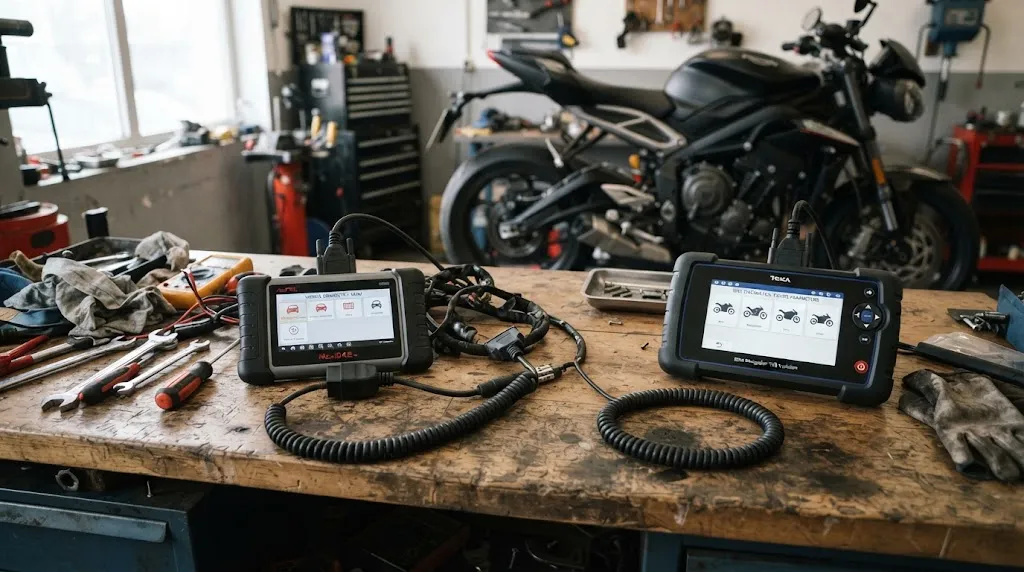
If you own a newer Euro 5 bike with a 6-pin connector and only need basic engine codes and live data, a CAN-capable car scanner plus the correct 6-pin to 16-pin adapter is a reasonable first try. Check compatibility for your exact model first, and keep your expectations to generic codes.
If your bike is older, uses a proprietary connector, needs ABS or service functions, or has already failed to communicate with a generic scanner, a motorcycle-specific tool is usually the better spend. The software and system coverage are what turn a connection into a diagnosis.
Related Product
Motorcycle OBD2 Scanner Adapter
A motorcycle-specific adapter or scanner helps you connect a standard OBD2 tool to a 4-pin or 6-pin bike port without guessing at the wiring.
As an Amazon Associate, we earn from qualifying purchases.
Frequently Asked Questions
Can I plug a car OBD2 scanner directly into a motorcycle?
Usually not. Most motorcycles do not have the car’s 16-pin socket, so you need an adapter that matches the bike’s port. Even then, the scanner must support the bike’s protocol and code system to return useful results.
Do all Euro 5 motorcycles work with a generic OBD2 scanner?
No. Many Euro 5 bikes use a 6-pin ISO 19689 connector with CAN or K-Line communication, but manufacturers can still limit which data channels a generic tool can see. Check your exact model and scanner compatibility list before assuming full coverage.
What adapter do I need for a motorcycle?
It depends on your bike’s port, most commonly a 4-pin or 6-pin adapter to a 16-pin OBD2 socket. Identify the port shape and pin count from your owner’s manual, then buy the adapter made for that exact port.
Why does my scanner say “no communication” on a motorcycle?
The most likely causes are the wrong adapter, a protocol the scanner does not support, the ignition not being in the correct position, or a bike system that a generic scanner cannot reach. Recheck the port, adapter mapping, protocol support, and model compatibility before concluding that the bike or scanner is faulty.
Can an OBD2 scanner read ABS codes on a motorcycle?
Sometimes, but often not with a generic car scanner. ABS and other chassis systems frequently need a motorcycle-specific or brand-specific tool. A generic scan that connects successfully may still show only engine-related codes.
Is it safe to clear a code on a motorcycle?
Reading codes is low risk when the correct adapter is used, but clearing a code does not fix the fault and can erase useful diagnostic history. Clear a code only after noting it and, where possible, after the underlying repair, and seek professional help for safety-related faults.
Conclusion
An OBD2 scanner can work on a motorcycle, but only when the bike, adapter, protocol, and software line up. Newer Euro 5 bikes give you the best chance with a CAN-capable scanner and the correct 6-pin adapter, while older or proprietary bikes are more likely to need a motorcycle-specific tool. Start by identifying your bike’s exact port and system, rather than buying a scanner on a universal claim, and treat a generic scan as a useful first check, not a complete diagnosis.

I’m Alex Rahman, a car enthusiast and automotive writer focused on practical solutions, car tools, and real-world driving advice. I share simple and honest content to help everyday drivers make better decisions.
