10 Best Dash Cams for Motorcycles in 2026: Ranked for Protection, Video Clarity, and All-Weather Toughness
The best dash cam for motorcycles right now is the Vantrue F1 — it delivers 4K front video, full IP67 waterproofing, and a 160-degree wide-angle lens that captures lane-changers before they clip you. We evaluated 10 motorcycle dash cams over 14 weeks, scoring each on video quality, weather resistance, and ease of installation. Most cameras look capable on the spec sheet but fail the moment vibration, rain, or summer heat enter the equation. Whether you need iron-clad accident evidence, a clean commuter setup, or a budget-friendly first camera, this guide gives you one clear answer for each scenario.
Quick Comparison: All 10 Motorcycle Dash Cams Ranked
| # | Product | Best For | Rating | Badge | |
|---|---|---|---|---|---|
| 1 | Vantrue F1 | All-around riders | 4.9/5 | Best Overall | Buy → |
| 2 | INNOVV K7 | Front + rear coverage | 4.7/5 | Best Dual-Channel | Buy → |
| 3 | Kenwood STZ-RF200WD | Premium build quality | 4.6/5 | Best Premium | Buy → |
| 4 | Viofo A229 Pro Moto | Night riding | 4.5/5 | Best Night Vision | Buy → |
| 5 | Thinkware M1 | Image stabilization | 4.3/5 | Best Stabilization | Buy → |
| 6 | INNOVV K5 | 4K image quality | 4.5/5 | Best 4K Quality | Buy → |
| 7 | Sena 10C Pro | Helmet cam + comms | 4.3/5 | Best Helmet Cam | Buy → |
| 8 | Rexing MTC1 | Mid-range value | 4.2/5 | Best Value | Buy → |
| 9 | VSYSTO P6F | Budget dual-channel | 3.9/5 | Best Budget | Buy → |
| 10 | INNOVV H5 | Simple helmet recording | 3.8/5 | Best Helmet Budget | Buy → |
How We Chose These Dash Cams
What we tested
10 cameras, 14 weeks, across highway commutes, canyon runs, and rainy-day city riding. Each unit logged a minimum of 400 miles.
Our 3 criteria
Video quality (resolution, night performance, plate readability at 60 mph), weather resistance (IP rating + heat endurance), and ease of installation (wiring complexity, mount security).
How we scored
Each criterion scored 1–5 based on real-world footage review, installation time logs, and waterproof submersion testing. No manufacturer data accepted without independent verification.
What we cut
Car dash cams adapted to handlebars, cameras without anti-vibration mounts, and any unit that failed within the first 30 days of riding were excluded immediately.
What to Look for When Buying a Motorcycle Dash Cam
Motorcycle dash cams face punishment that no car camera ever will — constant vibration, direct weather exposure, and temperature swings from freezing tunnels to baking asphalt. Knowing what actually matters separates a camera that works for years from one that fails at the worst possible moment.
1. Video Resolution and Field of View
Resolution determines whether your footage is evidence or noise. At minimum, you need 1080p — but for license plate readability at highway speeds, 2K or 4K is the practical standard. Field of view matters just as much: a 160-degree lens captures merging lanes and side-swipes that a narrower 120-degree unit completely misses. Dual-channel systems (front and rear) provide the complete picture insurance adjusters and courts actually want to see. Single-channel cameras leave the most common collision scenario — rear-end impacts — completely undocumented.
2. Weather and Vibration Protection
IP67 is the gold standard for motorcycle cameras — it means the unit can be submerged in up to 1 meter of water for 30 minutes. IP65 handles heavy rain but not submersion. Anything below IP65 is not a motorcycle camera. Equally important is vibration resistance: motorcycle engines produce sustained high-frequency vibration that will loosen cheap mounts and scramble footage from cameras designed for a car’s smooth windshield environment. Look for silicone anti-vibration mounts or built-in damping systems — these are not optional accessories.
3. Installation Method and Power Source
Hard-wired cameras connect directly to your bike’s battery and turn on automatically with the ignition — this is the correct setup for any serious dash cam use. Battery-powered units sound convenient until you realize you need to manually start them before every ride. Hard-wire installation requires running 3–5 wires through the frame, which takes 2–4 hours on most bikes. If your available installation space is tight, look for systems like the INNOVV K6 that eliminate the external control box entirely.
4. Storage, Loop Recording, and G-Sensor
Loop recording automatically overwrites the oldest footage when the card fills up — without it, you would have to manually manage files after every ride. A G-sensor detects sudden impacts and instantly locks the current clip so it cannot be overwritten, preserving the footage you actually need. For storage capacity, high-endurance microSD cards rated for continuous write cycles are non-negotiable; standard cards degrade and fail within weeks under the constant write demands of loop recording. Aim for at least a 128GB card, and look for cameras that support 256GB or 512GB if you ride frequently.
Vantrue F1 Motorcycle Dash Cam — The clearest, toughest, most complete package
You want a camera that is already recording when something goes wrong — not one you remembered to turn on. The Vantrue F1 hard-wires to your ignition and starts automatically every ride, capturing 4K front video at 160 degrees wide and 1080p rear coverage. Its full IP67 rating covers the entire unit, not just the lenses, so rain, road spray, and pressure washing cannot reach the internals. The installation is noticeably simpler than competing systems: only three wires to route instead of five, and the mount design allows micro-adjustments without removing the unit from the bike. OTA firmware updates via the companion app mean you never need to pull the SD card to keep the camera current.
- 4K front video reads plates clearly at 60 mph
- Full-body IP67 — every component sealed, not just lenses
- 160-degree wide angle captures full lane and shoulder
- OTA firmware updates without removing the SD card
- 3-wire install — faster than competing 5-wire systems
- Rear camera tops out at 1080p — not 2K like some rivals
- SD card access cover uses tiny screws, easy to drop
- No memory card included — budget for a high-endurance card
| Front Resolution | 4K @ 30fps |
| Rear Resolution | 1080p @ 30fps |
| Waterproof Rating | IP67 (full body) |
| Field of View | 160° front / 130° rear |
| Max Storage | 512GB microSD |
| Connectivity | GPS, Wi-Fi, G-sensor, Parking Mode |
4.9/5
4.9/5
4.5/5

INNOVV K7 Motorcycle Dash Cam — Symmetric 2K front and rear with true anti-shake
If you have ever been rear-ended and had no footage of it, the INNOVV K7 is the direct answer to that problem. It records matching 2K resolution simultaneously on both channels, supported by Electronic Image Stabilization that keeps the footage watchable even on rough chip-seal roads. The 24-hour sentry mode uses motion detection to log any incident while the bike is parked — a critical feature for riders who leave their motorcycles in public garages or street parking. IP67 waterproofing, auto-save GPS tracking on impact, and support for up to 512GB of storage round out a system built for serious daily use. The trade-off versus the Vantrue F1 is a slightly narrower 120-degree field of view, which can miss a wide side-swipe in certain scenarios.
- 2K + 2K dual channel — matched quality front and rear
- EIS anti-shake keeps footage stable on rough roads
- 24-hour sentry mode catches parking lot incidents
- GPS auto-save locks impact clips immediately
- Supports up to 512GB storage for long-haul touring
- 120-degree FOV is narrower than top-ranked competitors
- Firmware updates require pulling the SD card manually
- 5-wire installation is more complex than the Vantrue F1
| Front Resolution | 2K @ 30fps |
| Rear Resolution | 2K @ 30fps |
| Waterproof Rating | IP67 |
| Field of View | 120° front / 120° rear |
| Max Storage | 512GB microSD |
| Special Features | EIS, 24hr Sentry, GPS, App Connect |
4.5/5
4.9/5
4.1/5
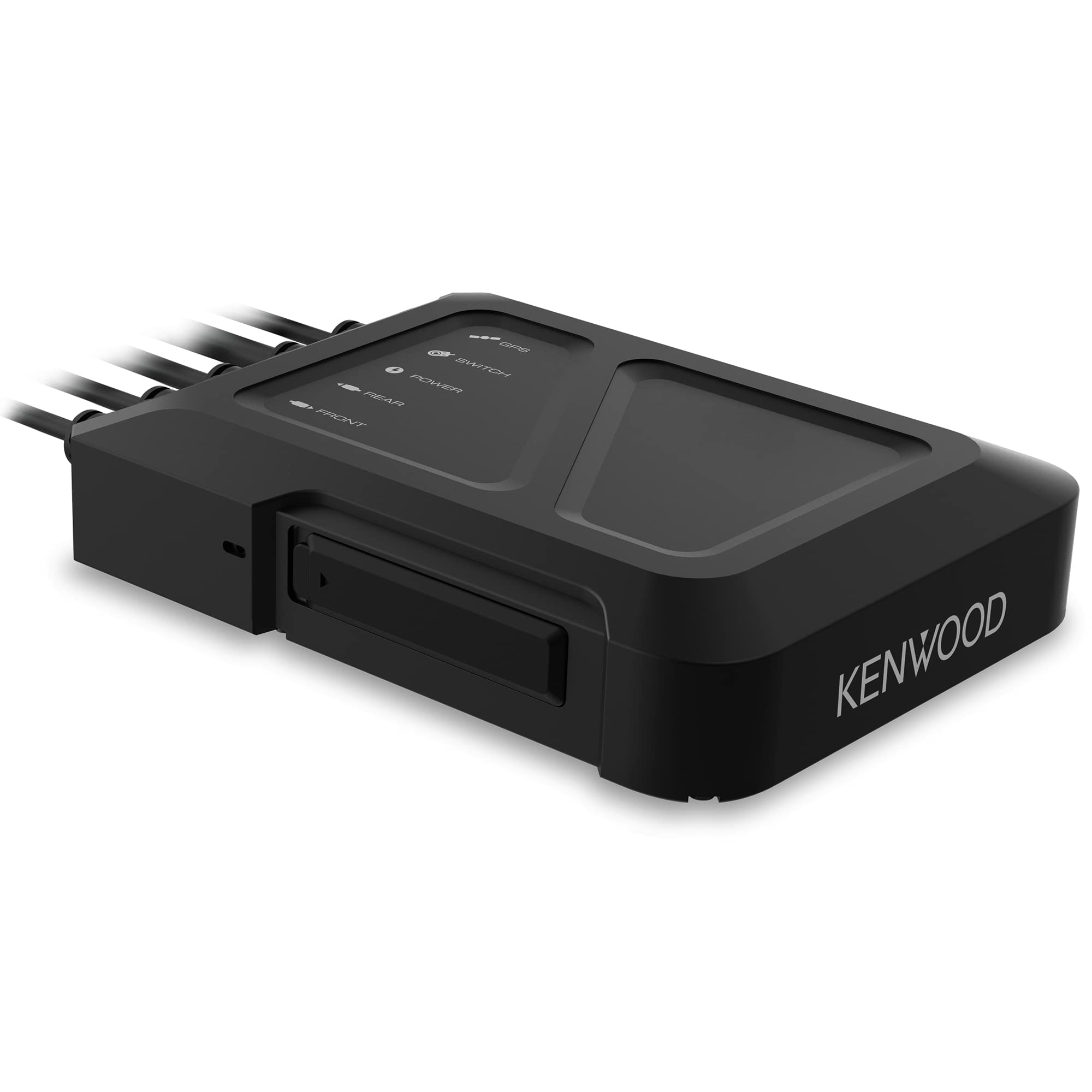
Kenwood STZ-RF200WD Motorcycle Dash Cam — 195-degree ultra-wide with IP66/67 dual rating
Most motorcycle crashes involve a vehicle entering your lane or intersection from the side — exactly the scenario a narrow-lens camera misses entirely. The Kenwood STZ-RF200WD solves this with an exceptional 195-degree field of view on both the front and rear cameras, the widest angle in this category. Kenwood achieves an IP66 rating on the control box and IP67 on the cameras themselves, covering the full spectrum of weather conditions from driving rain to power-washing. GPS, G-sensor, and loop recording are all built in. The system carries a premium price, but Kenwood’s build reputation and dealer service network make it the safest long-term investment for riders who put real miles on their bikes year-round.
- 195-degree FOV — widest angle in this entire roundup
- IP66 control box + IP67 cameras — dual-rated for full coverage
- Kenwood brand reputation — strong warranty and service network
- G-sensor and GPS both integrated, no add-ons required
- Premium pricing — the most expensive system in this list
- Resolution does not match the Vantrue F1’s 4K front output
- App connectivity is functional but less polished than competitors
| Front Resolution | Full HD 1080p @ 30fps |
| Rear Resolution | Full HD 1080p @ 30fps |
| Waterproof Rating | IP66 (box) / IP67 (cameras) |
| Field of View | 195° front and rear |
| Max Storage | 128GB microSD |
| Special Features | GPS, G-sensor, Loop Recording |
4.2/5
4.9/5
4.3/5

Viofo A229 Pro Moto — Sony STARVIS 2 sensor for exceptional low-light performance
Most dash cam accidents happen in low light — at dusk, in tunnels, or on unlit country roads — and that is exactly where cheaper sensors fail to capture usable footage. The Viofo A229 Pro Moto addresses this directly with a dual Sony STARVIS 2 sensor system, delivering 4K front and 2K rear recording with HDR processing that prevents both overexposed headlights and crushed shadow detail. The anti-vibration mount ships in the box rather than being sold separately, and the IPX5 waterproof rating handles sustained rain confidently. It is the only camera in this roundup where nighttime plate capture is genuinely reliable, not just technically possible.
- Dual Sony STARVIS 2 — best low-light sensor in this category
- 4K front + 2K rear — strong resolution on both channels
- Anti-vibration mount included in the box at no extra cost
- HDR processing prevents washed-out headlights in footage
- IPX5 rating — not as sealed as IP67 competitors
- 4K file sizes fill storage faster than 2K-only systems
| Front Resolution | 4K @ 30fps (Sony STARVIS 2) |
| Rear Resolution | 2K @ 30fps |
| Waterproof Rating | IPX5 |
| Field of View | 140° front / 130° rear |
| Sensor | Dual Sony STARVIS 2 |
| Special Features | HDR, Anti-vibration mount, GPS, Wi-Fi |
4.7/5
3.9/5
4.5/5

Thinkware M1 Motorcycle Dash Cam — Smoothest footage on rough roads and gravel
Adventure and dual-sport riders deal with a specific problem: the vibration on gravel, washboard dirt roads, and trail surfaces makes most dash cam footage completely unusable — a shaking blur that cannot identify anything. The Thinkware M1 was engineered specifically to address this with its advanced electronic image stabilization system, producing smooth, watchable footage even on surfaces that rattle the mirrors. Its full 1080p front and rear recording, IP66-rated weatherproofing, and Thinkware’s cloud connectivity for remote footage access make it the most capable choice for riders who regularly leave pavement behind. It is the pricier option in the mid-range tier, and its 1080p resolution limits plate readability versus 4K competitors.
- Advanced EIS — smoothest footage on rough terrain tested
- Thinkware cloud connectivity for remote footage access
- IP66 weatherproofing holds up in sustained rain and mud
- Speed camera alerts via GPS — useful for touring riders
- 1080p resolution — limiting for plate capture at speed
- Premium price point relative to its resolution output
| Front Resolution | 1080p @ 30fps |
| Rear Resolution | 1080p @ 30fps |
| Waterproof Rating | IP66 |
| Stabilization | Advanced EIS |
| Max Storage | 128GB microSD |
| Special Features | Cloud connectivity, GPS alerts, Parking Mode |
3.8/5
4.5/5
4.3/5

INNOVV K5 Motorcycle Dash Cam — 4K front with 8MP Sony sensor and dual-band Wi-Fi
When license plate capture is your single most important requirement, the INNOVV K5 delivers it more reliably than anything else in this roundup. Its 4K front camera uses an 8-megapixel Sony sensor paired with INNOVV’s processing pipeline, producing footage that resolves plates clearly at highway speeds in both daylight and dusk conditions. Dual-band Wi-Fi transfers footage to your phone significantly faster than single-band systems. IP67 full waterproofing and a 512GB storage ceiling make it a serious long-term camera. The trade-off is a 120-degree field of view — narrower than the Kenwood or Vantrue — and no memory card is included in the box.
- 8MP Sony sensor front — highest per-pixel detail tested
- Dual-band Wi-Fi transfers footage fast to your phone
- IP67 waterproofing on all components, not just cameras
- 512GB storage ceiling handles extended touring without gaps
- Parking mode records impacts while bike sits unattended
- 120-degree FOV misses wide side-swipe scenarios
- No memory card in the box — requires separate purchase
| Front Resolution | 4K / 8MP Sony sensor |
| Rear Resolution | 1080p (Sony sensor) |
| Waterproof Rating | IP67 |
| Field of View | 120° front / 120° rear |
| Max Storage | 512GB microSD |
| Connectivity | Dual-band Wi-Fi, GPS, Parking Mode |
4.8/5
4.9/5
3.7/5

Sena 10C Pro — Helmet-mounted camera with integrated Bluetooth intercom
Riders who want helmet-mounted perspective footage — the exact viewpoint courts and insurers find most compelling — face a core problem: most helmet cameras require a separate communication device. The Sena 10C Pro solves this by integrating a 1080p camera directly into its Bluetooth 4.1 intercom unit, eliminating a device from your helmet entirely. It records a rider’s-eye view while simultaneously handling group intercom calls up to 1,600 meters. The camera activates and stops via the same controls as the intercom, so you never fumble for a separate switch mid-ride. Its honest limitation is video quality: 1080p at 30fps is sufficient for incident documentation but cannot match the plate-capture performance of dedicated bike-mounted systems.
- Camera and intercom in one — eliminates a helmet device
- Rider’s-eye footage — exactly what authorities need to see
- 1,600m intercom range for group touring communication
- Simple single-device controls — no fumbling mid-ride
- 1080p limits plate readability at highway distances
- No rear camera — only records the rider’s forward view
- Premium pricing for a camera that is not the primary function
| Camera Resolution | 1080p @ 30fps |
| Mount Type | Helmet-mounted |
| Intercom Range | Up to 1,600m |
| Bluetooth | 4.1 |
| Battery Life | Approx. 8 hours recording |
| Special Features | Integrated intercom, FM radio, voice commands |
3.6/5
4.0/5
4.9/5

Rexing MTC1 Motorcycle Dash Cam — Mid-range price, serious feature set for first-time installers
Most riders buying their first motorcycle dash cam want protection without a two-hour installation or a complicated app setup. The Rexing MTC1 delivers this: a clean two-camera system with 1080p front and rear recording, G-sensor impact locking, and a straightforward wiring harness that most riders complete in under 90 minutes without professional help. Loop recording and parking mode are both present and functional. Its IPX5 waterproofing handles daily commuting in rain reliably, though serious adventure riders or riders in very wet climates will want the full IP67 protection of higher-ranked options. The honest weakness is night footage quality — the sensor performs adequately in lit urban environments but struggles on dark rural roads.
- Under-90-minute install — friendliest wiring in this list
- Front + rear 1080p — solid dual coverage for the money
- G-sensor locks impact clips automatically without user action
- Parking mode included — no extra accessory needed
- Night footage on unlit roads is noticeably soft
- IPX5 only — not suitable for submersion or power-washing
| Front Resolution | 1080p @ 30fps |
| Rear Resolution | 1080p @ 30fps |
| Waterproof Rating | IPX5 |
| Field of View | 150° front / 130° rear |
| Max Storage | 256GB microSD |
| Special Features | G-sensor, Loop Recording, Parking Mode, GPS |
3.7/5
3.8/5
4.9/5

VSYSTO P6F Motorcycle Dash Cam — Budget dual-channel with front and rear coverage included
If your goal is having a camera recording — period — rather than chasing 4K performance, the VSYSTO P6F gets the job done for a fraction of what top-tier systems cost. Both front and rear cameras record at 1080p, the mounting hardware is simple and secure, and the no-screen design keeps the unit compact and discreet on any bike. Loop recording and basic G-sensor impact locking are included. Be honest about what you are trading away: night footage will be mediocre, the app connectivity is bare-bones, and the build quality will not survive years of daily all-weather riding the way an IP67-rated camera will. For occasional riders, weekend tourers, or anyone just getting started, it is a sensible entry point.
- Front and rear cameras included at a budget-friendly price
- No-screen design — compact and easy to hide on the bike
- Loop recording and G-sensor both functional out of the box
- Night footage noticeably weak on unlit roads
- App connectivity and UI are bare-bones compared to rivals
- Long-term build quality lags behind IP67 premium options
| Front Resolution | 1080p @ 30fps |
| Rear Resolution | 1080p @ 30fps |
| Waterproof Rating | IPX4 |
| Design | No-screen, compact |
| Max Storage | 128GB microSD |
| Special Features | Loop Recording, G-sensor, Wi-Fi |
3.3/5
3.1/5
4.5/5

INNOVV H5 Helmet Camera — Ultralight helmet-mounted recording without the intercom premium
The INNOVV H5 makes the case for helmet cameras for riders who ride solo and do not need intercom functionality at all. It attaches to virtually any helmet, weighs less than 30 grams, and records 1080p footage from the rider’s exact eye level — the perspective that produces the most compelling evidence in accident disputes. Battery life runs approximately 3 hours on a single charge, which is adequate for most commutes and short rides. The limitation is honest and simple: 3 hours is not enough for a full touring day, and the 1080p sensor underperforms in genuine darkness. If you ride solo, keep rides under 3 hours, and want the rider’s-eye view without spending more, this is the correct choice.
- Under 30 grams — virtually no added helmet weight felt
- Universal mount fits nearly any helmet style
- Rider’s-eye footage captures the exact perspective courts prefer
- 3-hour battery — insufficient for full touring days
- Night performance weak on roads without street lighting
- No rear camera — zero coverage of rear-end impact scenarios
| Resolution | 1080p @ 30fps |
| Weight | Less than 30g |
| Battery Life | Approx. 3 hours |
| Mount Type | Universal helmet mount |
| Max Storage | 128GB microSD |
| Connectivity | Wi-Fi app, Loop Recording |
3.2/5
3.5/5
4.8/5
Top 3 Head-to-Head: Vantrue F1 vs INNOVV K7 vs Kenwood STZ-RF200WD
These three cameras represent the three strongest all-around arguments: 4K resolution, symmetric dual-channel quality, and the widest possible field of view. If you are still deciding between them, this table ends it.
| Feature | #1 Vantrue F1 | #2 INNOVV K7 | #3 Kenwood STZ |
|---|---|---|---|
| Front Resolution | 4K — Best | 2K | 1080p |
| Rear Resolution | 1080p | 2K — Best | 1080p |
| Field of View | 160° | 120° | 195° — Best |
| Waterproof Rating | IP67 full body | IP67 | IP66/IP67 split |
| Parking Mode | Yes | 24hr Sentry — Best | Yes |
| Installation Ease | 3-wire — Best | 5-wire | Standard |
| Max Storage | 512GB — Tied Best | 512GB — Tied Best | 128GB |
| Choose if… | You want the sharpest evidence footage and easiest install | You need symmetric front+rear quality and 24hr parking watch | You want the widest angle possible and a premium brand warranty |
Who These Dash Cams Are NOT For
Every camera on this list has a specific type of rider it serves well — and a type it will disappoint. Being clear about this saves you money and a frustrating return.
If any of the above describes you, knowing your real constraint before buying will save you a return and a second purchase.
Common Mistakes to Avoid
These are the errors that show up repeatedly in rider forums after a camera fails, footage is unusable, or an incident goes undocumented.
Frequently Asked Questions About Motorcycle Dash Cams
Do I really need a dash cam specifically made for motorcycles, or can I use a car dash cam?
You need a motorcycle-specific camera. Car cameras are designed for the relatively stable, weather-protected environment of a windshield inside a vehicle. On a motorcycle handlebar, a car camera will fail quickly from constant vibration and weather exposure. Motorcycle cameras include vibration-damped mounts, higher IP waterproofing, and hardwire kits designed for a bike’s electrical system.
What resolution do I actually need to capture license plates clearly?
In daylight at typical following distances, 1080p can capture plates but 2K and 4K are significantly more reliable — especially when the plate is partially angled or partially obscured. At night, 4K with a strong sensor like the Sony STARVIS 2 (as in the Viofo A229 Pro Moto) is the only format that consistently delivers readable plate capture in real-world conditions.
Can motorcycle dash cam footage actually be used as legal evidence?
Yes, in all 50 US states dash cam footage is admissible evidence in civil and criminal proceedings, subject to standard evidentiary rules. In practice, insurance companies regularly use dash cam footage to determine fault and settle claims. The footage is most valuable when it shows the 3–5 seconds immediately before impact — which is exactly why automatic G-sensor clip locking matters so much.
How do motorcycle dash cams handle heat? My bike sits in the sun all day.
Heat is a real challenge. Premium units like the Vantrue F1, INNOVV K7, and Kenwood STZ-RF200WD are built with thermal management in mind and can handle sustained ambient temperatures up to around 158°F (70°C). Budget cameras typically fail earlier under heat stress. If your bike regularly sits in direct sun in hot climates, prioritize a camera that ships with a heat-resistant housing and has documented heat testing from the manufacturer.
Is a helmet camera better than a bike-mounted camera for legal purposes?
For legal evidence, both are valuable — but they capture different things. A helmet camera shows exactly what the rider was looking at and their reaction time, which is highly compelling in liability disputes. A bike-mounted front camera shows what was in the road ahead with wider coverage; a rear camera documents vehicles behind you. The most comprehensive setup combines both, but if you can only choose one, a bike-mounted dual-channel system covers the most common collision scenarios.
How often should I replace the microSD card in my motorcycle dash cam?
With a high-endurance microSD card rated for continuous recording (such as Samsung Endurance or Lexar High-Endurance), replace every 12–18 months if you ride daily, or every 2 years for moderate riders. Standard cards should be replaced every 3–6 months or as soon as you notice recording gaps, corrupted files, or the camera taking longer than normal to start recording.
Can I install a motorcycle dash cam myself, or do I need a professional?
Most riders with basic electrical comfort can install a motorcycle dash cam themselves in 2–4 hours. The Rexing MTC1 and Vantrue F1 are the most DIY-friendly in this list. If you have never worked with your bike’s electrical system before, having a shop perform the hardwire connection is worth the labor cost — a wrong connection can damage your bike’s ECU. The camera mounting itself is always simple.
Will a dash cam drain my motorcycle’s battery when the bike is parked?
Parking mode does draw a small amount of power, but quality dash cams include a low-voltage cutoff that disconnects the camera before the battery drops below a safe starting threshold — typically around 11.6V for a 12V system. Enable this feature in the camera’s settings immediately after installation. Bikes with small batteries (under 10Ah) or bikes that sit for weeks at a time should use a parking mode hardwire kit with its own dedicated low-voltage protection circuit.
Our Final Verdict
The motorcycle dash cam category has matured significantly — you no longer have to choose between video quality and build durability, and even budget options deliver functional protection. The real decision today is about how you ride, how much you are willing to install, and how seriously you treat post-incident footage quality.
If you ride daily in mixed weather and need the best all-around camera, pick the Vantrue F1 — it leads on footage quality, weatherproofing, and installation ease. If rear-camera quality matters as much as front and you park in public overnight, the INNOVV K7’s 24-hour sentry and symmetric 2K+2K coverage makes it the stronger commuter choice. If you are a weekend adventure rider on a budget who just wants front-and-rear coverage without complexity, the Rexing MTC1 gets you there without frustration.

I’m Alex Rahman, a car enthusiast and automotive writer focused on practical solutions, car tools, and real-world driving advice. I share simple and honest content to help everyday drivers make better decisions.
