Is OBD2 a Protocol or a Standard? Explained Clearly
Quick Answer
OBD2 is a standard, not a single protocol. It is a set of agreed rules that covers the diagnostic connector, trouble codes, diagnostic services, and monitoring. Inside that standard, a vehicle uses one of several communication protocols, such as CAN, to carry the messages.
People ask this question for a practical reason. A scanner box may say “OBD2 protocol,” a forum post may call CAN the OBD2 protocol, and another source may call OBD2 a standard. In short, the standard is the whole rulebook, and a protocol is one way of sending messages under it.
So, Is OBD2 a Protocol or a Standard?
OBD2 is best described as a diagnostic standard. More precisely, it is a family of related standards, not one document with one title. Before OBD2, manufacturers used different connectors, codes, and procedures.
OBD2 changed that by fixing the parts that need to match: the shape and pins of the 16-pin diagnostic connector, the format of generic trouble codes, the diagnostic services a tool can request, and the emissions-related monitors a vehicle must run. A vehicle that meets those requirements is OBD2-compliant in the relevant sense, even if its internal wiring differs from another compliant vehicle.
Calling OBD2 “a protocol” is therefore incomplete. A protocol answers a narrower question: how are bits sent, framed, timed, and acknowledged between the tool and the vehicle? OBD2 allows more than one answer, and the standard says which answers are acceptable and what information must be available through them.
For a fuller overview, see what OBD2 is and what it does.
What a Standard Covers in OBD2
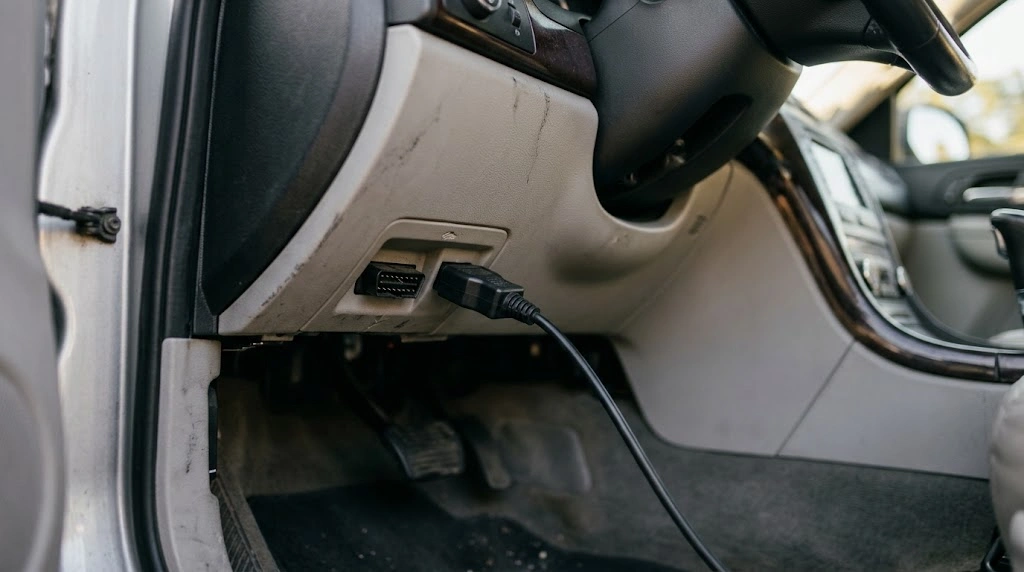
First, the standard covers the physical connection. SAE J1962 defines the 16-pin diagnostic link connector, including its shape and pin assignments. That is why a compliant tool can physically plug into cars from different manufacturers, even when the cars use different communication methods inside.
Second, it covers the diagnostic language at the application level. SAE J1979, published internationally as ISO 15031-5, defines emissions-related diagnostic services, often called modes, including live data, freeze-frame data, stored and pending trouble codes, vehicle information, and permanent codes.
Third, it covers code definitions. SAE J2012 defines the structure and meaning of generic diagnostic trouble codes, so a P0xxx code has the same basic meaning across compliant vehicles. Manufacturer-specific codes still exist, but they sit alongside the generic set rather than replacing it.
Fourth, it covers monitoring. OBD2 requires the vehicle to watch emissions-related systems, run readiness monitors, and store a fault when a problem could raise emissions beyond the allowed limit. The malfunction indicator lamp, often called the check-engine light, is part of that same system.
What a Protocol Does in OBD2
A protocol is a set of rules for communication. It covers how a message is started, how data is encoded, how fast it travels, how errors are handled, and how a response is recognised. If the standard is the rulebook for a diagnostic visit, the protocol is the conversation method used during that visit.
Two OBD2 vehicles can therefore return the same generic trouble code, such as a misfire code, while using different protocols to deliver it. The code meaning is standardised; the transport is not identical. So a tool needs both: it must understand the standard services and codes, and support that vehicle’s protocol.
That is also why a tool can fail even when the vehicle is OBD2-compliant. A CAN-only tool may work well on a modern car but fail on an older car that uses a K-line or J1850 protocol. The car has not broken the standard. The tool simply does not speak that car’s protocol.
Key Insight
“OBD2-compliant” does not mean “uses CAN.” It means the vehicle follows the OBD2 standard. CAN is now the dominant protocol inside that standard, but it is not the standard itself.
The Protocols That Sit Inside the OBD2 Standard

Traditionally, five protocol families are associated with OBD2. They are not five different standards competing with OBD2. They are five approved communication methods under it.
| Protocol family | Common association | Typical pins |
|---|---|---|
| SAE J1850 PWM | Older Ford-family vehicles | 2, 10 |
| SAE J1850 VPW | Older General Motors vehicles | 2 |
| ISO 9141-2 | Older European and Asian vehicles | 7, optional 15 |
| ISO 14230-4 KWP2000 | Later pre-CAN European and Asian vehicles | 7, optional 15 |
| ISO 15765-4 CAN | Modern vehicles; US from 2008 | 6, 14 |
The associations in the table are historical patterns, not identification rules. A manufacturer could change protocols by model, year, engine, or market. For a detailed comparison, see what OBD2 protocols are used.
CAN causes most of the confusion. CAN, or Controller Area Network, is a vehicle networking technology, and ISO 15765-4 specifies how emissions-related OBD diagnostics run over CAN. CAN is the road; OBD2 is the set of diagnostic rules for using that road for emissions checks. For that comparison in full, see the difference between OBD2 and CAN.
Why People Call OBD2 a Protocol Anyway
Loose language is the first reason. In casual writing, “OBD2 protocol” is often used as shorthand for “the way an OBD2 tool talks to a car.” That shorthand hides the fact that there is no single OBD2 protocol to name. When a product page says it supports the OBD2 protocol, the useful follow-up is: which protocols, exactly, does it support?
Marketing is the second reason. A tool that supports only CAN may still be sold as an OBD2 scanner, because CAN is the protocol most current cars use. That claim may be accurate for a 2015 car and misleading for a 2001 car. The label “OBD2” describes the diagnostic system, not a guarantee that every protocol family is included.
How the Pieces Fit Together
A simple layered picture helps. At the bottom is the physical connector, defined by SAE J1962. Above it is the communication protocol, such as CAN under ISO 15765-4, KWP2000 under ISO 14230-4, or one of the J1850 variants. Above that is the diagnostic application layer, defined by SAE J1979, which sets out the services and message formats. Code definitions from SAE J2012 then give those responses a shared meaning.
Consider a request for engine speed. The tool sends a service request for live data and a parameter identifier for engine speed, the protocol carries it to the vehicle, and the standard determines what the request means and how the value is scaled. Change the protocol, and the framing changes; keep the standard, and the diagnostic meaning stays comparable.
That layered view also explains why how CAN bus works with OBD2 is a different question from what OBD2 is. CAN explains the transport. OBD2 explains the diagnostic purpose, services, codes, and monitoring that run over that transport.
One more boundary matters. Manufacturer-specific diagnostics, advanced service functions, and systems such as ABS or airbags are not automatically part of generic OBD2, even when they use the same connector.
What This Means When You Choose or Use a Scanner
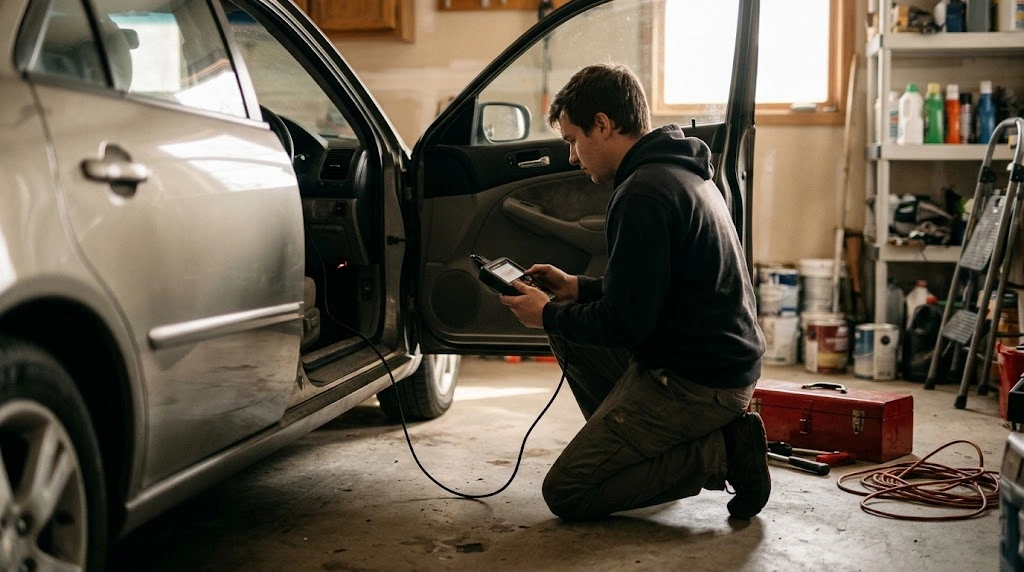
Start with the vehicle, not the label. If the car is a modern US light-duty vehicle from model year 2008 onward, CAN support is the key requirement for generic OBD2. If the car is older, check the supported protocol list before assuming a CAN-only adapter will connect.
Next, separate protocol support from diagnostic coverage. A scanner can connect through the correct protocol and still lack access to manufacturer-specific systems, service resets, or advanced functions. Protocol compatibility answers whether the tool can talk to the car. Coverage answers what it can ask about once connected.
Finally, use automatic protocol detection when the tool offers it, rather than forcing a protocol by guesswork. Forcing the wrong protocol will not change the vehicle’s hardware. If it fails, check ignition, contact, power, and the protocol list.
What OBD2 Is Not
OBD2 is not CAN, even though CAN is now its most common carrier. It is not UDS, or Unified Diagnostic Services, which is a separate, more extensive diagnostic protocol used for manufacturer-level work. It is not SAE J1939, the heavy-duty vehicle network protocol. And it is not the same as every regional variant: EOBD in Europe and JOBD in Japan share the same general idea, but their rules, dates, and details differ by market.
It is also not the same as OBD1. The earlier generation lacked the common connector, common codes, and common services that define OBD2. For that contrast, see the difference between OBD and OBD2. The change was not just a new protocol; it was a move toward a shared standard.
Keeping those boundaries clear prevents two common mistakes: assuming a CAN tool can read everything in a car, and assuming a car without CAN cannot be OBD2-compliant.
Related Product
Multi-Protocol OBD2 Scanner
A scanner that lists support for CAN, J1850 PWM and VPW, ISO 9141-2, and KWP2000 is a practical match for both modern and older OBD2 vehicles.
As an Amazon Associate, we earn from qualifying purchases.
Frequently Asked Questions
Is OBD2 the same as CAN?
No. OBD2 is the diagnostic standard, and CAN is a network technology that often carries OBD2 messages. ISO 15765-4 defines how OBD diagnostics run over CAN, but a car can use CAN for internal systems that generic OBD2 does not cover.
Does every OBD2 car use the same protocol?
No. A compliant car uses one of the approved protocol families for its generic OBD2 connection, and that choice varies by manufacturer, model, year, and market. Modern US light-duty cars from model year 2008 onward use CAN, while older cars may use J1850, ISO 9141-2, or KWP2000.
Is a protocol the same as a language?
It is a useful analogy, but only up to a point. A protocol is more like a set of rules for sending and recognising messages, including timing and framing, not just vocabulary. Two systems can share the same trouble-code meanings while sending messages by different protocol rules.
Why do some listings say “OBD2 protocol” in the singular?
Usually it is shorthand, or it refers to the protocol that particular tool supports, most often CAN. Treat the singular phrase as a prompt to check the full supported-protocol list, rather than as proof that only one OBD2 protocol exists.
Is EOBD a different standard from OBD2?
EOBD is the European equivalent in concept, with its own rules and introduction dates. It shares much of the OBD2 approach, including a standard connector and comparable diagnostic services, but regional requirements are not identical. Do not assume a US OBD2 rule applies unchanged in Europe.
Does a 16-pin port prove a car follows the OBD2 standard?
Not on its own. The 16-pin connector is defined by SAE J1962, but a similar-looking port can appear on a vehicle without full generic OBD2 support. Model year, market, emissions label, and a successful generic diagnostic connection are stronger checks than the shape of the port alone.
Conclusion
OBD2 is a standard that contains protocols, not a protocol on its own. The standard fixes the connector, the diagnostic services, the generic code meanings, and the monitoring a compliant vehicle must provide. The protocol fixes how those messages travel, and that job can be done by CAN, J1850, ISO 9141-2, or KWP2000, depending on the vehicle. Remembering that split makes scanner choices clearer: check the standard for what a tool should be able to ask, and check the protocol list for whether it can actually talk to your car.

I’m Alex Rahman, a car enthusiast and automotive writer focused on practical solutions, car tools, and real-world driving advice. I share simple and honest content to help everyday drivers make better decisions.
