Can OBD2 Diagnose an ABS Warning Light? | Leadfoot
Quick Answer
Yes, but only with a scanner that can talk to the ABS module. A basic generic OBD2 reader usually finds no ABS codes at all, even when the ABS light is on, because ABS faults live outside the standard emissions data it reads. With an ABS-capable tool for your exact make, model, and year, you can usually read the stored chassis code, compare live wheel speeds, and see whether the fault is still present after a repair.
That distinction explains most of the confusion. The same 16-pin port is used for both jobs, so it is easy to assume one scan covers everything. It does not: which systems a scanner can enter depends on its software.
What the ABS Light Is Actually Telling You

ABS stops the wheels from locking during hard braking so you can keep steering, by watching each wheel speed and rapidly adjusting brake pressure at a wheel slowing too fast compared with the others.
When the ABS module detects a fault, it turns on the amber ABS light and usually disables ABS as a precaution. On many cars ordinary braking still works, but anti-lock help will not be there in a hard stop or on a slippery surface, which is why a car can feel normal on dry roads while the light is on.
A brief light at switch-on is normally just a self-check. A light that stays on, or comes on while driving, means a fault is present or recorded. Note whether traction or stability lights come on with it, since those systems often share the same wheel-speed data.
Why a Basic OBD2 Scan Often Finds Nothing
Generic OBD2 was built around emissions. Its standard services cover powertrain codes, readiness monitors, and engine live data on any compliant car. Ross-Tech’s overview of generic OBD-II modes describes those modes as emissions-related functions, which is the key limit here.
ABS faults are stored in the ABS module, not in generic engine data. A basic reader that only asks the engine computer for powertrain codes will therefore report “no codes” while the ABS module holds a fault it never asked about. That does not mean the car is fine; it means the wrong question was asked.
The same limit applies to low-cost Bluetooth adapters. If the adapter and app have no ABS profile for that car, they cannot reach the ABS module, however well they read engine codes. See our guide to whether an ELM327 can read ABS codes.
What an ABS-Capable Scan Can Actually Show
An ABS-capable scanner asks the ABS module directly, using maker-specific requests for that vehicle. That turns a vague warning into a testable starting point.
| What you get | What it tells you |
|---|---|
| Stored ABS code | Which circuit or function the module flagged, often by wheel position |
| Live wheel speeds | Whether all four wheels report plausible, matching speeds while driving |
| Code status | Whether the fault is current, stored, or has cleared after a repair |
ABS codes are usually chassis codes, beginning with C, rather than powertrain P-codes. A familiar example is C0035, often linked to the left front wheel speed sensor circuit, but the same code can mean something different on another make, so read the definition for your exact vehicle.
Live data matters as much as the code. A sensor can pass a static check yet drop out at speed, or read zero while the other three read normally. That comparison differs from the single vehicle speed value in generic data, explained in our guide to what the vehicle speed PID shows. Freeze frame, which captures engine conditions for an emissions fault, is likewise not an ABS record, as explained in our guide to why freeze frame data is useful.
Key Insight
“No codes found” on a generic scan is not a clean bill of health for ABS. It usually means the scanner never reached the module that stores the fault.
How to Diagnose an ABS Light in a Sensible Order
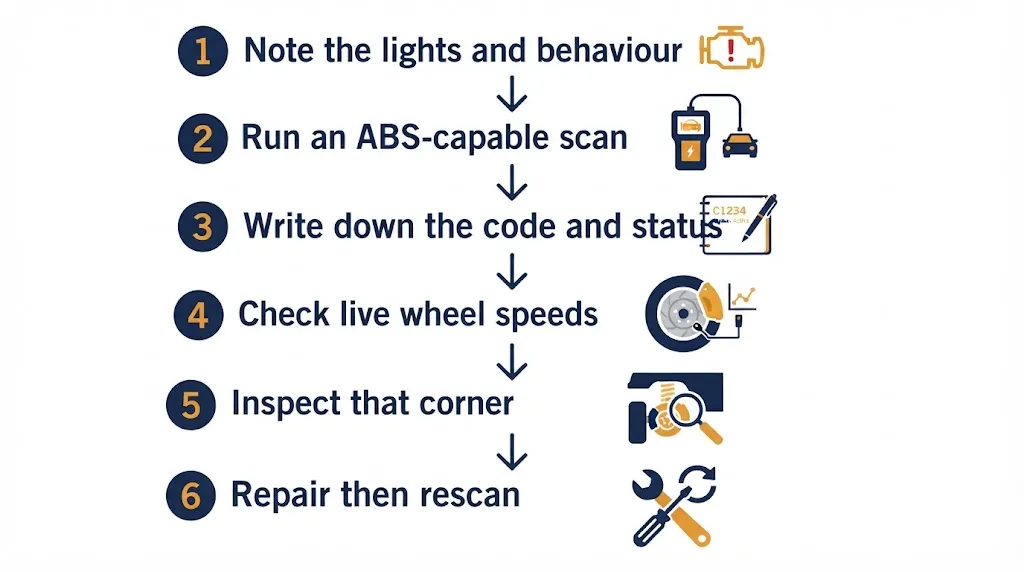
Work from the most likely checks toward the harder ones, and record the code before clearing anything.
- Note the lights and behaviour. Record whether only the ABS light is on, whether the red brake light is also on, and whether the fault is steady or intermittent.
- Run an ABS-capable scan. Select the exact make, model, and year, then read codes from the ABS module specifically, not just a generic engine scan.
- Write down the full code and status. Keep the code, its definition for your vehicle, and whether it is current or stored.
- Check live wheel speeds. With the car driven slowly and safely, compare all four readings. A wheel stuck at zero, jumping wildly, or dropping out points to that corner first.
- Inspect that corner. Look for damaged wiring, a loose or corroded connector, debris on the sensor or tone ring, and obvious physical damage.
- Repair, then rescan. Clear the ABS code only after the repair, then drive and rescan to confirm the fault does not return.
If the scanner cannot connect to the ABS module at all, that is itself a clue: the tool may lack coverage, or the module may not be communicating. A communication code from another module, such as U0121, points the same way and needs a different check than a single sensor code.
What the Common Results Usually Mean
Most ABS lights trace back to a small set of causes, but the code alone rarely proves which one. Use it to narrow the corner and circuit, then confirm with live data and inspection.
Wheel speed sensor or its circuit. This is the most common starting point: the sensor, wiring, or connector fails and the module loses a believable speed signal. Our guide to whether OBD2 can diagnose a wheel speed sensor explains why a code names a circuit rather than proving the sensor itself is dead.
Tone ring or debris. A cracked, rusted, or debris-covered tone ring can make the signal erratic even when the sensor is sound. Live data that drops out or fluctuates at certain speeds often fits this better than a clean zero reading.
Wiring and connectors. Flexing near the wheel, corrosion, and chafing can break the signal intermittently. If moving a harness changes the live reading, check the wiring before replacing any part.
Module, pump, or valve circuit. Codes for the pump motor, a solenoid, or the module itself are less common and harder to confirm at home. Multiple unrelated sensor codes at once point the same way. These cases are a good reason to get a professional diagnosis rather than replacing parts by guesswork.
Warning
Do not treat the ABS light like the check engine light. If the red brake warning light is on as well, braking itself may be affected. Stop safely, check brake fluid level only if you know how and it is safe to do so, and get the car checked before driving further. If the pedal feels soft, sinks, or the car pulls hard under braking, do not keep driving to test it.
When Clearing the Light Helps, and When It Does Not
Clearing an ABS code with an ABS-capable tool can turn the light off, but it does not repair anything. If the fault is still present, the module will usually set the code again and the light will return.
Clearing is useful after a repair, to confirm the fix and see whether the fault returns. Clearing before recording the code, or repeatedly without a repair, only hides the pattern a technician needs. Some faults also need a drive with turns and varied speeds before the module retests, so rescan after a proper drive before calling the job done.
ABS Light, Check Engine Light, and Other Warnings Are Not the Same Job

Drivers often use one scan for every dashboard light, but the lights belong to different systems. The check engine light is an emissions and powertrain warning, and a generic scan is designed for it. The ABS light is a chassis warning, and it needs chassis access.
Our guide to diagnosing a check engine light with OBD2 follows the engine-side sequence. The ABS sequence is parallel, but it starts in a different module, uses different codes, and ends with wheel-speed comparison rather than fuel trims or oxygen sensor readings.
Traction and stability lights that appear with the ABS light do not automatically mean three separate faults. All three rely on wheel-speed information, so one bad signal can disturb all of them. Fix the ABS fault first, then see which companion lights clear.
Tip
Before buying a scanner for this job, check for “ABS” listed for your exact make, model, and year, not just “OBD2 compatible.” Also confirm it can show live wheel speeds for all four wheels, since that single feature often separates a useful ABS tool from one that only reads and clears codes.
Related Product
ABS-Capable OBD2 Scanner
A scanner with ABS coverage for your exact vehicle lets you read chassis codes and compare live wheel speeds instead of getting a misleading “no codes” result from a generic reader.
As an Amazon Associate, we earn from qualifying purchases.
Frequently Asked Questions
Can a basic OBD2 scanner diagnose an ABS warning light?
Usually no. A basic generic scanner reads emissions-related powertrain codes from the engine computer, while ABS faults are stored in the ABS module. You need a scanner with ABS coverage for your vehicle to read those codes.
Why does my scanner say no codes when the ABS light is on?
Most often, the scanner never reached the ABS module. It may lack ABS support or coverage for your make and year, or be running only a generic engine scan.
Can OBD2 read ABS codes through the same port?
Yes, on many cars the ABS module is reached through the same 16-pin port, but through maker-specific requests rather than generic OBD2 services. The shared port does not mean every scanner can access every module.
Does clearing an ABS code fix the problem?
No. Clearing only erases the stored code and turns the light off until the module retests. If the fault remains, the code and light will return. Clear codes after a repair to confirm the fix, not as a substitute for one.
Is it safe to drive with the ABS light on?
On many cars ordinary braking still works while ABS is disabled, but you lose anti-lock help in hard or slippery stops. If the red brake light is also on, or braking feels abnormal, stop safely and get help rather than continuing to drive.
What should I check if the scanner cannot connect to the ABS module?
First confirm the tool lists ABS coverage for your exact make, model, and year and that you selected the ABS system, not just a generic scan. If coverage is correct and connection still fails, a module, power, or network fault is possible, and professional diagnosis is the sensible next step.
Conclusion
OBD2 can diagnose an ABS warning light, but only when the tool can reach the ABS module. A generic scan reporting no codes has usually missed the right system, not ruled out a fault. Get an ABS-specific code, compare live wheel speeds, inspect the corner the evidence points to, and rescan after any repair. If the red brake light joins the ABS light, or the scanner cannot reach the module, get professional help rather than clearing codes again.

I’m Alex Rahman, a car enthusiast and automotive writer focused on practical solutions, car tools, and real-world driving advice. I share simple and honest content to help everyday drivers make better decisions.
