Can OBD2 Diagnose an EVAP System Leak? What to Know
Quick Answer
Yes, an OBD2 scanner can diagnose an EVAP (Evaporative Emission Control) system leak, but with specific limitations. Basic OBD2 code readers can retrieve diagnostic trouble codes (DTCs) like P0442 or P0455 and monitor readiness monitors, but they cannot perform active system tests unless they are advanced bidirectional scan tools capable of commanding the EVAP purge and vent solenoids.
How the OBD2 System Detects EVAP Leaks

The vehicle’s Powertrain Control Module (PCM) continuously monitors the sealed fuel system to prevent raw fuel vapors from escaping into the atmosphere. When the computer detects pressure drops, flow anomalies, or a failure to maintain vacuum, it triggers a diagnostic trouble code.
Standard OBD2 systems perform self-tests under specific driving conditions—usually when the fuel level is between 15% and 85%, vehicle speed is steady, and engine load is minimal. If the PCM detects a leak equivalent to a hole 0.040 inches or 0.020 inches in diameter, it registers a fault code and illuminates the Check Engine Light.
Key Insight
An OBD2 scanner tells you that the computer has registered a sealed system fault, but it rarely points directly to the exact physical location of the leak.
Common OBD2 EVAP Diagnostic Trouble Codes
When an OBD2 scanner communicates with your vehicle’s computer, specific codes indicate the nature of the EVAP issue:
- P0440: General Evaporative Emission Control System Malfunction
- P0442: Evaporative Emission Control System Leak Detected (Small Leak)
- P0455: Evaporative Emission Control System Leak Detected (Gross Leak)
- P0446: Evaporative Emission Control System Vent Control Circuit Malfunction
- P0441: Evaporative Emission Control System Incorrect Purge Flow
Basic Code Readers vs. Advanced Bidirectional Scanners
Understanding what your diagnostic tool can actually accomplish prevents wasted time during troubleshooting.
| Scanner Type | Reads DTCs | Views Live Data | Bidirectional Control |
|---|---|---|---|
| Basic Code Reader | Yes | Limited / None | No |
| Mid-Range Diagnostic Tool | Yes | Yes (Fuel Trim, Purge Duty) | Sometimes |
| Advanced Bidirectional Tool | Yes | Full Access | Yes (Command Purge/Vent) |
A basic reader simply retrieves stored codes and allows you to clear them. Mid-range and advanced tools display live sensor data, such as fuel trim percentages and purge solenoid duty cycles, which help confirm if a valve is stuck open or closed.
Limitations of OBD2 Diagnostics for EVAP Leaks
While an OBD2 scan tool successfully identifies that a problem exists within the evaporative emissions system, it has clear boundaries:
- It cannot visually show you where a rubber hose is cracked.
- It cannot pinpoint a hairline crack in a plastic charcoal canister.
- It cannot detect a deteriorated fuel filler neck gasket without supplementary inspection.
Warning
Simply clearing an EVAP code with an OBD2 scanner without repairing the underlying mechanical issue will cause the Check Engine Light to return after the vehicle completes its internal drive cycle.
Next Steps After Retrieving an EVAP Code
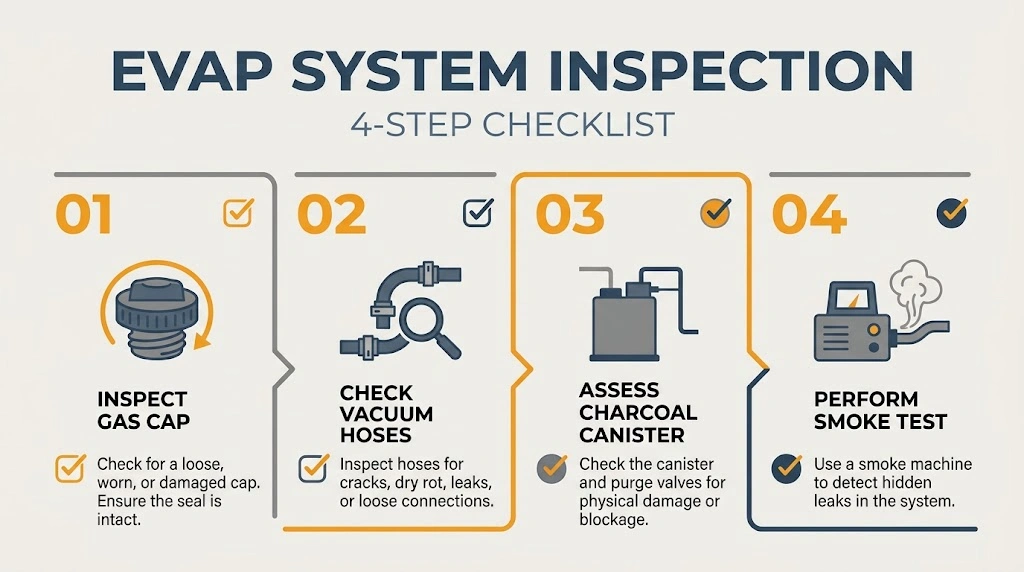
Once your OBD2 scanner points to an EVAP system fault, proceed with targeted physical checks rather than guessing parts:
- Inspect the gas cap: Check for a loose, damaged, or aftermarket cap that fails to seal properly. A worn rubber O-ring is the most frequent cause of minor EVAP leaks.
- Examine accessible hoses: Look under the hood for disconnected, brittle, or cracked vacuum lines connected to the purge valve.
- Check for charcoal canister damage: Inspect the underside of the vehicle near the fuel tank where the charcoal canister and vent valve reside for physical impacts or rusted metal lines.
- Perform a smoke test: If visual checks reveal nothing, professional shops use low-pressure smoke machines injected into the EVAP port to watch smoke escape from the exact leak location.
Related Product
OBD2 Diagnostic Scan Tool
A reliable diagnostic scanner allows you to read and clear emission codes, view live sensor data, and check readiness monitors.
As an Amazon Associate, we earn from qualifying purchases.
Frequently Asked Questions
Can a loose gas cap cause an OBD2 EVAP code?
Yes. A loose, missing, or worn gas cap prevents the system from maintaining pressure, which immediately triggers codes like P0442 or P0455.
Will an EVAP leak code clear itself automatically?
If the underlying issue is resolved—such as tightening a loose gas cap—the computer will often turn off the Check Engine Light after several successful driving cycles, though the historical code may remain stored in memory until cleared with a scanner.
Can I pass an emissions test with an EVAP code present?
No. An active Check Engine Light or an uncompleted EVAP monitor readiness test will result in an automatic failure during most state emissions inspections.
Do I need an advanced bidirectional scanner to find an EVAP leak?
Not necessarily. While bidirectional tools help command valves open and closed for testing, standard code readers identify the fault code, allowing you to perform manual visual and smoke inspections.
What is the difference between a small leak and a gross leak code?
A small leak code (like P0442) usually points to a minor seal failure, small pinprick hole in a hose, or a slightly degraded gas cap seal. A gross leak code (like P0455) indicates a major opening, such as a disconnected hose, a severely damaged canister, or a missing gas cap entirely.
How long does it take for the EVAP monitor to run after clearing a code?
The EVAP monitor requires specific driving conditions—often including a cold start, steady highway cruising, and a specific fuel level—which can take anywhere from a single drive cycle to several days of normal commuting to complete.
Conclusion
An OBD2 scanner serves as a vital first diagnostic step for identifying evaporative emission system faults, informing you when system pressure anomalies occur. While it cannot visually pinpoint physical cracks or loose clamps on its own, it provides the precise trouble codes needed to direct your inspection toward the gas cap, purge valves, or vacuum lines. Pairing code retrieval with methodical physical checks ensures you resolve the root cause efficiently and keep your vehicle running cleanly.

I’m Alex Rahman, a car enthusiast and automotive writer focused on practical solutions, car tools, and real-world driving advice. I share simple and honest content to help everyday drivers make better decisions.
