Can an OBD2 Scanner Reset the ECU?
Quick Answer
Yes, an OBD2 scanner can reset certain ECU functions, depending on the vehicle and scanner. Most basic scanners can clear stored engine trouble codes, but this is not the same as factory-resetting, reprogramming, or replacing the ECU’s learned settings. For a broader explanation, see this guide to using an OBD2 scanner correctly.
What an OBD2 scanner can reset
- Stored fault codes: Remove eligible diagnostic trouble codes after recording them and addressing the underlying problem.
- Check engine light: Turn off the light associated with cleared emissions-related codes when the vehicle permits it.
- Readiness monitors: Reset emissions self-test status to incomplete when clearing applicable diagnostic information.
- Service functions: Perform supported oil, battery, electronic parking brake, or other maintenance resets with a compatible advanced scanner.
- Permanent codes: Cannot normally be erased on demand; the vehicle must verify that the underlying fault has been repaired.
Before you reset anything
- Save the trouble codes, freeze-frame data, and readiness status before clearing memory.
- Check your vehicle’s service manual and scanner compatibility list before attempting an ECU or module reset.
An OBD2 scanner is useful when a check engine light appears, a repair has been completed, or you need to understand what your vehicle’s computer is reporting. The tricky part is knowing what the word “reset” means in each situation.
I’m Alex Rahman, and in this guide, I’ll explain the difference between clearing codes, resetting ECU adaptations, and performing more advanced control-module operations. You’ll also learn which scanner features matter, when a reset is appropriate, and when you should leave the computer alone.
What Does Resetting the ECU Actually Mean?
Resetting the ECU means clearing or restarting a particular part of an engine or vehicle control system, depending on the operation performed. It can refer to erasing stored fault codes, resetting learned values, restarting a module, or restoring certain settings through a manufacturer-specific procedure.
These operations aren’t interchangeable. A scanner that clears engine trouble codes doesn’t automatically have the ability to reprogram the ECU or erase every learned value stored in the vehicle.
What is an ECU?
An engine control unit (ECU) is an electronic computer that manages engine functions using information from sensors and other vehicle systems. It may control fuel delivery, ignition timing, idle speed, and emissions-related operations.
Modern vehicles can contain several other electronic control units, including a transmission control module (TCM), an anti-lock braking system (ABS) module, and an airbag control module.
- ECU or ECM: Usually refers to the engine control unit or engine control module.
- PCM: The powertrain control module, which may manage engine and transmission functions together.
- TCM: Controls transmission functions on vehicles with a separate transmission module.
- ABS/SRS modules: Manage braking and supplemental restraint systems, respectively.
This distinction matters because a generic OBD2 scanner typically focuses on standardized emissions-related diagnostics. Access to other modules and reset functions depends on the vehicle, diagnostic protocol, and tool capabilities.
Can an OBD2 Scanner Clear ECU Codes?
Yes. Most conventional OBD2 code readers can clear supported stored engine and emissions-related diagnostic trouble codes. This function is often labeled “Erase Codes,” “Clear DTCs,” or “Clear Fault Codes.”
However, erasing a code only removes eligible diagnostic information. It doesn’t repair a faulty sensor, reconnect damaged wiring, fix a vacuum leak, or restore a failing catalytic converter.
What happens when you clear the codes?
On a compatible vehicle, the scanner sends a diagnostic command to clear supported emissions-related information. Depending on the vehicle and command, this can erase stored codes and freeze-frame information, reset readiness monitors, and switch off the check engine light.
The ECU continues monitoring the engine. If the original problem remains, the vehicle may detect the fault again and turn the light back on.
- Stored codes: Eligible confirmed faults can be erased.
- Pending codes: Some pending diagnostic records may be cleared, depending on the system.
- Freeze-frame data: The recorded operating conditions associated with a fault may disappear.
- Readiness monitors: Applicable emissions self-tests may return to incomplete status.
- Permanent DTCs: These generally remain until the vehicle verifies that the fault has been corrected.
For that reason, I recommend reading and saving the codes before using the erase function. Those details can help you or a mechanic identify the original problem.
Can an OBD2 Scanner Perform a Full ECU Reset?
Sometimes, but a basic code reader usually cannot perform a complete ECU reset. The available functions depend on the make, model, year, control module, and scanner software.
A full reset is also an imprecise term. Some vehicles support specific initialization or relearn procedures, while others require manufacturer-level diagnostic equipment for advanced module operations.
| Operation | Basic scanner | Advanced scanner |
|---|---|---|
| Read generic engine codes | Usually supported | Usually supported |
| Clear eligible emissions codes | Usually supported | Usually supported |
| Read live engine data | Model-dependent | Often broader coverage |
| Access ABS or airbag modules | Usually limited | Vehicle-dependent |
| Reset supported service functions | Rarely available | Available on supported vehicles |
| Reprogram ECU firmware | No | Only with suitable programming equipment and support |
This comparison describes typical capabilities rather than a universal compatibility guarantee. Always check the scanner’s official vehicle coverage and supported functions before purchasing it.
Does an ECU reset restore factory settings?
Not necessarily. Clearing codes doesn’t restore factory software, undo engine modifications, or automatically return every learned value to its original state.
Some supported service procedures reset particular adaptations or initialize a component after replacement. ECU reprogramming, coding, and flashing are different tasks that require the correct software, equipment, and vehicle-specific instructions.
How to Reset ECU Codes Using an OBD2 Scanner
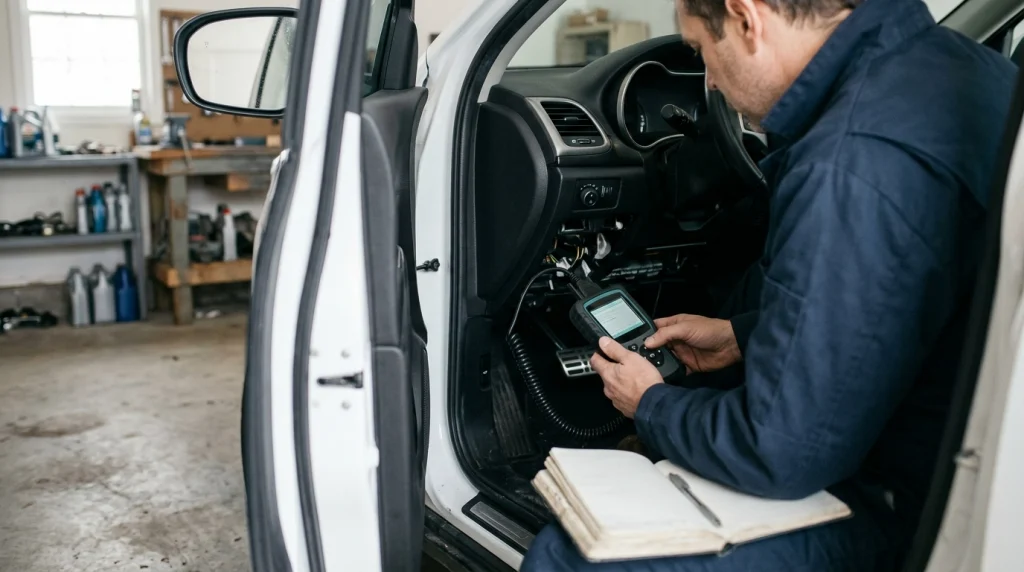
If your goal is to clear eligible engine codes after diagnosing or repairing a fault, follow the scanner manufacturer’s instructions and your vehicle’s service information. The process below covers a typical OBD2 code reader.
- Park safely. Park the vehicle, apply the parking brake, and follow the tool’s instructions for ignition position and engine status.
- Locate the diagnostic port. The OBD2 connector is commonly under the dashboard near the steering column, although its exact position varies.
- Connect the scanner. Insert the connector securely and switch the ignition to the required position.
- Read the diagnostic codes. Record all displayed codes and descriptions before changing anything.
- Save supporting data. If available, record freeze-frame data and readiness-monitor status.
- Address the fault. Repair the underlying issue when possible rather than clearing the warning as a substitute for diagnosis.
- Select the clear function. Choose the supported code-erasing option and confirm only after reviewing its warning.
- Recheck the vehicle. Read the codes again and check whether the fault returns or remains active.
Some scanners require the ignition to be on with the engine off for code clearing, but procedures vary. Follow the scanner’s instructions rather than assuming every vehicle uses the same sequence.
Important: Don’t clear codes before a mechanic has recorded relevant diagnostic information if you plan to seek professional help. Erasing that information can make an intermittent fault harder to investigate.
Will Resetting the ECU Turn Off the Check Engine Light?
It can, provided the scanner supports the relevant clear command and the vehicle permits the operation. However, a light going out doesn’t prove that the engine is repaired or that the vehicle has passed its emissions self-tests.
If the underlying fault remains, the ECU may detect it during a later drive cycle. The warning might return immediately, after a restart, or only when the vehicle reaches the conditions needed to run a particular diagnostic test.
Why does the check engine light come back?
The computer monitors engine and emissions systems as you drive. If it detects the same problem again, it can store another diagnostic code and illuminate the warning light.
- A loose or damaged fuel cap may cause an evaporative-emissions fault.
- A faulty oxygen sensor or damaged circuit may trigger a sensor-related code.
- An ignition misfire may point to problems with spark plugs, ignition coils, fuel delivery, or engine compression.
- An air leak or incorrect airflow reading may cause fuel-trim or mixture-related faults.
These are examples, not diagnoses. A trouble code identifies a detected condition or circuit issue; it doesn’t automatically prove that the component named in the description needs replacement.
Does Resetting the ECU Affect Fuel Economy or Engine Performance?
It can temporarily affect some vehicle behaviors when the operation clears learned adaptations or resets specific control-module settings. The effect depends on the vehicle and the exact procedure.
Modern engine computers may learn corrections for fuel delivery, idle behavior, and other operating conditions. When a supported reset clears particular learned values, the vehicle may need to relearn them under normal operating conditions.
However, clearing ordinary diagnostic trouble codes doesn’t necessarily erase every adaptive value. Don’t assume that a code-clear command will improve fuel economy, restore lost power, or resolve rough idling.
When should you consider an adaptation reset?
An adaptation reset may be appropriate after certain repairs or component replacements when the manufacturer specifically requires it. The correct procedure varies by vehicle.
- After throttle-body service: Some vehicles require an electronic throttle or idle relearn.
- After battery replacement: Certain models need battery registration or monitoring-system initialization.
- After transmission work: Some vehicles require specified adaptation procedures or calibration.
- After replacing a control module: Coding, programming, or configuration may be necessary.
Use the factory service procedure for your exact vehicle. An unsupported reset can cause new drivability problems or create additional diagnostic work.
Can an OBD2 Scanner Reset ABS, Airbag, or Transmission Modules?
Some advanced scanners can access and clear eligible faults in ABS, airbag, transmission, and other modules. A basic engine-code reader generally cannot provide the same level of system access.
Even when a scanner can read a module, it might not support clearing its codes or performing a particular reset. Reading, clearing, active testing, calibration, and programming are separate capabilities.
- ABS: An enhanced scanner may read wheel-speed sensor faults and support selected brake-related service functions.
- Airbag/SRS: Compatible tools may access restraint-system faults, but safety-system repairs require correct procedures.
- Transmission: Some tools read transmission codes and support selected adaptation or service functions.
- Body control: Access to locks, lights, windows, and other body functions varies considerably by vehicle.
Never treat clearing an airbag or ABS warning as proof that the safety system works correctly. Diagnose and repair the fault, then verify the system according to the manufacturer’s instructions.
Why Won’t My OBD2 Scanner Reset the ECU?
If the scanner refuses to clear codes or displays a communication error, the problem may involve tool compatibility, vehicle conditions, access restrictions, or a fault in the diagnostic connection. It doesn’t automatically mean the ECU has failed.
- Unsupported function: The scanner may read codes without supporting the requested reset.
- Wrong module: A generic scanner may not access the control unit that stores the fault.
- Ignition conditions: The vehicle may require a specific ignition position or operating state.
- Communication problem: A damaged connector, missing power, poor ground, or network fault can prevent access.
- Permanent code: The vehicle may not allow the permanent diagnostic record to be erased manually.
- Security restrictions: Some newer vehicles require approved access or manufacturer-specific procedures for certain functions.
Start by checking the scanner’s manual, confirming the vehicle profile, and reviewing the exact error message. If the tool cannot communicate with multiple supported modules, inspect the diagnostic connector and follow the manufacturer’s troubleshooting steps.
For more detailed troubleshooting, the guide to connecting a Bluetooth OBD2 scanner covers common connection issues for wireless tools.
Should You Disconnect the Battery Instead of Using a Scanner?
I wouldn’t disconnect the battery just to force an ECU reset without checking the vehicle’s service information first. Battery disconnection isn’t a reliable substitute for a supported diagnostic procedure.
Depending on the vehicle, disconnecting power may erase certain stored information, reset learned values, affect convenience settings, or require additional initialization. It also won’t reliably remove permanent diagnostic trouble codes.
Some vehicles have battery-monitoring systems, electronic throttle procedures, security settings, or other requirements that make an unplanned power interruption inconvenient. Follow the correct battery-disconnection procedure when a repair genuinely requires it.
For a routine check engine light, reading the codes and identifying the cause is usually the better first step.
What Happens to Emissions Readiness After an ECU Reset?
Clearing applicable emissions-related diagnostic information commonly resets supported readiness monitors to an incomplete or not-ready state. These monitors are self-tests that the vehicle performs to check emissions-related systems.
After a reset, the vehicle needs to complete the relevant tests under suitable driving conditions. The time required depends on the vehicle, the monitor, environmental conditions, and the manufacturer’s drive-cycle requirements.
- Ready: The supported monitor has completed its test.
- Not ready: The monitor hasn’t completed its required test since the last reset.
- Not supported: The vehicle doesn’t use that particular monitor.
A vehicle can have no currently displayed check engine light and still show incomplete readiness monitors. Depending on local inspection rules, that status may prevent an emissions test from being accepted.
The U.S. Environmental Protection Agency provides information about vehicle emissions inspection and maintenance through its vehicle inspection and maintenance resources. Check your local requirements before clearing codes shortly before an inspection.
How Do You Choose an OBD2 Scanner for ECU Reset Functions?
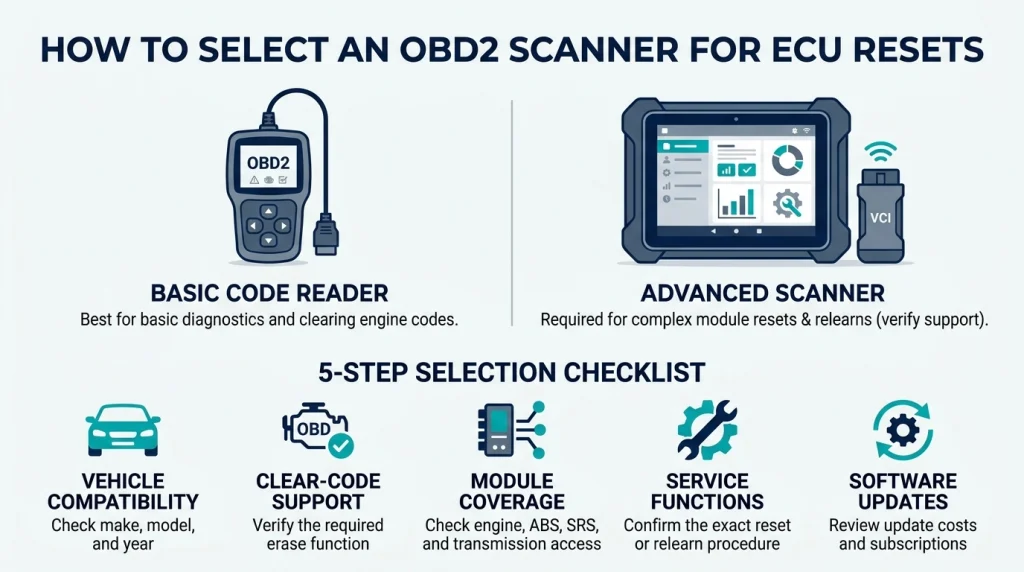
Choose a scanner based on the specific operation you need, not just its price or the number of functions advertised. A budget reader can be sufficient for checking and clearing generic engine codes, while broader module access often requires a more capable tool.
Before buying, confirm these features:
- Vehicle compatibility: Check your exact make, model, year, and powertrain.
- Clear-code support: Confirm that it can erase the relevant diagnostic codes.
- Module coverage: Check whether it supports the engine only or also ABS, SRS, transmission, and other modules.
- Service functions: Verify the specific reset or relearn function you need, rather than relying on a general claim of “full-system reset.”
- Software updates: Review update costs, subscription requirements, and ongoing vehicle coverage.
In my view, compatibility is more useful than an impressive feature count. A scanner that supports the exact procedure your vehicle needs is a better choice than one with dozens of functions that don’t apply to your car.
Recommended OBD2 Scanners for Clearing Codes and Advanced Diagnostics
If you’re choosing a scanner, start with the task you expect to perform most often. The following established product lines offer different approaches to diagnostics; check the manufacturer’s current specifications and vehicle coverage before buying.
Best for DIY owners
BlueDriver Bluetooth Pro OBDII Scan Tool
★★★★☆
A phone-connected diagnostic tool designed for code reading, clearing supported faults, and viewing diagnostic information through its app. I’d consider it for home troubleshooting, but I’d verify whether its coverage includes the specific module or reset function I need.
Best for broader diagnostics
Autel MaxiCOM MK808S
★★★★☆
A tablet-style diagnostic scanner aimed at broader system access and supported service functions. I’d investigate this type of tool for regular diagnostic work, checking the exact reset menu and vehicle coverage before assuming it can perform a particular ECU procedure.
Best for professional workflows
Launch X-431 diagnostic scanner series
★★★★☆
The X-431 family includes advanced diagnostic tools with capabilities that vary by model, software, and vehicle. I’d compare the exact model’s module coverage, supported active tests, service functions, and update terms before using it for workshop-level work.
The stars above are editorial fit assessments, not verified customer-review averages or laboratory test scores. The recommendations are based on the tools’ intended use categories, and exact features vary by model and vehicle.
Frequently Asked Questions
Can an OBD2 scanner reset the ECU without disconnecting the battery?
Yes, a compatible scanner can clear eligible diagnostic codes and perform certain supported reset procedures without disconnecting the battery. However, a basic code reader cannot perform every ECU initialization or adaptation reset, so check the exact function supported by your vehicle and tool.
Will resetting the ECU remove all trouble codes permanently?
No. Clearing eligible stored codes removes diagnostic records but doesn’t eliminate the fault that caused them. The vehicle can detect the problem again and store another code. Permanent diagnostic trouble codes also generally remain until the ECU confirms that the underlying fault has been corrected.
Can a cheap OBD2 scanner reset the check engine light?
Many inexpensive OBD2 readers can clear supported emissions-related codes and turn off the check engine light. They usually offer fewer features than advanced scanners, however. If the fault remains, the warning can return, and the reader may not access ABS, airbag, or other control modules.
How long does an ECU reset take?
Clearing supported diagnostic codes usually takes only a short time once the scanner communicates with the vehicle. Relearning adaptations or completing emissions readiness monitors can take longer. The required time depends on the vehicle, the procedure, and the driving conditions needed to complete its self-tests.
Can resetting the ECU damage my car?
Clearing ordinary diagnostic codes with a compatible scanner is a routine diagnostic function, but it can erase useful fault information and reset emissions readiness. Unsupported adaptations, coding, or programming procedures carry greater risks. Follow vehicle-specific instructions and seek professional help before performing unfamiliar module operations.
Final Takeaway: Should You Reset Your ECU With an OBD2 Scanner?
An OBD2 scanner can clear eligible engine trouble codes and perform certain supported ECU or module reset functions, but it cannot universally reset every computer in every vehicle. The correct approach depends on whether you need to erase a diagnostic record, reset an adaptation, run a service procedure, or reprogram a module.
My recommendation is straightforward: read and save the codes first, fix the underlying problem, and use only the reset function specified for your vehicle. If your goal is a full ECU initialization or a safety-critical module repair, confirm compatibility before proceeding or have a qualified technician perform the procedure.
Choose a scanner for the actual functions your car supports, not just the word “reset” on the packaging. That simple check can save time, prevent unnecessary troubleshooting, and help you make a better buying decision.

I’m Alex Rahman, a car enthusiast and automotive writer focused on practical solutions, car tools, and real-world driving advice. I share simple and honest content to help everyday drivers make better decisions.
