How Much Does a Car Diagnostic Test Cost? (2026 Guide)
Quick Answer
A car diagnostic test typically costs $50–$150 at an independent repair shop in the United States, while dealership diagnostics often cost $100–$250 or more. Some auto parts stores offer free basic check-engine-code scans, but a complete diagnosis requires additional testing to identify the actual cause. You can also use an OBD2 diagnostic scanner to read compatible trouble codes yourself.
Typical diagnostic costs
- Free code scan: $0 at participating auto parts stores for basic code reading.
- Independent mechanic: Approximately $50–$150 for a standard diagnostic appointment.
- Dealership: Around $100–$250 or more, depending on the vehicle and testing required.
- Complex electrical faults: $150–$400 or more when troubleshooting takes several hours.
- DIY code reading: A basic scanner can cost roughly $20–$50, with more advanced tools costing considerably more.
- Repair costs: Parts and labor usually cost extra unless the shop explicitly includes them in its quote.
How to avoid overpaying
- Ask what is included: Confirm whether the fee covers a basic scan, hands-on troubleshooting, or a set amount of technician time.
- Compare written quotes: Check whether the diagnostic fee is credited toward the repair.
- Don’t guess at parts: A trouble code points to a system or condition, not necessarily a failed component.
When a check engine light appears or your car starts running differently, knowing the likely diagnostic cost helps you decide what to do next. I approach the question by separating a quick code scan from the deeper testing a mechanic may need to find the real fault.
In this guide, I’ll explain typical 2026 prices, what changes the bill, when a free scan is enough, and whether buying your own OBD2 scanner makes financial sense.
What Is a Car Diagnostic Test?
A car diagnostic test is a process that uses electronic scan tools and mechanical testing to identify faults affecting a vehicle’s engine, transmission, emissions system, or other components.
The process can begin with an OBD2 scan, but a complete diagnosis may also involve checking wiring, measuring electrical signals, reviewing live sensor data, and testing suspected components.
These are two different services, and confusing them can lead to unrealistic expectations about the price.
- Code reading: Retrieves stored diagnostic trouble codes from compatible vehicle systems.
- Fault diagnosis: Uses the codes, symptoms, measurements, and additional tests to determine the likely cause.
- Repair: Replaces or fixes the faulty component after the findings support that decision.
For example, a code related to an oxygen sensor circuit doesn’t automatically prove the oxygen sensor has failed. A damaged wire, connector problem, exhaust leak, or another fault could produce related symptoms.
How Much Does a Car Diagnostic Test Cost in 2026?
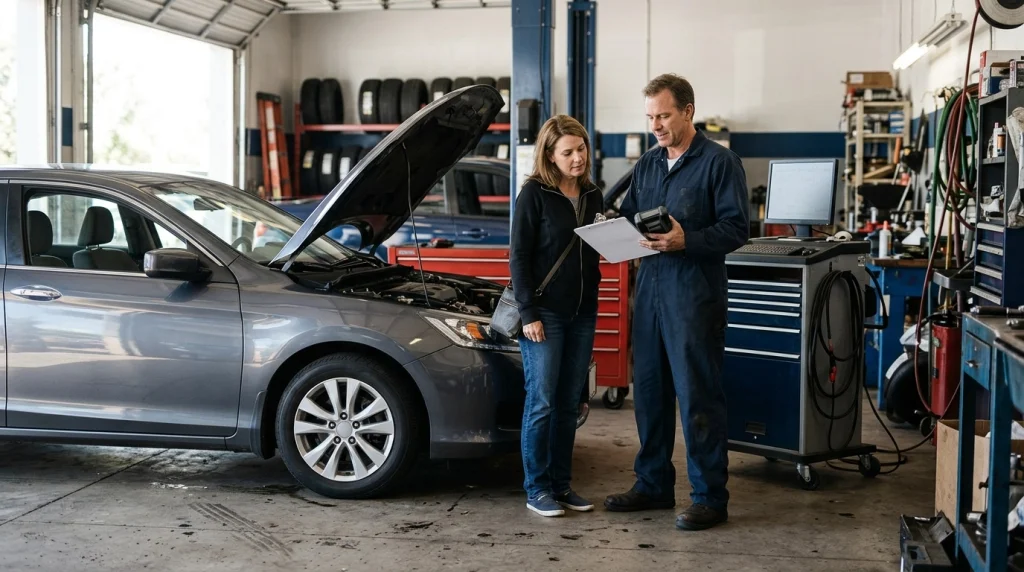
In the United States, a standard diagnostic appointment generally costs $50–$150 at an independent shop and $100–$250 or more at a dealership. Complicated electrical problems, luxury vehicles, and specialist testing can push the total higher.
These figures are budgeting estimates, not fixed national rates. The actual price depends on local labor charges, the vehicle, the systems being tested, and how long the technician needs.
| Diagnostic service | Estimated cost (USD) | Typical scope |
|---|---|---|
| Basic code scan | $0–$50 | Reads compatible trouble codes |
| Independent shop diagnosis | $50–$150 | Initial testing and fault investigation |
| Dealership diagnosis | $100–$250+ | Vehicle-specific diagnostics and testing |
| Advanced electrical diagnosis | $150–$400+ | Complex, intermittent, or hard-to-trace faults |
| Specialist or manufacturer-specific testing | $150–$300+ | Advanced modules and specialized systems |
The ranges overlap because shops don’t all define a diagnostic service the same way. A $75 appointment might cover a limited scan and initial checks, while a $150 appointment might include more extensive troubleshooting.
AAA’s auto repair guidance explains why diagnostic work often depends on technician time rather than a simple fixed-price procedure. Consumer Reports also discusses the value of obtaining a thorough inspection and a written estimate when assessing a used car.
Why Do Car Diagnostic Prices Vary So Much?
The biggest factor is the amount of testing required to identify the problem. A stored code that matches an obvious fault may take little time to investigate, while an intermittent electrical issue can require repeated measurements and careful troubleshooting.
Here are the main factors that affect the bill.
- Labor rates: Shops in expensive metropolitan areas often charge more per hour than shops in lower-cost areas.
- Vehicle make and model: Luxury cars and specialized vehicles may need manufacturer-specific tools or training.
- Fault complexity: Multiple codes, wiring faults, and symptoms that appear only occasionally can require extra testing.
- Diagnostic coverage: An engine-only scan differs from testing transmission, ABS, airbag, and body-control modules.
- Shop policy: Some shops charge a flat fee, while others bill diagnostic labor by the hour.
- Mobile service: A mobile mechanic may add a call-out or travel charge, depending on the service area.
As an example, a mechanic might identify a loose electrical connection quickly during an initial inspection. Tracking down a wire that intermittently loses contact behind the dashboard could take considerably longer, even if the eventual repair is small.
That is why diagnostic charges reflect the work required to locate the fault, not just the price of the part that eventually fixes it.
Is a Free Car Diagnostic Test Enough?
A free code scan can be a useful starting point, but it generally doesn’t replace a professional diagnosis. Participating stores such as AutoZone and O’Reilly Auto Parts may offer basic check-engine-code reading, subject to local service availability and vehicle compatibility.
Free scans are most useful when you want to learn which code the vehicle has stored before deciding what to do next.
| Feature | Free code scan | Professional diagnosis |
|---|---|---|
| Reads basic codes | Usually | Yes |
| Reviews symptoms and history | Limited | Typically |
| Tests wiring and components | Usually not | When needed |
| Confirms the root cause | Not reliably | The goal of testing |
| Provides repair recommendations | May be limited | Usually |
Consider a check engine light accompanied by poor fuel economy. A scan might reveal a lean-condition code, but the underlying cause could involve a vacuum leak, a sensor problem, or inadequate fuel delivery.
A free scan helps narrow the investigation. Further testing helps distinguish between those possibilities.
For general background on vehicle maintenance and repair, the AAA automotive repair articles are a useful starting point.
How Much Does a Dealership Charge Compared With an Independent Mechanic?
An independent mechanic usually offers a lower starting diagnostic fee, while a dealership may charge more for factory-specific testing and specialized expertise. Neither option automatically guarantees a better diagnosis for every problem.
| Factor | Independent shop | Dealership |
|---|---|---|
| Typical starting range | $50–$150 | $100–$250+ |
| Diagnostic equipment | General and sometimes brand-specific tools | Factory-oriented tools and software may be available |
| Best suited for | Routine faults and many common repairs | Brand-specific faults and specialized systems |
| Potential savings | Competitive labor rates | Possible warranty or service-plan coverage |
For a common check-engine fault on an older Honda, Toyota, Ford, or Chevrolet, an experienced independent shop may have everything needed. A newer luxury vehicle with manufacturer-specific electronic faults might justify a dealership or specialist.
Before booking either option, ask whether the shop has the equipment and experience to diagnose your specific vehicle. You can also ask for the diagnostic fee to be credited toward an approved repair.
Does the Diagnostic Fee Include the Repair?
Usually, a diagnostic fee pays for finding the problem rather than fixing it. Parts, installation labor, fluids, programming, and any additional testing may appear as separate charges on your estimate.
Some shops apply the diagnostic fee toward the repair when you authorize the work, but others keep the charges separate. Ask about the policy before approving the appointment.
Here’s an illustrative example of how a repair bill might look:
| Charge | Example amount |
|---|---|
| Diagnostic fee | $100 |
| Replacement part | $80 |
| Repair labor | $120 |
| Total before applicable taxes and fees | $300 |
These amounts are examples, not a quote for a particular vehicle. If the shop credits the $100 diagnostic fee toward the repair, the final total could fall to $200 before applicable taxes and fees.
Always request an itemized estimate showing the diagnostic work, parts, labor, and any additional charges. Tell the shop to contact you before performing extra work beyond the amount you’ve approved.
Can You Diagnose Your Car Yourself With an OBD2 Scanner?
Yes, a compatible OBD2 scanner can read many engine and emissions-related trouble codes without requiring a paid shop visit. More advanced scanners can also display live sensor readings and communicate with additional vehicle systems, depending on the tool and vehicle.
I recommend considering a DIY scanner if you regularly maintain your car, want to understand warning lights, or prefer to collect information before visiting a mechanic. It won’t replace professional testing for every fault.
What can a basic OBD2 scanner tell you?
- Stored trouble codes: Shows codes recorded by supported vehicle systems.
- Pending codes: May reveal faults that the computer has detected but hasn’t confirmed.
- Freeze-frame data: On supported vehicles and tools, records operating conditions when certain faults occurred.
- Readiness status: Shows whether supported emissions self-checks have completed.
- Live data: Some scanners display engine speed, coolant temperature, fuel-trim values, and other sensor readings.
Compatibility matters. A basic reader may not access ABS, airbag, transmission, or manufacturer-specific modules, even when it works correctly for engine codes.
How much does it cost to buy an OBD2 scanner?
Basic readers often cost around $20–$50, while feature-rich handheld scanners and professional diagnostic tools can cost hundreds of dollars or more. Bluetooth adapters may also require a compatible phone app, and some apps charge separately for advanced features.
| Tool type | Estimated purchase cost | Best use |
|---|---|---|
| Basic handheld reader | $20–$50 | Occasional engine-code checks |
| Bluetooth OBD2 adapter | $20–$80 | Phone-based code reading and supported live data |
| Enhanced diagnostic scanner | $100–$300+ | Broader testing and selected additional systems |
| Professional scan tool | $300–$1,000+ | Advanced diagnostics and workshop use |
These are broad budgeting ranges, not verified prices for individual models. Vehicle coverage, software subscriptions, bidirectional controls, and update policies can affect the total ownership cost.
When does buying a scanner save money?
Suppose a scanner costs $40 and a shop charges $100 for a diagnostic appointment. Avoiding one paid visit could cover the scanner’s purchase price, provided a basic scan is sufficient for your situation.
That calculation doesn’t mean every future diagnosis will be free. You may still need a professional to test wiring, confirm a failing component, or access systems your reader cannot communicate with.
For a one-time warning light, a free scan may make more financial sense. For repeated troubleshooting, a compatible personal scanner can be a useful investment.
Which OBD2 Scanner Should You Consider?
If you want to reduce repeat diagnostic visits, choose a scanner based on your vehicle and the information you need. I would prioritize compatibility, clear code descriptions, and the ability to save diagnostic information over a long list of features you may never use.
Budget pick
ANCEL AD310 Classic Enhanced Universal OBD II Scanner
★★★★☆
A wired handheld reader designed for standard OBD2 engine and emissions code checks. I’d consider this style for straightforward home troubleshooting, after confirming compatibility with the vehicle.
Phone-based option
Veepeak OBDCheck BLE Bluetooth OBD2 Adapter
★★★★☆
A compact Bluetooth adapter that works with compatible phones and diagnostic apps. I’d look at this option if I wanted supported live data on a mobile device, while checking operating-system and app compatibility first.
Advanced DIY option
Autel MaxiCOM MK808S Diagnostic Scanner
★★★★☆
A more advanced diagnostic tablet intended for broader system access and service functions on supported vehicles. I’d consider it for frequent DIY work, after checking the exact model’s coverage and ongoing update costs.
These are examples of tools in different categories, not a claim that each has been independently tested for this article. The star symbols indicate illustrative editorial fit, not verified customer ratings.
What Should You Ask Before Paying for a Diagnostic Test?
A few questions can help you understand what you’re paying for and prevent unexpected charges. I would clarify the scope of the appointment before leaving the vehicle at the shop.
- What does the initial fee cover? Ask whether it includes a code scan, technician inspection, and a specific amount of diagnostic time.
- Will you identify the root cause? Find out whether the quoted service includes testing to confirm the fault or only retrieving codes.
- Can you apply the fee toward repairs? Confirm the shop’s policy and any conditions that apply.
- What happens if diagnosis takes longer? Request approval before the shop adds more diagnostic labor.
- Will I receive a written report? Ask for the codes, test results, recommended repairs, and an itemized estimate.
- Could my warranty cover the diagnosis? Check your warranty terms before authorizing paid work that might qualify for coverage.
The Federal Trade Commission’s consumer guidance and alerts offer general information about evaluating purchases and avoiding misleading claims. For vehicle repairs, a written estimate and clear authorization terms are practical ways to reduce misunderstandings.
When Should You Get a Diagnostic Test Immediately?
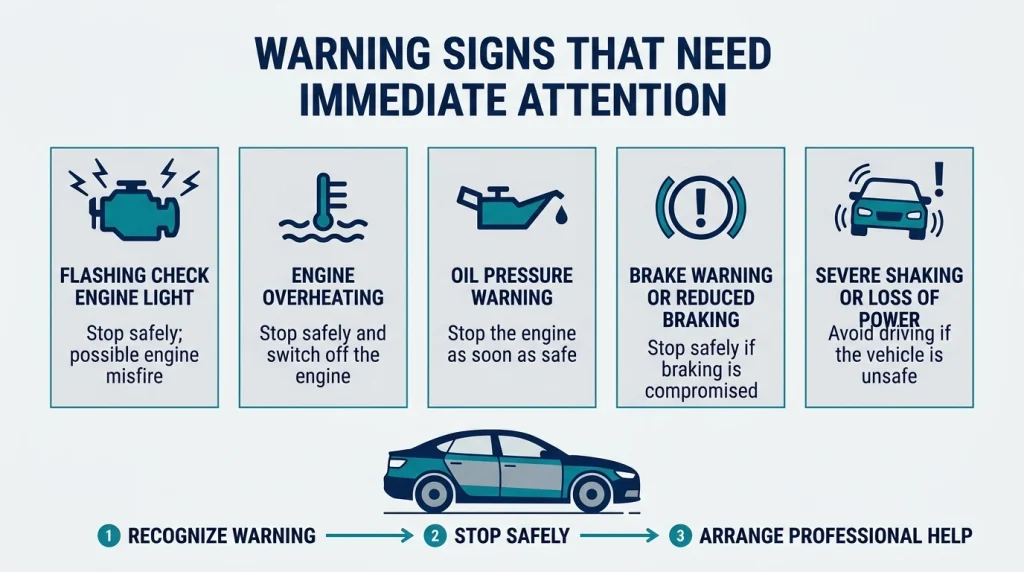
Don’t delay diagnosis when warning lights appear alongside changes in how your car runs. Some symptoms indicate a potentially serious fault that requires immediate attention rather than another routine code scan.
- Flashing check engine light: Pull over safely and stop driving when possible; a flashing light can indicate a misfire that risks catalytic-converter damage.
- Engine overheating: Stop in a safe location and shut the engine off according to your owner’s manual.
- Oil pressure warning: Stop the engine as soon as it is safe because continued operation can cause severe damage.
- Brake warning or reduced braking: Stop safely and arrange professional assistance if braking performance is compromised.
- Severe shaking, stalling, or loss of power: Avoid continued driving if the vehicle feels unsafe or may stall in traffic.
A steady check engine light without other symptoms usually calls for prompt assessment rather than an automatic emergency stop. However, your owner’s manual and the symptoms you observe should guide your response.
The National Highway Traffic Safety Administration’s vehicle safety resources provide additional information about vehicle safety and recognizing potential hazards.
Frequently Asked Questions
How much does a car diagnostic test cost at AutoZone or O’Reilly?
O’Reilly Auto Parts offers free check-engine-light code reading through its VeriScan service at participating locations. AutoZone also offers free check-engine-light testing at participating stores. These services can identify stored codes, but they don’t necessarily include the hands-on testing required to confirm the failed component.
Is a $200 car diagnostic fee too expensive?
A $200 diagnostic fee can be reasonable for dealership testing, advanced system diagnosis, or a difficult electrical problem requiring extended labor. It may be expensive for a basic code scan alone. Ask how much technician time the fee covers, what tests are included, and whether additional charges require your approval.
How long does a car diagnostic test take?
A basic code scan may take only a few minutes, while an initial diagnostic appointment often takes around 30–60 minutes. Complex electrical faults, intermittent problems, and multi-system issues can require several hours or multiple appointments. The actual time depends on the vehicle, symptoms, and tests needed to confirm the cause.
Can I drive my car after a diagnostic test?
Usually, yes, if the mechanic finds no safety-critical problem and the vehicle operates normally. However, a diagnostic scan doesn’t automatically establish that the car is safe to drive. Follow the mechanic’s advice, pay attention to warning lights, and avoid driving if braking, steering, overheating, or severe engine problems make the vehicle unsafe.
Will a diagnostic test tell me exactly which part to replace?
Not always. A scanner reports trouble codes and other available vehicle data, which help narrow down potential causes. A mechanic may need to inspect wiring, test electrical signals, or examine mechanical components before confirming a faulty part. Replacing a component based only on a code can waste money if another fault caused it.
Final Takeaway: Budget for the Diagnosis, Not Just the Scan
For most drivers in the United States, budgeting $50–$150 for an independent-shop diagnostic appointment is a reasonable starting point in 2026. Dealership visits and complicated faults can cost more, while free code-reading services offer a useful first step for straightforward warning-light questions.
My main recommendation is to compare the scope of the service rather than choosing a shop solely by its advertised fee. Ask what the technician will test, whether the charge includes a confirmed diagnosis, and how the shop handles additional labor.
If you frequently troubleshoot your own vehicle, a compatible OBD2 scanner can help you understand trouble codes before visiting a mechanic. For difficult or safety-related faults, professional testing remains the better way to establish what needs repair.
Before booking: Get the diagnostic fee in writing, ask whether it applies toward repairs, and approve additional work only after you understand the estimate.

I’m Alex Rahman, a car enthusiast and automotive writer focused on practical solutions, car tools, and real-world driving advice. I share simple and honest content to help everyday drivers make better decisions.
