Is OBD2 Pin 16 Always 12 Volts? SAE J1962 Explained
Quick Answer
Pin 16 is always defined as battery voltage, but it is not always exactly 12 volts. On a standard passenger vehicle with the engine off, a healthy pin 16 typically reads about 12.2 to 12.6 volts. With the engine running, it rises to roughly 13.5 to 14.7 volts as the charging system works. On heavy-duty vehicles using a Type B connector, the nominal voltage is 24 volts. If pin 16 reads zero or a very low voltage, the most likely cause is a blown fuse.
What SAE J1962 Specifies for Pin 16

The 16-pin diagnostic link connector (DLC) is defined by the SAE J1962 standard. That standard fixes several pins to specific functions so that any compliant scan tool can connect to any compliant vehicle. Pin 4 is chassis ground, pin 5 is signal ground, and pin 16 is reserved for battery power.
The specification is explicit: pin 16 “should always be battery voltage” according to the SAE J1962 pinout definitions. The standard goes on to give two examples: 12 volts and 4 amps for Type A connectors used on light-duty vehicles, and 24 volts and 2 amps for Type B connectors used on heavy-duty vehicles.
This is an important distinction. The standard does not say “12 volts.” It says “battery voltage.” The 12-volt figure is a convenient shorthand because most passenger cars use a nominal 12-volt electrical system. But the actual voltage present at pin 16 is whatever the vehicle’s battery and charging system are producing at that moment.
If you want a broader walkthrough of what this pin powers and how it interacts with the rest of the port, our guide to what OBD2 pin 16 does covers the full function and testing sequence.
What Voltage Should You Actually See on Pin 16?
The voltage on pin 16 tracks the vehicle’s electrical system. It is not a regulated 12.0-volt output like you would get from a bench power supply. It is a direct feed from the battery circuit, so it rises and falls with the battery’s state of charge and the alternator’s output.
These are the ranges a healthy system typically produces:
| Condition | Typical Voltage at Pin 16 |
|---|---|
| Engine off, battery fully charged | 12.2 – 12.6 V |
| Engine running (charging) | 13.5 – 14.7 V |
| During cranking or with a low battery | Can dip below 12 V, sometimes well below |
| Heavy-duty vehicle (Type B connector) | Nominal 24 V system, actual voltage varies with state of charge |
Those figures come from practical measurement guidance rather than a fixed standard value. The Stack Exchange automotive community, for example, notes that the voltage is “12–12.6 ish volt engine off” and “13.9–14.4 ish engine running” on a typical passenger car. A diagnostic port that reads 12.5 volts with the key off is perfectly healthy.
The key point is that “12 volts” is a label for the circuit, not a guaranteed output. A pin 16 reading of 13.8 volts with the engine running is not a fault. It is the normal charging voltage.
Why “12 Volts” Is a Nominal Rating, Not a Fixed Number
Automotive electrical systems are called “12-volt systems” because the battery has six cells that produce roughly 2.1 volts each, adding up to about 12.6 volts at full charge. But the system is designed to operate over a range, not at a single point.
When the engine is running, the alternator must produce a higher voltage than the battery’s resting voltage to push current back into the battery and recharge it. That is why a healthy charging system holds the system voltage around 13.5 to 14.7 volts. If pin 16 stayed locked at exactly 12.0 volts while the engine was running, the battery would never recharge properly.
This is also why scan tool manufacturers design their hardware to accept a range of input voltages. A tool that only worked at exactly 12.0 volts would be useless on a running vehicle. The standard’s use of the phrase “battery voltage” rather than “12 volts” reflects that reality.
Tip
When testing pin 16, always note whether the engine is off or running. A reading of 12.4 V with the engine off and 14.1 V with the engine running are both normal. If you see 12.0 V or lower with the engine running, the charging system may not be working correctly.
When Pin 16 Doesn’t Show Voltage (or Shows the Wrong Voltage)
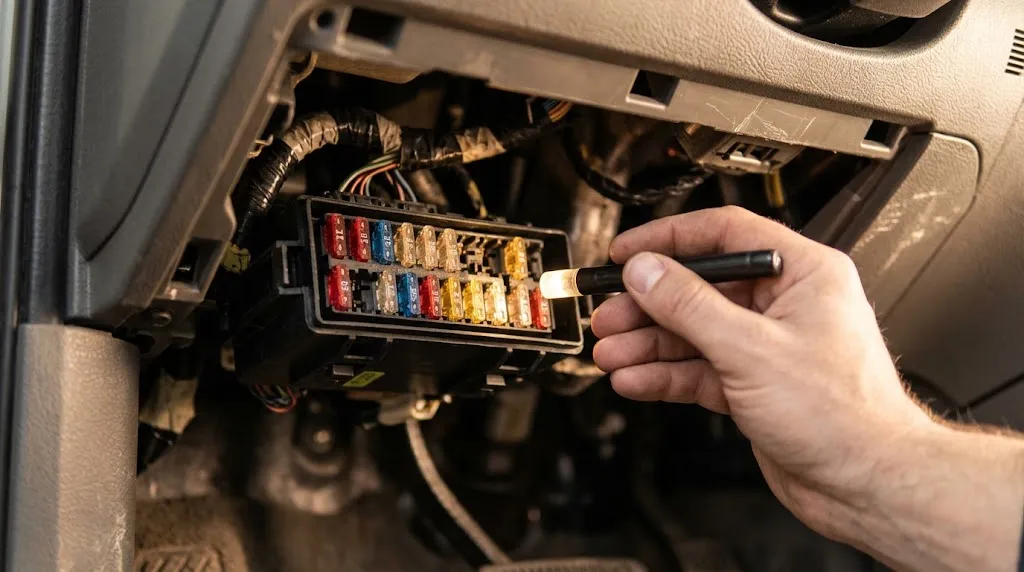
If a scan tool will not power on, or a multimeter reads zero volts between pin 16 and pin 4, the problem is almost never the pin itself. The circuit that feeds pin 16 has failed somewhere upstream.
The most common cause is a blown fuse. On many vehicles, pin 16 shares a fuse with the cigarette lighter, the 12-volt accessory socket, or another interior circuit. A shorted phone charger, a coin in the socket, or an overloaded accessory outlet can pop that fuse. The car will start and run normally, but the diagnostic port will be dead. The fuse is usually a low-cost blade fuse in the interior fuse box, and the owner’s manual will identify it as “CIG,” “AUX,” “DLC,” or “OBD.”
If the fuse is intact, the next possibilities are a damaged wiring harness, a loose or pushed-back terminal inside the connector, or corrosion at the back of the port. A voltage reading that is present but low—say 5 volts or 7 volts instead of battery voltage—points to high resistance in the circuit, often from a corroded splice or a partially broken wire.
Our guide to why an OBD2 scanner won’t connect walks through the fuse and connector checks in the order that makes the most sense. If the scanner powers on but still cannot communicate, the issue shifts from power delivery to the data lines, which is covered in OBD2 scanner has power but no communication.
How to Test Pin 16 Safely
A digital multimeter set to DC volts is the right tool for checking pin 16. Set the meter to a range that includes 20 volts DC, then place the black probe on pin 4 (chassis ground) and the red probe into the cavity for pin 16. With the key off, a healthy circuit should show battery voltage. With the engine running, it should show charging voltage.
If you are not comfortable probing the connector, many scan tools and OBD2 adapters display live voltage on their screen. That reading comes from the tool’s own measurement of pin 16, so it provides a quick sanity check without needing a multimeter.
Warning
Do not bridge pins with metal tools or force oversized plugs into the connector. Pin 16 carries a direct battery feed, and shorting it against a data pin can damage sensitive control modules. If a pin looks damaged or recessed, have the connector inspected before plugging in another device.
Common Misunderstandings About Pin 16
One frequent assumption is that pin 16 should read exactly 12.0 volts at all times. That is not how the circuit works. The pin is a battery feed, so its voltage changes with the battery and charging system. A reading of 12.4 volts with the engine off and 14.2 volts with the engine running is entirely normal.
Another assumption is that a powered scan tool means the diagnostic port is fully healthy. Power on pin 16 only proves that the tool is receiving voltage. Communication also requires good grounds on pins 4 and 5 and functioning data lines. A scanner can light up and still fail to connect if a ground is corroded or a data wire is damaged.
A third misconception is that pin 16 is switched with the ignition. It is not. The standard defines it as unswitched battery power, which is why the port remains live even when the key is removed. That design allows scan tools to power up without turning on the vehicle, but it also means a high-draw device left plugged in can drain the battery over time.
Frequently Asked Questions
Does OBD2 pin 16 turn off when the ignition is off?
No. Pin 16 is an unswitched battery feed. It remains live even when the key is removed and the vehicle is locked. That is why a scan tool can power on without the ignition being turned on.
Why does my scan tool show 14 volts on pin 16 instead of 12?
With the engine running, the alternator raises system voltage to recharge the battery. A reading of 13.5 to 14.7 volts is normal charging voltage, not a fault.
What is the most common reason for no power at pin 16?
A blown fuse. On many vehicles, the diagnostic port shares a fuse with the cigarette lighter or accessory socket. A shorted accessory can blow the fuse and cut power to pin 16 while the rest of the vehicle works normally.
Is pin 16 always 12 volts on heavy-duty trucks?
Not necessarily. Standard passenger cars and light trucks use a 12-volt Type A connector. Heavy-duty vehicles can use a 24-volt Type B connector, so pin 16 will show battery voltage for a 24-volt system. The connectors are keyed differently to prevent mismating.
Can I use pin 16 to power a dash camera permanently?
Pin 16 can supply low-current devices, but it is not designed for high-draw accessories. Tapping it for a dash camera or other device can overload the circuit, blow fuses, or interfere with vehicle communications. Use a proper fused circuit for permanent accessories.
Does a pin 16 voltage reading of 11.8 volts mean the battery is bad?
Not necessarily. A reading of 11.8 volts with the engine off suggests the battery is partially discharged. It could be due to age, a recent load, or a charging problem. Recharge the battery and retest before condemning it.
Conclusion
Pin 16 is always battery voltage, but that does not mean it is always exactly 12 volts. The SAE J1962 standard defines the pin as a direct battery feed, and the actual voltage tracks whatever the vehicle’s electrical system is doing at the time. On a healthy passenger car, expect roughly 12.2 to 12.6 volts with the engine off and 13.5 to 14.7 volts with the engine running. If the pin reads zero, check the fuse first. It is the simplest, most common, and least expensive fix.

I’m Alex Rahman, a car enthusiast and automotive writer focused on practical solutions, car tools, and real-world driving advice. I share simple and honest content to help everyday drivers make better decisions.
