What Is a DTC in OBD2? How to Decode Trouble Codes
Quick Answer
In an OBD2 system, a DTC (Diagnostic Trouble Code) is a five-character alphanumeric code generated by your vehicle’s onboard computer when a sensor reading, electrical circuit, or mechanical actuator falls outside normal operating parameters. While a DTC identifies the affected system and the specific fault condition, it indicates which circuit or subsystem needs testing rather than automatically naming a part to replace.
Seeing a check engine light appear on your dashboard usually triggers an immediate question: is the vehicle safe to drive, or is an expensive repair imminent? Beneath that warning light lies a standardized diagnostic language shared by almost every passenger car and light truck built since 1996.
When your vehicle’s onboard computer detects an abnormal voltage, an implausible sensor signal, or a system performance failure, it logs a Diagnostic Trouble Code in its internal memory. Understanding how these five characters are structured allows you to translate a cryptic string like P0301, B0020, or U0100 into a clear, logical starting point for troubleshooting.
How an OBD2 System Generates a Trouble Code
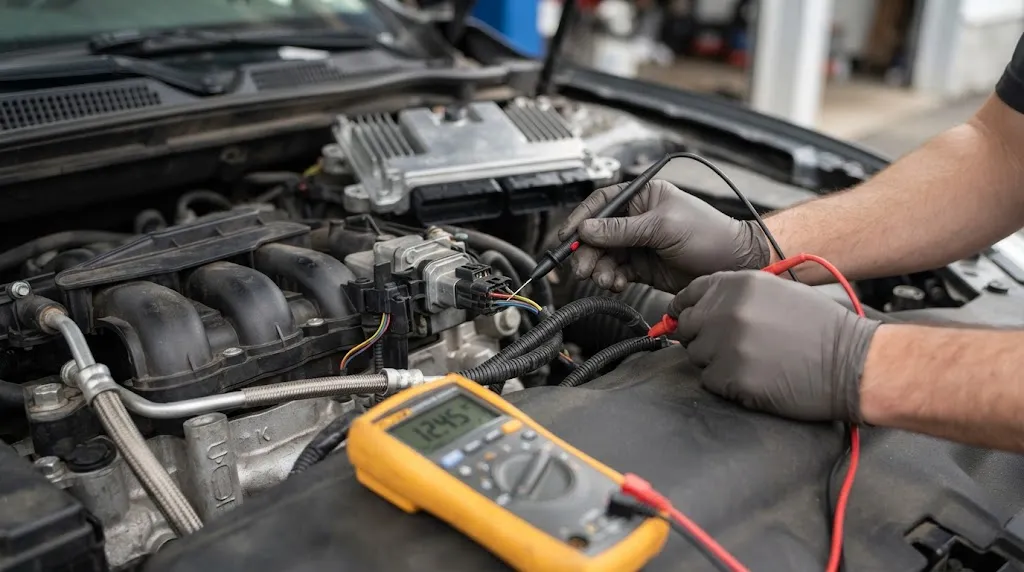
An On-Board Diagnostics II (OBD2) system does not physically inspect mechanical parts; instead, it monitors electrical signals, pressures, temperatures, exhaust gas composition, and response times across the vehicle’s control modules. The primary computer—often called the Engine Control Module (ECM) or Powertrain Control Module (PCM)—constantly compares live sensor data against pre-programmed factory thresholds known as Diagnostic Executive Monitors.
Every time you drive, the computer runs continuous monitors (such as misfire detection and fuel system trim) alongside non-continuous monitors (such as catalytic converter efficiency and evaporative emissions checks) that only execute when specific speed, load, and temperature conditions are met. When a signal crosses factory boundaries for a specified period or across a required number of driving cycles, the module records a DTC.
Standardized under the SAE J2012 and ISO 15031-6 engineering protocols, these codes ensure that any technician or vehicle owner can plug a scan tool into the 16-pin Data Link Connector (DLC) and read baseline fault data regardless of the vehicle’s make or model.
Key Insight
A Diagnostic Trouble Code never says “replace this specific sensor.” It reports that a specific circuit, sensor signal, or subsystem is behaving outside expected limits. A code pointing to an oxygen sensor or mass airflow sensor is frequently caused by a damaged wire, an exhaust leak, a blown fuse, or an intake vacuum leak rather than a defective sensor.
How to Read a 5-Character OBD2 DTC Step by Step
Every standard OBD2 trouble code consists of one letter followed by four characters (typically numbers 0 through 9, though hexadecimal letters A through F appear in newer hybrid, electric, and advanced emissions codes). Each position in that five-character sequence narrows down where the fault lives and who defined the code.
The table below breaks down all five character positions so you can decode any standard trouble code at a glance.
| Character Position | Code Value | System or Category Meaning |
|---|---|---|
| 1st Character (System) | P, B, C, U | P = Powertrain, B = Body, C = Chassis, U = Network / Communication |
| 2nd Character (Code Type) | 0, 1, 2, 3 | 0 = Generic (SAE/ISO), 1 = Manufacturer-Specific, 2 = Generic or OEM (depends on prefix), 3 = Reserved / Joint SAE-OEM |
| 3rd Character (Subsystem) | 0–9 (or A–F) | 1–2 = Fuel/Air Metering, 3 = Ignition/Misfire, 4 = Auxiliary Emissions, 5 = Speed/Idle Control, 6 = Computer/Output Circuit, 7–9 = Transmission, A–C = Hybrid/EV Propulsion |
| 4th & 5th Characters | 00–99 (or Hex) | Identifies the specific fault index, individual sensor, engine bank, cylinder number, or electrical fault condition |
By reading the table from top to bottom, you can immediately determine whether a fault belongs to the engine or the chassis, and whether it uses a universal definition or requires factory service documentation.
Position 1: The System Prefix (P, B, C, U)
The initial letter identifies which major vehicle domain set the code. Because OBD2 was originally mandated to monitor vehicle emissions, powertrain codes are the most common, but modern vehicles network dozens of modules across four categories:
- P (Powertrain): Covers the engine, transmission, transfer case, drivetrain, fuel delivery, ignition, charging system, and emissions controls. Almost all codes that illuminate the main Check Engine Light start with P.
- B (Body): Covers components primarily inside the passenger compartment that deal with comfort, convenience, and passive safety. Examples include airbags and supplemental restraint systems (SRS), seatbelt pretensioners, power windows, heated seats, climate control HVAC actuators, and immobilizer security modules.
- C (Chassis): Covers mechanical and electro-hydraulic systems outside the passenger cabin that control vehicle dynamics, braking, and ride stability. This includes Anti-lock Braking Systems (ABS), wheel speed sensors, electronic stability control (ESC), traction control, electronic power steering (EPS), and adaptive air suspension.
- U (Network / Undefined): Covers Controller Area Network (CAN bus) wiring, Local Interconnect Network (LIN) buses, and module-to-module communication across the vehicle. A U-code indicates that one computer stopped receiving expected data messages from another module—often due to low battery voltage, corroded ground straps, a damaged communication wire, or an unplugged control unit.
Position 2: Generic vs. Manufacturer-Specific (0, 1, 2, 3)
The first digit following the letter reveals whether the code is universal across all automakers or proprietary to the company that built the vehicle:
- 0 (Generic / Global): Defined universally by the Society of Automotive Engineers (SAE) and ISO. For example, P0420 means “Catalyst System Efficiency Below Threshold (Bank 1)” whether you are scanning a Ford, Toyota, BMW, or Hyundai.
- 1 (Manufacturer-Specific / Enhanced): Created by the individual automaker to monitor proprietary hardware, variable valve timing designs, or unique control logic. A P1-code on a Subaru has a completely different definition than the exact same P1-code on a General Motors truck. When looking up a “1” code, you must always include your vehicle’s exact make, model, and year.
- 2 and 3 (Split Designations): Meanings divide between universal SAE definitions and manufacturer-reserved blocks depending on the prefix letter. Within Powertrain (P) codes, P2xxx codes are standardized by SAE (covering modern fuel trim, turbocharger boost, and Diesel Particulate Filter systems), whereas P3000–P3399 is reserved for manufacturer-specific codes and P3400–P3999 is SAE-defined (frequently used for cylinder deactivation systems).
Position 3: The Affected Subsystem
For Powertrain (P) codes, the third character narrows the trouble down to a specific mechanical or electrical group. Knowing this single character immediately tells you where under the hood to focus your inspection:
- 0: Overall fuel, air, and auxiliary emissions system controls
- 1 and 2: Fuel and air metering (including Mass Airflow sensors, Manifold Absolute Pressure sensors, throttle position sensors, fuel injectors, fuel pumps, and fuel rail pressure regulators)
- 3: Ignition system or engine misfire detection (including crankshaft and camshaft position sensors, knock sensors, ignition coils, spark plugs, and individual cylinder misfire counters)
- 4: Auxiliary emission controls (including catalytic converters, Evaporative Emission EVAP purge and vent valves, Exhaust Gas Recirculation EGR systems, and secondary air injection pumps)
- 5: Vehicle speed control, idle air control systems, cruise control inputs, and auxiliary inputs
- 6: Internal computer memory (RAM/ROM checks), module programming errors, sensor reference voltage circuits (5-volt reference buses), and module output drivers
- 7, 8, and 9: Automatic and manual transmission controls, shift solenoids, torque converter clutch circuits, fluid temperature sensors, and transfer case range sensors
- A, B, and C: Hybrid propulsion and electric drive subsystems (including high-voltage battery pack management, inverter temperature sensors, DC-DC converters, and traction motor phase circuits)
Positions 4 and 5: The Specific Fault Index and Failure Mode
The final two characters pinpoint the exact component, engine bank, sensor location, cylinder number, or electrical fault condition. In cylinder misfire codes, the final digit directly identifies the affected cylinder: P0300 indicates a random or multiple-cylinder misfire, whereas P0301 through P0308 point specifically to Cylinders 1 through 8.
Similarly, oxygen sensor and fuel trim codes use these final two digits to distinguish between Bank 1 (the side of the engine containing Cylinder 1) and Bank 2 (the opposite cylinder bank on V6, V8, or flat engines), as well as Sensor 1 (upstream, before the catalytic converter) and Sensor 2 (downstream, after the catalytic converter).
Circuit Faults vs. Performance Faults: Why the Wording Matters
One of the biggest mistakes in DIY car repair is treating every trouble code for a sensor the same way. When you read the text description of a DTC, it almost always falls into one of two distinct diagnostic categories: an electrical circuit fault or a range/performance fault.
- Circuit Low / Circuit High / Circuit Open Codes: These codes indicate a hard electrical problem. Every sensor operates within a strict voltage window (typically between 0.1V and 4.9V on a 5-volt reference circuit). If the computer reads exactly 0.0V or 5.0V, it knows a wire is broken, shorted to ground, shorted to battery power, or unplugged. You should reach for a digital multimeter and inspect the wiring harness and connector pins first.
- Range / Performance or Rationality Codes: These codes mean the electrical circuit is intact and sending a valid voltage, but the physical value makes no sense compared to other sensors on the engine. For example, if the Throttle Position Sensor says the throttle is wide open and the engine is spinning at 4,000 RPM, yet the Mass Airflow (MAF) sensor reports an airflow value typical of a slow idle, the computer sets a MAF “Range/Performance” code. The cause could be a dirty sensor element, a torn rubber intake boot letting unmetered air bypass the sensor, or a restricted exhaust.
- System Too Lean / System Too Rich Codes (e.g., P0171 / P0172): System codes describe the final outcome of combustion rather than blaming a single sensor. They indicate that the computer has reached the limit of its fuel injection adjustments trying to compensate for an air leak, weak fuel pump, clogged injector, or faulty pressure regulator.
The 4 Types of DTC Statuses: Why Some Codes Do Not Turn on the Check Engine Light
Not every trouble code stored in your vehicle’s computer illuminates the dashboard Malfunction Indicator Lamp (MIL). Modern OBD2 modules classify faults into four distinct states based on how recently, how frequently, and how severely the failure occurred.
Comparing these four states explains why a scan tool might display codes even when your dashboard looks completely normal, or why a code refuses to disappear after you press the clear button.
| DTC Status | Check Engine Light | When It Sets | How It Clears |
|---|---|---|---|
| Pending (Mode $07) | Off | Fault detected during a single drive cycle on a “two-trip” monitor | Clears via scan tool or automatically if the next drive cycle passes without fault |
| Confirmed / Active (Mode $03) | On (Steady or Flashing) | Fault verified immediately (Type A one-trip) or across consecutive drive cycles (Type B two-trip) | Clears manually with a scan tool or turns off the light after 3 consecutive fault-free trips |
| History (Inactive) | Off | A previously Confirmed fault is no longer currently present after passing self-tests | Clears with a scan tool or self-erases after 40 engine warm-up cycles without recurrence |
| Permanent (Mode $0A) | Off (once active code is cleared) | Stored in non-volatile memory alongside an emissions-related Confirmed code (2010+ vehicles) | Cannot be erased by a scanner or battery disconnect; clears only after the ECM verifies the repair during driving |
Understanding Permanent DTCs is especially important if you are repairing a vehicle built from the 2010 model year onward or preparing for a state emissions inspection. Regulators introduced Permanent codes (requested via OBD2 Service Mode $0A) to prevent drivers from clearing the Check Engine Light in the inspection station parking lot without fixing the car. Even after you replace the broken part and clear the active codes with a scanner, the Permanent DTC stays stored in Non-Volatile Random Access Memory (NVRAM) until the vehicle completes the specific onboard diagnostic monitor during normal driving and proves the fault is resolved.
What Happens When a DTC Triggers: Freeze Frame Data and Readiness Monitors
When a Confirmed DTC sets and commands the Check Engine Light on, the vehicle’s computer does more than save a five-character code. It simultaneously captures a snapshot of engine operating conditions at the exact moment the fault occurred, known as Freeze Frame Data (OBD2 Mode $02).
Freeze Frame Data gives essential diagnostic context by recording variables such as:
- Engine speed (RPM) and vehicle road speed (MPH / km/h)
- Engine coolant temperature (ECT) and intake air temperature (IAT)
- Calculated engine load percentage and manifold absolute pressure
- Short-Term Fuel Trim (STFT) and Long-Term Fuel Trim (LTFT) percentages
- Fuel system loop status (Open Loop during cold start vs. Closed Loop when warmed up)
For example, if a vehicle logs a lean fuel mixture code (P0171), checking the Freeze Frame Data reveals whether the lean condition happened at idle (around 750 RPM, low engine load) or under heavy highway acceleration (3,800 RPM, 80% engine load). A lean code at idle that disappears at higher RPM strongly points toward an intake manifold vacuum leak, whereas a lean code that triggers only under heavy highway load typically indicates weak fuel delivery, a failing fuel pump, or a restricted fuel filter.
What to Do When Your Vehicle Logs a DTC

When a dashboard warning light comes on or a diagnostic scan reveals stored trouble codes, following a structured diagnostic order prevents wasted money on unnecessary parts.
- Check whether the Check Engine Light is steady or flashing: A steady amber light indicates an emissions or sensor fault that needs inspection soon, assuming the engine temperature, oil pressure, and braking feel normal. A flashing Check Engine Light signals a severe active engine misfire (Type A catalyst-damaging fault) that is dumping raw, unburned fuel directly into the exhaust stream, which can melt the internal ceramic honeycomb of your catalytic converter within minutes. Reduce speed and engine load immediately, and stop driving as soon as it is safe.
- Retrieve all code types with an OBD2 scanner: Plug a reader into the 16-pin DLC port under the driver-side dashboard with the ignition key in the ON position (engine off). Record every Confirmed, Pending, History, and Permanent code, along with the full Freeze Frame snapshot.
- Prioritize circuit codes and primary upstream codes first: If multiple codes appear simultaneously, never start at the bottom of the list. Fix electrical circuit faults (such as 5V reference errors, battery voltage low codes, or “circuit open/low/high” faults) before performance codes. Similarly, resolve upstream engine codes—such as Mass Airflow (MAF), thermostat (P0128), or misfire codes (P030x)—before addressing downstream oxygen sensor or catalytic converter codes (P0420), which are frequently triggered as collateral effects.
- Inspect the physical basics before buying parts: Check the wiring harness, electrical connector terminals, ground straps, vacuum hoses, and fuse feeding the affected circuit. Rodent-chewed wires, green pin corrosion, chafed insulation against an exhaust bracket, or a cracked rubber vacuum hose will generate the exact same trouble code as a failed sensor.
- Verify the repair before and after clearing codes: Only clear the active codes after documenting all Freeze Frame data and completing your physical test or repair, then perform a test drive to ensure the diagnostic monitor runs and passes.
Warning
Never clear Diagnostic Trouble Codes right before a state emissions test or before bringing your car to a mechanic. Erasing DTCs wipes out Freeze Frame Data and resets all emissions Readiness Monitors (Catalyst, EVAP, O2 Sensor, EGR) to “Not Ready” or “Incomplete,” which causes an automatic emissions inspection failure and forces a technician to spend extra labor time recreating the fault.
Why Basic Code Readers Miss Certain DTCs
A common frustration occurs when an ABS, airbag (SRS), traction control, or transmission warning light stays illuminated on the dashboard, yet a basic handheld OBD2 code reader reports “No Codes Stored.” This happens because entry-level OBD2 code readers only query universal emissions-related Powertrain registers (Service Modes $01 through $0A).
To retrieve Body (B), Chassis (C), and Network (U) codes—or manufacturer-specific codes stored inside separate ABS, airbag, body control, and transmission computers—you need a multi-system diagnostic scanner capable of reading enhanced OEM protocols across all vehicle modules.
Related Product
OBD2 Diagnostic Scanner with Live Data & Freeze Frame Support
A diagnostic scanner that reads Pending, Confirmed, and Permanent DTCs along with live sensor data and Freeze Frame snapshots helps you verify the root cause of a fault before replacing parts.
As an Amazon Associate, we earn from qualifying purchases.
Frequently Asked Questions
Can a vehicle have a stored DTC without the Check Engine Light being on?
Yes. Pending codes, History codes, and Permanent codes do not turn on the Check Engine Light by themselves, and many Body (B), Chassis (C), and Network (U) codes either trigger separate system warning lights (like the ABS or airbag light) or stay silently logged in auxiliary modules for technician reference.
Does disconnecting the car battery clear OBD2 trouble codes?
Disconnecting the 12-volt battery may erase active and pending trouble codes on older vehicles, but it will never erase Permanent (Mode $0A) codes on 2010 and newer vehicles. Furthermore, disconnecting the battery wipes out learned throttle body adaptations, fuel trim tables, and emissions readiness monitors, often causing rough idling until the computer relearns its baseline settings.
What is the difference between a 5-character DTC and a 7-character DTC with a symptom byte?
Many modern vehicles use the SAE J2012-DA extended format, which adds a hyphen and two extra hexadecimal characters to the end of a standard 5-character code (such as P0171-00 or C0035-15). Those final two characters are the Failure Type Byte (or symptom byte), which tells you the exact electrical nature of the fault, such as a short to ground, open circuit, or signal plausibility failure.
Why did a catalytic converter code (P0420) come back after replacing the oxygen sensor?
Code P0420 does not mean the oxygen sensor is broken; it means the upstream and downstream oxygen sensors are reporting nearly identical voltage waveforms, proving that the catalytic converter is no longer storing oxygen effectively. Unless an exhaust leak or damaged sensor wire tricked the computer, P0420 usually points to a degraded catalytic converter—often damaged by an earlier engine misfire or rich fuel condition.
How long does it take for a DTC to clear itself after a repair?
If you fix the underlying problem without using a scan tool to clear the memory, the Check Engine Light typically turns off after three consecutive drive cycles in which the diagnostic monitor runs under similar speed, load, and temperature conditions and passes without detecting the fault. The code then remains in History memory for roughly 40 warm-up cycles before erasing completely.
Are OBD2 trouble codes the same on all car brands?
Codes with a “0” in the second position (such as P0xxx, B0xxx, C0xxx, and U0xxx) share universal definitions across all OBD2-compliant vehicles manufactured since 1996 in the United States. Codes with a “1” in the second position (such as P1xxx) are manufacturer-specific and vary completely between brands.
Conclusion
A Diagnostic Trouble Code is the starting point of an automotive diagnosis, not the final verdict on a broken part. By breaking down the five characters of an OBD2 code, you can immediately identify whether the issue lies in the powertrain, body, chassis, or network wiring, and whether it uses a universal SAE definition or a brand-specific protocol.
Before replacing any component or clearing the computer’s memory, always record the Pending, Confirmed, and Permanent codes along with the Freeze Frame snapshot. Using that data to inspect the wiring, connectors, and live sensor readings ensures you fix the actual fault the first time.

I’m Alex Rahman, a car enthusiast and automotive writer focused on practical solutions, car tools, and real-world driving advice. I share simple and honest content to help everyday drivers make better decisions.
