What Is an OBD2 Trouble Code? A Simple Guide
Quick Answer
An OBD2 trouble code is a diagnostic code stored by your vehicle’s onboard computer when it detects a problem or abnormal condition. These codes, also called Diagnostic Trouble Codes (DTCs), help identify which system needs attention. For example, P0301 indicates a misfire detected in cylinder 1. You can read OBD2 codes with a compatible scan tool, but a code identifies a detected problem rather than proving which part is faulty.
Your car can detect many engine and emissions problems before you notice unusual driving behavior. When one of its self-checks finds a fault, it may save a diagnostic code and turn on the check engine light.
That code is your starting point. Understanding what it says can help you decide what to check, how urgently to respond, and when professional diagnosis makes sense.
How Does an OBD2 Trouble Code Work?
An OBD2 trouble code is created when a vehicle’s electronic control system detects a condition that meets its fault criteria. The computer stores information about the detected issue so a technician or vehicle owner can retrieve it with diagnostic equipment.
OBD2 stands for On-Board Diagnostics, Second Generation. It monitors engine operation, emissions-related components, and other supported vehicle systems.
The process generally works like this:
- A system is monitored. Sensors and control modules provide information about vehicle operation.
- An abnormal condition is detected. A diagnostic test finds a value or behavior outside its acceptable range.
- A code is recorded. Depending on the fault and monitoring rules, the code may first appear as pending or become confirmed.
- A warning may appear. Certain confirmed faults cause the check engine light to illuminate.
- A scan tool retrieves the code. The code helps narrow down which system requires further checks.
For example, an engine computer might detect repeated misfires in one cylinder. Instead of identifying one particular broken component, it records a misfire code that directs diagnosis toward that cylinder.
According to the U.S. Environmental Protection Agency, onboard diagnostics can detect emissions-related problems before drivers notice obvious symptoms.
How to Read an OBD2 Trouble Code
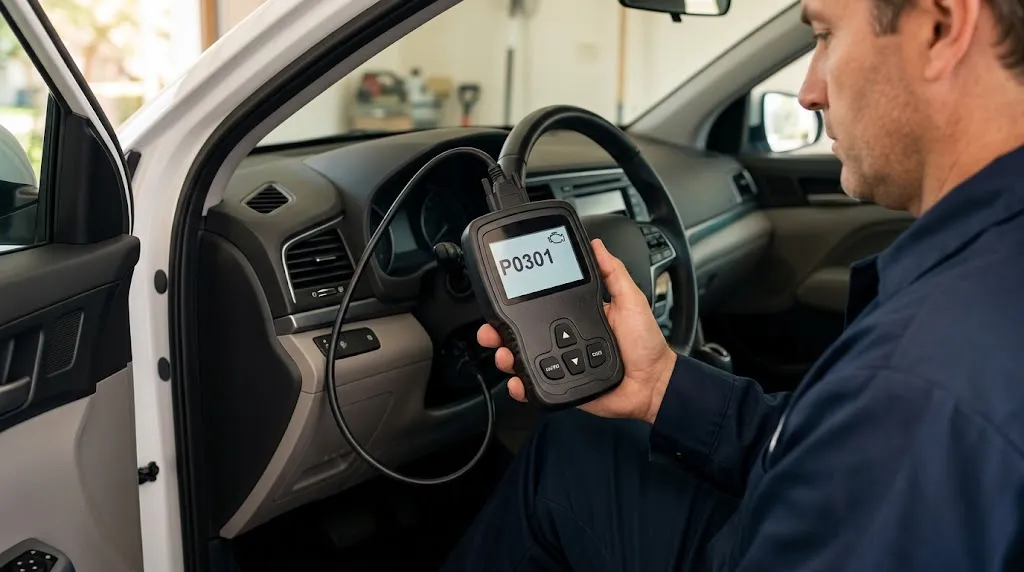
Most familiar OBD2 trouble codes contain five characters. Each part of the code helps identify the general system and the type of fault.
Consider this example: P0301.
| Character | Meaning |
|---|---|
| P | Powertrain system |
| 0 | Standardized code family |
| 3 | Ignition or misfire-related category in this powertrain code |
| 01 | Identifies the particular fault: cylinder 1 misfire detected |
The exact definition matters more than guessing from individual digits. Code numbering rules vary across categories, and not every number has one universal interpretation.
What Do P, B, C, and U Mean?
The first letter identifies the general vehicle system associated with the code.
| Letter | System | Examples |
|---|---|---|
| P | Powertrain | Engine, transmission, fuel control |
| B | Body | Airbags, climate systems, body electronics |
| C | Chassis | Steering, suspension, braking controls |
| U | Network | Communication between electronic modules |
A basic emissions-focused scanner may not retrieve every body, chassis, or network code. Access to those modules depends on the vehicle and the scanner’s capabilities.
Generic vs. Manufacturer-Specific Codes
Some codes have standardized meanings across compatible vehicles. Others require information specific to the manufacturer.
For example, P0xxx codes are commonly standardized powertrain codes, while P1xxx codes are generally manufacturer-specific. Other numbering ranges can contain different allocations, so the second character alone is not a complete lookup method.
The SAE J2012 diagnostic trouble code standard defines standardized DTCs and addresses code ranges reserved for manufacturer-specific use.
When researching a manufacturer’s code, always include the vehicle’s make, model, model year, and engine information.
Common OBD2 Trouble Codes and Their Meanings
These examples show how a diagnostic code points to a problem area without necessarily identifying the failed component.
| Code | Meaning | What May Need Checking |
|---|---|---|
| P0300 | Random/multiple cylinder misfire detected | Ignition, fuel delivery, air leaks, mechanical condition |
| P0301 | Cylinder 1 misfire detected | Spark plug, ignition coil, injector, cylinder condition |
| P0171 | System too lean, bank 1 | Unmetered air, fuel supply, sensor readings |
| P0420 | Catalyst system efficiency below threshold, bank 1 | Exhaust leaks, catalyst performance, sensor data |
| P0455 | Large evaporative emissions system leak detected | Fuel cap where fitted, EVAP hoses, valves, connections |
Suppose a scanner displays P0420. It would be a mistake to immediately buy a catalytic converter. Exhaust leaks, other engine problems, or inaccurate sensor readings can affect the system’s evaluation.
The code tells you where diagnosis should begin. Testing is what establishes the cause.
What Is the Difference Between Pending, Stored, and Permanent Codes?
These terms describe how the onboard system has recorded a fault. They do not automatically indicate how expensive or dangerous the problem is.
Pending Codes
A pending code means the vehicle has detected a fault that has not yet met all the conditions for confirmation. It can appear before the check engine light turns on.
A fault that does not recur may eventually stop appearing as pending, depending on the vehicle’s monitoring rules.
Stored or Confirmed Codes
A stored or confirmed code indicates that the vehicle has met the applicable fault-recording conditions. Confirmed emissions-related faults commonly accompany an illuminated check engine light.
However, a code may remain stored after the warning light turns off. The code’s presence and the current warning-light status are separate pieces of diagnostic information.
Permanent Codes
A permanent code is a retained record of certain confirmed emissions-related faults. It cannot simply be erased with a standard scanner command or by disconnecting the battery.
The vehicle must complete the required monitoring conditions and verify that the fault is no longer present before removing the permanent record.
Key Insight
Code status and fault severity are different. A pending code can involve an important problem, while a retained code may describe an issue that has already been repaired.
How to Check OBD2 Trouble Codes Yourself
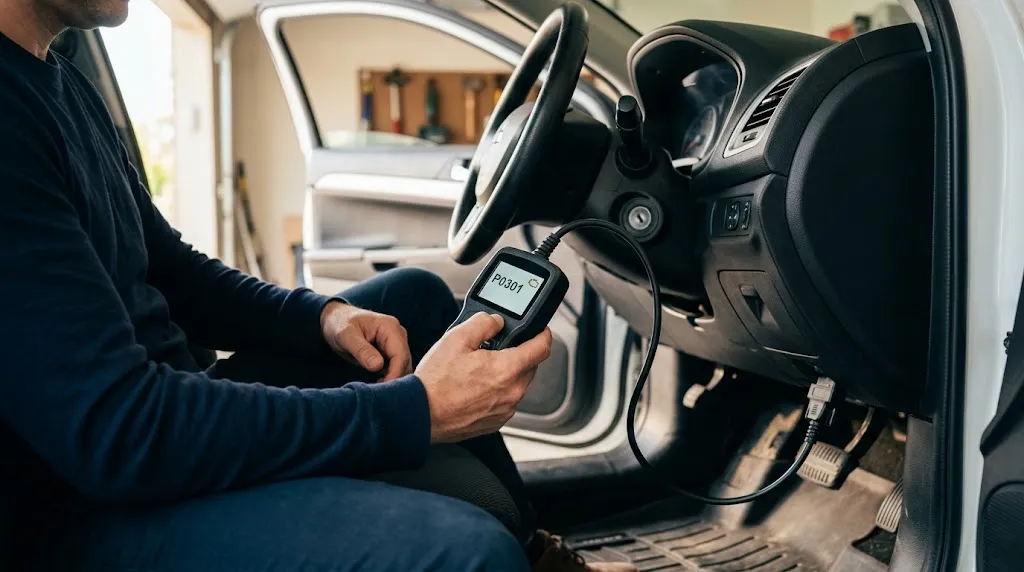
You can retrieve many OBD2 codes with a compatible diagnostic scanner. The process is usually straightforward, even if you have never used one before.
- Park safely. Turn off the engine, apply the parking brake, and follow your scanner’s instructions.
- Find the OBD2 port. It is commonly located beneath the dashboard on the driver’s side. Check the owner’s manual if you cannot find it.
- Connect the scanner. Insert the connector gently without forcing it.
- Turn on the ignition as instructed. Many scanners read codes with the ignition on and engine off. Some tests require the engine running.
- Select the diagnostic function. Choose Read Codes or the equivalent menu and allow communication with the vehicle.
- Record all results. Save the exact codes, status, module, and available freeze-frame data.
- Look up the definitions. Use reliable vehicle-specific service information and assess the symptoms before deciding on repairs.
Freeze-frame data is particularly useful. When supported, it records selected operating conditions associated with a detected fault, such as engine speed, temperature, or load.
For instance, knowing that a fault appeared during a cold start can change which checks make sense compared with the same fault appearing under heavy acceleration.
If your scanner shows no codes despite a warning from the braking, airbag, or another system, that does not establish that the vehicle is fault-free. The scanner may lack access to the relevant module.
What Should You Do After Finding an OBD2 Code?
Start with the code, but make your repair decision using symptoms, supporting data, and basic checks.
First, assess how the vehicle is behaving. A flashing check engine light, strong shaking, major power loss, overheating, smoke, or an oil-pressure warning can indicate a condition that requires immediate action.
If the check engine light is flashing while driving, reduce demand on the engine, find a safe place to stop, and arrange appropriate assistance. Continuing to drive with a severe misfire can damage the catalytic converter.
When the vehicle operates normally and the check engine light is steady, you may have time to arrange a diagnosis, but the fault should not be ignored.
Next, investigate the likely causes. Check the code definition against the vehicle’s symptoms. Simple inspections may reveal disconnected hoses, visibly damaged wiring, or an improperly secured fuel cap on vehicles that use one.
A misfire code, for example, may involve an ignition coil, spark plug, injector, wiring problem, or engine mechanical issue. Replacing parts without confirming the cause can quickly become expensive.
Finally, verify the repair. Once the fault has been corrected, the appropriate diagnostic tests or drive cycles should confirm that the problem is gone.
Warning
Do not erase trouble codes before recording them. Clearing codes may remove useful diagnostic evidence and reset emissions readiness monitors. It also does not repair the underlying fault.
Why a Trouble Code Does Not Always Identify a Bad Part
A vehicle computer detects patterns and operating conditions, not every physical cause behind them.
Imagine a car reports P0171, indicating that its fuel control system is detecting a lean condition on bank 1. Possible explanations include an intake air leak, incorrect airflow measurements, or insufficient fuel delivery.
Replacing an oxygen sensor simply because it contributes to the fault detection may accomplish nothing.
Good diagnosis checks whether the sensor is reporting a real problem and then looks for the condition responsible.
One fault can also produce multiple codes. For example, an air leak might contribute to fuel-trim problems and poor combustion. Addressing the underlying leak could resolve several related symptoms.
That is why technicians consider code relationships, freeze-frame data, live sensor readings, manufacturer procedures, and physical inspections rather than treating each code as a shopping list.
Can You Clear OBD2 Codes Without Repairing the Problem?
Many pending and stored codes can be erased with a compatible scanner, but clearing them does not fix the problem that caused them.
If the fault is still present, the vehicle may detect it again and store the code after the relevant diagnostic test runs.
Clearing codes can also reset emissions readiness monitors to an incomplete state. This matters if your vehicle must pass an emissions inspection.
The Ohio EPA OBD readiness guidance explains that monitors may require further driving under suitable conditions after diagnostic information is erased.
A better approach is to preserve the initial scan results, repair the verified cause, and confirm the vehicle passes its monitoring checks.
When Is Professional Diagnosis Necessary?
Professional help makes sense when the symptoms are serious, the cause remains unclear, or diagnosis requires equipment beyond a basic scanner.
Consider professional evaluation when:
- The engine runs roughly, stalls repeatedly, overheats, or loses significant power.
- The check engine light flashes or returns after a repair.
- Multiple unrelated codes appear together.
- Electrical, network, ABS, or airbag problems require module-level testing.
- Basic inspections reveal no clear cause.
- The repair requires specialized tools, electrical testing, or manufacturer procedures.
Knowing the exact code before visiting a repair shop can still help. It gives you a clearer way to describe the issue and understand which diagnostic tests are being recommended.
Related Product
OBD2 Diagnostic Code Reader
A compatible OBD2 code reader can retrieve trouble codes and help you document an issue before arranging repairs. Check vehicle compatibility and supported diagnostic functions before choosing one.
As an Amazon Associate, we earn from qualifying purchases.
Frequently Asked Questions
Can a car have an OBD2 code without the check engine light being on?
Yes. A pending code may be present before the check engine light illuminates. Certain stored or historical records can also remain available after the light turns off.
Does every OBD2 code mean an expensive repair?
No. Some faults have simple causes, while others need complex repairs. The code alone cannot establish the repair cost because it does not always identify the failed component.
Can a bad battery cause multiple trouble codes?
Yes. Low system voltage or unstable power can sometimes cause communication faults and other diagnostic records. Battery and charging-system conditions should be considered when several unrelated electrical codes appear together.
Will an OBD2 scanner work on every car?
No. Scanner compatibility depends on the vehicle’s diagnostic standard, market, model year, and the functions supported by the tool. A scanner that reads generic engine codes may not access every vehicle module.
What does it mean when an OBD2 scanner says no codes found?
It means the selected diagnostic system has not reported codes that the scanner can retrieve. Other vehicle modules may still contain faults, or the condition may not yet meet the criteria for storing a code.
Can an OBD2 code disappear on its own?
Yes. Some pending or stored codes can clear automatically after the applicable monitoring conditions are met without the fault returning. A permanent code requires its specific verification conditions before it can be removed.
Conclusion
An OBD2 trouble code gives you a useful clue about a problem your vehicle has detected. Reading the exact code, checking its status, and considering your car’s symptoms are the first steps toward an accurate diagnosis.
Remember that a trouble code is a starting point, not a confirmed repair instruction. Identify the cause before replacing parts or clearing diagnostic information.

I’m Alex Rahman, a car enthusiast and automotive writer focused on practical solutions, car tools, and real-world driving advice. I share simple and honest content to help everyday drivers make better decisions.
