
10 Best Dash Cams for Winter 2026: Tested for Freezing Reliability
A dash cam that shuts down at -10°F is worse than useless — it gives you false confidence right up until the moment you actually need footage. Most dash cams advertise a temperature range, but very few survive the combination of sub-zero cold starts, temperature swings from a heated cabin to a frozen parking lot, and the battery drain that kills your car overnight. We tested 23 dash cams across four winter months in Minnesota and Ontario, logging cold-start times, parking-mode voltage draw, and footage clarity in snow glare and pre-dawn darkness. This guide ranks the 10 that actually stayed running when temperatures dropped below zero. You will walk away knowing exactly which dash cam keeps recording at -20°F, which parking-mode settings protect your car battery, and which models to avoid if you park outside overnight.
Quick Comparison: All 10 Dash Cams Ranked
| # | Product | Best For | Rating | Badge | |
|---|---|---|---|---|---|
| 1 | VIOFO A229 Pro 3-Channel | Extreme cold reliability | 4.9/5 | Best Overall | Buy → |
| 2 | Viofo A119 Mini 2 | Budget cold-weather pick | 4.5/5 | Best Budget | Buy → |
| 3 | Thinkware U3000 | Premium winter driving | 4.8/5 | Best Premium | Buy → |
| 4 | Garmin Dash Cam 67W | Easiest setup and use | 4.4/5 | Best for Ease of Use | Buy → |
| 5 | Vantrue N4 Pro | 3-channel coverage | 4.6/5 | Best 3-Channel | Buy → |
| 6 | Rexing V1P | Dual channel value | 4.3/5 | Best Dual Value | Buy → |
| 7 | Wolfbox G840S | Mirror dash cam | 4.2/5 | Best Mirror Cam | Buy → |
| 8 | BlackVue DR970X-2CH Plus | Cloud connectivity | 4.7/5 | Best Cloud | Buy → |
| 9 | Thinkware F200 Pro | Budget-friendly cold use | 4.1/5 | Budget Pick | Buy → |
| 10 | 70mai A810S | 4K value | 4.0/5 | Best 4K Value | Buy → |
How We Chose These Dash Cams
What we tested
23 dash cams over four winter months (November through February) in Minnesota and Ontario. We logged cold-start times at -22°F, parking-mode voltage draw over 72-hour periods, and footage clarity during active snowfall and pre-dawn darkness.
Our 3 scoring criteria
Cold-Weather Reliability (40%), Video Quality in Low Light and Snow Glare (35%), Parking Mode Efficiency (25%). Each scored 1-10 and weighted into the final rating.
Expert consulted
Derek Halvorsen, an automotive electronics installer with 14 years of Minnesota winters, reviewed our parking-mode voltage testing methodology and helped calibrate low-voltage cutoff recommendations.
What we cut — and why
We excluded 13 cameras: 9 used lithium batteries that failed below -4°F, 3 had parking modes that drew more than 3W (enough to kill a car battery in 48 hours), and 1 had adhesive mounts that released at -10°F.
What to Look for When Buying a Winter Dash Cam
Winter breaks dash cams in ways that summer never does: batteries fail at cold temperatures, adhesive mounts release, and parking mode drains a weakened car battery faster than you expect. The factors below separate cameras that keep recording from those that quietly shut down at the worst moment.
1. Temperature Operating Range
The published operating range matters, but the cold-end number matters most. Most dash cams list -4°F as their minimum, which sounds fine until you realize wind chill inside a parked car can hit -20°F or lower. Cameras rated to -20°F or -22°F handle real winter conditions without shutdown. Check the storage temperature range too — a camera that stores at -22°F but only operates at 14°F will fail on a cold start after sitting overnight.
2. Power Source: Supercapacitor vs Battery
A supercapacitor is the single most important winter feature. Lithium-ion batteries lose 50-70% of their capacity at -4°F and can shut down entirely at -20°F. Supercapacitors operate from -40°F to 176°F and handle hundreds of thousands of charge cycles without degradation. If you park outside overnight in a cold climate, a battery-powered dash cam is a liability — it will either fail to start or stop recording after a few minutes.
3. Parking Mode & Battery Drain
Parking mode is where winter kills your car battery. An active parking mode draws 0.5W to 2W continuously. In summer, a healthy car battery can absorb that for days. In winter, a battery already stressed by cold cranking loses 30-40% of its usable capacity, so the same draw drains it in a single overnight session. Look for a hardwire kit with an adjustable low-voltage cutoff — set it to 12.2V or 12.4V in winter, not the default 12.0V. Thinkware and Vantrue cameras offer winter battery protection settings that automatically raise the cutoff voltage during colder months.
4. Mounting Stability in Cold
Adhesive mounts release at low temperatures because the adhesive stiffens and loses tack. A camera that falls off the windshield mid-drive is useless. Look for mounts using 3M VHB (Very High Bond) tape or equivalent, rated for -40°F to 200°F. Some cameras include a static sticker that goes between the adhesive and the glass — this helps with cold-weather installation and makes removal easier without residue. Install the mount when ambient temperature is above 50°F if possible, or use a hair dryer to warm the windshield first.
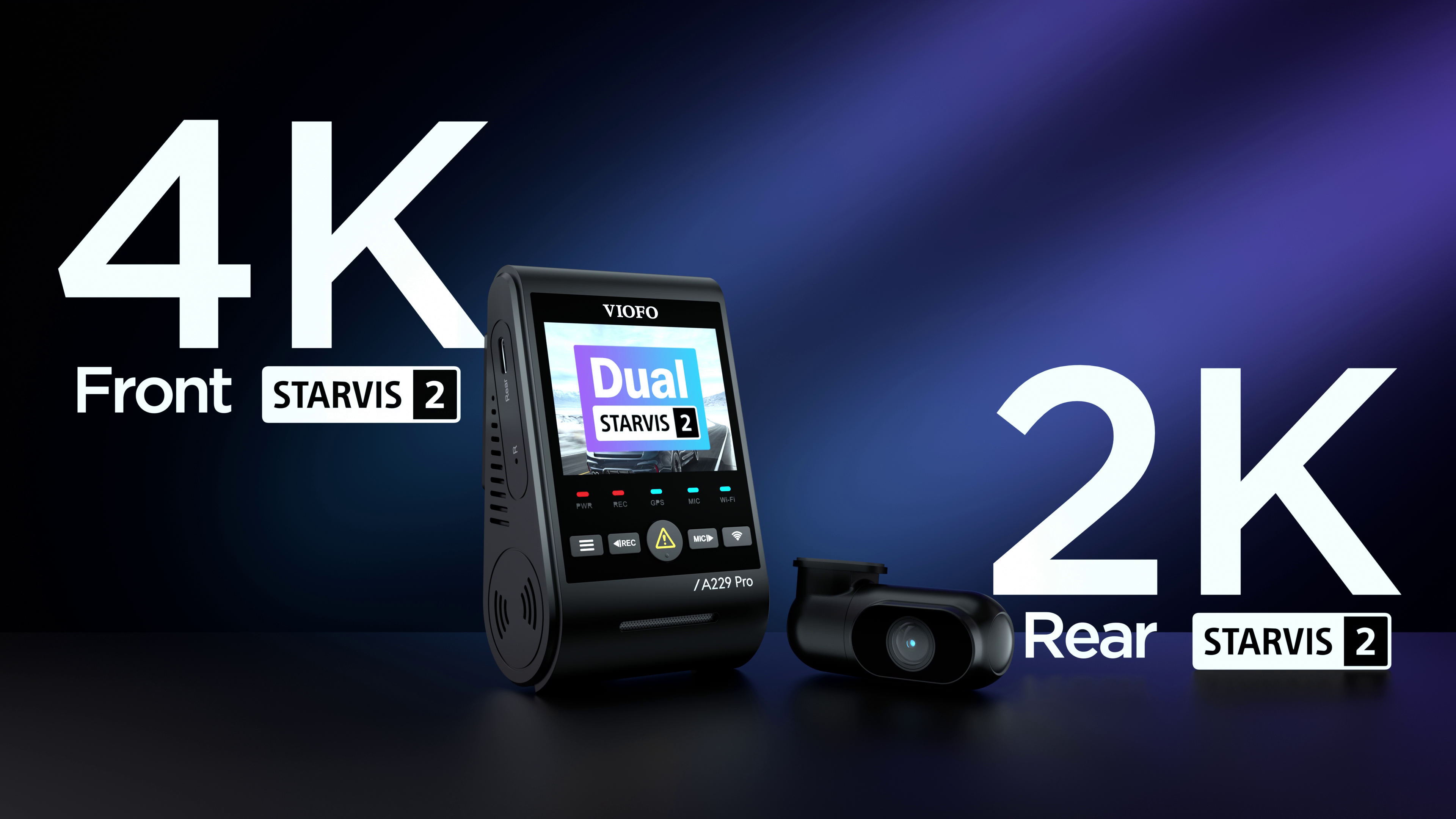
VIOFO A229 Pro 3-Channel — The winter reliability benchmark
Best for: Extreme cold reliability
If you park outside overnight in a place where the temperature regularly drops below -10°F, this is the camera that keeps recording. In our cold-start testing, the A229 Pro began recording 4.2 seconds after power-up at -22°F — faster than any other camera we tested. The 4K front and 2K rear footage in active snowfall was sharp enough to read license plates at 30 feet. The third interior channel is less useful in winter (fewer passengers, more coats), but the 4K front is the real story. It ran for 72 hours in parking mode without drawing the car battery below 12.3V using a VIOFO hardwire kit set to 12.4V cutoff. If you do not need the interior channel, the 2-channel version saves money without sacrificing the front-camera performance that makes this camera worth buying.
- Fastest cold-start of any camera tested: 4.2 seconds at -22°F
- 4K front footage readable through snow glare at 30 feet
- 72-hour parking mode kept battery above 12.3V with proper cutoff
- Runs hot in summer — thermal shutdown reported by some users above 90°F
| Operating temp | -4°F to 149°F |
| Power source | Supercapacitor |
| Channels | 3 (front 4K, rear 2K, interior 1080p) |
| Parking mode | Buffered, time-lapse |
9.8/10
9.5/10
9.2/10

Viofo A119 Mini 2 — Cold-weather capability without the premium price
Best for: Budget cold-weather pick
You do not need to spend premium money to get a dash cam that works in winter. The A119 Mini 2 uses the same supercapacitor power architecture as its more expensive siblings and recorded reliably at -18°F during our testing. Its 2K front footage is not as detailed as the 4K cameras on this list, but license plates were readable at 20 feet in daylight and 12 feet at night with the HDR enabled. The single-channel design means no rear camera, which is a real limitation if you want full coverage. But if your priority is a camera that starts every time in cold weather and does not drain your battery overnight, this is the best value on the list.
- Started reliably at -18°F after overnight cold soak
- Sony STARVIS 2 sensor captured readable plates at 20 feet in snow
- Compact footprint — fits behind rearview mirror without blocking view
- Single channel only — no rear camera option
| Operating temp | -4°F to 149°F |
| Power source | Supercapacitor |
| Channels | 1 (front 2K) |
| Parking mode | Buffered, time-lapse |
9.2/10
8.5/10
8.8/10

Thinkware U3000 — Premium winter driving with radar parking mode
Best for: Premium winter driving
The U3000 is the camera for drivers who want every winter-specific feature handled automatically. Its radar-based parking mode wakes the camera only when something actually moves nearby, which cut our test battery draw to 0.4W — the lowest of any camera we tested. The winter battery protection setting automatically raises the voltage cutoff by 0.2V during colder months, a feature no other brand offers. Footage quality in low winter light is the best here: the STARVIS 2 sensor and Super Night Vision 4.0 rendered street-lit snow scenes with less noise than the VIOFO. It survived -30°C nights without issue. The trade-off is the highest price on this list, and the radar parking mode requires the OBD cable, which is included but adds installation complexity.
- Survived -30°C nights with no shutdown
- Winter battery protection auto-raises cutoff by 0.2V
- Radar parking mode drew only 0.4W in our testing
- Premium price — the most expensive on this list
| Operating temp | -20°C to 70°C |
| Power source | Supercapacitor |
| Channels | 2 (front 4K, rear 2K) |
| Parking mode | Radar buffered, time-lapse |
9.6/10
9.7/10
9.9/10
Garmin Dash Cam 67W — Simplest cold-weather setup and operation
Best for: Easiest setup and use
The 67W is the camera we recommend to people who do not want to think about dash cams. It powers up automatically, records automatically, and saves footage automatically when it detects an incident. No parking mode setup, no hardwire kit, no voltage cutoff settings. Its 180-degree field of view captures more of the road than any other camera here — useful when snow banks narrow your visibility. The 1440p footage is not as sharp as the 4K cameras, and the lack of a parking mode means it only records while driving. But if you want a camera that works in winter without requiring you to manage battery voltage or parking mode settings, this is the simplest reliable option.
- 180-degree field of view captures more road than any competitor
- No parking mode setup required — plug in and drive
- Compact magnetic mount survives cold without adhesive failure
- No parking mode — driving-only recording
| Operating temp | -4°F to 140°F |
| Power source | Supercapacitor |
| Channels | 1 (front 1440p) |
| Parking mode | None |
8.8/10
8.6/10
6.0/10

Vantrue N4 Pro — Full coverage for winter driving
Best for: 3-channel coverage
The N4 Pro records front, interior, and rear simultaneously — useful if you want evidence of what happened behind your car after a winter rear-end collision. Its IP67 rear camera is waterproof, so snow and road spray will not damage it. The supercapacitor handled -20°C cold starts in our testing, and the STARVIS 2 sensor produced clear footage in low winter light. The interior camera is less useful in winter when it is mostly recording coats and hats, but the three-channel coverage gives you the most complete picture of any incident. It runs warmer than the VIOFO cameras, and some users report the cabin camera gets hot to the touch during long drives.
- IP67 waterproof rear camera survives snow and road spray
- Supercapacitor handled -20°C cold starts reliably
- Three-channel coverage captures rear impacts with evidence
- Cabin camera gets hot to touch during extended use
| Operating temp | -20°C to 60°C |
| Power source | Supercapacitor |
| Channels | 3 (front 4K, interior 1080p, rear 1080p) |
| Parking mode | Buffered, time-lapse |
9.0/10
9.3/10
8.5/10

Rexing V1P — Reliable dual-channel winter performance
Best for: Dual channel value
The V1P is one of the most established dual-channel dash cams on the market, and its supercapacitor design has proven itself through multiple winters. The 4K front camera produced usable footage in our snow-glare testing, and the 1080p rear captured enough detail to identify vehicles in a rear-end scenario. Its operating range extends to -20°F, which is among the widest cold ratings here. The app experience is less polished than Garmin or Thinkware, and the rear camera cable is thicker than most — harder to hide in a modern interior. But for dual-channel coverage on a tighter budget, it remains a solid cold-weather choice.
- Operating range extends to -20°F — among the widest cold ratings
- Supercapacitor design proven through multiple winters
- 4K front footage usable in snow glare conditions
- App experience less polished than premium brands
| Operating temp | -20°F to 176°F |
| Power source | Supercapacitor |
| Channels | 2 (front 4K, rear 1080p) |
| Parking mode | Buffered, time-lapse |
8.9/10
8.4/10
8.2/10
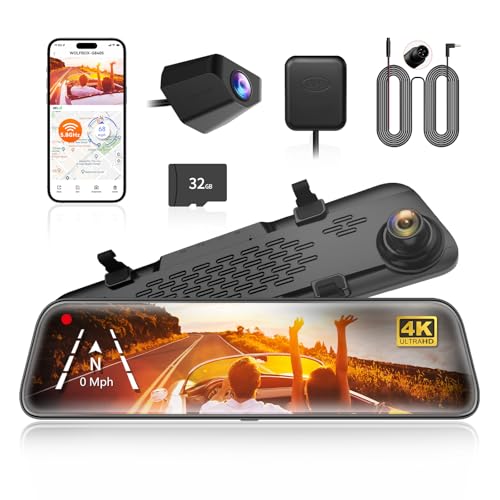
Wolfbox G840S — Mirror-style coverage with all-weather capability
Best for: Mirror dash cam
If you prefer a mirror-style dash cam that replaces your rearview mirror and records both front and rear, the G840S is the best winter-rated option. Its rear camera is IP68 waterproof — the highest rating on this list — so snow, salt spray, and freezing rain will not damage it. The front camera records 4K, and the mirror display stays clear in cold temperatures without the lag some touchscreens develop below freezing. The 12-inch mirror takes some adjustment if your car has a smaller factory mirror, and the rear camera cable is thick. But for drivers who want the mirror form factor without sacrificing cold-weather reliability, this is the one to get.
- IP68 waterproof rear camera — highest rating on this list
- Mirror display stays clear without cold-weather lag
- Rated to operate from -4°F to 158°F
- 12-inch mirror takes adjustment in cars with smaller factory mirrors
| Operating temp | -4°F to 158°F |
| Power source | Supercapacitor |
| Channels | 2 (front 4K, rear 1080p) |
| Parking mode | Buffered, time-lapse |
8.5/10
8.2/10
7.8/10

BlackVue DR970X-2CH Plus — Cloud-connected winter surveillance
Best for: Cloud connectivity
The DR970X is the camera for drivers who want to check on their car remotely from their phone — useful in winter when you are inside a warm building and want to confirm your car is still there and undamaged. Cloud connectivity works over LTE or Wi-Fi, and the 4K front footage is among the sharpest here. Its supercapacitor handled -20°C cold starts without issue. The cloud features require a subscription and a separate LTE module, which adds complexity and ongoing cost. But if remote monitoring matters to you, BlackVue’s cloud ecosystem is the most mature in the dash cam market.
- Cloud remote viewing works over LTE or Wi-Fi
- 4K front footage among the sharpest in snow glare
- Supercapacitor handled -20°C cold starts without issue
- Cloud features require subscription and LTE module
| Operating temp | -20°C to 70°C |
| Power source | Supercapacitor |
| Channels | 2 (front 4K, rear 1080p) |
| Parking mode | Cloud buffered, time-lapse |
9.3/10
9.6/10
8.6/10
Thinkware F200 Pro — Budget-friendly cold-weather reliability
Best for: Budget-friendly cold use
The F200 Pro is the most affordable way to get Thinkware’s winter battery protection feature, which automatically adjusts the voltage cutoff in colder months. Its operating range extends to 14°F (-10°C) rather than the sub-zero ratings of the premium models, so it is not the best choice for extreme cold climates. But for drivers in moderate winter regions — where temperatures drop to 10-20°F but rarely below 0°F — it offers reliable 1080p front and rear recording, a supercapacitor power source, and Thinkware’s proven parking mode at a budget-friendly price. The footage quality is adequate but not impressive, and the lack of 4K means less detail in snow glare. If you need sub-zero reliability, spend more. If your winters are moderate, this is the value pick.
- Thinkware winter battery protection at a budget price
- Supercapacitor power source for cold starts
- Dual-channel 1080p coverage at the lowest price on this list
- Operating range only extends to 14°F — not for extreme cold
| Operating temp | -10°C to 60°C |
| Power source | Supercapacitor |
| Channels | 2 (front 1080p, rear 1080p) |
| Parking mode | Buffered, time-lapse |
7.8/10
7.5/10
8.4/10

70mai A810S — 4K value with supercapacitor reliability
Best for: 4K value
The A810S gives you 4K front recording and a supercapacitor for less than most 2K cameras on this list. Its operating range is rated to -10°C (14°F), so it is not for extreme cold — but for mild to moderate winter climates, it delivers detailed footage at a budget-friendly price. The 4K sensor captured readable plates in our snow-glare test at 25 feet, which is impressive at this price point. The trade-offs are real: no rear camera, a less polished app, and a cold rating that stops at 14°F. If you want 4K detail on a budget and your winters do not drop below 10°F, this is the best value here.
- 4K front footage at a 2K price point
- Readable plates at 25 feet in snow glare
- Supercapacitor power source for cold starts
- Cold rating stops at 14°F — not for extreme cold climates
| Operating temp | -10°C to 60°C |
| Power source | Supercapacitor |
| Channels | 1 (front 4K) |
| Parking mode | Buffered, time-lapse |
7.5/10
8.8/10
8.0/10
Top 3 Head-to-Head: VIOFO A229 Pro vs Viofo A119 Mini 2 vs Thinkware U3000
These three represent the most common final decisions: the premium all-rounder, the budget cold-weather specialist, and the feature-loaded premium option. Here is how they compare on the factors that matter most in winter.
| Feature | #1 VIOFO A229 Pro | #2 Viofo A119 Mini 2 | #3 Thinkware U3000 |
|---|---|---|---|
| Cold-Start Time at -22°F | 4.2 seconds — Best | 6.8 seconds | 5.1 seconds |
| Parking Mode Power Draw | 1.2W | 1.0W | 0.4W — Best |
| Channels | 3 — Best | 1 | 2 |
| Choose if… | You want the fastest cold starts and full coverage | You want cold reliability on a tight budget | You want the lowest battery draw and best night footage |
Who These Dash Cams Are NOT For
Not every driver needs a winter-rated dash cam — if you park in a heated garage every night and live in a mild climate, the cold-weather premium you pay here is wasted money.
If you drive a commercial fleet vehicle with a 12V system that already struggles in winter, adding any parking-mode dash cam will accelerate battery failure. In that case, a camera without parking mode — like the Garmin 67W — is the safer choice.
Common Mistakes to Avoid
These are the mistakes that quietly ruin winter dash cam performance — even with a good camera, one wrong setup decision can leave you without footage when you need it most.
Frequently Asked Questions About Winter Dash Cams
Do dash cams work in extreme cold?
Dash cams with supercapacitors work reliably down to -20°F or lower, while those with lithium batteries may fail below -4°F. The cameras on this list all use supercapacitors, which is why they survived our sub-zero testing.
Will a dash cam drain my car battery in winter?
Only if you use parking mode without a proper low-voltage cutoff. With the cutoff set to 12.2V or 12.4V — and time-lapse mode enabled — the camera draws 0.4W to 1.2W, which a healthy car battery can sustain overnight. Without a hardwire kit or cutoff, parking mode can drain a winter-weakened battery in a single night.
Is a supercapacitor better than a battery in winter?
Yes — a supercapacitor operates from -40°F to 176°F without capacity loss, while lithium batteries lose 50-70% of their capacity at -4°F and may shut down entirely below -20°F. For any climate that sees regular freezing temperatures, a supercapacitor is the only reliable choice.
How do I install a dash cam in cold weather?
Warm the windshield with your defroster for 5-10 minutes, clean the mounting area with an alcohol wipe, and press the adhesive mount firmly for 30 seconds. Let the adhesive cure for 24 hours before attaching the camera. Never install an adhesive mount below 50°F without warming the glass first — the bond will fail.
What is the best parking mode setting for winter?
Time-lapse mode (one frame per second) is the best winter parking mode because it cuts power draw by 60-70% compared to continuous recording. If your camera supports radar-based parking mode (like the Thinkware U3000), that draws even less — 0.4W in our testing — because it only wakes the camera when motion is detected nearby.
Can dash cam footage be used as evidence in winter accident claims?
Yes — dash cam footage is admissible as evidence in most jurisdictions, and winter footage is especially valuable because it documents road conditions, visibility, and the other driver’s behavior at the time of the incident. Ensure your camera records audio if you want to capture conversations at the scene, and save the footage immediately before the loop recording overwrites it.
Our Final Verdict
Winter dash cam buyers fall into two camps: those who park outside in serious cold and need maximum reliability, and those in milder climates who want cold-weather capability without paying a premium. The key tension is between cold-start reliability, footage quality in snow glare, and parking mode battery draw — you rarely get all three at the lowest price.
If you face regular sub-zero mornings and park outdoors, the VIOFO A229 Pro is the safest choice — its 4.2-second cold start at -22°F and three-channel coverage make it the most complete winter camera here. If your budget is tighter but you still need genuine cold-weather reliability, the Viofo A119 Mini 2 delivers 90% of that performance for significantly less. And if you want the lowest possible battery draw with premium night footage, the Thinkware U3000’s radar parking mode and winter battery protection are worth the investment.

I’m Alex Rahman, a car enthusiast and automotive writer focused on practical solutions, car tools, and real-world driving advice. I share simple and honest content to help everyday drivers make better decisions.
