
How Much Does a Car Battery Weigh? Weight by Type Guide
Quick Answer
A standard lead-acid car battery weighs 30 to 50 pounds (14 to 23 kg), and most sit near 40 pounds. Size, chemistry, and design set the exact number. Flooded lead-acid units sit in the middle of the range. AGM units run heavier, and lithium starter batteries run much lighter.
- Small Group 51 batteries can weigh about 25 pounds.
- Large Group 49 batteries can weigh about 57 to 63 pounds.
- Hybrid traction packs weigh about 100 to 300 pounds.
- Electric car packs weigh about 960 to 1,200 pounds.
You may be lifting one out for a swap, or you may be checking a spec before you buy. Weight matters for handling, fit, and safe transport. This guide gives the ranges by type and group size, explains what makes a battery heavy, and shows how to find the exact number for your unit. If the car will not start, learn what happens when your car battery dies before you plan the next step.
How much does a car battery weigh by type?
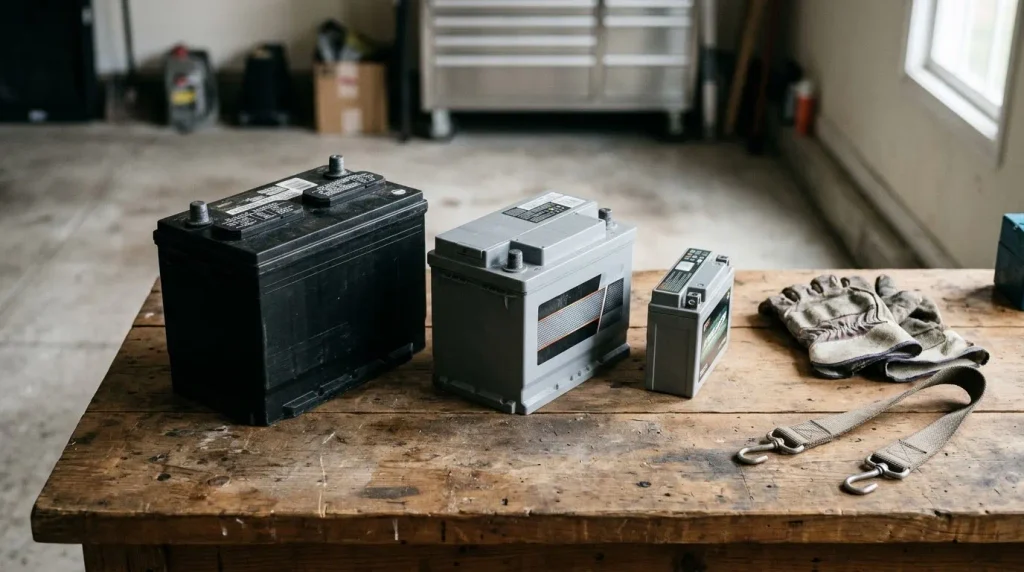
A flooded lead-acid battery weighs 35 to 50 pounds. An AGM battery weighs 40 to 60 pounds, and a 12-volt lithium starter battery weighs 10 to 20 pounds.
Chemistry sets the weight more than any other factor. Flooded batteries hold liquid electrolyte around lead plates. AGM batteries hold the electrolyte in glass mats, and the denser build adds weight. Lithium starter batteries use lighter cells, so they cut the weight by more than half in many cases. See the weight ranges by type and size for the full comparison.
The table below compares the three main starter battery types.
| Battery type | Weight in pounds | Weight in kg | Common use |
|---|---|---|---|
| Flooded lead-acid | 35 to 50 | 16 to 23 | Most gas cars and trucks |
| AGM | 40 to 60 | 18 to 27 | Stop-start cars and luxury cars |
| Lithium starter | 10 to 20 | 5 to 9 | Race cars and light builds |
AGM costs more than flooded in most cases, and lithium costs more still. Check that a lithium starter battery fits your car and charging system before you swap one in.
How much does a car battery weigh by group size?
Group size sets the case size, so it sets a rough weight range. A small Group 51 battery weighs 25 to 43 pounds, while a large Group 49 battery weighs 57 to 63 pounds.
BCI group sizes fix the case dimensions and terminal layout, so a battery from any brand fits the same tray. The same group can still vary a lot. Starting, dual-purpose, and deep-cycle units can share one case, and each design packs a different amount of lead and electrolyte inside.
The table below lists lead-acid ranges for six common groups.
| Group size | Weight in pounds | Weight in kg | Typical fit |
|---|---|---|---|
| 51 and 51R | 25 to 43 | 11 to 20 | Small cars |
| 35 | 31 to 50 | 14 to 23 | Sedans and small SUVs |
| 34 and 34/78 | 37 to 51 | 17 to 23 | Mid-size cars and SUVs |
| 48 (H6) | 45 to 54 | 20 to 25 | Trucks and European cars |
| 65 | 45 to 57 | 20 to 26 | Large trucks and SUVs |
| 49 (H8) | 57 to 63 | 26 to 29 | Large SUVs and luxury sedans |
Use the group as a guide, and check the label for the exact number. Two batteries in one group can sit at opposite ends of the range.
Tip
Read the group number on the label before you shop. It narrows the fit and the weight range in one step.
Why are car batteries so heavy?
Lead makes a car battery heavy. Lead plates give the battery its cranking power, and lead is a dense metal.
Lead makes up about 60 percent of the total mass, according to Engineer Fix. The liquid electrolyte makes up nearly 30 percent of the mass in a flooded lead-acid design. The US EPA says a lead-acid battery may hold up to 18 pounds of lead and about one gallon of corrosive sulfuric acid. See the EPA guidance on used batteries for handling and recycling rules.
The case, separators, and terminals add the rest of the weight. More plates and a higher cold cranking amps rating mean more lead, so the battery weighs more. That is why a truck battery with a high cranking rating weighs more than a small car battery.
60%
Share of total weight from lead
Source: Engineer Fix
18 lb
Lead in a lead-acid battery, up to
Source: US EPA
41 lb
Average car battery weight
Source: NAPA
How heavy are hybrid and electric car batteries?
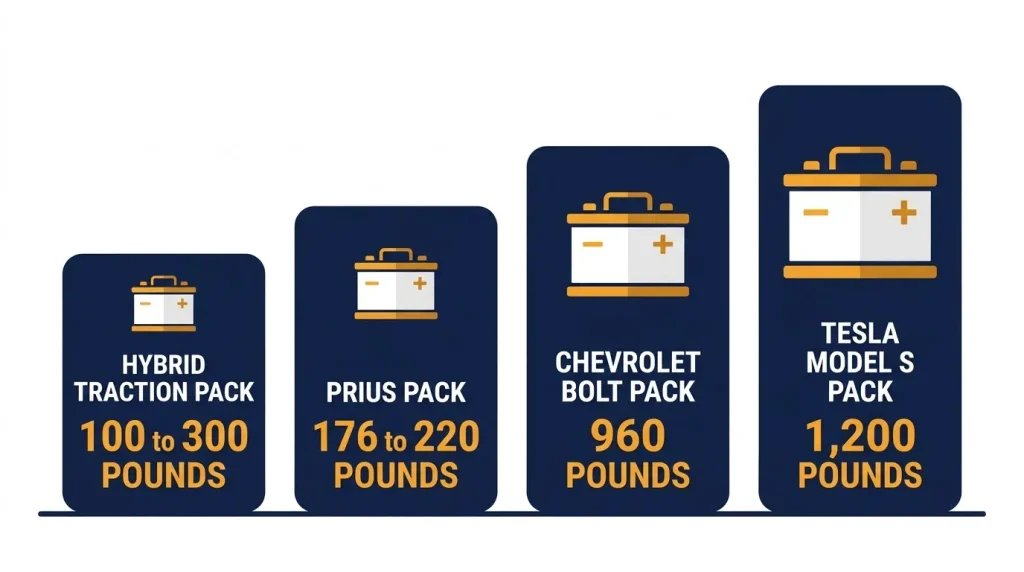
Hybrid traction packs weigh about 100 to 300 pounds, and full electric car packs weigh about 960 to 1,200 pounds.
A hybrid carries two batteries. The 12-volt starter battery runs the starter and basic electrics, and the traction pack drives the motor. A Toyota Prius nickel-metal hydride pack weighs about 80 to 100 kg, or about 176 to 220 pounds, according to Battery Equivalents. Plug-in hybrids carry larger packs, so they weigh more than standard hybrids.
Electric car packs are far heavier still. A Chevrolet Bolt pack weighs about 960 pounds (435 kg), while a long-range Tesla Model S pack weighs about 1,200 pounds (544 kg), according to Holo Battery. These packs sit under the floor, and no driver lifts one by hand.
How can you find the exact weight of your battery?
The label gives the exact weight. Check the top or side of the case for a weight in pounds or kilograms.
Four checks cover most cases, and each one takes a minute or less.
Step 1
Read the label
Look on the top or side of the case for the weight in pounds or kilograms.
Step 2
Find the group number
Use the group number on the side of the case to find the range in a chart.
Step 3
Check the manual
Look in the owner manual for the factory battery size and spec.
Step 4
Ask the maker
Give the maker the model number for the exact weight if the label is worn.
If the label is worn, use the group chart above as a guide. Then confirm the number with the maker spec sheet before you buy or lift the unit.
Does battery weight show if a battery is good?
Weight alone does not show if a battery is good. A heavy battery can still fail, and a light battery can still start a car.
Health depends on charge, cranking power, age, and internal damage. Weight can fall a little as electrolyte is lost, according to Learn Mechanical, but that change is small and hard to read by hand. A scale will not tell you if the plates are worn or if a cell has failed.
Test the battery instead of guessing from weight. A scan can help detect a bad battery when cranking turns slow or the car will not start. A load test and a voltage check give a clearer answer than the weight does.
How do you lift and carry a car battery safely?

A car battery is heavy enough to strain your back, so lift it with your legs and keep it upright.
NAPA puts the range at 30 to 60 pounds, with an average of 41 pounds. Stand close, bend at the knees, and keep your back straight. Use the built-in handle or a battery carrier, and keep the battery close to your body. See the handling tips from NAPA before you start.
Warning
Battery acid burns skin and eyes. Wear gloves and eye protection, and keep the battery upright to stop leaks.
Never lift a battery by its cables or terminals, since they are not built to hold the weight. Cover the terminals if you carry the unit, and secure it in the tray so it cannot tip or slide. If the battery is too weak to crank the engine, check whether a jump starter can start a completely dead battery before you remove it. Return a dead battery to a retailer or collection point for recycling.
Car Battery
A replacement battery is the product most readers need after a dead or weak unit.
Frequently Asked Questions
How much does a standard car battery weigh in pounds?
A standard lead-acid car battery weighs 30 to 50 pounds, and most weigh about 40 pounds. Small cars use lighter units near 25 pounds. Large trucks and SUVs use heavier units that can pass 60 pounds. Check the group size and the label for the exact number for your car.
How much does a truck battery weigh?
A heavy-duty truck battery weighs about 50 to 70 pounds, and some large units weigh more. Diesel trucks often use two batteries, so the pair weighs far more than one unit. Check each battery label, since size and design change the number.
How much does an electric car battery weigh?
A full electric car battery pack weighs about 960 to 1,200 pounds, and larger packs weigh more. A Chevrolet Bolt pack weighs about 960 pounds, while a long-range Tesla Model S pack weighs about 1,200 pounds. These packs sit under the floor and are not lifted by hand.
Can I lift a car battery by myself?
Most adults can lift a standard car battery alone with the right grip and leg lift. Use the built-in handle or a battery carrier, and keep the battery close to your body. Ask for help if the battery is large, damaged, or leaking.
Does a heavier battery last longer?
A heavier battery does not always last longer, since life depends on design, use, and care. A heavier unit may hold more lead and capacity, but heat, deep discharge, and age wear any battery down. Test voltage and cranking power to judge health.
Where is the weight listed on a car battery?
The weight is often printed on the top or side label in pounds or kilograms. If the label is worn or missing, use the group number to find the range in a chart. The maker can also give the exact weight from the model number.
Conclusion
How much does a car battery weigh in most cars? About 30 to 50 pounds, so plan for a 40-pound lift and check the label for the exact number. If you are replacing one, match the group size and chemistry to your car, then lift with your legs and recycle the old unit.

I’m Alex Rahman, a car enthusiast and automotive writer focused on practical solutions, car tools, and real-world driving advice. I share simple and honest content to help everyday drivers make better decisions.
