
Is an OBD2 Scanner Worth It? Decide Before You Buy
Quick Answer
An OBD2 scanner is worth it for most drivers who check warning lights, buy used cars, or fix simple faults themselves. It turns a check engine light into a code, live data, and readiness status you can act on. It is less useful if you drive a car with rare faults and always use a shop for every repair.
- Buy one if you will scan more than once, check a used car, or track a fault over time.
- Borrow one or use a free store scan for a single warning light on a car you will take to a shop.
- Match the scanner to the job, because a basic reader may miss ABS, airbag, and transmission codes.
- A code points to a system, so test the cause before you replace a part.
A check engine light gives you a warning, not an answer. This guide helps you decide if an OBD2 scanner earns its place in your glove box, what it can read, and when a borrowed scan makes more sense.
In this article
- What does an OBD2 scanner do?
- How does an OBD2 scanner save you money?
- When is an OBD2 scanner worth it for you?
- Which type of OBD2 scanner fits your use?
- What can an OBD2 scanner not do?
- When is an OBD2 scanner not worth buying?
- How do you get value from an OBD2 scanner?
What does an OBD2 scanner do?
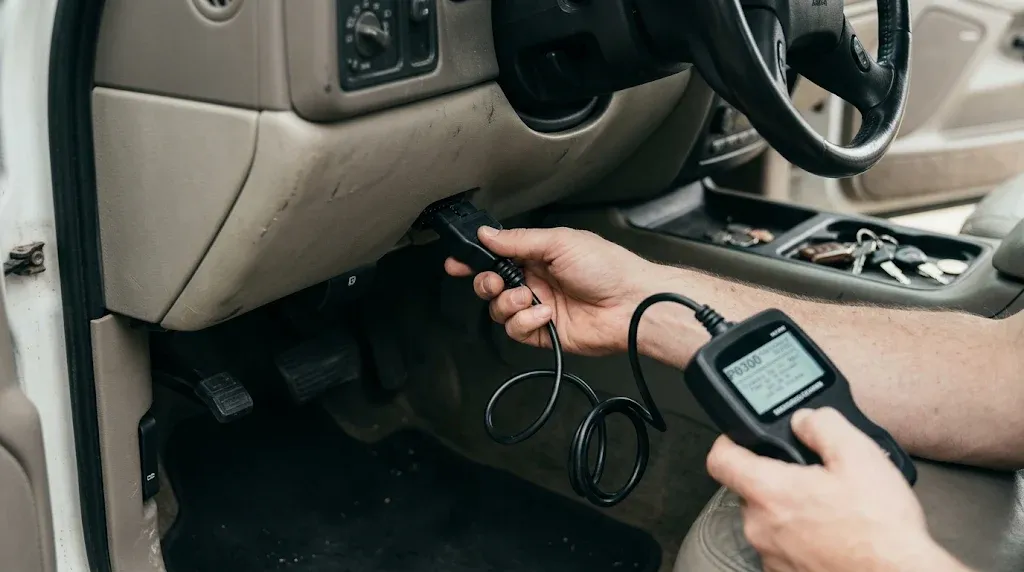
An OBD2 scanner reads fault codes, live sensor data, and emissions readiness from your car computer. It plugs into the standard 16-pin port, usually under the driver side dashboard, and turns a warning light into information you can check.
OBD2 stands for On-Board Diagnostics, second generation. The system monitors engine and emissions parts, and it stores a diagnostic trouble code when a monitor finds a fault. The EPA OBD regulations describe OBD as software that monitors emission control parts and engine parts, then lights the check engine lamp when a fault can affect emissions.
Most gasoline passenger cars sold in the United States after the OBD2 mandate use the same port and code format. That shared format is why one tool can work on many makes, even when the cars differ in other ways. To learn the full range of functions, see what an OBD2 scanner does.
What information does a scanner read?
A scanner reads stored, pending, and permanent trouble codes, plus freeze frame data and readiness status. Stored codes mark a confirmed fault, pending codes mark a fault seen once, and permanent codes stay until the car passes its own tests.
Freeze frame data is a snapshot of engine speed, load, temperature, and vehicle speed at the moment the code was set. Readiness status shows if the emissions monitors have finished their self-tests. Those details matter more than the code alone, because they show the conditions behind the fault.
What do live data and freeze frame add?
Live data shows sensor values while the engine runs, such as RPM, coolant temperature, fuel trim, and oxygen sensor activity. A single code can have several causes, so live data helps you narrow the list before you test a part.
Live data also helps you confirm a repair. If fuel trim returns to a normal range after a fix, the change supports the repair. If the same pattern returns, the fault may have a different cause, or the repair may not have solved it.
How does an OBD2 scanner save you money?
An OBD2 scanner saves money by giving you facts before you pay for a shop visit or a part. You can tell if a fault is simple, if it needs a shop, or if it needs more testing first.
A loose gas cap can set an evaporative system code, and a scan can point you to that area before you book a visit. A misfire code can show which cylinder has the fault, so you do not replace parts on every cylinder. Early checks can also catch a fault before it harms a costly part, such as a catalytic converter.
A scanner can also help before an emissions test. You can check emissions readiness at home, so you do not pay for a test with monitors still incomplete. A ready status does not promise a pass, but an incomplete status warns you to wait and drive the car through its normal cycle first.
Tip
Record codes, freeze frame, and readiness before you clear anything. A photo of each screen keeps the evidence if the light returns.
Used car checks add another saving. A scan can reveal pending codes, a permanent code, or many incomplete monitors on a car that looks clean. Those signs do not prove the car is bad, but they give you a reason to ask for repair proof or a professional inspection before you pay.
When is an OBD2 scanner worth it for you?
An OBD2 scanner is worth it when the tool matches a job you will repeat. A driver with an older car, a used car search, or a simple repair habit gets more value than a driver who sees one light in a long stretch.
Use the situations below to test your own case. If more than one fits, the scanner is more likely to pay off. If none fits, a borrowed scan may serve you just as well.
If you
Fix simple faults yourself or check warning lights more than once a year
Choose a reader with live data, because it helps you test a cause and verify a repair.
If you
Shop for a used car or check emissions readiness before a test
Choose a tool that shows pending codes and readiness, because those screens reveal hidden faults.
If you
Always use a shop and see a warning light only once in a long while
Choose a borrowed scan, because a shop visit already covers the diagnosis.
A scanner also helps when you want to talk with a mechanic from a clear starting point. You can share the exact code, the freeze frame, and the symptoms you saw. That record can cut guesswork, and it can stop a shop from replacing a part you already ruled out.
For a used car, a scan works best with a cold start, a test drive, and a second scan after the drive. A single idle scan can miss a fault that appears only when cold or under load. To see how that check works, read the guide on how to detect intermittent faults in a used car.
Which type of OBD2 scanner fits your use?
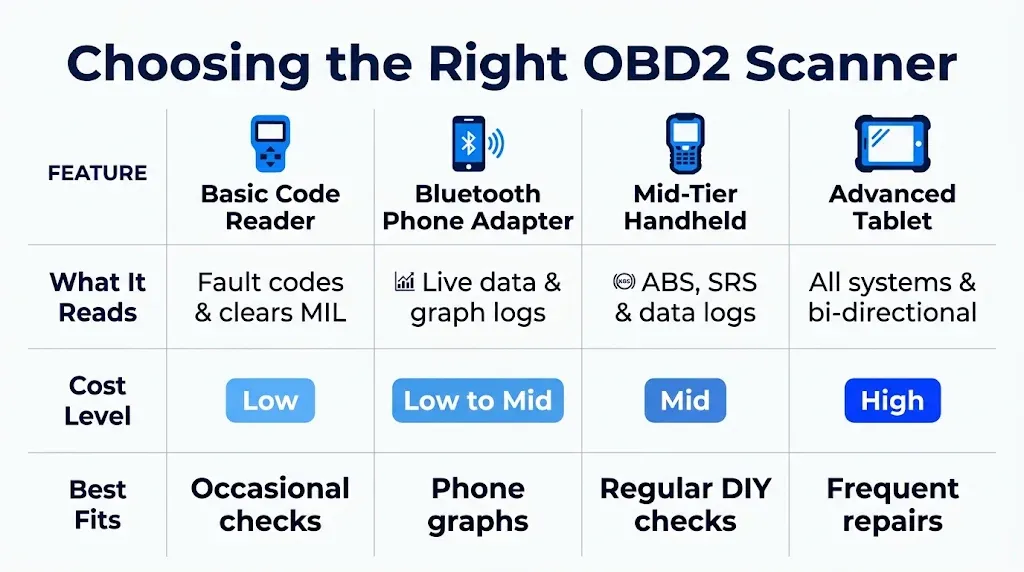
The right type depends on the systems you need to reach and the way you like to work. A basic reader covers generic engine codes, while a fuller tool reaches more modules and adds tests.
Drive-Insight lists Bluetooth dongles at about 50 to 150 dollars, while professional tools in the same guide cost about 500 to 3,000 dollars or more. That gap shows why a home user should not buy a shop tool for a simple warning light check.
The table below compares the main types on the same points. Use it to match the tool to your car and your repair habit, not to the longest feature list.
| Scanner type | What it reads | Cost level | Fits |
|---|---|---|---|
| Basic code reader | Generic engine codes and readiness | Low | Occasional warning light checks |
| Bluetooth phone adapter | Codes, live data, logs, and app reports | Low to mid | Drivers who like phone graphs and records |
| Mid-tier handheld | Codes, live data, freeze frame, and some extra modules | Mid | Regular DIY checks and used car scans |
| Advanced tablet | Many modules, service resets, and active tests | High | Frequent repairs on several cars |
A basic reader is enough when you only need the code and readiness status. A phone adapter adds graphs and logs, but it needs a charged phone and a working app. A mid-tier handheld works on its own screen, while an advanced tablet adds service functions that most home users will not use.
Check coverage for your exact car before you buy. A tool can read generic engine codes on your car and still miss ABS, airbag, transmission, or hybrid modules. Check the update terms too, because some tools charge for software updates, app features, or vehicle coverage after the first period.
What can an OBD2 scanner not do?
An OBD2 scanner cannot prove a diagnosis, fix a fault, or replace a physical inspection. It reads what the computer recorded, and it leaves the cause to testing and inspection.
A code names a system or circuit, not a part. A lean code can come from a vacuum leak, a faulty sensor, or a fuel delivery fault. A catalytic converter code can come from a worn sensor, an exhaust leak, or a failing converter. The scanner narrows the search, and a test confirms the cause.
A scanner also cannot judge brakes, tires, suspension, fluid condition, or most mechanical wear. Those faults may set no code at all. A clean scan does not prove a used car is sound, and it does not prove a repair is safe.
Why does a code not name the part?
A code does not name the part because the computer watches a circuit and its readings, not the part itself. The same reading can come from wiring, a connector, a sensor, a mechanical fault, or a control fault.
Innova explains this limit with a lean code example, where live fuel trim data helps separate a vacuum leak from a sensor fault or a fuel delivery fault. The Innova guide to OBD2 scanners also notes that bidirectional controls on higher tier tools can command a part and watch its response, which helps test a suspect part instead of guessing.
Warning
A flashing check engine light can point to a misfire that harms the catalytic converter, so stop in a safe place and get help instead of driving on.
Some faults need a shop even when the code looks simple. Get help for an airbag or brake warning, a high voltage warning, overheating, a fuel smell, a visible leak, or a loss of power. Do not use a reset or an active test as a substitute for the repair steps in the service guide for your car.
When is an OBD2 scanner not worth buying?
An OBD2 scanner is not worth buying when you will not use it enough to learn from it. A tool in a drawer does not save money, and a tool bought for one light may cost more than the scan you needed.
Skip a purchase if you always use a shop, your car is under a service plan that covers diagnosis, or you only need one code read. A parts store scan, a borrowed tool, or a single shop visit can give you the same code for that one case.
Skip a high tier tool if your car cannot use its extra functions. A basic engine reader will not gain ABS or airbag access from a higher price alone, and a tool built for one brand may not cover your car. Check the exact vehicle, module, and function before you pay for more depth.
Also skip a tool with unclear update terms if you plan to keep it for a long time. A scanner that stops updating can lose coverage for newer cars, and a subscription can turn a one-time buy into a yearly cost. Read the update, app, and account terms before you choose.
How do you get value from an OBD2 scanner?
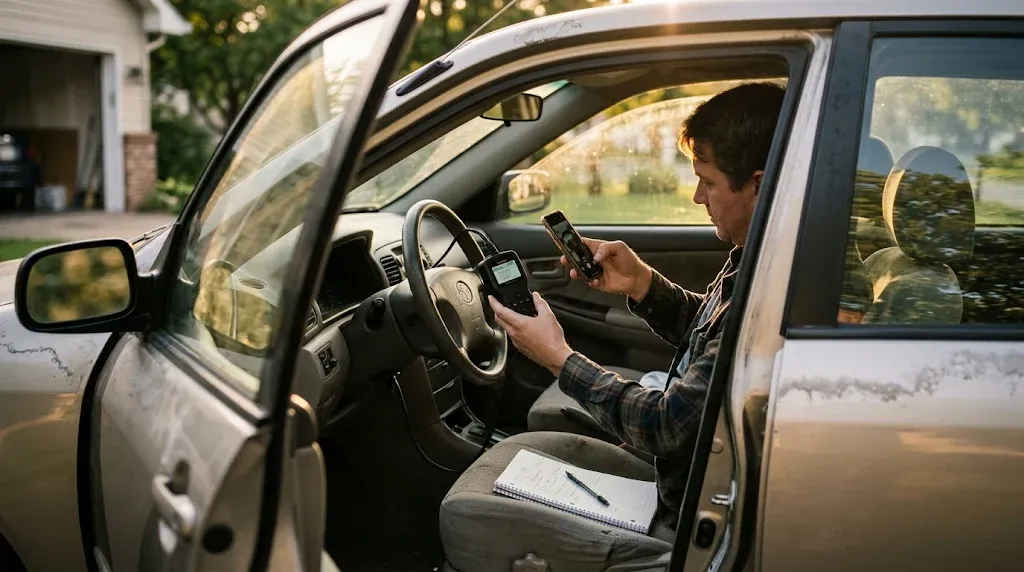
You get value from an OBD2 scanner by scanning in the right order and saving the evidence. A calm first scan beats a fast clear, because a clear erases the data you need to find the cause.
Use the steps below for a warning light, a used car check, or a repair check. They work for a basic reader, a phone adapter, and a handheld tool, with the same rule at each step: record first, then decide.
Step 1
Plug in and read codes first
Connect the scanner, turn the ignition on, and read stored, pending, and permanent codes. Note the exact code letters and numbers.
Step 2
Save freeze frame and readiness
Photograph the freeze frame and the readiness screen before you change anything. Those screens show the fault conditions and the test status.
Step 3
Match the code to the symptoms
Compare the code with noises, smells, rough running, fuel use, and recent work. A code that fits the symptoms is a stronger lead than a code alone.
Step 4
Test before you replace a part
Use live data, a visual check, and the service steps for your car to test the likely cause. Replace one part at a time when a test points to it.
Step 5
Clear codes only after the repair
Clear eligible codes after the repair, then drive and scan again. If the code returns, the fault is still present or has a different cause.
For the full connection steps and screen layout, see how to use an OBD2 scanner. Keep the tool in the car if you use it often, and unplug a Bluetooth adapter when you park for a long stretch, because some adapters draw power while the car sits.
A scanner works best as part of a simple habit. Scan when a light appears, scan before a used car purchase, and scan after a repair. That habit gives you a record to share with a shop, and it helps you spot a pattern before a small fault grows.
OBD2 Scanner
A scanner in this category helps you read codes, check live data, and check readiness at home.
Frequently Asked Questions
Can a cheap OBD2 scanner read check engine codes?
A cheap OBD2 scanner can read generic engine codes and clear them after a repair on a compatible car. It may miss ABS, airbag, and transmission codes, and it may show little live data. Check the exact coverage for your car before you buy a low-cost reader.
Do I need an OBD2 scanner if a parts store reads codes free?
A free parts store scan can work for a single warning light when you only need the code read once. The store scan gives you less control over timing, saved data, and follow-up checks. An owned scanner helps more when the light returns, when you check readiness, or when you track a fault over time.
Will an OBD2 scanner work on my car?
An OBD2 scanner works on most gasoline passenger cars sold in the United States after the OBD2 mandate took effect. Older cars, some diesels, and heavy trucks may need a different connector or tool. Check your port, model year, and fuel type before you buy.
Can an OBD2 scanner tell me which part to replace?
An OBD2 scanner cannot name the failed part, because a code points to a system or circuit, not a single component. A lean code can come from a vacuum leak, a sensor fault, or a fuel delivery fault. Test the likely causes before you replace any part.
Is a Bluetooth OBD2 scanner better than a handheld reader?
A Bluetooth OBD2 scanner suits phone users who want graphs, logs, and repair notes, while a handheld reader suits simple plug-in checks. A phone adapter needs a charged phone and a working app, while a handheld reader works on its own screen. Pick the form you will keep in the car and use.
Can I clear a check engine light with an OBD2 scanner?
An OBD2 scanner can clear eligible codes and turn off the check engine light after you complete the repair. Clearing a code does not fix the fault, and the light returns if the fault stays. Clearing also resets readiness monitors, so save the codes and freeze frame first.
Conclusion
An OBD2 scanner is worth it when you will use it to check a warning light, test a used car, or verify a repair. If you drive one car, see rare faults, and use a shop for every job, borrow a scan or pay for one visit instead.

I’m Alex Rahman, a car enthusiast and automotive writer focused on practical solutions, car tools, and real-world driving advice. I share simple and honest content to help everyday drivers make better decisions.
