Can an OBD2 Scan Detect Intermittent Faults in a Car?
Quick Answer
Yes, sometimes. An OBD2 scan can catch an intermittent fault when the car stored it as a pending, stored, or permanent code, or saved freeze-frame data from the moment it happened. It cannot catch a fault that never repeated enough to be recorded, was cleared recently, or never triggers a monitor.
A used car can feel fine on a short viewing and still carry a fault that appears only on a cold morning or under load. A scan helps, but only if you understand what it records: it reads what the control modules already noticed and kept.
What “Intermittent” Means to the Car’s Computer
To a driver, intermittent means the symptom comes and goes: a hesitation, a rough idle, a warning light that appears for a day and then disappears. To the engine control unit, it means something narrower: a reading crossed a limit or a monitor test failed, but the condition did not repeat often enough to confirm the fault.
Most emissions-related faults use a two-trip rule. The fault must be detected on one drive, then again on a second, similar drive before the system confirms it and turns on the check engine light. The first detection usually becomes a pending code. The second makes it a stored code. If the fault does not return, the pending code can clear itself after several fault-free drives.
What an OBD2 Scan Can Actually Catch
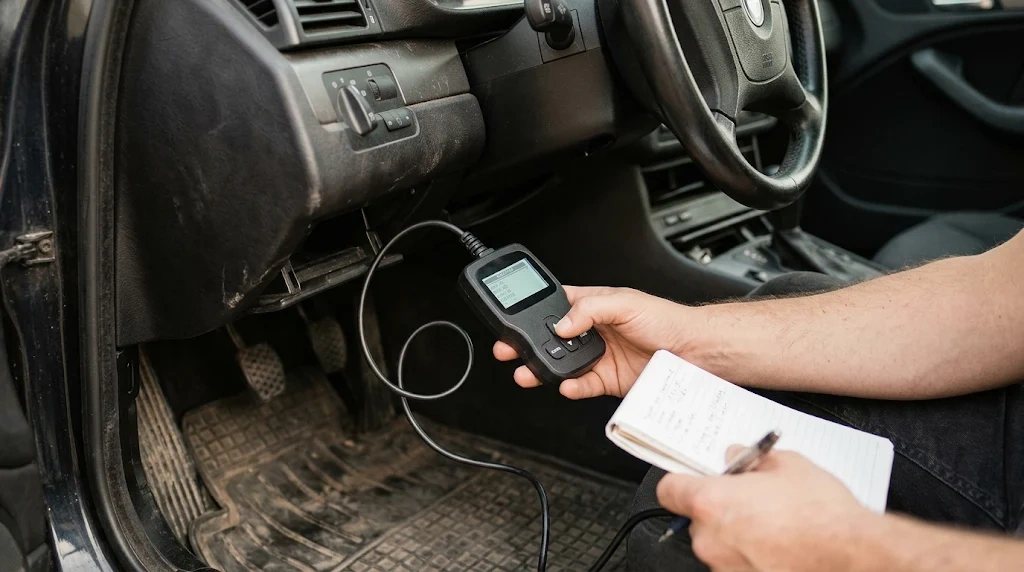
Pending codes are the earliest warning: a fault detected once but not yet confirmed. A pending misfire or lean-fuel code may explain a slight stumble the seller calls normal. The EngineerFix guide to pending trouble codes explains that a pending code does not light the check engine light, yet it is stored and readable with a scan tool.
Stored codes are confirmed faults. The condition repeated enough to meet the car’s criteria, and the light usually came on. Even if the light is off now, a stored code can remain readable for a while. Our guide to stored vs pending trouble codes explains how the two statuses differ and why both matter.
Permanent codes are emissions-related confirmed codes that a scanner cannot erase. Clearing codes or disconnecting the battery does not remove them. The car clears one only after it runs its own tests and passes them.
Freeze-frame data is a snapshot saved when a code was set: engine speed, load, coolant temperature, vehicle speed, and fuel trim at that exact moment. That snapshot often matters more than the code alone, because it shows whether the fault happened cold, hot, at idle, or under load.
Live data and Mode 06 results show what sensors are doing now and what the monitors recorded during their last tests. Misfire counts, fuel trim, and oxygen sensor response can point to a developing fault before it becomes a confirmed code. A basic reader may not show Mode 06, so check what your tool supports first.
Pending, Stored, and Permanent Codes at a Glance
| Code status | What it means | Light | What to do |
|---|---|---|---|
| Pending | Fault seen once, not confirmed | Usually off | Record it, check freeze frame, test-drive in similar conditions |
| Stored | Fault repeated and confirmed | Usually on, or was on | Treat as a real fault needing diagnosis |
| Permanent | Confirmed emissions fault, not erasable by a tool | Was on | Ask for repair proof; the car must pass its tests to clear it |
| History | Fault happened before, not active now | Off now | Check when it happened and whether it matches the seller’s story |
A pending code is not proof a part has failed, and a stored code is not a repair instruction. The code names a system and a symptom; the cause still needs checking.
Why a Clean Scan Does Not Prove a Clean Car
A scan with no codes can mean three things: the car has no recorded fault, the fault has not recurred yet, or the evidence was erased. Clearing codes is quick. It erases stored and pending codes, freeze-frame data, and test results, and resets the readiness monitors to “not ready.” The fault itself is untouched, so it usually returns once the car repeats the conditions that triggered it.
That is why readiness matters. If several monitors show “not ready” on a car that has supposedly been driven normally, the codes may have been cleared recently, or the battery was disconnected. Our guide on whether an OBD2 scanner can detect a recently cleared code explains the traces a clear leaves behind.
A fault can also be too new, too rare, or outside the scanned systems. A basic reader usually covers generic powertrain codes only. It may miss manufacturer-specific codes and faults in ABS, airbag, transmission, and body modules. A worn clutch, tired suspension, rust, or a slow oil leak may never set a code at all. For a fuller picture, see what an OBD2 scan can reveal on a used car.
Warning
Do not clear codes during a viewing. Clearing erases the freeze frame and pending codes you need, resets readiness monitors, and makes the next scan less useful. Record everything first, then decide.
How to Scan a Used Car for Intermittent Faults
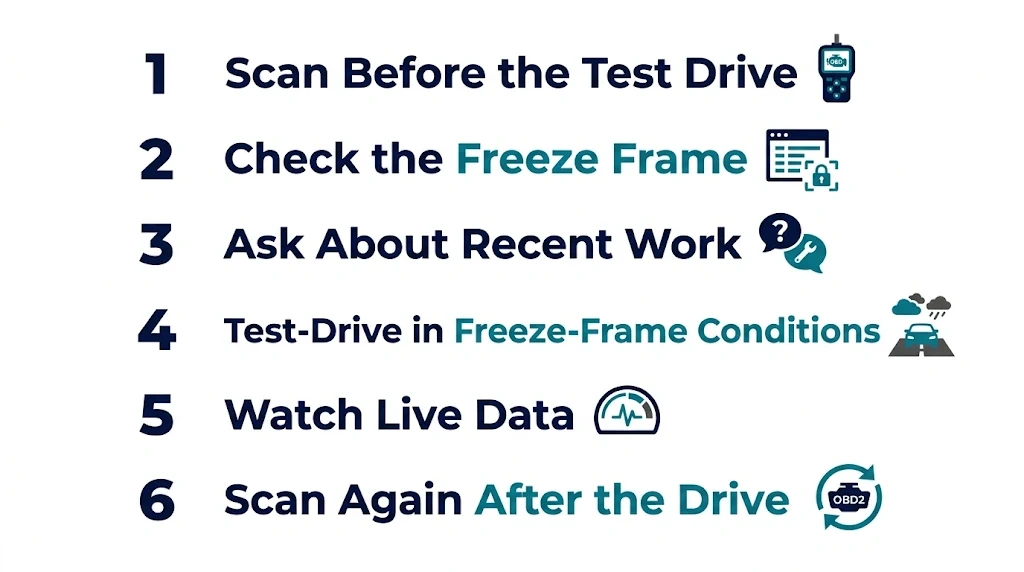
Order matters. A scan done only at idle, after the seller warmed the car up, misses the conditions where many intermittent faults appear. Photograph every screen.
- Scan before the test drive, engine off and then idling. Read stored, pending, permanent, and history codes. Note readiness status and save any freeze-frame data.
- Check the freeze frame for each code. Note coolant temperature, engine load, speed, and fuel trim. The OBDeleven explanation of freeze-frame data lists the parameters a frame usually holds. Our guide to when OBD2 freeze frame is captured explains why most cars keep only one frame.
- Ask what has been done recently. A new battery, a repair, or a code clear all reset monitors. Compare the answer with the readiness status you just saw.
- Test-drive under the conditions in the freeze frame. If the fault happened cold, start cold. If it happened under load, include a hill or a motorway merge.
- Watch live data during the drive. Pick two or three readings that match the code: misfire counts for a misfire code, fuel trim for a lean code, oxygen sensor switching for an emissions code.
- Scan again after the drive. A pending code that appears now, or a misfire count that climbed on one cylinder, is new evidence. No change does not clear the car; it only means the fault did not repeat on that drive.
What to Watch in Live Data During the Test Drive
Live data helps only when you know what to watch. Watching every parameter at once is noisy and easy to misread. Choose the readings that match the code or symptom, and look for a pattern rather than a single odd number.
For a misfire code, watch misfire counts per cylinder. For a lean or rich code, watch fuel trim at idle and under load. For an oxygen sensor code, watch whether the sensor switches steadily or hangs. A fault that appears only when cold may not repeat on a car the seller warmed up first, so ask for a cold start when the freeze frame shows a cold engine.
Red Flags That Deserve a Professional Inspection

Some scan results are not a reason to walk away immediately, but they are a reason to pause and get a second opinion before paying.
- A permanent code is present, with no repair invoice or a vague explanation of what was fixed.
- Several readiness monitors are “not ready” on a car described as driven daily, with no recent battery or repair work to explain it.
- A pending code matches a symptom you felt on the test drive, even though the light stayed off.
- The same code returns after the drive, or a misfire count climbs steadily on one cylinder.
- Codes appear in systems a basic reader cannot reach, once a fuller scan is done, especially ABS or airbag codes.
- The seller discourages a cold start, a longer drive, or an independent inspection.
A single pending code on an older car is not automatically a deal-breaker. What matters is whether the code, the freeze frame, the test drive, and the seller’s account line up. When they do not, a professional pre-purchase inspection is the sensible next step. It is also worth checking whether an OBD2 scan can find a problem before the check engine light comes on.
Common Mistakes When Checking for Intermittent Faults
The most common mistake is reading only stored codes and stopping there. A basic reader that shows “no codes” may still be hiding pending codes, permanent codes, freeze-frame data, and readiness status in other menus. Open each of those screens, even when the first screen looks clean.
The second mistake is clearing a code to “see if it comes back.” That destroys the evidence and starts the confirmation process from zero. The fault may take days to return, long after the viewing ends. The third mistake is treating a code as a diagnosis. A P0300 random misfire code does not name a failed coil or plug. It says misfires were detected. Finally, do not let a clean scan override what you felt on the drive. A hesitation, a smell, or a light that flickered and went out are all evidence, even when the scanner shows nothing.
Related Product
OBD2 Scanner With Pending Codes, Freeze Frame, and Live Data
A scanner that shows pending and permanent codes, freeze-frame data, readiness monitors, and live data makes an intermittent-fault check far more useful than a basic code reader.
As an Amazon Associate, we earn from qualifying purchases.
Frequently Asked Questions
Can an OBD2 scan detect an intermittent fault if the check engine light is off?
Yes, when the fault left a pending, stored, permanent, or history code, or freeze-frame data. A pending code is the most common trace when the light is off. If nothing was recorded, the scan will show nothing.
What is the difference between a pending code and an intermittent fault?
An intermittent fault is the underlying problem that comes and goes. A pending code is one record the car keeps after detecting that problem once. Not every intermittent fault creates a pending code, and not every pending code becomes a confirmed fault.
Can a seller hide an intermittent fault by clearing the codes?
Clearing codes erases stored and pending codes and freeze-frame data, so a scan done right after a clear can look clean. It cannot erase permanent codes, and it resets readiness monitors to “not ready.”
How long does a pending code stay on the car?
A pending code usually clears itself after several fault-free drives if the fault does not return. If it repeats on a second similar drive, it becomes a confirmed code.
Does a basic OBD2 reader detect intermittent faults?
Only partly. Many basic readers show stored codes but hide pending codes, permanent codes, freeze-frame data, and readiness status. For this check, use a tool that clearly shows pending codes, freeze frame, live data, and readiness monitors.
Should I still get a professional inspection if the OBD2 scan is clean?
Yes, if the car is a significant purchase or anything on the drive felt wrong. A clean scan does not cover mechanical wear, body or chassis issues, or faults in systems a basic scan cannot reach.
Conclusion
An OBD2 scan can detect an intermittent fault in a used car, but only when the fault has left a trace: a pending code, a stored or permanent code, freeze-frame data, or a live-data pattern that repeats under the right conditions. A clean scan at idle is not proof the car is fault-free. Scan before and after a proper test drive, record everything, check readiness monitors, and let a professional inspection settle the cases where the scan, the drive, and the seller’s story do not line up.

I’m Alex Rahman, a car enthusiast and automotive writer focused on practical solutions, car tools, and real-world driving advice. I share simple and honest content to help everyday drivers make better decisions.
