What’s the Difference Between a Cheap and Expensive OBD2 Scanner?
Quick Answer
A cheap OBD2 scanner typically reads and clears basic engine trouble codes, while an expensive scanner may diagnose ABS, airbag, transmission, and other vehicle systems. Higher-priced models can also offer advanced live data, bidirectional controls, service functions, and better diagnostic guidance. For occasional check-engine-light checks, a basic reader may be enough; for regular DIY repairs or professional work, broader diagnostic coverage can justify spending more. Learn how these functions work in this guide to choosing an OBD2 scanner.
What changes as the price increases?
- Diagnostic coverage: Budget readers usually focus on standard engine and emissions codes, while advanced tools may access additional modules.
- Live data: More capable models can graph sensor readings and help you spot changing engine conditions.
- Active testing: Some scanners can command compatible vehicle components to operate during diagnostic tests.
- Repair functions: Higher tiers may support oil resets, electronic parking brake service, and other vehicle-specific procedures.
- Usability: Larger screens, clearer menus, reports, and guided diagnostics can make troubleshooting easier.
- Ongoing costs: Some advanced tools require paid software updates or subscriptions, so check the total cost before buying.
Choosing an OBD2 scanner can feel confusing when one tool costs less than a family meal and another costs several hundred dollars. I’ve found that the most useful way to compare them is to look beyond the price tag and ask what each device can actually tell you about your car.
In this guide, I’ll explain the main differences, compare typical price ranges, and show which features matter for everyday drivers, DIY mechanics, and professional technicians. I’ll also cover compatibility and ongoing costs so you can avoid paying for functions you’ll never use.
What Is the Difference Between a Cheap and Expensive OBD2 Scanner?
A cheap OBD2 scanner usually focuses on basic engine diagnostics, while an expensive scan tool may communicate with multiple electronic control modules and perform advanced tests. The important difference is diagnostic capability, not simply how many buttons, cables, or screen features a device has.
An OBD2 scanner is a diagnostic device that connects to a vehicle’s onboard diagnostic system to retrieve trouble codes and, depending on the model, display sensor information or run supported tests. OBD2 stands for On-Board Diagnostics, Second Generation.
The standardized system helps compatible vehicles report certain engine and emissions-related problems. However, not every scanner can access every electronic system installed in a vehicle.
- Budget code reader: Retrieves common engine trouble codes and may clear eligible codes.
- Midrange diagnostic scanner: Often adds live data, freeze-frame information, better code descriptions, or selected manufacturer-specific functions.
- Advanced scan tool: May support multiple modules, bidirectional tests, service procedures, and deeper vehicle-specific diagnostics.
The boundaries overlap. Some affordable scanners offer useful live data, and certain midrange tools provide advanced functions that older, more expensive devices lack.
How Much Do Cheap and Expensive OBD2 Scanners Cost in 2026?
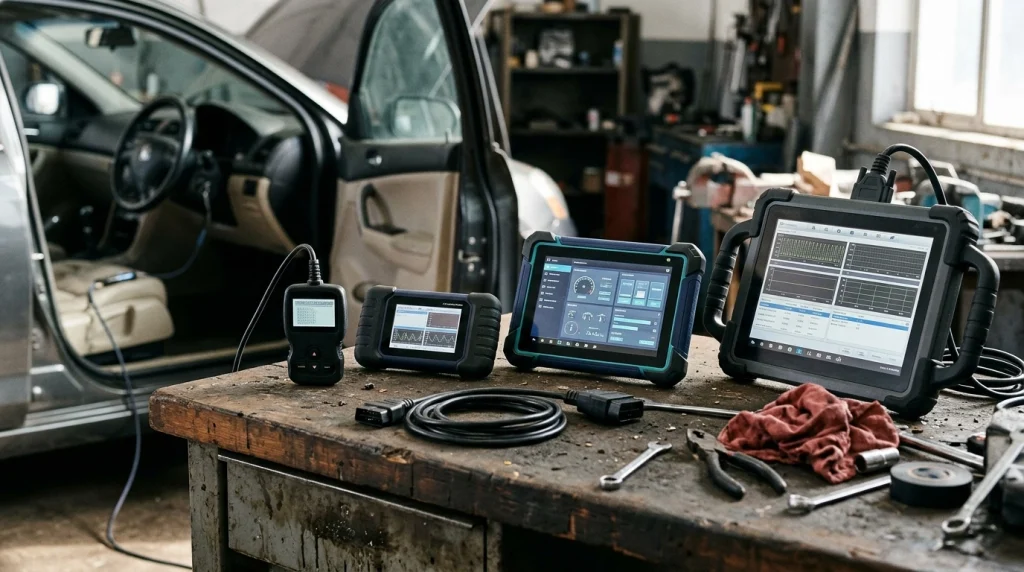
As a general U.S. market guide in 2026, basic OBD2 readers often cost around $20–$60, more capable consumer scanners commonly fall around $60–$200, and advanced diagnostic tools can cost $200–$600 or more. Professional platforms may cost considerably more when subscriptions, specialized interfaces, or manufacturer-specific software enter the picture.
These are broad shopping ranges, not fixed market prices. Features, sales, regional availability, and vehicle compatibility can change the value of a particular model.
| Scanner tier | Typical price | Common capabilities | Best suited to |
|---|---|---|---|
| Basic | $20–$60 | Generic engine codes, code clearing, sometimes readiness checks | Occasional troubleshooting |
| Midrange | $60–$200 | Live data, freeze-frame, improved interfaces, selected enhanced diagnostics | Regular DIY maintenance |
| Advanced | $200–$600+ | Potential all-system access, bidirectional tests, service functions | Frequent repairs and advanced DIY work |
| Professional platform | $600–$2,000+ | Broader vehicle coverage, advanced workflows, specialized software | Repair shops and technicians |
For example, a $30 reader might tell you that your engine has stored a fault code, while a more advanced tool may let you examine live sensor readings and run a supported component test. That extra information is valuable only when it helps you identify the cause or complete a repair.
What Features Do Expensive OBD2 Scanners Offer?
Expensive scanners can provide access to additional vehicle systems, deeper diagnostic data, and tests that basic code readers cannot perform. However, the exact features depend on the tool, vehicle make, model year, and supported software.
1. Access to ABS, SRS, and transmission systems
Many basic scanners focus on powertrain diagnostics, which cover the engine and emissions-related systems. Advanced models may also access the anti-lock braking system (ABS), supplemental restraint system (SRS), transmission control module, and body electronics.
This difference matters when the dashboard displays an ABS warning or an airbag light. A basic reader may return no relevant code even though a compatible advanced scanner can retrieve a fault from the affected module.
Don’t assume that an expensive tool covers every module on every car. Check its supported vehicle list before buying.
2. Live data and graphing
Live data shows measurements reported by the vehicle while the system operates. Depending on the vehicle and scanner, these readings may include engine speed, coolant temperature, fuel-system information, intake readings, and oxygen-sensor activity.
Graphing lets you observe how a reading changes over time rather than relying on a single number. That can help when investigating intermittent problems, but interpreting the results still requires knowledge of normal operating conditions.
3. Bidirectional control
Bidirectional control allows a compatible scanner to send supported commands to a vehicle module instead of only receiving information. A technician might use this capability to command a fan, operate an actuator, or perform another manufacturer-supported active test.
This is one of the most meaningful differences between a basic reader and a professional-style scan tool. It can help narrow down faults without relying entirely on guesswork or replacing parts unnecessarily.
Active tests must match the vehicle and procedure. Sending commands without understanding the system can create risks, so follow the service information and scanner instructions.
4. Service and maintenance functions
Some advanced scanners offer guided service procedures that go beyond reading trouble codes. Depending on the vehicle, these may include:
- Oil service interval resets.
- Electronic parking brake maintenance mode.
- Steering angle sensor calibration.
- Battery registration or replacement procedures.
- Diesel particulate filter service functions.
- ABS bleeding procedures on supported vehicles.
Not every scanner supports every function, even when its product listing uses terms such as “full system” or “professional.” Verify the exact procedure for your vehicle before paying extra.
5. Better diagnostic guidance and reporting
Higher-tier scanners may provide more detailed code descriptions, freeze-frame information, diagnostic reports, and repair-related guidance. Freeze-frame data records selected operating conditions associated with a fault, which can help explain what the engine was doing when the problem appeared.
These features are useful when comparing readings or discussing a fault with a mechanic. Still, no scanner can guarantee the correct repair simply by displaying a code.
Is a Cheap OBD2 Scanner Accurate Enough?
A reputable budget scanner can read standard diagnostic trouble codes accurately when it supports the vehicle and communicates correctly. Its main limitation is often the amount of information it can access, not necessarily the accuracy of every code it displays.
For example, a scanner may retrieve a code associated with a mass airflow sensor circuit. That code identifies the system or condition detected by the vehicle’s computer, but it doesn’t automatically prove the sensor itself has failed.
The underlying issue could involve wiring, a connector, an air leak, contamination, or another condition affecting the reading. A more advanced scanner may help investigate further, but it still needs correct testing and interpretation.
Before replacing a part, I recommend checking the code description, freeze-frame data when available, relevant service information, and other symptoms. The U.S. Environmental Protection Agency explains how onboard diagnostics store trouble codes when monitored systems detect certain faults; see the EPA’s official website for background on emissions-related diagnostics.
Which Scanner Is Better for Reading and Clearing Codes?
If your main goal is to read a check-engine code before visiting a repair shop, a basic scanner may do everything you need. A more expensive model becomes useful when you want to investigate the problem further or access systems beyond standard engine diagnostics.
Consider a common example: your check-engine light comes on, and the scanner retrieves P0420, a code associated with catalyst-system efficiency below the expected threshold. Both a cheap and an expensive scanner may read that code if they support the vehicle’s standard OBD2 information.
The advanced tool might offer more live data or diagnostic options, but neither device proves that replacing the catalytic converter is the correct repair. The fault needs proper diagnosis.
For code clearing, both budget and advanced tools may erase eligible codes. However, clearing a code doesn’t repair the fault, and it can erase useful diagnostic information or reset emissions readiness monitors.
Are Bluetooth OBD2 Scanners as Good as Expensive Handheld Models?
Bluetooth scanners can offer strong value because the adapter uses your phone as the display and interface. Their capabilities depend on the adapter, companion app, subscription level, and vehicle compatibility.
A simple Bluetooth dongle may cost less than a dedicated handheld unit while providing convenient live-data charts and code descriptions. Some premium phone-based systems also offer enhanced diagnostics for supported makes.
- Bluetooth adapter: Compact and convenient, but it relies on a compatible phone and app.
- Basic handheld: Usually works without a phone and often provides straightforward code reading.
- Advanced handheld: May offer broader diagnostics, active tests, and service functions through a dedicated interface.
Phone compatibility deserves attention before buying. Some adapters work with Android but not iOS, while others support both platforms or require specific apps and permissions.
Also review app costs. A low-priced adapter can become less attractive if the functions you need require recurring payments.
Does a More Expensive Scanner Work on Every Car?
No, an expensive OBD2 scanner doesn’t automatically support every vehicle or diagnostic function. Compatibility depends on the vehicle’s model year, make, control modules, communication protocols, and the manufacturer’s support for each feature.
Standard OBD2 functions cover defined engine and emissions-related information on compatible vehicles, but enhanced diagnostics vary by manufacturer. Newer vehicles may also require support for newer communication technologies or specialized interfaces.
Before purchasing, check these details:
- The exact make, model, and year of your vehicle.
- Whether the scanner supports your engine and market version.
- Which modules it can read, such as ABS, SRS, or transmission.
- Whether advertised service functions apply to your vehicle.
- Whether updates are included or require an additional fee.
When buying a tool for multiple cars, verify each vehicle individually. Broad compatibility claims don’t always mean every feature works across every model.
What Are the Hidden Costs of Expensive OBD2 Scanners?
The purchase price doesn’t always reflect the full cost of owning a diagnostic tool. Some manufacturers include software updates for a limited period, while others charge for continued access to certain features or vehicle coverage.
Look beyond the initial price and check the following:
- Subscriptions: Find out whether enhanced diagnostics require a monthly or annual payment.
- Software updates: Check how long updates remain free and what happens after that period.
- Vehicle coverage: Confirm that your car’s modules and service procedures are supported.
- Accessories: Some functions require separate adapters or battery-testing equipment.
- Repair information: Determine whether wiring diagrams, technical guidance, or reports cost extra.
A $200 scanner with the features you need and no recurring fee could be a better long-term purchase than a cheaper device that locks essential functions behind a subscription. The reverse can also be true if you only need basic code reading.
When Is It Worth Spending More on an OBD2 Scanner?
Spending more makes sense when the additional functions match the repairs you perform. If you maintain several vehicles or regularly investigate warning lights, the extra diagnostic access can save time and reduce unnecessary parts replacement.
- Choose a budget reader if you mainly want to retrieve engine codes, check emissions readiness, or gather information before a mechanic visit.
- Choose a midrange scanner if you frequently troubleshoot engine problems and want useful live data or enhanced code access.
- Choose an advanced scanner if you work on ABS, airbag, transmission, electronic parking brake, or other supported systems.
- Choose a professional platform if you diagnose vehicles regularly and need broader coverage, reporting, and advanced test functions.
My main buying principle is simple: pay for diagnostic functions you can use, not for a long feature list you may never open. For a driver who checks a warning light twice a year, a well-supported basic reader can be a sensible purchase.
For a DIY mechanic who services multiple cars, spending more can be worthwhile if it unlocks specific modules and tests needed for real repairs.
Which OBD2 Scanner Should You Buy?
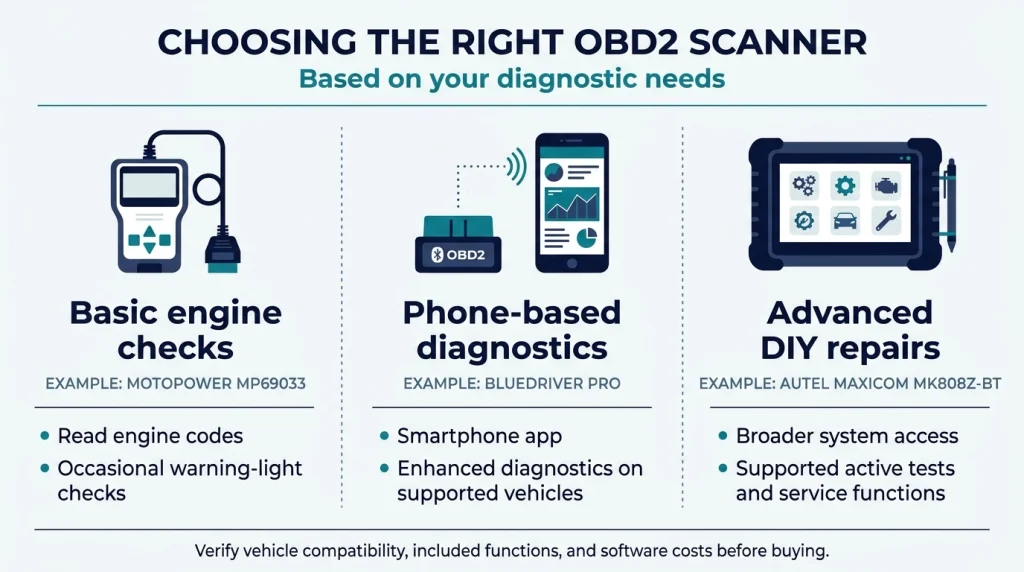
The best choice depends on your budget, repair experience, and the diagnostic functions you need. Here are three established options representing different levels of capability, from basic code reading to advanced vehicle diagnostics.
💰 BEST FOR BASIC CHECKS
MOTOPOWER MP69033
★★★★☆
A wired code reader designed for straightforward engine diagnostics, with code reading, code clearing, and selected live-data functions. I’d consider this type of tool for occasional check-engine-light checks rather than complex repairs.
📱 BEST FOR PHONE-BASED DIAGNOSTICS
BlueDriver Pro
★★★★☆
This Bluetooth-based diagnostic tool pairs with a compatible smartphone app and offers enhanced diagnostics for supported vehicles. I’d consider it for drivers who want a more detailed interface without buying a large handheld tablet.
🔧 BEST FOR ADVANCED DIY WORK
Autel MaxiCOM MK808Z-BT
★★★★☆
This advanced diagnostic platform offers broader system access and supported active tests and service functions. I’d shortlist it for frequent DIY repairs, provided its vehicle coverage and software costs match the cars being serviced.
Product note: These are examples of different scanner categories, not results of hands-on testing for this article. Confirm current specifications, vehicle compatibility, included functions, subscription terms, and retailer pricing before ordering; the displayed star symbols are illustrative category indicators, not verified customer ratings.
Frequently Asked Questions
Is a $20 OBD2 scanner good enough?
A $20 OBD2 scanner can be sufficient if you mainly want to read common engine trouble codes and check the reason for a check-engine light. Before buying, confirm that it supports your vehicle and provides the functions you need, since inexpensive models vary in quality and capability.
Will an expensive OBD2 scanner tell me exactly what is wrong with my car?
No scanner can guarantee an exact diagnosis from a trouble code alone. An advanced model may provide additional module access, live sensor data, and active tests, helping you narrow down the cause. You still need to interpret the results and perform the appropriate diagnostic checks.
Can a cheap OBD2 scanner read ABS and airbag codes?
Some inexpensive models support selected ABS or airbag diagnostics, but many basic code readers only cover standard engine and emissions-related information. Check the scanner’s supported systems for your exact vehicle rather than relying on a general claim that it supports OBD2.
Do expensive OBD2 scanners need subscriptions?
Some do, while others include updates or certain functions without recurring fees. Subscription terms vary by manufacturer and model, so check the price of future updates, enhanced diagnostics, and service functions before purchasing. A low initial price may not represent the lowest long-term cost.
Should beginners buy a professional OBD2 scanner?
Most beginners don’t need a professional scan tool immediately. A dependable basic or midrange scanner can help them understand common engine faults and learn how to interpret diagnostic data. Upgrade when you encounter a specific need, such as ABS diagnostics, bidirectional testing, or supported service procedures.
Final Takeaway: Pay for the Features You Need
The difference between a cheap and expensive OBD2 scanner comes down to diagnostic coverage, data access, active testing, usability, and ongoing costs. A basic reader can be enough for everyday warning-light checks, while an advanced scan tool can provide the additional functions needed for more involved repairs.
Before spending more, check compatibility with your vehicle and identify the functions you’ll realistically use. A well-matched scanner offers more value than a costly tool packed with features you don’t need.
If you’re comparing models now, start with your vehicle’s make, model, and year, then decide whether basic engine codes, all-system diagnostics, or bidirectional controls are your priority.

I’m Alex Rahman, a car enthusiast and automotive writer focused on practical solutions, car tools, and real-world driving advice. I share simple and honest content to help everyday drivers make better decisions.
