Can OBD2 Reveal Used Car Emissions Problems?
Quick Answer
Yes. An OBD2 scanner can reveal emissions-related problems on a used car by reading diagnostic trouble codes, checking emissions readiness monitors, and viewing available engine sensor data. It may identify issues involving the catalytic converter, oxygen sensors, evaporative emissions system, or engine misfires. However, a scan showing no trouble codes does not guarantee that the car is emissions-compliant or mechanically healthy. Always check readiness status and arrange a pre-purchase inspection before buying.
A used car can run smoothly during a test drive and still have an emissions problem waiting to appear. A failing catalytic converter, intermittent oxygen sensor fault, or small fuel-vapor leak may produce little noticeable change in the way the vehicle drives.
That is where OBD2 diagnostics become useful. The vehicle’s computer continuously or periodically checks emissions-related systems and records certain malfunctions when they meet specific detection criteria.
For a buyer, the important question is not simply whether the check engine light is off. It is whether the vehicle has completed its emissions self-tests, whether any faults have been recorded, and whether the available evidence suggests a problem that needs further investigation.
What Emissions Problems Can an OBD2 Scanner Detect?
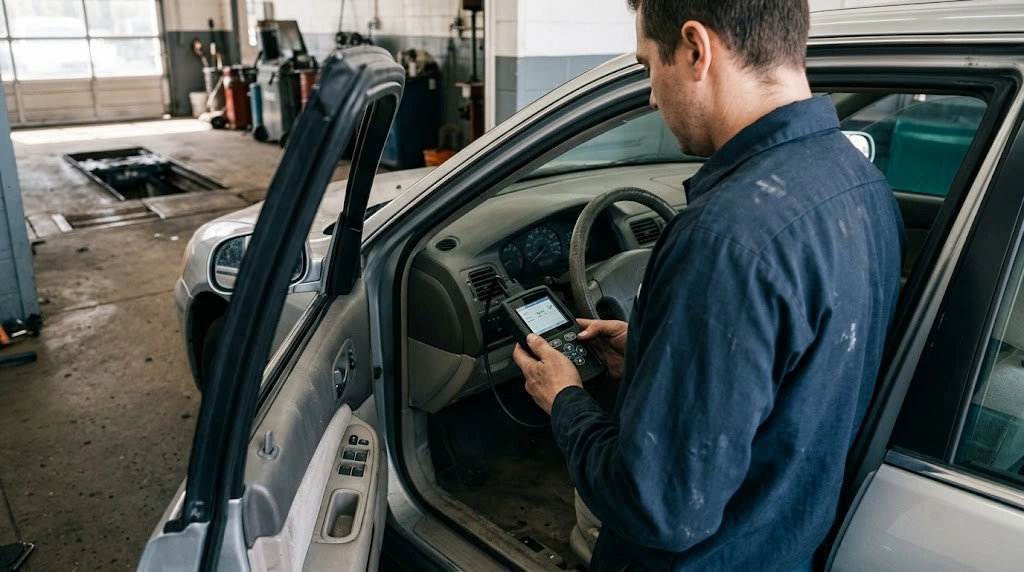
OBD2 can detect many faults that affect engine operation and emissions control. It does not measure every pollutant directly; instead, it evaluates sensors, components, and operating conditions to identify malfunctions that could increase emissions.
The U.S. Environmental Protection Agency’s OBD guidance explains how onboard diagnostics monitor emissions-related components and alert drivers when relevant malfunctions are detected.
Catalytic Converter Problems
The catalytic converter helps reduce harmful pollutants in vehicle exhaust. OBD2 systems can monitor catalyst efficiency, commonly using information from upstream and downstream oxygen or air-fuel sensors.
A code such as P0420 indicates that catalyst-system efficiency is below the diagnostic threshold for Bank 1.
However, P0420 does not automatically prove that the catalytic converter itself needs replacement. Exhaust leaks, fuel-control problems, sensor faults, and other conditions can contribute to the code.
A proper diagnosis should identify the underlying cause before expensive parts are replaced.
Oxygen Sensor and Fuel-Control Faults
Oxygen sensors and air-fuel ratio sensors provide information that helps the engine computer manage fuel delivery and evaluate emissions performance.
Depending on the vehicle and fault, an OBD2 scanner may retrieve codes such as:
- P0130: Oxygen sensor circuit malfunction, Bank 1 Sensor 1.
- P0133: Oxygen sensor circuit slow response, Bank 1 Sensor 1.
- P0171: Fuel system too lean, Bank 1.
- P0174: Fuel system too lean, Bank 2.
These codes indicate diagnostic conditions rather than confirmed failed parts. For example, P0171 may result from unmetered intake air, fuel delivery problems, or inaccurate sensor information.
Evaporative Emissions System Leaks
The evaporative emissions control system, often called EVAP, helps prevent gasoline vapors from escaping into the atmosphere.
OBD2 may detect leaks or control-system faults involving the gas cap, hoses, valves, charcoal canister, and associated components.
Relevant codes include:
- P0440: EVAP system malfunction.
- P0442: Small EVAP leak detected.
- P0455: Large EVAP leak detected.
- P0456: Very small EVAP leak detected.
A loose gas cap may explain some EVAP warnings, but it should not be assumed to be the cause of every EVAP code.
Engine Misfires
Engine misfires can increase exhaust emissions and, under certain conditions, damage a catalytic converter.
Common codes include P0300 for random or multiple-cylinder misfires and P0301 through P0308 for misfires associated with individual cylinders.
A used vehicle with recurring misfire codes deserves further inspection even when the engine seems to run normally at idle.
Warning
A flashing check engine light can indicate a catalyst-damaging misfire. Avoid continuing a test drive with an actively flashing warning light. Arrange a professional diagnosis before driving the vehicle further.
Which OBD2 Codes Should Concern Used Car Buyers?
The following examples help identify systems that deserve additional investigation. They are not a complete list of emissions-related codes.
| OBD2 Code | Indicated Problem | Buyer Action |
|---|---|---|
| P0420 / P0430 | Catalyst efficiency below threshold | Request diagnosis of catalyst, sensors, and exhaust system. |
| P0130 / P0133 | Oxygen sensor circuit or response fault | Investigate sensor operation, wiring, and related causes. |
| P0442 / P0456 | Small or very small EVAP leak | Check cap and seals; request leak diagnosis if needed. |
| P0171 / P0174 | Lean fuel-system condition | Check intake, fuel delivery, and fuel-trim data. |
| P0300–P0308 | Random or cylinder-specific misfire | Arrange diagnosis before purchase. |
One code may have several possible causes, while multiple codes may share a common cause. Do not estimate repair costs or authorize parts replacement from a code description alone.
Why Readiness Monitors Matter More Than a Blank Code Screen
Readiness monitors show whether the vehicle’s onboard emissions checks have completed since relevant diagnostic information was last reset.
A scanner may show each supported monitor as Ready, Not Ready, or Not Supported.
- Ready: The applicable diagnostic monitor has completed its evaluation.
- Not Ready: The monitor has not completed its evaluation since the reset or under the conditions needed.
- Not Supported: The vehicle does not support that particular monitor.
Importantly, Ready is not the same as Passed for every possible emissions problem. It indicates completion of that monitor’s self-test. Results and trouble codes must still be interpreted.
The EPA’s vehicle emissions inspection guidance explains the role of readiness status in OBD-based inspection programs.
Can a Seller Clear Codes Before a Test Drive?
Yes. Clearing diagnostic codes can turn off the check engine light and reset emissions readiness monitors. Disconnecting the vehicle battery may also reset readiness information.
After a reset, several noncontinuous monitors may remain incomplete until the car has been driven under the appropriate conditions.
That creates an important distinction:
Key Insight
No trouble codes plus several incomplete readiness monitors means the vehicle has not yet completed important emissions checks. It does not prove a hidden defect or dishonest seller, but it is a reason to delay your buying decision until the tests have completed.
A recent battery replacement, legitimate repair, or routine diagnostic reset can also explain incomplete readiness. Read more about how clearing codes resets readiness monitors before interpreting an incomplete result as suspicious.
How to Check a Used Car for Emissions Problems With OBD2

You can perform a useful preliminary check with an OBD2 scanner that supports diagnostic trouble codes and I/M readiness. Access to pending codes, permanent codes, freeze-frame data, and live sensor information makes the inspection more informative.
- Confirm compatibility. Check whether the vehicle supports your scanner’s OBD2 standard. Most U.S.-market light-duty vehicles from model year 1996 onward use OBD2; requirements and connector compatibility vary in other markets.
- Check the warning-light bulb test. With the ignition on and engine off, observe whether the check engine indicator illuminates briefly as expected. Confirm that it goes out after the engine starts, unless there is an active malfunction.
- Connect the scanner. Locate the diagnostic connector, commonly underneath the driver’s dashboard, and follow the scanner’s connection instructions.
- Read stored codes. Record every confirmed trouble code and its description. Do not erase anything.
- Check pending and permanent codes. These may provide useful information beyond the standard stored-code screen, depending on vehicle and scanner support.
- Examine I/M readiness. Identify whether the catalyst, oxygen sensor, EVAP, and other supported emissions monitors are complete.
- Review freeze-frame and live data. Look for diagnostic context such as engine temperature, fuel trims, and relevant sensor readings. These require vehicle-specific interpretation.
- Inspect and test-drive the car. With the seller’s permission, examine visible exhaust damage, unusual smells, rough running, hesitation, and warning lights. Drive only when the vehicle is safe.
- Scan again. Check whether new pending or confirmed faults appeared during the drive. Remember that a short drive may not complete all monitors.
- Get an independent inspection. Ask a qualified technician to investigate unresolved codes or incomplete monitors before you agree to buy the vehicle.
For help navigating the scan tool itself, see our guide to using an OBD2 scanner to read codes correctly.
Can OBD2 Find Emissions Problems Without a Check Engine Light?
Sometimes. A vehicle may have pending trouble codes before a condition has met the requirements for illuminating the check engine light.
Some scanners can also display stored test information through OBD2 Mode $06, which provides results from certain onboard monitoring tests. Depending on the vehicle and scanner, these results may reveal useful diagnostic clues even without a currently illuminated warning light.
However, Mode $06 data can be difficult to interpret. Test identifiers, scaling, and reported limits may differ between manufacturers and vehicles.
For a deeper explanation, our guide to OBD2 Mode $06 test results explains what this information can and cannot establish.
No warning light, no pending codes, and completed monitors are encouraging findings, but they are not a substitute for an inspection.
What Emissions Problems Can OBD2 Miss?
OBD2 is useful because it monitors many emissions-related systems, but it is not a comprehensive measurement of a used car’s emissions or mechanical condition.
Its limitations include:
- Faults that have not met detection conditions: Some monitors require specific temperatures, speeds, fuel levels, or driving patterns.
- Intermittent defects: A problem that occurs only occasionally may not produce a current trouble code.
- Physical exhaust defects: Some leaks, damaged components, or modifications may require visual inspection even when no code appears.
- Actual pollutant concentrations: A typical OBD2 scanner does not directly measure exhaust gases as a dedicated emissions analyzer does.
- Unsupported or manufacturer-specific information: A generic scanner may not retrieve every diagnostic detail available from the vehicle’s control modules.
Vehicle age, manufacturer-specific monitoring strategies, diagnostic thresholds, and the quality of the scan tool all affect what a scan can reveal.
Does a Clean OBD2 Scan Mean the Car Will Pass an Emissions Test?
No. A clean scan is a favorable sign, but it is not a guarantee of passing a formal emissions inspection.
Inspection programs may consider the malfunction indicator light, stored fault information, supported readiness monitors, vehicle eligibility, and additional testing requirements.
Some jurisdictions permit a limited number of incomplete monitors for certain model years, while others apply different requirements. The rules depend on the inspection program and vehicle.
Moreover, some vehicles may be subject to tailpipe measurements, visual checks, or other inspection methods that a generic scanner cannot replicate.
Before buying a car in an emissions-testing area, confirm the requirements that apply to that specific vehicle and location. When possible, request a recent official emissions inspection result rather than relying only on the seller’s scan.
Should You Buy a Used Car With Emissions-Related OBD2 Codes?

Buying a car with emissions-related codes is not automatically a bad decision, but the fault should be diagnosed and its repair implications understood before purchase.
Use the following decision guide:
| Scan Result | Practical Decision |
|---|---|
| No codes; supported monitors complete | Encouraging result. Continue with a full vehicle inspection. |
| No codes; several monitors incomplete | Ask about recent repairs or resets. Recheck after appropriate driving. |
| Pending emissions-related code | Investigate before making a final buying decision. |
| Confirmed catalyst, misfire, or fuel-system code | Get an independent diagnosis and repair estimate. |
| Seller refuses a scan or independent inspection | Treat the uncertainty as a significant purchasing risk. |
A documented repair followed by completed readiness monitors and no returning faults provides stronger evidence than a verbal assurance that the problem has been fixed.
If the vehicle’s check engine light is illuminated, our guide to diagnosing a check engine light with OBD2 explains how to preserve and evaluate the diagnostic information.
Common Mistakes When Checking a Used Car With OBD2
The most costly scanning mistakes often involve interpreting incomplete information as proof that a vehicle is healthy.
- Looking only for the check engine light: Pending codes and incomplete monitors can provide additional information.
- Checking only confirmed codes: Important diagnostic clues may appear in pending or permanent code categories.
- Assuming Not Ready means failed: An incomplete self-test is not automatically evidence that an emissions component is defective.
- Erasing codes during the inspection: This can remove useful diagnostic records and reset readiness status.
- Replacing the part named in a code: A code describes a detected condition, not necessarily the failed component.
- Skipping a professional inspection: Many mechanical and emissions-related problems cannot be excluded by a basic scanner.
The safest approach is to preserve the original diagnostic information, investigate anything unusual, and make the purchase decision only after the remaining uncertainty is acceptable.
Frequently Asked Questions
Can an OBD2 scanner tell whether a catalytic converter is bad?
It can identify catalyst-efficiency faults, including P0420 or P0430, and some scanners provide supporting sensor or monitor data. However, a catalyst-efficiency code does not by itself prove that the converter needs replacement. Other causes must be checked.
Can an OBD2 scanner detect a bad oxygen sensor?
Yes, OBD2 can identify certain oxygen sensor circuit, heater, and response faults. The result is a diagnostic clue rather than definitive proof that the sensor itself has failed.
Can a used car have emissions problems with no codes?
Yes. Some problems may not have triggered the onboard diagnostic criteria, may occur intermittently, or may not be covered by the vehicle’s monitoring capabilities. A recent code reset can also temporarily leave the code screen empty while monitors are incomplete.
How can I tell whether the seller recently cleared OBD2 codes?
Multiple incomplete readiness monitors can indicate a recent reset, although they do not establish why it happened. Battery disconnection, repairs, and legitimate diagnostic work can produce similar results. Ask for repair records and recheck after appropriate driving.
Is a cheap OBD2 scanner enough for a used car inspection?
A basic scanner that reads stored and pending codes and displays I/M readiness can provide useful preliminary information. Additional access to permanent codes, freeze-frame data, live data, and manufacturer-specific diagnostics can improve the evaluation. Neither type replaces a thorough mechanical inspection.
Will OBD2 tell me whether a used car is legally emissions-compliant?
Not conclusively. An OBD2 scan can help evaluate systems used in emissions inspections, but legal compliance depends on the applicable regulations and official testing methods. Check your local requirements and request an official inspection result when necessary.
Final Verdict: Is OBD2 Worth Using Before Buying a Used Car?
Yes. Checking OBD2 is a sensible part of evaluating a used car because it can uncover emissions-related fault codes, incomplete self-tests, and diagnostic clues that may not be obvious during a short test drive.
The most useful inspection combines three things: trouble-code history, emissions readiness status, and an independent mechanical evaluation.
If the scanner shows no codes and the supported monitors have completed, that is encouraging. If important monitors remain incomplete or emissions-related faults are present, investigate before making a purchase commitment.
An OBD2 scanner cannot guarantee a trouble-free car, but it can help you avoid making an expensive decision with incomplete information.

I’m Alex Rahman, a car enthusiast and automotive writer focused on practical solutions, car tools, and real-world driving advice. I share simple and honest content to help everyday drivers make better decisions.
