Can OBD2 Diagnose Diesel Emissions? Yes, With Limits
Quick Answer
Yes, OBD2 can diagnose many diesel emissions faults, but it does not measure tailpipe emissions directly. It watches the aftertreatment systems, stores fault codes when a self-test fails, and reports readiness and live sensor data. A scan points to the faulty system; it rarely proves the exact failed part on its own.
That distinction matters. A clean scan, a warning light, and a failed emissions test are three different results, and knowing what the computer actually checks helps avoid replacing parts on the strength of one code.
What Diagnosing Diesel Emissions Really Means
On a modern diesel, “diagnosing emissions” usually means checking whether the emissions controls are working as designed, not measuring grams of pollutants leaving the exhaust. The engine control unit runs continuous and periodic self-tests on sensors, actuators, and aftertreatment components. When a test result falls outside its expected range, it stores a diagnostic trouble code and may switch on the malfunction indicator lamp.
A code is therefore best read as a system clue. A nitrogen oxides (NOx) code, for example, can involve a sensor, the selective catalytic reduction (SCR) system, diesel exhaust fluid (DEF) quality or dosing, or an upstream fault. It tells you where to start checking, not which part to buy first.
Coverage also depends on market, model year, and weight class, so a light-duty diesel and a large truck do not always use the same route. Whether an OBD2 scanner works on diesel cars explains that boundary.
Which Diesel Emissions Systems OBD2 Watches

Diesel aftertreatment is a chain, and a weakness in one link can affect the next. OBD2 monitoring follows that chain.
| System | What OBD2 can flag | What it cannot prove alone |
|---|---|---|
| Diesel particulate filter (DPF) | Pressure difference, soot load estimates, failed regeneration | Exact soot mass or internal filter damage |
| SCR and DEF system | NOx sensor readings, dosing faults, low or poor-quality DEF | True tailpipe NOx output in grams |
| Exhaust gas recirculation (EGR) | Flow, position, and temperature faults | Whether a valve is stuck or only carbon-coated |
| Oxidation catalyst and sensors | Sensor drift, heater faults, implausible readings | Catalyst efficiency without further testing |
| Fuel, boost, and air supply | Pressure, boost, and injector-related faults | That an emissions fault started here |
The pattern is clear: OBD2 is strong on system behaviour and sensor plausibility, weaker on physical condition. A DPF pressure reading can support a blockage diagnosis, but cannot show a cracked substrate. A NOx reading can show poor conversion, but cannot by itself separate a faulty sensor from a faulty SCR catalyst.
For DPF-specific checks, how OBD2 diagnoses a DPF problem covers soot load, pressure, and regeneration signals.
What a Diesel Emissions Scan Can Actually Show You
A useful scan looks beyond the first code. These checks, in order, give a clearer picture than a code list alone.
- Stored, pending, and permanent codes. Stored codes are confirmed faults; pending codes have not yet met confirmation criteria. Permanent codes cannot be cleared with a scan tool alone, which is why clearing codes does not hide a real fault from an inspection.
- Freeze-frame data. This snapshot records speed, load, and temperature when the code set, helping separate faults that appear only when cold, under load, or during regeneration.
- Live data. DPF pressure, exhaust temperatures, NOx values before and after treatment, DEF dosing, and EGR position show whether a system is responding. A stuck sensor, or two sensors disagreeing, is often more informative than the code itself.
- On-board monitor results. Mode 6 results show the vehicle’s own component tests against internal limits. They can reveal deterioration before a confirmed code, but values are manufacturer-specific and need care.
- Readiness monitors. These show whether each emissions self-test has completed. A monitor marked “not ready” does not mean a fault exists; it means the test has not yet run under the required conditions.
Together, these checks answer what fault was recorded, under what conditions, whether sensors agree now, and whether the tests have even run. Skipping straight to parts replacement misses most of that evidence.
Key Insight
OBD2 diagnoses the emissions control system, not the exhaust plume. It can prove a control system failed its own test, but it cannot report the vehicle’s actual pollutant output.
What OBD2 Cannot Diagnose on a Diesel
Knowing the blind spots prevents false confidence: a clean scan does not guarantee clean exhaust, and a single code does not guarantee a failed test.
- Actual tailpipe concentration. Standard OBD2 does not replace an exhaust gas analyser or opacity test; it infers performance from sensor readings.
- Physical damage sensors cannot see. A cracked filter, a leaking exhaust joint, or diluted DEF may produce confusing readings rather than a precise diagnosis.
- Intermittent faults that have not repeated. If enabling conditions have not recurred, the fault may sit as a pending code, or not appear at all, despite noticed smoke or poor regeneration.
- Deleted or tampered systems reliably. Missing components or altered software can produce codes or implausible data, but a generic scan is not a tamper-proof audit.
- The root cause behind a downstream code. Low boost, a leaking injector, or a faulty temperature sensor can trigger an aftertreatment code. Fixing that part would not fix the chain.
General and diesel diagnosis overlap but are not identical. How OBD2 diagnoses emissions problems in general covers the shared logic; this article stays on DPF regeneration, SCR dosing, and NOx aftertreatment.
Why Diesel Readiness Monitors Are Trickier
Readiness confuses many owners before an inspection. A diesel monitor may need warm-up, steady cruising, and sometimes a completed DPF regeneration — conditions a short urban drive never provides. Until then, the monitor stays incomplete even though nothing is broken.
Clearing codes makes this worse. It resets monitors to “not ready,” so a vehicle taken straight to a test may fail on readiness alone. Fix the fault, drive under varied conditions, and recheck readiness before booking a test. A model-specific drive cycle beats a generic “drive 50 miles” tip.
What readiness monitors mean, ready versus not ready explains each state, and how OBD2 monitors vehicle emissions explains why self-tests run only under set conditions.
Warning
Do not clear codes just before an emissions test to hide a warning light. The cleared monitors, permanent codes, and inspection data will usually reveal the reset, and the underlying fault will still need repair.
A Practical Check Before an Emissions Test
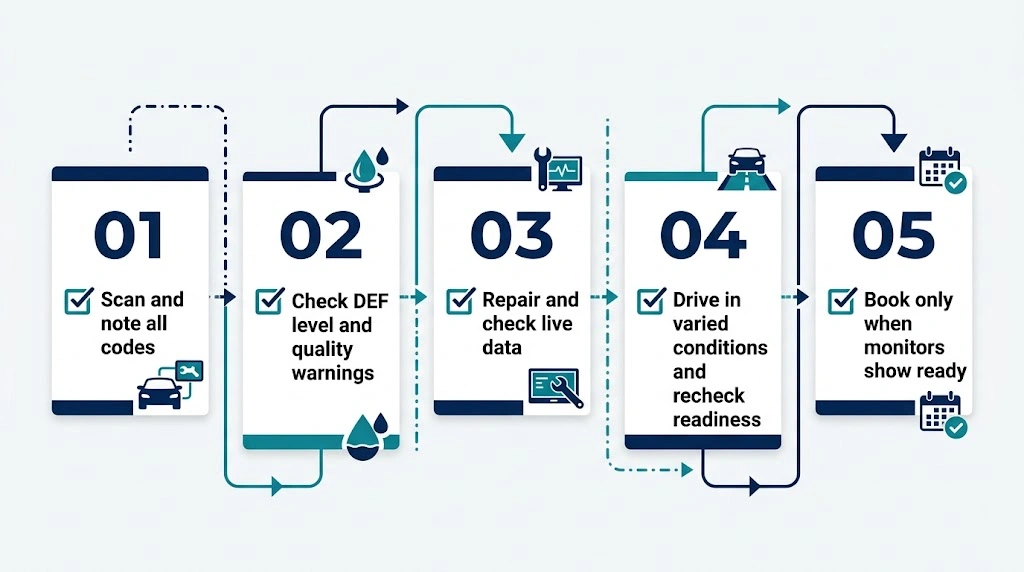
Use this sequence when the goal is a test, not just curiosity.
- Scan and note all codes, including pending and permanent codes, before clearing anything.
- Check DEF level and quality warnings, and note any SCR, NOx, DPF, or EGR codes separately from unrelated codes.
- Repair the emissions fault, then check live data to see whether sensor values respond normally.
- Drive in varied conditions, including warm-up and steady cruising, and recheck readiness.
- Book the test only when the required monitors show ready and no emissions code has returned.
If a monitor stays incomplete after varied driving, that itself is diagnostic information: a precondition such as exhaust temperature or regeneration may never be met. That needs fault diagnosis, not more identical short trips.
Common Misreads to Avoid
“The code names the part, so replace it.” Codes name a circuit, system, or test result. A NOx sensor code can be caused by the sensor, its wiring, exhaust leaks, DEF dosing, or SCR performance. Check live data and freeze frame before ordering.
“No code means the emissions system is fine.” A deteriorating catalyst or filter can still pass a threshold test while performing worse than new. Mode 6 margins and frequent regeneration still matter.
“A generic scanner sees everything.” Generic OBD2 covers standard emissions data well, but manufacturer-specific diesel data, forced regeneration, and some SCR tests may need enhanced access. A generic “no fault found” is not a full diesel diagnostic.
“Smoke colour alone diagnoses the fault.” Exhaust colour can narrow possibilities, but it does not replace code, live data, and readiness evidence.
Light-Duty OBD2 and the Heavy-Duty Boundary

Standard OBD2 applies to light-duty vehicles, generally up to 14,000 pounds gross vehicle weight rating in the United States framework, with phase-in differences for diesel models. Larger trucks commonly use heavy-duty diagnostics, often based on SAE J1939, rather than the light-duty OBD2 code set.
That boundary explains a frequent frustration: a car scanner may connect to a truck, show limited data, or miss aftertreatment tests. It does not mean the truck has no diagnostics; the tool and protocol do not match the vehicle class.
The EPA’s diesel exhaust fluid guidance notes that OBD must monitor the SCR system to detect low DEF levels and system failures and alert the driver — a reminder that DEF warnings are emissions diagnostics, not just a fluid reminder.
Related Product
Diesel-capable OBD2 scanner
A scanner with diesel live data and readiness checks makes DPF, SCR, and NOx readings easier to compare before a test.
As an Amazon Associate, we earn from qualifying purchases.
Frequently Asked Questions
Can OBD2 tell me if my diesel will pass an emissions test?
It can improve the odds, but it cannot guarantee a pass. A scan showing no emissions codes and ready monitors is a good sign. The test itself may still use its own inspection rules, visual checks, or opacity measurement, and a fault that has not yet repeated may not appear on the scan.
Why does my diesel show a DPF code but no warning light?
Some faults are stored as pending codes before the warning threshold is met, and some systems report soot load or regeneration issues without immediately commanding the lamp. Check pending codes, DPF pressure, and regeneration status rather than waiting for the light.
Does a NOx sensor code always mean the sensor is faulty?
No. The sensor may be reporting correctly while SCR conversion, DEF dosing, exhaust temperature, or an upstream leak is at fault. Compare upstream and downstream NOx values, check DEF warnings, and inspect for leaks before replacing the sensor.
Can a basic scanner diagnose SCR and DEF problems?
Often it can read the generic SCR and NOx codes and basic live data, but deeper dosing tests, adaptation values, and forced procedures may need enhanced diesel access. A basic “no code” result should not be treated as proof the SCR system is healthy.
How long after a repair should readiness monitors take to set?
There is no single time or distance that works for every diesel. Monitors need their enabling conditions, which can include warm-up, steady driving, and sometimes regeneration. Varied driving over several trips is more reliable than one long motorway run.
Can OBD2 detect a diesel emissions delete?
It may flag missing components, implausible sensor data, or readiness problems, but a generic scan is not a reliable tamper audit. A vehicle can show confusing data rather than a clear “deleted” result, and inspection and visual checks remain part of enforcement in many jurisdictions.
Conclusion
OBD2 is a strong first step for diesel emissions diagnosis: it watches the DPF, SCR, EGR, sensors, and fuel and boost systems, records codes and freeze-frame evidence, and reports whether the self-tests have run. Its limit is equally clear. It diagnoses control-system faults, not tailpipe output, and a code alone rarely identifies the failed part. Use codes with live data, readiness, and symptoms, repair the upstream cause as well as the flagged system, and confirm readiness before an emissions test.

I’m Alex Rahman, a car enthusiast and automotive writer focused on practical solutions, car tools, and real-world driving advice. I share simple and honest content to help everyday drivers make better decisions.
