Can a Scan Tool Perform ECU Coding? What You Need to Know
Quick Answer
Yes, advanced diagnostic scan tools can perform ECU coding, but standard, basic OBD2 code readers cannot. Performing ECU coding requires a bi-directional, mid-to-high-tier diagnostic tool capable of communicating with vehicle modules to alter configuration parameters, match replacement parts, or activate hidden features. However, full ECU programming or firmware flashing often requires factory software or specialized calibration hardware.
Modern vehicles rely heavily on electronic control units (ECUs) to manage everything from engine performance and fuel injection to transmission behavior and comfort settings. When a module is replaced or a new feature is added, the vehicle’s computer system often needs to be reconfigured. This has led many vehicle owners and DIY mechanics to ask whether a standard diagnostic scan tool can handle these advanced adjustments.
Understanding what a scan tool can and cannot do prevents costly mistakes, wasted tool purchases, and potential module corruption. While high-end diagnostic tablets bridge the gap once reserved exclusively for dealership equipment, not all scanners are created equal.
ECU Coding vs. ECU Programming: Understanding the Difference
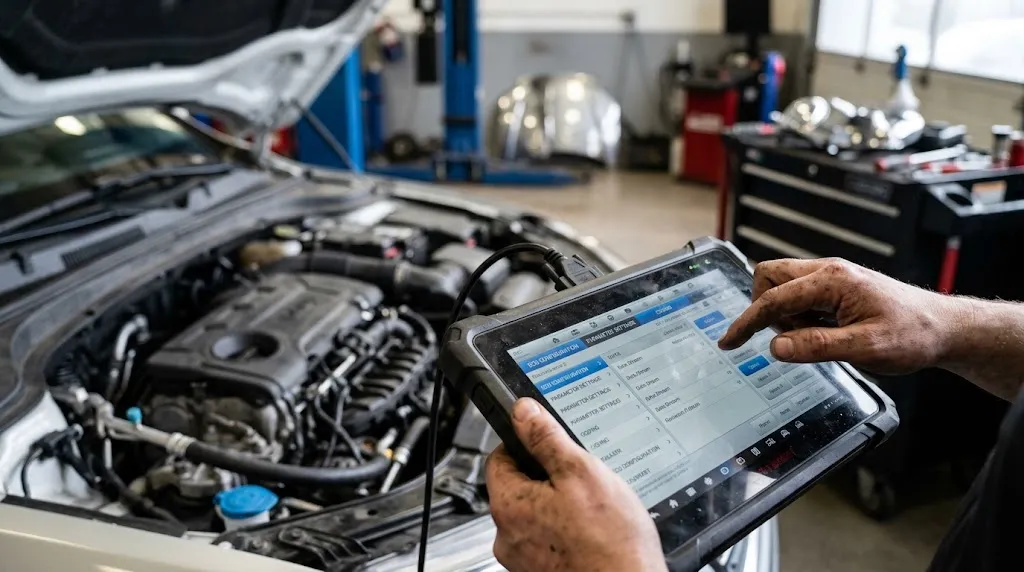
Before evaluating scan tool capabilities, it is essential to distinguish between ECU coding and ECU programming. Although these terms are often used interchangeably, they perform fundamentally different functions within a vehicle’s network.
ECU coding involves modifying existing configuration parameters within a module. It does not rewrite the core operating software. Instead, it tells the ECU how to interpret signals based on installed accessories, vehicle variants, or replacement parts. Examples include registering a new battery, coding diesel fuel injectors, or enabling comfort features like auto-folding mirrors.
ECU programming (sometimes called flashing or re-flashing) is a much deeper process. It involves rewriting the entire firmware or calibration data inside the controller. This is typically done to fix deep software bugs, update powertrain management maps, or install factory software onto a completely blank replacement module.
| Feature | ECU Coding | ECU Programming |
|---|---|---|
| Core Action | Adjusts configuration parameters and variant settings | Rewrites internal firmware or core software maps |
| Typical Use Case | Battery registration, injector matching, feature activation | Blank module setup, software bug fixes, major recalls |
| Tool Requirements | Bi-directional mid-to-high scan tool | Factory interface, J2534 pass-thru, or specialized flashing tool |
| Risk Level | Low to moderate (reversible variant changes) | High (interrupted data can brick a module) |
While advanced scan tools frequently support both coding and light programming for select modules, understanding this boundary helps manage expectations when shopping for diagnostic hardware.
Types of Scan Tools and Their Coding Capabilities
Not all code readers can talk to your car’s computers on a deep level. Diagnostic equipment spans distinct tiers:
- Basic Code Readers: These entry-level handheld units plug into the OBD2 port to read and clear generic powertrain diagnostic trouble codes (DTCs). They lack bi-directional control and cannot perform coding.
- Mid-Range Bi-Directional Scanners: These advanced tablets can send commands to vehicle systems, actuate components, and perform common service resets (such as electronic parking brake retraction or steering angle calibration). Many support basic offline coding and module matching.
- Professional & OE-Level Diagnostic Systems: High-end diagnostic platforms support comprehensive offline and online ECU coding, variant configuration, and module initialization across a wide array of global vehicle brands.
When selecting a diagnostic tool for coding work, verifying vehicle brand coverage and software subscription models is critical. Many modern systems require an active internet connection to download specific manufacturer configuration strings.
What Coding Operations Can a Capable Scan Tool Perform?
Advanced diagnostic tools handle a variety of configuration tasks that used to require a trip to the dealership. Routine maintenance and replacement workflows include:
- Injector Calibration: Entering the specific correction codes stamped onto new diesel or direct-injection fuel injectors so the ECU manages fuel delivery accurately.
- Battery Registration: Informing the power management computer of a new battery’s chemistry, age, and capacity to adjust charging rates properly.
- Sensor Matching: Registering replacement tire pressure monitoring sensors (TPMS) or calibrating steering angle sensors after suspension work.
- Variant Coding: Telling a newly installed body control module (BCM) or ABS module what optional equipment the vehicle has, such as all-wheel drive, towing packages, or specific lighting configurations.
Warning
Always maintain a stable external power supply or battery maintainer to vehicle battery terminals during ECU coding sessions. Voltage drops caused by weak batteries can interrupt data transmission and permanently brick the control module.
Offline vs. Online Coding on Modern Vehicles
As vehicle networks grow more complex, scan tools utilize two distinct methods to execute coding tasks:
Offline coding relies entirely on data already stored within the scan tool’s local software database or extracted from the vehicle’s existing configuration backup. No active internet connection is required, making it convenient for quick variant adjustments or standard service resets.
Online coding requires the scan tool to connect directly to the vehicle manufacturer’s secure cloud servers via the internet. When a new or replacement module is installed, the scan tool requests the exact factory-approved parameter string matching the vehicle’s specific VIN. This method is heavily utilized by modern European and Asian manufacturers to maintain strict security and configuration accuracy.
Limitations and Risks of DIY ECU Coding

While advanced scan tools empower independent repair shops and advanced DIYers, certain boundaries remain. Understanding these limitations prevents failed procedures and damaged modules:
- Gateway Security Restrictions: Modern vehicles feature secure gateways (such as FCA Security Gateway or Mercedes SFD protection) that block unauthorized write commands unless the scan tool has active manufacturer authentication credentials.
- Incomplete Software Support: A scan tool may code existing modules but lack the authorization to download or install factory firmware updates for completely blank replacement computers.
- Configuration Errors: Modifying variant codes incorrectly can disable safety systems, disrupt communication networks (CAN bus), or trigger persistent warning lights that require factory reset procedures to clear.
Key Insight
Always perform a complete pre-scan and save a backup of the original module coding parameters before making any adjustments. This provides a safe restoration point if a new configuration causes communication faults.
Related Product
Advanced Automotive Diagnostic Scan Tool
A bi-directional diagnostic tablet with active ECU coding capabilities helps you configure replacement modules and perform specialized service resets.
As an Amazon Associate, we earn from qualifying purchases.
Frequently Asked Questions
Can a cheap OBD2 scanner perform ECU coding?
No. Inexpensive code readers can only read and clear basic diagnostic trouble codes. ECU coding requires an advanced, bi-directional scan tool with specialized software protocols capable of writing data back to vehicle modules.
Do I need an internet connection for ECU coding?
It depends on the vehicle and the operation. Basic offline coding uses data stored within the tool or vehicle, while online coding requires a stable internet connection to retrieve factory security codes or configuration data directly from manufacturer servers.
What happens if ECU coding fails halfway through?
If a coding session is interrupted by a voltage drop or connection loss, the module can become unresponsive or bricked. This often requires recovery procedures, specialized flashing software, or module replacement.
Can any scan tool program a brand-new blank ECU?
Generally no. Brand-new modules often arrive completely unformatted. While some high-end diagnostic tools support module initialization, full programming of blank units frequently requires factory OE software and J2534 pass-thru programming hardware.
Is ECU coding the same thing as chip tuning?
No. ECU coding alters factory configuration parameters, variant settings, and component pairing. Chip tuning (or ECU remapping) modifies the internal fuel and ignition maps to alter engine performance, power output, and torque limits.
How do I know if my scan tool supports coding?
Check the manufacturer specifications and software feature list for terms like bi-directional control, offline coding, online coding, or specific service functions like injector coding and battery registration.
Conclusion
Advanced diagnostic scan tools can successfully perform ECU coding, enabling technicians and DIYers to handle component replacements, feature adjustments, and routine maintenance tasks without a trip to the dealership. However, recognizing the technical line between configuration coding and deep software programming ensures you choose the right equipment and avoid module damage. Verifying scan tool capabilities, maintaining steady battery voltage, and understanding vehicle gateway security protocols are essential steps for any successful diagnostic procedure.

I’m Alex Rahman, a car enthusiast and automotive writer focused on practical solutions, car tools, and real-world driving advice. I share simple and honest content to help everyday drivers make better decisions.
