Can OBD2 Diagnose an Airbag Warning Light?
Quick Answer
Yes, an OBD2 scanner can help diagnose an airbag warning light, but only if it supports SRS (Supplemental Restraint System) diagnostics for your specific vehicle. Basic OBD2 scanners usually read engine and emissions codes, not airbag faults. An SRS-compatible scanner can retrieve airbag trouble codes and help identify where further diagnosis is needed.
An illuminated airbag warning light deserves attention because it may indicate a problem affecting the vehicle’s occupant protection system. Unfortunately, connecting an ordinary OBD2 scanner does not always reveal the cause.
The important distinction is between a scanner that reads standard engine diagnostics and one that can communicate with the vehicle’s airbag control module. Understanding that difference can prevent unnecessary purchases, misleading scan results, and potentially unsafe repairs.
Why Basic OBD2 Scanners Usually Cannot Read Airbag Codes
Standard OBD2 diagnostics primarily cover emissions-related powertrain problems. This includes many faults involving the engine, fuel delivery, ignition, and emission-control components.
The airbag system operates through a separate electronic control module, commonly called the SRS module or airbag control module.
Although both systems may be accessible through the vehicle’s diagnostic connector, they do not necessarily use the same diagnostic services or fault-code definitions.
A basic scanner typically communicates with the engine or powertrain computer. It may successfully read a check engine light while remaining unable to communicate with the airbag module.
This difference explains why a scanner can display “No Codes Found” even when the dashboard’s airbag warning remains illuminated.
No engine codes does not mean no airbag problems. It simply means the scanner did not report faults from the systems it checked.
The distinction is consistent with the EPA’s explanation of OBD-II emissions diagnostics, which describes monitoring associated with emission-control systems and powertrain operation.
What Type of Scanner Can Diagnose an Airbag Warning Light?
You need an enhanced diagnostic scanner that explicitly supports SRS or airbag system diagnostics for your vehicle’s make, model, and model year.
Different scanner categories offer different levels of access.
| Scanner Type | Airbag Code Access | Main Limitation |
|---|---|---|
| Basic OBD2 code reader | Usually none | Primarily engine and emissions diagnostics |
| Enhanced ABS/SRS scanner | Yes, on supported vehicles | Vehicle-specific coverage varies |
| All-system diagnostic scanner | Often supported | Not every module or function is guaranteed |
| Manufacturer-specific diagnostic equipment | Generally provides extensive supported SRS access | May require specialist equipment or authorized access |
The scanner’s actual vehicle coverage matters more than a broad label such as “professional” or “advanced.”
Check SRS Compatibility Before Using a Scanner
Look for explicit support for the airbag or Supplemental Restraint System. Check the manufacturer’s compatibility information for your exact vehicle, including its model year and regional version.
Some scanners can retrieve SRS codes but cannot display detailed module data, perform calibration procedures, or execute manufacturer-specific service functions.
For example, the OBDLink enhanced diagnostics documentation explains that supported vehicles may provide access to additional modules, including SRS, beyond standard OBD-II functionality.
How to Scan an Airbag Warning Light Safely

If you have a scanner with confirmed SRS support, you can perform an initial electronic diagnosis without dismantling any restraint-system components.
- Confirm scanner compatibility. Verify SRS support for the exact vehicle before beginning.
- Locate the diagnostic connector. It is commonly found beneath the dashboard on the driver’s side. Consult the owner’s manual if its location is unclear.
- Connect the scanner. Follow the scanner manufacturer’s connection instructions.
- Set the ignition as instructed. Many diagnostic procedures require ignition power without starting the engine. Use the procedure specified for your vehicle and scanner.
- Select the SRS or airbag module. Choose the appropriate diagnostic system rather than the standard engine-only scan.
- Read and record the fault codes. Save their exact identifiers, descriptions, and status information before making changes.
- Interpret the results using vehicle-specific service information. Identify the affected circuit or system and the recommended next diagnostic checks.
For an initial inspection, reading codes is preferable to immediately deleting them. Stored information can help a technician distinguish an intermittent fault from an active problem.
A code is a diagnostic starting point, not automatic confirmation that a particular component must be replaced.
Safety Warning
Do not probe airbag connectors, test inflator circuits with ordinary electrical equipment, disconnect restraint components, or attempt airbag repairs without the manufacturer’s approved procedures. SRS components can present serious deployment hazards, and an illuminated warning may mean occupant protection is compromised.
What Problems Can an SRS Scanner Help Identify?
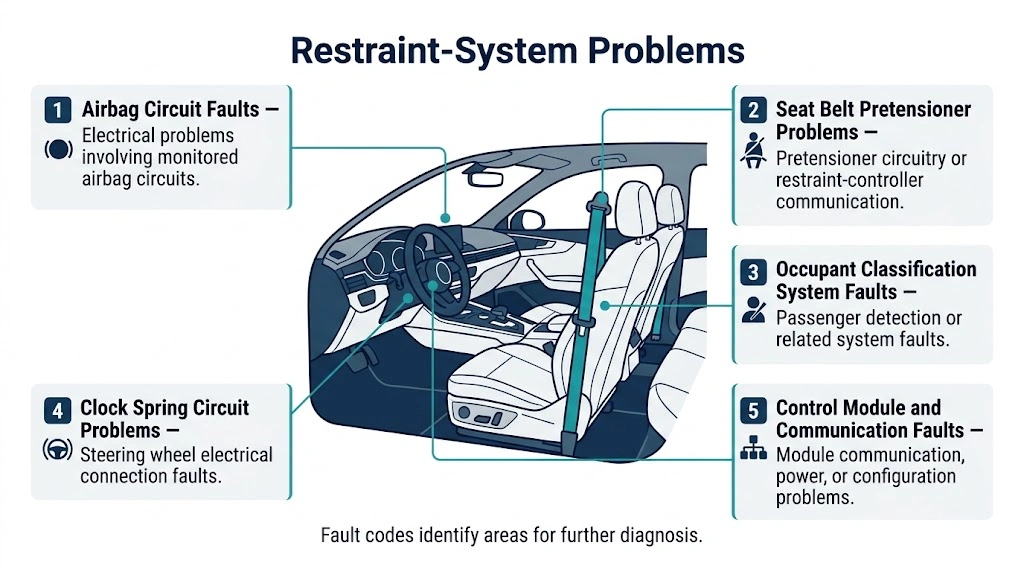
An SRS-compatible scanner can report trouble codes associated with several parts of the restraint system. The exact information depends on the vehicle and diagnostic equipment.
Airbag Circuit Faults
Diagnostic codes may identify an electrical problem associated with a driver’s, passenger’s, side, or curtain airbag circuit.
However, a circuit-related code does not prove the airbag itself is defective. Wiring, connectors, or other circuit components may require investigation.
Seat Belt Pretensioner Problems
Seat belt pretensioners are part of many modern supplemental restraint systems. A relevant fault may involve pretensioner circuitry or communication with the restraint controller.
These components are safety-critical and should be evaluated according to manufacturer repair instructions.
Occupant Classification System Faults
Vehicles equipped with passenger occupant classification systems may monitor sensors that help determine appropriate passenger airbag operation.
Some SRS scanners can retrieve related codes. Certain repairs may also require calibration with equipment specifically supporting that vehicle.
Steering Wheel Clock Spring Circuit Problems
A clock spring or spiral cable provides electrical connections between rotating steering wheel components and stationary vehicle wiring.
A fault involving this circuit may produce an SRS warning. A scanner can help identify the relevant circuit, but it cannot establish a failed clock spring without appropriate confirmation.
Control Module and Communication Faults
Some vehicles store trouble codes for airbag control module communication, internal faults, power supply, or configuration problems.
These conditions may require professional electrical diagnosis, specialized programming, or manufacturer-authorized procedures.
Why Does the Airbag Light Stay On After a Scan?
Reading codes does not repair a problem. The warning usually remains illuminated while the control module identifies an active fault or another condition requiring attention.
Common explanations include:
- The underlying electrical or component fault remains present.
- The scanner does not support clearing SRS faults on that vehicle.
- The system has stored a fault requiring a specific service procedure.
- A replacement component requires configuration or calibration.
- The module detects the problem again after a code-clearing attempt.
Some scanner interfaces also distinguish current, stored, and historical faults. These classifications help describe what the module has detected, but their exact meanings depend on the vehicle manufacturer.
Clearing a fault code is not evidence that the restraint system has been repaired. A proper repair includes confirming the cause, performing the necessary work, and verifying normal system operation.
What If an SRS Scanner Finds No Airbag Codes?
A no-code result is not conclusive until you know which module was actually scanned and whether communication succeeded.
First, confirm that the scanner entered the airbag control module instead of displaying only standard OBD2 results.
Next, check whether the software supports your vehicle’s specific SRS system. A scanner may support engine diagnostics on a vehicle without offering equivalent access to its restraint module.
If the scanner reports a communication error, record that message rather than treating it as confirmation that the system is healthy.
Some intermittent problems may also require stored history, manufacturer-specific diagnostic information, or further testing.
Key Insight
A successful connection to the OBD2 port is not proof that the scanner checked the airbag system. Confirm that it communicated with the actual SRS module before relying on the result.
Can You Drive With the Airbag Warning Light On?

A persistent airbag warning light should be treated as a safety concern because the system may not provide its intended protection during a collision.
The exact consequence depends on the fault and vehicle design. The illuminated warning alone does not tell you which airbags or pretensioners are affected.
Airbags supplement seat belts rather than replace them, as explained in the National Highway Traffic Safety Administration’s airbag safety guidance.
If the light stays on after the normal startup check, appears while driving, or behaves abnormally, arrange prompt diagnosis with a qualified repair professional.
Consult the owner’s manual for vehicle-specific guidance. Avoid assuming the vehicle is fully protected simply because it starts, drives, and brakes normally.
If the warning appeared after a collision or an airbag deployment, obtain a professional inspection before returning the vehicle to ordinary use.
When Is Professional Airbag Diagnosis Necessary?
Professional diagnosis is appropriate when the SRS light remains illuminated, the scanner cannot establish communication, or the fault involves safety-critical restraint components.
A qualified technician may have access to vehicle-specific wiring information, diagnostic procedures, approved test equipment, and module configuration tools that ordinary scanners lack.
Professional attention is particularly important when:
- The vehicle has been involved in a collision.
- Airbags or seat belt pretensioners have deployed.
- The scanner reports an active restraint circuit fault.
- A control module requires programming or calibration.
- The warning remains after an attempted repair.
- There is a manufacturer recall affecting the restraint system.
You can also check applicable safety recalls through the vehicle manufacturer’s official resources or the NHTSA recall lookup service.
The purpose of professional diagnosis is not simply to extinguish the dashboard light. It is to establish that the restraint system has been inspected and repaired according to the applicable requirements.
Practical Tip
Before visiting a repair shop, record the complete SRS code, whether it is current or stored, and when the warning first appeared. This information may help the technician investigate efficiently without losing useful diagnostic history.
Related Diagnostic Tool
An OBD2 scanner with verified SRS/airbag coverage can help retrieve restraint-system fault codes. Confirm compatibility with your vehicle before selecting a tool. A scanner does not replace professional airbag repair.
As an Amazon Associate, we may earn from qualifying purchases.
Frequently Asked Questions
Can a cheap OBD2 scanner read airbag codes?
Only if it explicitly supports SRS diagnostics for your vehicle. Many inexpensive scanners provide engine and emissions diagnostics without access to the airbag module. Price alone does not establish compatibility.
Can a Bluetooth OBD2 adapter diagnose an airbag light?
Sometimes. The adapter, application, and vehicle must collectively support enhanced SRS diagnostics. A Bluetooth connection and successful engine scan do not guarantee airbag access.
Can I reset an airbag warning light with an OBD2 scanner?
Some SRS-capable scanners can clear supported airbag fault codes. However, an active fault may cause the warning to return immediately. Diagnosis and proper repair should come before resetting the system.
Does the airbag warning light always mean an airbag is defective?
No. The warning may relate to wiring, control modules, seat belt pretensioners, occupant detection equipment, or other monitored restraint-system components. A diagnostic code helps narrow the investigation.
Is an airbag warning light related to the check engine light?
They generally monitor different systems. The check engine light is associated with powertrain and emissions diagnostics, while the airbag warning light concerns the supplemental restraint system. Both can appear independently.
Will disconnecting the car battery reset the airbag light?
Not reliably. SRS faults may remain stored, and disconnecting the battery does not correct damaged wiring or defective components. Avoid using battery disconnection as a substitute for proper diagnosis.
Final Thoughts
An OBD2 scanner can help diagnose an airbag warning light when it has compatible SRS diagnostic capabilities. Standard engine-only readers usually cannot access the information required.
Choose the right diagnostic mode, preserve fault information, and avoid confusing code clearing with repair. Because airbag faults can affect occupant protection, persistent warnings deserve prompt professional evaluation.

I’m Alex Rahman, a car enthusiast and automotive writer focused on practical solutions, car tools, and real-world driving advice. I share simple and honest content to help everyday drivers make better decisions.
