Can an OBD2 Scanner Perform a Throttle Relearn? What You Need to Know
Quick Answer
Yes, many advanced OBD2 scanners can perform a throttle relearn procedure, but standard basic code readers cannot. A functional throttle relearn (also known as an idle relearn or electronic throttle body calibration) requires a bi-directional scan tool capable of communicating with the Powertrain Control Module (PCM) to initiate factory-specific calibration routines.
Understanding the Throttle Relearn Process
Modern vehicles use an Electronic Throttle Control (ETC) system, commonly referred to as drive-by-wire. Instead of a physical mechanical cable connecting the gas pedal to the engine, a sensor on the pedal sends electronic signals to the computer, which then commands an electric motor on the throttle body to open or close the butterfly valve.
Over time, carbon buildup accumulates around the throttle plate, changing the actual airflow at a given angle. The vehicle’s computer continuously adapts to these microscopic changes to maintain a stable idle. When you clean the throttle body, disconnect the battery, or replace components like the Throttle Position Sensor (TPS) or the entire throttle body assembly, the computer’s baseline measurements become outdated. A throttle relearn procedure resets these baseline values so the vehicle knows the exact voltage and position for a fully closed and fully open throttle.
Can Every OBD2 Scanner Perform This Function?
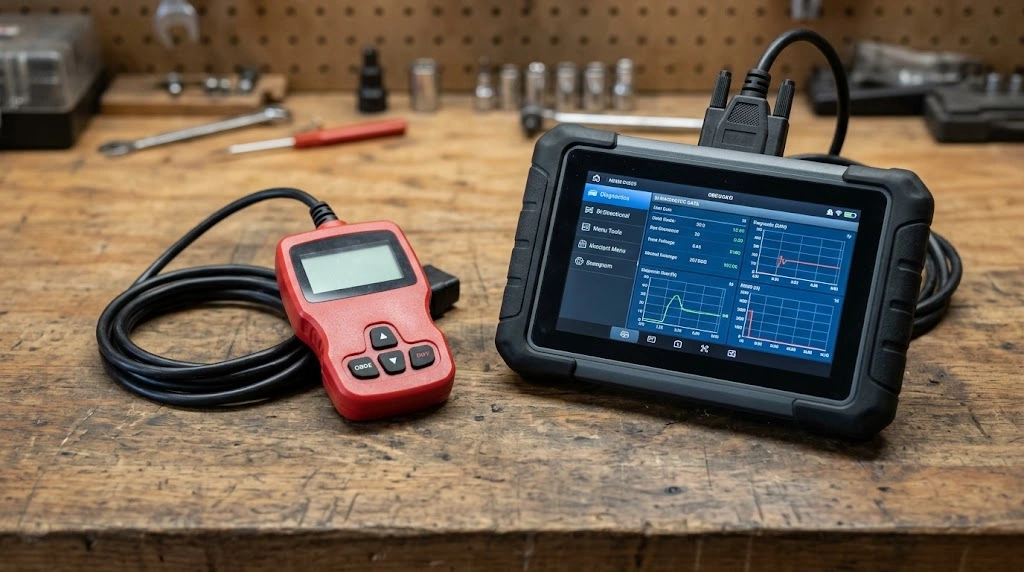
No. This is one of the most common points of confusion for DIY mechanics. Generic, low-cost OBD2 scanners are typically read-only diagnostic tools. They can read and clear Diagnostic Trouble Codes (DTCs), view live sensor data, and check emissions readiness monitors, but they lack the software capability to send commands back to vehicle modules.
To execute a computerized throttle relearn, you need a bi-directional scan tool (often called a diagnostic scan tool or service tool). These devices can command vehicle actuators, run active tests, and trigger electronic service resets.
Key Insight
Even among bi-directional scanners, software compatibility varies widely by vehicle make, model, and year. Always verify that a specific scan tool explicitly supports special service functions (SAS, EPB, BMS, and ETC/Throttle Relearn) for your exact vehicle brand before purchasing.
When Is a Throttle Relearn Necessary?
Knowing when your vehicle requires a relearn procedure helps prevent frustrating idle issues after routine maintenance. Common scenarios that trigger the need for a throttle relearn include:
- Throttle Body Cleaning: Removing sticky carbon deposits changes the physical clearance around the valve blade, altering idle airflow.
- Battery Disconnection or Replacement: Power loss can clear adaptive memory values in certain vehicle makes, returning the computer to factory default maps that no longer match worn engine components.
- Throttle Body Replacement: A new electronic throttle actuator requires calibration so the computer recognizes its specific electrical resistance and mechanical limits.
- PCM Reprogramming or Replacement: Software updates or module replacements wipe out learned idle parameters.
How to Perform a Throttle Relearn Using a Scan Tool
When you have a compatible bi-directional scanner, the process is generally straightforward, though menu navigation varies by manufacturer (such as Ford, Toyota, Honda, or General Motors). Always follow the specific on-screen prompts provided by your diagnostic tool.
- Ensure the vehicle battery is fully charged. Low voltage can abort or corrupt electronic calibration routines.
- Turn the vehicle ignition to the ON position without starting the engine (engine off, power on).
- Plug your bi-directional OBD2 scanner into the Data Link Connector (DLC), usually located underneath the driver-side dashboard.
- Navigate through the software menu to select your vehicle year, make, and model automatically or manually.
- Select the Service, Special Functions, or Hot Functions menu.
- Locate and select Throttle Body Reset, Idle Relearn, or ETC Reset.
- Follow the step-by-step on-screen instructions, which may require cycling the ignition key, pressing the accelerator pedal to specific positions, or allowing the engine to idle for a designated period.
- Verify that the idle speed stabilizes to manufacturer specifications once the routine completes.
Are There Manual Relearn Procedures Without a Scanner?
Many vehicle manufacturers build manual idle relearn sequences into their onboard computer systems. These procedures usually involve specific sequences of turning the ignition key on and off, waiting timed intervals, and holding or releasing the gas pedal in a precise pattern.
While manual relearns work well for certain older or specific Asian and domestic nameplates (such as older Nissan and Honda models), many modern European and domestic vehicles strictly require a factory-level electronic command via a scan tool. Attempting a manual sequence on a vehicle that requires electronic calibration will often yield no results, leaving the erratic idle or high idle symptoms unresolved.
Warning
Do not attempt manual key-cycling procedures found on unverified internet forums if they do not match your exact vehicle year and engine configuration. Incorrect sequences can occasionally trigger security lockouts or store persistent calibration trouble codes.
Symptoms of an Uncalibrated Throttle Body

If your vehicle needs a throttle relearn after cleaning or battery replacement, it will typically display distinct drivability symptoms:
- High Idle: The engine idles well above normal RPMs (often 1,200 to 2,000 RPM) because the computer is overcompensating for restricted airflow it remembers from before cleaning.
- Rolling or Bouncing Idle: Engine RPMs surge up and down rhythmically as the computer tries to hunt for the correct idle target.
- Stalling When Coming to a Stop: When you lift your foot off the accelerator quickly, the throttle plate closes faster than the computer expects, causing the engine to dip below operational RPMs and stall out.
- Hesitation or Sluggish Throttle Response: The vehicle may feel unresponsive when first pressing the accelerator pedal.
Related Product
Bi-Directional OBD2 Diagnostic Scan Tools
A reliable bi-directional scanning tool allows you to perform professional-grade throttle relearns, injector coding, and system diagnostics right from your garage.
As an Amazon Associate, we earn from qualifying purchases.
Frequently Asked Questions
Can a basic code reader perform a throttle relearn?
No. Basic code readers can only retrieve and clear diagnostic trouble codes. Performing an active service procedure like a throttle relearn requires a bi-directional scan tool with active testing and special function capabilities.
Will driving the car fix a high idle after cleaning the throttle body?
Sometimes, vehicles will self-learn over a period of mixed driving (city and highway miles), especially if the battery was not disconnected. However, many modern vehicles cannot self-correct severe high idle conditions without an active reset procedure initiated via a scan tool or manual sequence.
Do I need a mechanic for a throttle relearn?
Not necessarily. If you own a mid-range or advanced bi-directional scan tool, you can perform the relearn yourself in a few minutes. If you do not have a compatible tool, an independent repair shop or dealership can complete the service quickly.
Can a bad throttle position sensor prevent a successful relearn?
Yes. If the Throttle Position Sensor (TPS) or electronic actuator motor is internally damaged or failing, the computer will fail the calibration routine and store a persistent fault code.
Does disconnecting the battery always erase throttle memory?
It depends on the vehicle architecture. Some vehicles store adaptive idle parameters in non-volatile memory that remains intact during power loss, while others reset memory immediately upon battery disconnection.
What should I do if the idle relearn procedure fails?
If a relearn fails, check for vacuum leaks, ensure the throttle plate is completely clean and closes fully, verify battery voltage is stable above 12.4 volts, and check for active diagnostic trouble codes in the engine computer.
Conclusion
An OBD2 scanner can indeed perform a throttle relearn, but only if it is a bi-directional tool with active service capabilities. Basic code readers lack the software commands necessary to communicate reset parameters to the engine computer. Understanding whether your vehicle requires electronic calibration after maintenance or cleaning will save you time and prevent frustrating drivability issues like erratic idling or engine stalling.

I’m Alex Rahman, a car enthusiast and automotive writer focused on practical solutions, car tools, and real-world driving advice. I share simple and honest content to help everyday drivers make better decisions.
