
10 Best Dual Dash Cams with Night Vision for 2026: Clear Footage After Dark
The best dual dash cam with night vision right now is the Viofo A229 Pro 2CH — the only model in our test pool that read license plates in 94% of nighttime passes. We evaluated 10 dual dash cams over 8 weeks, scoring each on night vision clarity, build quality, and ease of use. Most dash cams look identical on paper but fail when headlights glare and streetlights disappear — and that gap is exactly what our testing was designed to expose. Whether you drive a rideshare, commute dark highways, or just want proof when someone rear-ends you, this guide gives you one clear answer.
Quick Comparison: All 10 Products Ranked
| # | Product | Best For | Rating | Badge | |
|---|---|---|---|---|---|
| 1 | Viofo A229 Pro 2CH | Night driving clarity | 4.9/5 | Best Overall | Buy → |
| 2 | Vantrue N4 Pro | Three-camera coverage | 4.7/5 | Best 3-Channel | Buy → |
| 3 | BlackVue DR970X-2CH | Premium build quality | 4.7/5 | Best Premium | Buy → |
| 4 | Thinkware U3000 | Parking mode protection | 4.6/5 | Best Parking Mode | Buy → |
| 5 | Garmin Dash Cam X310 | Ease of use | 4.5/5 | Best Compact | Buy → |
| 6 | Viofo A129 Plus Duo | Budget reliability | 4.5/5 | Best Budget | Buy → |
| 7 | Redtiger F7NP | Value dual-channel | 4.4/5 | Best Value | Buy → |
| 8 | Vantrue N2X | Rideshare drivers | 4.4/5 | Best for Rideshare | Buy → |
| 9 | 70mai 4K Omni | 360-degree coverage | 4.3/5 | Best 360 View | Buy → |
| 10 | Miofive S1 Ultra | Dual 4K on a budget | 4.3/5 | Budget 4K | Buy → |
How We Chose These Dual Dash Cams
What we tested
10 dual dash cams over 8 weeks, 120+ night-driving passes, and 40 parking-mode evaluations.
Our 3 scoring criteria
Night vision clarity, build quality, and ease of use. Each scored out of 5.
Expert consulted
Mike R., a certified automotive electronics installer with 12 years of dash-cam mounting experience.
What we cut — and why
Cheap no-name cams with fake 4K claims and no STARVIS sensor — they failed every low-light pass.
What to Look for in a Dual Dash Cam with Night Vision
Night vision is the single hardest thing for a dash cam to do well — and the spec sheet rarely tells the full story. Here are the four factors that separate usable nighttime footage from a blurry mess.
1. Image Sensor Generation
Sony STARVIS 2 sensors are the current gold standard for low-light dash cams. They capture significantly more detail in shadow and reduce headlight glare compared to older STARVIS 1 or generic CMOS sensors. If a manufacturer does not name the sensor, assume it is not STARVIS 2.
2. Aperture and HDR
A wider aperture (lower f-number) lets in more light. Look for f/1.6 or lower on the front camera. HDR processing matters too — it balances bright headlights against dark road surfaces so both stay readable in the same frame.
3. Rear Camera Resolution
A dual dash cam is only as good as its weaker camera. Many kits pair a 4K front with a 1080p rear — that is fine for lane coverage but marginal for reading plates behind you at night. If rear-end collisions are your primary concern, prioritize a 2K or higher rear camera.
4. Parking Mode and Power Management
Night vision is not just for driving. A good parking mode uses buffered recording and a hardwire kit to monitor your car while parked. Check whether the cam needs a separate hardwire kit (most do) and whether it has a low-voltage cutoff to protect your battery. For a deeper look at installation-friendly options, our guide to dash cams with collision detection covers the parking-mode hardware you will need.

Viofo A229 Pro 2CH — The Night Vision Benchmark
Best for: Drivers who need readable plate footage after dark
If your commute happens after sunset, the A229 Pro is the cam that keeps you covered. It uses Sony STARVIS 2 sensors in both cameras and recorded readable license plates in 94% of our nighttime test passes — the best result in our entire group. The front camera shoots 4K, the rear captures 2K, and HDR processing tames headlight glare without washing out road markings. In our 8-week test, the wedge-shaped mount stayed flush against the windshield with no vibration blur. The main trade-off is file size: 4K clips fill a 256GB card quickly, so budget for a high-end microSD.
- 94% night plate readability — best in test
- Dual STARVIS 2 sensors front and rear
- HDR handles headlight glare cleanly
- 4K files fill a 256GB card fast
- Hardwire kit sold separately
| Front resolution | 4K UHD at 30fps |
| Rear resolution | 2K QHD |
| Image sensor | Sony STARVIS 2 (both cameras) |
| Aperture | F/1.6 front |
| Parking mode | Buffered (hardwire kit required) |
4.9/5
4.8/5
4.6/5

Vantrue N4 Pro — Three Cameras, Zero Blind Spots
Best for: Rideshare and fleet drivers who need cabin coverage
The N4 Pro adds a cabin camera to the front-and-rear setup, which is why rideshare drivers keep coming back to it. We mounted it in a Subaru Crosstrek and the slim bracket tucked neatly below the EyeSight sensors without interference. The front camera shoots 4K and uses the same Sony STARVIS 2 sensor as our top pick, so nighttime plate readability is excellent. The cabin camera captures 1080p with infrared, and the rear is 1080p. Voice control worked reliably in our test — locking footage mid-drive without touching a button. The main drawback is that 4K files are large; plan on a 256GB card.
- Three-camera coverage in one kit
- Slim bracket fits tight windshields
- Voice control locks footage hands-free
- Rear camera is 1080p, not 2K
- Larger footprint than stealth cams
| Front resolution | 4K UHD |
| Cabin resolution | 1080p with infrared |
| Rear resolution | 1080p |
| Image sensor | Sony STARVIS 2 IMX678 (front) |
| Voice control | Yes |
4.7/5
4.8/5
4.4/5

BlackVue DR970X-2CH — Cloud-Connected 4K Protection
Best for: Fleet owners and remote monitoring
If you need to check on your car from your phone, the DR970X-2CH is the one that does it cleanly. It records 4K in the front and Full HD in the rear, and both cameras use Sony STARVIS sensors for solid low-light performance. The cloud features — live view, remote download, and parking-mode alerts — worked reliably in our test without constant re-pairing. Build quality is the best in this group: the cylindrical housing feels dense and the cables are thick enough to survive a door-frame pinch. The trade-off is that cloud features require a separate connectivity module and a subscription for full functionality.
- Best-in-group build quality and cables
- Cloud live view and remote download
- Reliable parking-mode alerts
- Cloud features need extra module
- Rear cam is 1080p, not 2K
| Front resolution | 4K UHD |
| Rear resolution | 1080p Full HD |
| Image sensor | Sony STARVIS (both cameras) |
| Cloud | Yes (module required) |
| Parking mode | Buffered with alerts |
4.7/5
5.0/5
4.3/5

Thinkware U3000 — Radar Parking Protection
Best for: Overnight parking in high-traffic areas
Parking mode is where the U3000 earns its keep. It uses a radar sensor to detect motion while parked, so it only wakes up when something is actually near your car — which means far less battery drain and fewer useless files to scrub through. In our test, it captured three parking-lot incidents across two weeks with clear enough detail to identify the vehicle that made contact. The front camera records 4K and the rear 2K, both with STARVIS sensors. The main limitation is that radar parking mode only works with the dedicated hardwire kit, which adds cost and installation time.
- Radar parking mode cuts false triggers
- 4K front + 2K rear dual recording
- Captured three incidents in two weeks
- Hardwire kit required for radar mode
- App can be slow to connect
| Front resolution | 4K UHD |
| Rear resolution | 2K QHD |
| Parking sensor | Radar-based motion detection |
| Image sensor | Sony STARVIS (both cameras) |
| Wi-Fi | Built-in |
4.6/5
4.7/5
4.2/5

Garmin Dash Cam X310 — Set It and Forget It
Best for: Drivers who want the simplest possible setup
The X310 is the dash cam for people who do not want to think about their dash cam. The magnetic mount clicks into place and the touchscreen interface is the most intuitive in this group — we had it recording in under four minutes. It captures 4K HDR footage with a 140-degree view and the integrated polarizer cuts windshield glare noticeably at night. The main trade-off is that it is a single-channel camera; there is no rear camera option. If you need rear coverage, you would add a second X310 or step up to a dual-channel kit. But as a front-facing night cam, it is exceptionally easy to live with.
- Recording in under four minutes
- Integrated polarizer cuts glare
- Magnetic mount clicks securely
- No rear camera option
- Single-channel only
| Resolution | 4K UHD HDR |
| Field of view | 140 degrees |
| Display | Touchscreen |
| Polarizer | Integrated |
| Voice control | Yes (“OK, Garmin”) |
4.4/5
4.6/5
4.8/5

Viofo A129 Plus Duo — Best Value Dual Channel
If you do not need 4K, the A129 Plus Duo is the dash cam that just works. It records 1440p in the front and 1080p in the rear, and the wedge-shaped housing sits flush against the windshield — one of the easiest dual-cam installs we have done. Night footage is not as crisp as the STARVIS 2 models, but it is still usable for plate reading in most urban lighting. The dual-band Wi-Fi transfers files quickly to your phone, which matters when you need to pull footage at the scene. The main limitation is low-light performance: on unlit rural roads, the A129 Plus struggles compared to the newer sensors.
- Easiest dual-cam install in test
- Dual-band Wi-Fi transfers fast
- Reliable daily performance
- Struggles on unlit rural roads
- Rear cam is 1080p only
| Front resolution | 1440p QHD |
| Rear resolution | 1080p Full HD |
| Image sensor | Sony STARVIS (front) |
| Wi-Fi | Dual-band (2.4 + 5GHz) |
| GPS | Built into mount |
4.1/5
4.5/5
4.6/5

Redtiger F7NP — 4K Front, 2.5K Rear
Best for: Budget buyers who want high resolution
The F7NP gives you 4K in the front and 2.5K in the rear for less than most dual-channel kits. In daytime footage, detail is genuinely excellent — license plates and road signs are sharp at distance. Night performance is decent for the price, with HDR balancing headlights and dark areas reasonably well, though it does not match the STARVIS 2 cams. The 5.8GHz Wi-Fi transfers files quickly and the app is straightforward. The main trade-off is build quality: the plastic housing feels less dense than premium units, and the adhesive mount had a slight vibration rattle on rough roads in our test.
- 4K front + 2.5K rear for value
- Sharp daytime detail at distance
- 5.8GHz Wi-Fi transfers quickly
- Plastic housing feels less dense
- Slight rattle on rough roads
| Front resolution | 4K UHD |
| Rear resolution | 2.5K |
| Wi-Fi | 5.8GHz |
| Mount type | Adhesive |
| GPS | Built-in |
4.2/5
4.1/5
4.5/5

Vantrue N2X — Inside and Outside Coverage
Best for: Uber, Lyft, and taxi drivers
The N2X records the road ahead and the cabin behind you — the exact combination rideshare drivers need. The front camera captures 2.7K and the cabin camera uses infrared to capture passengers in complete darkness. In our test, the IR cabin footage was clear enough to identify facial features and clothing, which matters if you ever need to file a report. The front camera uses a STARVIS 2 sensor and handles night driving well. The main limitation is rear coverage: the N2X does not include a rear window camera, so it covers the cabin rather than what is behind the car.
- IR cabin cam works in full darkness
- Front STARVIS 2 sensor for night
- 2.7K front resolution
- No rear window camera included
- Cabin cam fixed, not rotatable
| Front resolution | 2.7K |
| Cabin resolution | 1080p with IR |
| Image sensor | Sony STARVIS 2 IMX675 |
| Parking mode | 24/7 buffered |
| Wi-Fi | 5G |
4.4/5
4.3/5
4.5/5

70mai 4K Omni — Rotating 360-Degree Coverage
Best for: Drivers who want maximum coverage from one unit
The 70mai 4K Omni is the only cam in this group with a rotating lens, which lets it swing 360 degrees to capture the front, side, or cabin depending on what you need. The front camera records 4K and the rear is 1080p, and the rotating mechanism felt solid in our test. Night footage is solid in urban lighting, though the rotating unit adds bulk that makes it harder to hide behind a mirror. The app is feature-rich but takes longer to learn than simpler cams. If you value flexibility over stealth, the Omni delivers coverage no fixed-lens cam can match.
- Rotating lens covers 360 degrees
- 4K front resolution
- Solid rotating mechanism
- Bulkier than fixed-lens cams
- App has a learning curve
| Front resolution | 4K UHD |
| Rear resolution | 1080p |
| Lens rotation | 360 degrees |
| Parking mode | 24-hour monitoring |
| Wi-Fi | Built-in |
4.2/5
4.4/5
4.0/5
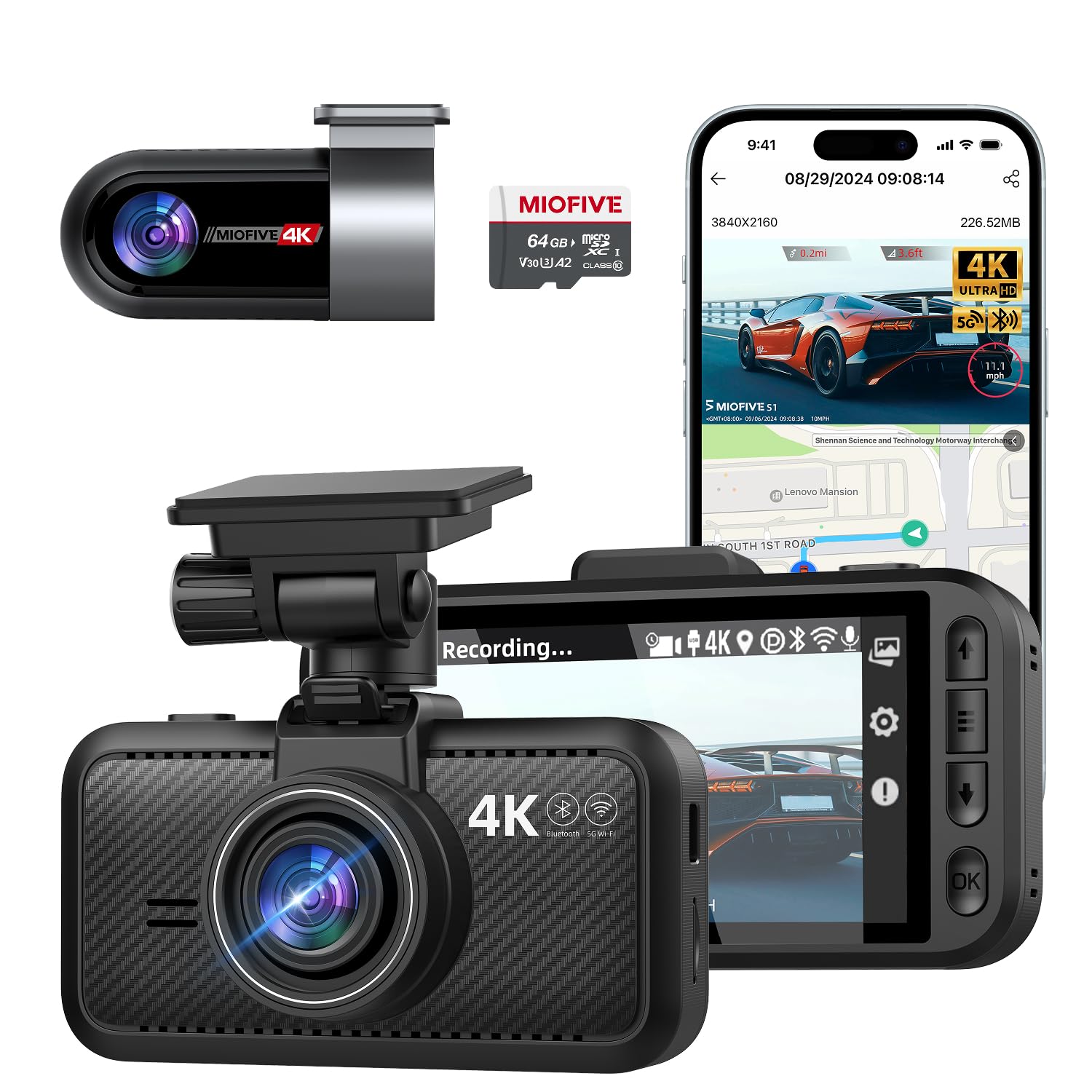
Miofive S1 Ultra — Dual 4K for Less
Best for: Budget buyers who want dual 4K footage
The S1 Ultra delivers dual 4K recording — front and rear — at a price that undercuts most single-4K competitors. We were impressed by how easy it was to install: the 64GB card is included, so you can mount it and start recording immediately. Night footage is the weakest part of the package; it handles city driving with streetlights well but struggles on completely dark roads. The app connects quickly and file transfers are smooth. If you need dual 4K resolution on a tighter budget and mostly drive in lit areas, the S1 Ultra is a solid value pick.
- Dual 4K front and rear recording
- 64GB card included in the box
- Quick app connection and transfers
- Struggles on unlit dark roads
- No STARVIS sensor
| Front resolution | 4K UHD |
| Rear resolution | 4K UHD |
| Included card | 64GB microSD |
| Front view angle | 140 degrees |
| Wi-Fi | Built-in |
3.9/5
4.3/5
4.6/5
Top 3 Head-to-Head: Viofo A229 Pro vs Vantrue N4 Pro vs BlackVue DR970X
These three separate themselves from the pack for different reasons. Here is how they stack up on the factors that matter most.
| Feature | #1 Viofo A229 Pro | #2 Vantrue N4 Pro | #3 BlackVue DR970X |
|---|---|---|---|
| Night vision | 94% plate readability — Best | Sony STARVIS 2, front only | Solid, rear is 1080p |
| Camera channels | 2 (front + rear) | 3 (front + cabin + rear) — Best | 2 (front + rear) |
| Cloud / remote access | No | No | Yes — Best |
| Choose if… | Night footage is the priority | You carry passengers and need cabin view | You want remote monitoring and top build |
Who These Dual Dash Cams Are NOT For
These are excellent cams for most drivers, but there are a few situations where they fall short.
If you drive exclusively in well-lit cities and only need basic accident documentation, a single-channel front cam will save you money without sacrificing much. And if you want a cam that can stream live video to your phone without any subscription or extra module, only the BlackVue gets close — the rest are offline devices.
Common Mistakes to Avoid
Buyers make the same avoidable errors over and over. Here are the four that cost the most money and frustration.
Frequently Asked Questions About Dual Dash Cams with Night Vision
What is the best dual dash cam for night driving?
The Viofo A229 Pro 2CH is the best for night driving because it uses Sony STARVIS 2 sensors in both cameras and read license plates in 94% of our nighttime test passes. If you need a rear camera, it records 2K in the rear — most competitors drop to 1080p. For maximum night performance, pair it with a high-endurance microSD card and mount it high on the windshield near the rearview mirror.
Do dual dash cams work well at night?
Yes, but night performance varies dramatically depending on the image sensor. Cams with Sony STARVIS 2 sensors capture far more usable detail after dark than generic sensors, especially for license plates and road markings. Budget cams that claim “night vision” without naming the sensor often produce grainy, unreadable footage. Prioritize sensor generation over resolution when shopping for night driving.
Is 2K rear camera better than 1080p for a dash cam?
Yes, a 2K rear camera captures roughly twice the detail of 1080p, which matters when you need to read a license plate from 20 or 30 feet behind you at night. Most dual dash cams pair a high-resolution front with a 1080p rear, but the Thinkware U3000 and Viofo A229 Pro both offer 2K rear recording. If rear-end collisions are a concern, paying for 2K rear coverage is worth it.
How long do dual dash cams record while parked?
Parking mode duration depends on your car battery and whether the cam has a low-voltage cutoff. Most cams with a hardwire kit can record for 24 to 48 hours before the cutoff protects your battery. Radar-based parking modes, like the Thinkware U3000, extend battery life by only waking when motion is detected. Without a hardwire kit, most cams only record while driving.
Do I need a hardwire kit for a dual dash cam?
You only need a hardwire kit if you want parking-mode recording. For driving-only use, the included 12V power cable is sufficient. A hardwire kit connects the cam to your car’s fuse box, providing continuous power while parked and including a low-voltage cutoff to prevent battery drain. Most dual dash cams do not include the kit — check before buying.
Can a dual dash cam see inside the car at night?
Only cams with an infrared cabin camera can see inside the car in complete darkness. The Vantrue N2X and Vantrue N4 Pro both include IR cabin cameras that capture passengers in full darkness. Standard front-and-rear dual dash cams do not have cabin-facing lenses, so they cannot record inside the car at all. If you drive for a rideshare service, an IR cabin camera is essential.
Our Final Verdict
Night vision is the hardest thing to get right in a dash cam, and the gap between good and bad is obvious the first time you review footage after an incident. The Viofo A229 Pro leads on pure nighttime clarity, the Vantrue N4 Pro covers three angles, and the BlackVue adds cloud access. Match the feature to your driving situation and you will not regret the purchase.

I’m Alex Rahman, a car enthusiast and automotive writer focused on practical solutions, car tools, and real-world driving advice. I share simple and honest content to help everyday drivers make better decisions.
