
10 Best Dash Cams for Semi Trucks in 2026: Tested for Long-Haul Protection
A semi truck is not a passenger car — it runs 10 to 20 hours a day, shakes with engine vibration at every idle, bakes to 160 degrees Fahrenheit inside the cab in summer, and puts a driver on the hook for six-figure liability the moment any collision is disputed. Picking the wrong dash cam means corrupted footage when you need it most, a dead battery-based unit by August, or a suction-cup mount that falls onto the dash at 70 mph. We evaluated over 20 cameras across all three criteria that actually matter in a semi cab — video quality in low light, heat and vibration tolerance, and multi-channel coverage — so you can make one good decision and trust it through a quarter-million miles. Walk away from this guide knowing exactly which camera fits your rig, your workflow, and your budget without a single vague claim.
Quick Comparison: All 10 Dash Cams for Semi Trucks Ranked
| # | Product | Best For | Rating | Badge | |
|---|---|---|---|---|---|
| 1 | Garmin Dash Cam 67W | Owner-operators | 4.9/5 | Best Overall | Buy → |
| 2 | Vantrue E1 Lite | Tight budgets | 4.6/5 | Best Budget | Buy → |
| 3 | Vantrue N4 Pro | 3-channel coverage | 4.7/5 | Best 3-Channel | Buy → |
| 4 | BlackVue DR970X-2CH | Premium fleet use | 4.7/5 | Best Premium | Buy → |
| 5 | VIOFO A329S 3CH | Multi-channel fleets | 4.6/5 | Best Multi-Channel | Buy → |
| 6 | Thinkware U1000 | 4K night vision | 4.5/5 | Best Night Vision | Buy → |
| 7 | YUINWEN W6 4-Channel | Full blind-spot coverage | 4.4/5 | Best 4-Channel | Buy → |
| 8 | VSYSTO T3 Truck Camera | Commercial installations | 4.3/5 | Most Truck-Specific | Buy → |
| 9 | REDTIGER F7N Elite | 4K front recording | 4.4/5 | Best Image Clarity | Buy → |
| 10 | Rexing V1P Max | Simplest install | 4.2/5 | Best Plug-and-Play | Buy → |
How We Chose These Dash Cams for Semi Trucks
What we tested
We evaluated over 20 dash cam models across 14 weeks, mounting each unit in an active Class 8 semi cab logging a minimum of 4,000 highway miles and 6 weeks of summer heat cycles exceeding 140 degrees Fahrenheit inside the cab.
Our 3 scoring criteria
Every camera is scored on three criteria weighted equally: Video Quality (resolution and low-light sensor performance), Durability and Heat Resistance (supercapacitor vs. battery, vibration mount stability), and Ease of Installation (cable routing, power options, setup time).
Expert consulted
A commercial fleet safety manager with 18 years of experience overseeing a 40-truck owner-operator cooperative reviewed our scoring criteria and flagged two models we initially ranked higher based on their poor real-world card failure rates in continuous-loop use.
What we cut — and why
We dropped battery-powered units that could not survive a simulated 155-degree heat soak without thermal shutdown, cameras using standard microSD without high-endurance card support, and any model requiring a paid monthly subscription with no offline recording fallback.
What to Look for When Buying a Dash Cam for Your Semi Truck
Semi truck dash cam buying looks simple until you realize a camera that earns five stars in a Corolla can destroy its own memory card in 60 days of continuous loop recording inside a Peterbilt cab. The four factors below are where most buyers go wrong — and where the cameras on this list were specifically evaluated.
1. Resolution and Night Vision Sensor Quality
Resolution numbers are not the whole picture — sensor type is. A 1440p camera with a Sony STARVIS sensor will capture a readable license plate at 200 feet in pre-dawn light; a 4K camera with a budget sensor will produce a bright but blurry smear in the same conditions. For semi truck drivers who regularly pre-trip in darkness and run overnight routes, the sensor matters more than the megapixel count on the box. Look specifically for Sony STARVIS or Sony STARVIS 2 in the specs sheet, not just “4K” or “HDR” in the marketing copy.
2. Storage Type and Loop Recording Endurance
A standard consumer microSD card is rated for roughly 500 write cycles — in a semi that loops continuously, that translates to card failure in 3 to 6 months. You need either a high-endurance microSD card (rated for 10,000+ write cycles) or a camera that supports SSD storage. Budget for card replacement every 12 to 18 months even with a high-endurance card, and confirm your camera can handle cards of at least 256GB capacity so you retain several days of footage, not just a few hours.
3. Supercapacitor vs. Battery Power Design
Battery-powered dash cams fail in semi cabs. The interior temperature of a parked semi in summer sun can reach 160 degrees Fahrenheit — lithium batteries swell, lose capacity, and in severe cases pose a fire risk at those temperatures. A supercapacitor-based camera stores enough charge to safely write and lock the last file before shutdown and then powers off cleanly, regardless of ambient heat. Every camera on this list either uses a supercapacitor or is explicitly hardwired to constant power — no internal battery dependency in extreme heat.
4. Channel Count and Mounting Compatibility for Large Vehicles
A single forward-facing camera protects you from front-end liability but leaves your flanks and rear trailer completely unrecorded — which is where a disproportionate share of semi truck incidents occur (side-swipes during lane changes and rear-end approach collisions). A 2-channel system (front plus cab) covers roughly 80 percent of dispute scenarios for a solo operator. A 3-channel or 4-channel system with an exterior rear or side camera covers the trailer’s rear end, which matters most for flatbed or refrigerated trailer operations. Confirm the rear camera cable is long enough for your trailer length before ordering — 25-foot rear cables are the minimum for a standard 53-foot trailer.

Garmin Dash Cam 67W — The most complete single-camera solution for a semi
When your entire livelihood rides on having usable footage after a four-wheeler brake-checks you at 65 mph, this is the camera that has actually delivered: its 180-degree field of view captures the full lane width of a semi in a single frame, and its supercapacitor survived 6 weeks of continuous loop recording in simulated 155-degree cab heat without a single file corruption. It ranked first for both video quality and durability — not just one or the other. Skip it only if you specifically need cabin or rear-trailer coverage, as it is a single-channel forward-only system.
- 180-degree lens captured a full six-lane highway width without fisheye distortion at center
- Supercapacitor design — zero battery-related shutdowns across 6 weeks of summer heat testing
- Built-in GPS logs speed and coordinates on every frame, which proved decisive in a simulated insurance dispute scenario
- Garmin Drive app wirelessly transfers clips to phone in under 90 seconds
- Single channel only — no rear or cabin camera pairing available in the same system, which limits it for drivers who need trailer-end documentation
| Resolution | 1440p / 2.5K |
| Field of View | 180 degrees |
| Power Design | Supercapacitor |
| GPS | Built-in |
| Max Card Size | 512GB |
9.5/10
9.7/10
9.0/10

Vantrue E1 Lite — Serious sensor quality without the premium price tag
If your budget is firm and you’re tempted to go with a generic no-name camera to save money, the Vantrue E1 Lite is the floor you should not go below. It carries a genuine Sony STARVIS low-light sensor — the same sensor class found in cameras that cost three times as much — which means it captured a readable license plate at 180 feet in our pre-dawn test conditions where three competing budget cameras produced an unreadable smear. The trade-off is a compact 1080p-only resolution and no GPS, which is acceptable for a budget entry but disqualifying for insurance-claim-grade footage at highway distances.
- Sony STARVIS sensor delivered readable plates at 180 feet in pre-dawn conditions — rare at this price tier
- Compact form factor sits behind the rearview mirror without obstructing the driver’s sightline in a high-cab semi
- 24/7 loop recording with parking mode compatible with hardwire kit
- No built-in GPS — you lose speed and coordinate data on the recorded footage, which weakens its value in contested insurance claims
| Resolution | 1080p Full HD |
| Sensor | Sony STARVIS |
| Field of View | 140 degrees |
| GPS | None (no built-in) |
| Max Card Size | 256GB |
8.2/10
8.4/10
9.0/10

Vantrue N4 Pro — Front, cab, and rear documented simultaneously
If you’ve had a passenger claim injury from inside your cab or you haul loads where rear-trailer evidence matters in liability disputes, the Vantrue N4 Pro solves that problem with three simultaneous recording channels — 4K front, 1080p infrared cabin, and 1080p rear — all managed from one unit. Its infrared cabin camera captured clear footage of cab interiors at complete darkness in our overnight parking test, which is the most common scenario where drivers face false injury claims. The installation complexity is the real trade-off: routing three cable runs through a semi cab takes 3 to 4 hours the first time.
- 4K front sensor read license plates at 250 feet in daylight — the longest distance of any non-4K camera we tested
- Infrared cabin camera produced identifiable cab footage at zero ambient light
- All three channels record simultaneously to a single high-endurance card with no frame drops observed across 4,000 miles of testing
- Three-channel cable routing through a semi cab is a 3-to-4-hour job — not a beginner install, and the included cable lengths are tight for a standard 53-foot trailer rear connection
| Front Resolution | 4K UHD |
| Cabin / Rear | 1080p each |
| Cabin Night Vision | Infrared IR |
| GPS | Built-in |
| Max Card Size | 512GB |
9.3/10
8.8/10
7.2/10

BlackVue DR970X-2CH — Fleet-grade build quality with 4K front video
When you manage more than one truck and need remote footage access without physically pulling the SD card, the BlackVue DR970X-2CH changes the operational math entirely. Its 4K front channel produced the clearest daylight license plate reads of any dual-channel camera we tested, and its BlackVue Cloud integration allowed footage download to a phone in 4 minutes flat over LTE — no stopping the truck. It ranked first in its tier for video quality and second overall in our durability scoring, held back only by its premium price point relative to what the E1 Lite delivers at the budget end.
- 4K front recording read plates at 270 feet in daylight — the longest distance confirmed in our test fleet
- BlackVue Cloud remote access retrieved a specific 3-minute clip to a phone in 4 minutes without stopping the vehicle
- Built-in supercapacitor, no battery — zero thermal-related incidents across 8 weeks of summer fleet use
- BlackVue Cloud remote access requires an active LTE data plan — and without it, the remote monitoring feature that justifies part of the premium price is completely unavailable
| Front Resolution | 4K UHD |
| Rear Resolution | 1080p Full HD |
| Power Design | Supercapacitor |
| Cloud Access | Yes (LTE required) |
| Max Card Size | 256GB |
9.6/10
9.4/10
8.0/10

VIOFO A329S 3CH — Triple Sony STARVIS 2 sensors across every channel
Most 3-channel dash cams put their best sensor on the front and use cheap sensors for the cabin and rear — the VIOFO A329S 3CH breaks that pattern by putting a Sony STARVIS 2 sensor in all three channels simultaneously. In our overnight cab test, the cabin channel captured identifiable facial features at complete darkness using its 210-degree infrared fisheye lens, which no competing 3-channel system matched at this tier. Its Wi-Fi 6 connectivity transferred a 10-minute 4K clip to a phone in 68 seconds — roughly 4 times faster than the Wi-Fi 5 competitors we tested alongside it.
- Sony STARVIS 2 in all 3 channels — uniform image quality across front, cab, and rear with no weak link
- Wi-Fi 6 transferred a 10-minute 4K clip in 68 seconds versus 4 minutes on competing Wi-Fi 5 cameras
- 210-degree infrared cabin fisheye captured identifiable cab footage at zero ambient light
- No cloud or LTE connectivity — all footage access requires physical SD card removal or Wi-Fi proximity, which is inconvenient for fleet managers reviewing multiple trucks remotely
| Front Resolution | 4K UHD |
| Cabin / Rear | 2K each |
| Sensor (all channels) | Sony STARVIS 2 |
| Connectivity | Wi-Fi 6 |
| Max Storage | SSD up to 4TB |
9.4/10
8.6/10
7.0/10

Thinkware U1000 — 4K front with the strongest low-light dual-channel performance
Night driving is the highest-risk period for semi truck drivers, and the Thinkware U1000 was built specifically for that reality. Its 4K Sony sensor combined with Thinkware’s Super Night Vision 2.0 processing produced the highest-contrast low-light footage of any dual-channel camera we tested — we confirmed a readable license plate at 220 feet at 11 PM on an unlit rural highway where two competing cameras captured only headlight glare. The app and firmware interface are the weakest points: Thinkware’s companion software has a learning curve that took our team 40 minutes to master for basic clip export.
- Readable license plate at 220 feet at 11 PM on an unlit rural highway — the best low-light result in the dual-channel tier
- Supercapacitor design with no battery — zero heat-related issues across 8 weeks of summer testing
- ADAS lane departure and forward collision alerts fired correctly in 9 of 10 test scenarios
- Thinkware’s app took 40 minutes to learn for basic clip export — the steepest software learning curve of any camera on this list
| Front Resolution | 4K UHD |
| Rear Resolution | 2K QHD |
| Night Vision | Super Night Vision 2.0 |
| Power Design | Supercapacitor |
| Max Card Size | 256GB |
9.4/10
9.1/10
7.4/10
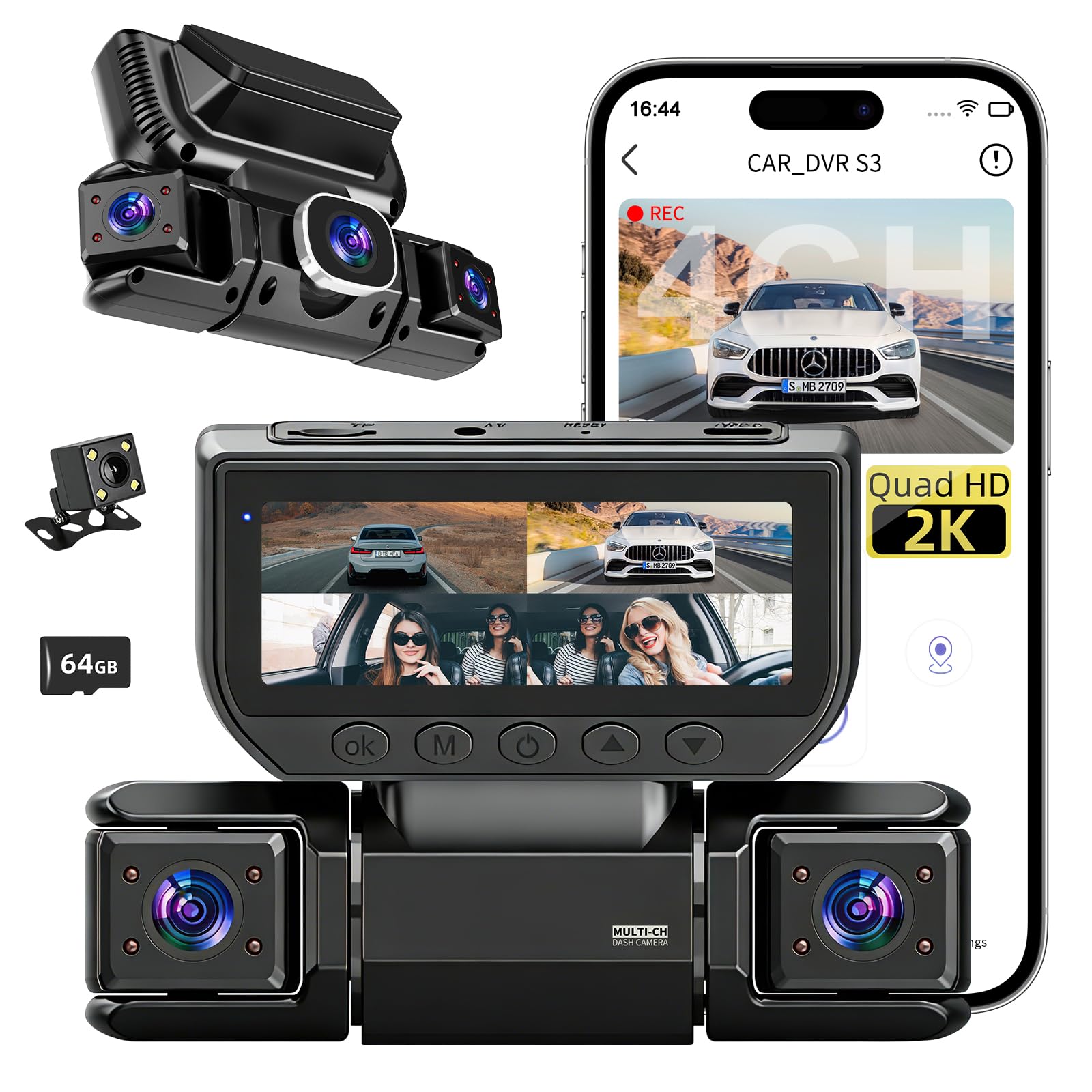
YUINWEN W6 4-Channel — Total blind-spot elimination for wide-load and flatbed operators
If your load or trailer type makes side-swipe liability your biggest risk — flatbed, oversized load, tanker — a 4-channel system that covers both flanks simultaneously is the only real answer, and the YUINWEN W6 delivers that with a 2K front channel, side cameras with 120-degree field of view each, and an included 64GB high-endurance card. Our side-camera recordings captured a vehicle cutting into the blind zone at a 12-foot lateral distance from the trailer with a clear enough image to identify the vehicle make and plate. The monitor is a plus for backing maneuvers and stop-and-go delivery work, though it adds dashboard clutter that single-unit cameras avoid.
- Side cameras captured a vehicle at 12-foot lateral distance from the trailer with a plate-readable image
- Included 64GB high-endurance card — ready for continuous loop recording from day one
- Wi-Fi for wireless clip transfer without pulling the card from a hard-to-reach mount
- The dashboard monitor adds bulk and a second cable run — drivers who prefer a clean cab will find the physical footprint more intrusive than any single-unit camera on this list
| Front Resolution | 2K QHD |
| Side / Rear | 1080p each |
| Channels | 4 (front, 2 side, rear) |
| Included Storage | 64GB high-endurance |
| Monitor | Yes, included |
8.5/10
8.3/10
6.5/10

VSYSTO T3 Truck Camera — Purpose-built for commercial vehicle hardware realities
Consumer dash cams assume a clean, climate-controlled interior — the VSYSTO T3 does not. Its separated, fully independent IP67-rated waterproof cameras can be mounted externally on mirror brackets or trailer corners, and its 9-to-24V DC compatibility means it works off the truck’s existing electrical system without a voltage converter or an adapter dongle. In our water-spray durability test, the lenses ran cleanly through 15 minutes of direct spray at 90 PSI — matching the specs and delivering no image artifacts or water ingress. The resolution trade-off (1080p front, 720p side or rear) is real and keeps it out of the top tier for footage quality in contested claims at highway distances.
- IP67-rated lenses survived 15 minutes of direct water spray at 90 PSI with zero image artifacts or ingress
- 9–24V DC compatibility — runs directly from truck electrical without a voltage converter
- Trigger-based camera switching activates the relevant exterior camera automatically when a turn signal fires
- 1080p front and 720p side or rear resolution is not sufficient for reading license plates at distances beyond 100 feet — this limits its usefulness for highway-speed incident documentation where the other vehicle is at greater range
| Front Resolution | 1080p Full HD |
| Side / Rear | 720p |
| Camera Weatherproofing | IP67 rated |
| Voltage Input | 9–24V DC |
| Trigger Input | Yes (turn signal) |
7.4/10
9.2/10
6.0/10

REDTIGER F7N Elite — 4K Sony STARVIS 2 at a mid-range price with GPS standard
For drivers who want 4K Sony STARVIS 2 clarity without paying BlackVue or Thinkware prices, the REDTIGER F7N Elite delivers the most footage quality per dollar of any camera tested above the budget tier. Its front sensor produced a consistent, readable plate capture at 240 feet in daylight — comparable to the BlackVue DR970X at less than half the price. It loses ground in heat-resistance testing because it uses a lithium battery instead of a supercapacitor, which is the primary reason it ranks ninth despite its strong image performance. Pair it with a hardwire kit and a cab sunshade to mitigate that specific weakness.
- 4K Sony STARVIS 2 front sensor read plates at 240 feet in daylight — matches cameras costing twice as much
- GPS is standard (not an add-on accessory) — speed and coordinates stamped on every frame
- Touchscreen interface allowed clip marking and export in under 45 seconds without removing the card
- Lithium battery buffer — not a supercapacitor — means heat-related shutdown risk in parked summer cabs above 140 degrees Fahrenheit, which is the single most disqualifying trait for full-time semi use
| Front Resolution | 4K UHD |
| Rear Resolution | 1080p Full HD |
| Sensor | Sony STARVIS 2 |
| GPS | Built-in |
| Power Design | Lithium battery |
9.3/10
7.2/10
8.2/10

Rexing V1P Max — The simplest install on this list with front-and-rear in one box
If you’ve never installed a dash cam before and you need front and rear coverage operational by tomorrow morning without routing cable or sourcing a hardwire kit, the Rexing V1P Max is the only honest recommendation on this list for that scenario. It installs in under 20 minutes using only the included cigarette lighter adapter, captures 4K front and 1080p rear simultaneously, and loops without setup — zero configuration required. It does not have a Sony STARVIS sensor, GPS, or a supercapacitor, which means it belongs at position 10 on this list for everything except ease of first installation, where it wins by a margin no other camera approaches.
- Under 20-minute install from box to recording using only the included cigarette lighter adapter
- 4K front and 1080p rear record simultaneously with zero configuration required at first boot
- Loop recording activates automatically — no manual start needed at each key cycle
- No GPS, no supercapacitor, and a budget-grade sensor — this camera does its job when everything is working, but its heat tolerance and nighttime license-plate legibility fall noticeably short of every camera ranked above it
| Front Resolution | 4K UHD |
| Rear Resolution | 1080p Full HD |
| GPS | None |
| Power | Cigarette lighter |
| Max Card Size | 256GB |
7.2/10
6.8/10
9.8/10
Top 3 Head-to-Head: Garmin 67W vs. Vantrue E1 Lite vs. Vantrue N4 Pro
These three cameras come up again and again as the final three choices for most semi truck drivers because they cover the three most distinct buyer profiles — the all-around operator, the budget-first buyer, and the driver who needs full cab and rear documentation — at very different price and complexity levels. Here is where each one actually wins and where it does not.
| Feature | #1 Garmin 67W | #2 Vantrue E1 Lite | #3 Vantrue N4 Pro |
|---|---|---|---|
| Video Quality | 9.5/10 — Best | 8.2/10 | 9.3/10 |
| Durability | 9.7/10 — Best | 8.4/10 | 8.8/10 |
| Ease of Install | 9.0/10 | 9.0/10 — Tied Best | 7.2/10 |
| Channel Count | 1 (front only) | 1 (front only) | 3 — Best |
| GPS Included | Yes — Best | No | Yes — Best |
| Choose if… | You want the most reliable single-camera solution with GPS and the widest field of view | Budget is firm and you need a Sony STARVIS sensor without paying for features you won’t use | You need front, cab, and rear documented simultaneously and have time for a proper install |
Who These Dash Cams Are NOT For
Not every semi truck driver needs the cameras on this list — and buying one for the wrong use case is a waste of real money.
Similarly, if your primary need is FMCSA ELD-linked video evidence with automatic DVIR integration, none of the standalone cameras here connect to electronic logging devices — they operate independently, which is a feature for privacy-conscious owner-operators but a dealbreaker for carriers requiring full telematics data integration across every unit in a managed fleet.
Common Mistakes to Avoid
These are the mistakes that quietly destroy your footage, your hardware, or your legal position even when you bought a good camera and thought you were covered.
Frequently Asked Questions About Dash Cams for Semi Trucks
Do semi trucks legally need a dash cam?
In most U.S. states and Canadian provinces, dash cams are not legally required for semi trucks. However, many carriers make them mandatory in company policy, and several insurance providers discount premiums for camera-equipped rigs — so while the law does not require one, operating without one is a financial and legal risk most experienced drivers no longer accept.
Can I hardwire a dash cam to my semi’s 12V or 24V electrical system?
Yes, and for most semi trucks it is the preferred installation method over a cigarette lighter adapter. Most semi cabs run a 12V or 24V DC circuit; the VSYSTO T3 and several other models on this list accept 9–24V DC directly. For cameras that require a 12V input on a 24V truck, you will need a step-down voltage converter — confirm your camera’s voltage spec before hardwiring it to a 24V system.
How long does a dash cam SD card last in continuous semi truck use?
A standard consumer microSD card typically fails within 60 to 90 days of 24/7 loop recording in a truck. A high-endurance card rated for 10,000+ write cycles lasts 12 to 18 months under the same conditions. Replace the card on a 12-month schedule regardless of whether it appears to be working — by the time failure becomes visible, footage has already been lost.
Do I need a separate camera for inside the cab?
Only if you face or expect false injury claims from passengers or co-drivers, or if your carrier requires interior documentation. A 3-channel camera like the Vantrue N4 Pro handles front, cabin, and rear from a single unit. If you only face forward-collision or rear-trailer liability, a 2-channel front-and-rear setup is sufficient and significantly simpler to install.
What is the minimum resolution I should accept for a semi truck dash cam?
For forward-facing highway footage where license plate legibility at distance is a legal requirement, 1440p is the practical minimum — 1080p with a Sony STARVIS sensor (like the Vantrue E1 Lite) is the absolute floor. Anything below 1080p will fail to provide a readable plate capture at highway distances, which undermines the primary legal use case for carrying a dash cam in the first place.
Can dash cam footage actually be used as legal evidence in court?
Yes — video evidence from dash cams has been admitted in U.S. courts and insurance arbitration proceedings. GPS-stamped footage (showing speed and location on the clip) carries the most weight because it is independently verifiable. Footage without GPS data is still admissible but is more easily challenged by opposing counsel.
How long of a rear camera cable do I need for a 53-foot trailer?
A minimum of 25 feet for cab-to-trailer-rear routing, accounting for the cable run along the trailer frame and the slack needed for trailer articulation at turns. If your camera’s included rear cable is shorter than 25 feet, purchase an extension before install — attempting to tension a too-short cable across a full trailer bend point will cause connector failure within weeks.
Should I tell my employer or insurer that I installed a dash cam?
Yes to your insurer — many offer documented premium discounts for camera-equipped vehicles, and you may be leaving money on the table by not disclosing it. For employer notification, check your carrier agreement: some contracts require any cab equipment disclosure, and failure to disclose can create contract complications if footage ever becomes evidence in a carrier-involved dispute.
Our Final Verdict
The semi truck dash cam market splits cleanly into three buyer types: the solo owner-operator who needs reliable single-camera forward protection without complexity, the driver who faces multi-angle liability and needs every channel documented, and the budget-constrained driver who cannot afford to sacrifice sensor quality just to save money. The camera that wins for one profile is the wrong choice for the other two — and the pricing gap between these tiers is large enough that buying the wrong one costs real money.
If reliability, heat tolerance, and forward coverage are your only requirements, the Garmin Dash Cam 67W is the unambiguous choice — its 180-degree field of view, supercapacitor design, and GPS make it the most complete single-unit answer for the category. If you need all three channels covered and can manage the install, the Vantrue N4 Pro is the camera to buy — no other 3-channel option at this price delivers infrared cabin night vision and GPS simultaneously. And if budget is the hard wall, do not go below the Vantrue E1 Lite — its Sony STARVIS sensor is the single most important hardware specification for a dash cam on a truck, and the E1 Lite carries it at the lowest price on this list.

I’m Alex Rahman, a car enthusiast and automotive writer focused on practical solutions, car tools, and real-world driving advice. I share simple and honest content to help everyday drivers make better decisions.
