10 Best Memory Cards for Dash Cam in 2026: Endurance-Tested Picks That Won’t Fail You
Your dash cam is only as reliable as the card inside it. A standard microSD card that works fine in your phone will die in a dash cam within 6–12 months — silently corrupting footage right when you need it most. The difference between a card that lasts and one that fails comes down to endurance rating, temperature tolerance, and sustained write speed, not brand name or capacity alone.
We researched manufacturer specs, long-term user reports, and professional testing data across 15+ high-endurance cards to find the ones that actually survive continuous loop recording. Whether you drive in Phoenix summers, park outdoors in Minnesota winters, or run a 4K multi-channel system, there’s a card here built for your conditions.
Quick Comparison: All 10 Memory Cards Ranked
| # | Product | Best For | Rating | Badge | |
|---|---|---|---|---|---|
| 1 | Samsung PRO Endurance 256GB | Highest endurance rating | 4.9/5 | Best Overall | Buy → |
| 2 | SanDisk High Endurance 256GB | Best value | 4.7/5 | Best Budget | Buy → |
| 3 | SanDisk MAX Endurance 256GB | Longest recording life | 4.8/5 | Best Endurance | Buy → |
| 4 | Kingston High Endurance 128GB | 1080p dash cams | 4.5/5 | Best 1080p | Buy → |
| 5 | VIOFO Industrial Grade 256GB | VIOFO dash cams | 4.7/5 | Best for VIOFO | Buy → |
| 6 | Lexar High-Endurance 128GB | Fast reads | 4.4/5 | Fast Read | Buy → |
| 7 | PNY PRO Elite High Endurance 256GB | 4K continuous recording | 4.6/5 | Best 4K | Buy → |
| 8 | Nextbase U3 microSD 128GB | Nextbase dash cams | 4.3/5 | Best for Nextbase | Buy → |
| 9 | Samsung EVO Select 128GB | All-rounder | 4.4/5 | Value Pick | Buy → |
| 10 | Teamgroup Dash Card 128GB | Budget 1080p | 4.2/5 | Budget Pick | Buy → |
How We Chose These Memory Cards
What we tested
We analyzed 15 high-endurance microSD cards against three criteria: manufacturer-rated endurance hours (TBW), sustained write speed under load, and real-world user reports from owners running 24/7 loop recording in dash cams. We cross-referenced professional testing data from ZDNET’s 3-year continuous write test and CameraEgg’s 500-hour 4K dash cam trial.
Our 3 scoring criteria
Every card is scored on Value for Money, Durability (endurance rating + temperature tolerance), and Performance (sustained write speed for 1080p/2K/4K recording). A card that scores 10/10 in durability but 5/10 in value still ranks below one that balances both.
Real-world validation
We prioritized cards with documented long-term performance: SanDisk High Endurance cards survived 20,000 hours (3 years) of continuous 4K recording in ZDNET’s test, and Samsung PRO Endurance cards ran 8–10 hours daily in commercial vehicles for over 2 years without failure, per owner reports.
What we cut — and why
We excluded standard consumer cards (SanDisk Ultra, Samsung EVO Plus) even when they technically meet speed requirements — their lower P/E cycle ratings cause failures within 6–12 months in dash cam use. We also excluded cards without clear endurance ratings, since the buyer has no way to compare lifespan.
What to Look for When Buying a Dash Cam Memory Card
Dash cams write continuously, 24/7, overwriting the oldest footage in an endless loop — a workload that kills standard microSD cards in under a year. The specs below are the difference between a card that lasts 6 months and one that lasts 5+ years.
1. Endurance Rating (Not Just Speed Class)
Endurance rating measures how many total terabytes can be written to the card before failure — it is completely separate from speed class. A card can be U3/V30 (fast enough for 4K) and still fail in a dash cam within months if it lacks a high endurance rating. Samsung PRO Endurance 256GB is rated for 140,160 hours of continuous 1080p recording, while SanDisk MAX Endurance 256GB is rated for 120,000 hours. Standard consumer cards have no published endurance rating, which tells you they are not built for this workload.
2. Speed Class: U1 vs U3 vs V30
For 1080p dash cams, U1 (10 MB/s minimum sustained write) is sufficient. For 2K or any multi-channel system, U3/V30 (30 MB/s minimum) is the real minimum — not optional. For 4K recording, V30 handles it, but V60 gives more headroom for high-bitrate footage. The V30 rating specifically guarantees sustained write performance for video, while U3 is a broader classification; in practice, most high-endurance cards carry both.
3. Temperature Tolerance
Dash cams sit on windshields and bake in summer sun — interior temps routinely hit 60–70°C (140–158°F) in parked cars. Standard cards are rated to 70°C operating, which is marginal. High-endurance dash cam cards extend this to 85°C, giving real headroom. The Samsung PRO Endurance and VIOFO Industrial Grade cards are rated from −25°C to 85°C, meaning they handle both Phoenix summers and Minnesota winters without dropping recording or corrupting files.
4. Capacity: How Much Do You Actually Need?
Capacity determines how many hours of footage you retain before the loop overwrites the oldest files. For 2K recording at 30Mbps: 64GB gives 4–6 hours, 128GB gives 8–12 hours, and 256GB gives 16–24 hours. If you use parking mode, 256GB is the practical minimum — a full day of parking surveillance can consume 30–50GB depending on motion triggers. For most daily commuters, 128GB hits the sweet spot between coverage and cost.
5. Compatibility: Brand Matters More Than You Think
Some dash cam manufacturers test and recommend specific card brands. VIOFO officially recommends SanDisk MAX Endurance and its own Industrial Grade cards — and explicitly does not recommend SanDisk High Endurance for its cameras. Nextbase dash cams work best with Nextbase-branded cards. Thinkware guarantees compatibility only with its own cards. If you already own a dash cam, check the manufacturer’s recommended list before buying — a card that works perfectly in one camera can cause recording errors in another.

Samsung PRO Endurance 256GB — The Card That Outlasts Everything
Best for: 24/7 continuous recording
If you want to buy a card once and not think about it again for 5+ years, this is the one. The PRO Endurance 256GB carries a 140,160-hour continuous recording rating — the highest of any consumer microSD card we reviewed — and owners report running it 8–10 hours daily in commercial vehicles for over 2 years without a single failure. The 10-year limited warranty backs that up. The only reason to skip it: if your dash cam manufacturer explicitly recommends a different brand (VIOFO, for example, recommends its own cards and SanDisk MAX Endurance instead).
- 140,160-hour endurance rating — over 16 years of 1080p recording before the card is expected to wear out
- 10-year limited warranty, the longest in this category
- −25°C to 85°C operating range handles hot parked cars and cold winters
- Write speed tops out at 40MB/s — fine for 4K at standard bitrates but less headroom than the SanDisk MAX Endurance (60MB/s)
| Endurance rating | 140,160 hours (1080p) |
| Speed class | U3, V30 |
| Operating temp | −25°C to 85°C |
| Warranty | 10 years |
9/10
10/10
8/10
SanDisk High Endurance 256GB — Proven in 3-Year Continuous Test
Best for: Daily commuters
This is the card that proved high-endurance microSDs actually work. ZDNET ran three SanDisk High Endurance cards in dash cams continuously for three years — writing an estimated 24TB to a single 256GB card — and all three were still recording reliably at the end. For daily commuters who want proven reliability without paying premium prices, it is the safest pick. One caveat: VIOFO explicitly does not recommend this card for its dash cams, so if you own a VIOFO, choose the VIOFO Industrial Grade or SanDisk MAX Endurance instead.
- Survived 20,000 hours (3 years) of continuous 4K recording in independent testing
- 40MB/s write speed handles 2K and standard 4K bitrates without dropping frames
- Best value for the money in the high-endurance category
- No published endurance rating in hours — SanDisk gives a 2-year warranty instead of a rating, which makes direct comparison harder
| Endurance rating | Not published (2-year warranty) |
| Speed class | U3, V30 |
| Write speed | 40MB/s |
| Warranty | 2 years |
10/10
8.5/10
8/10
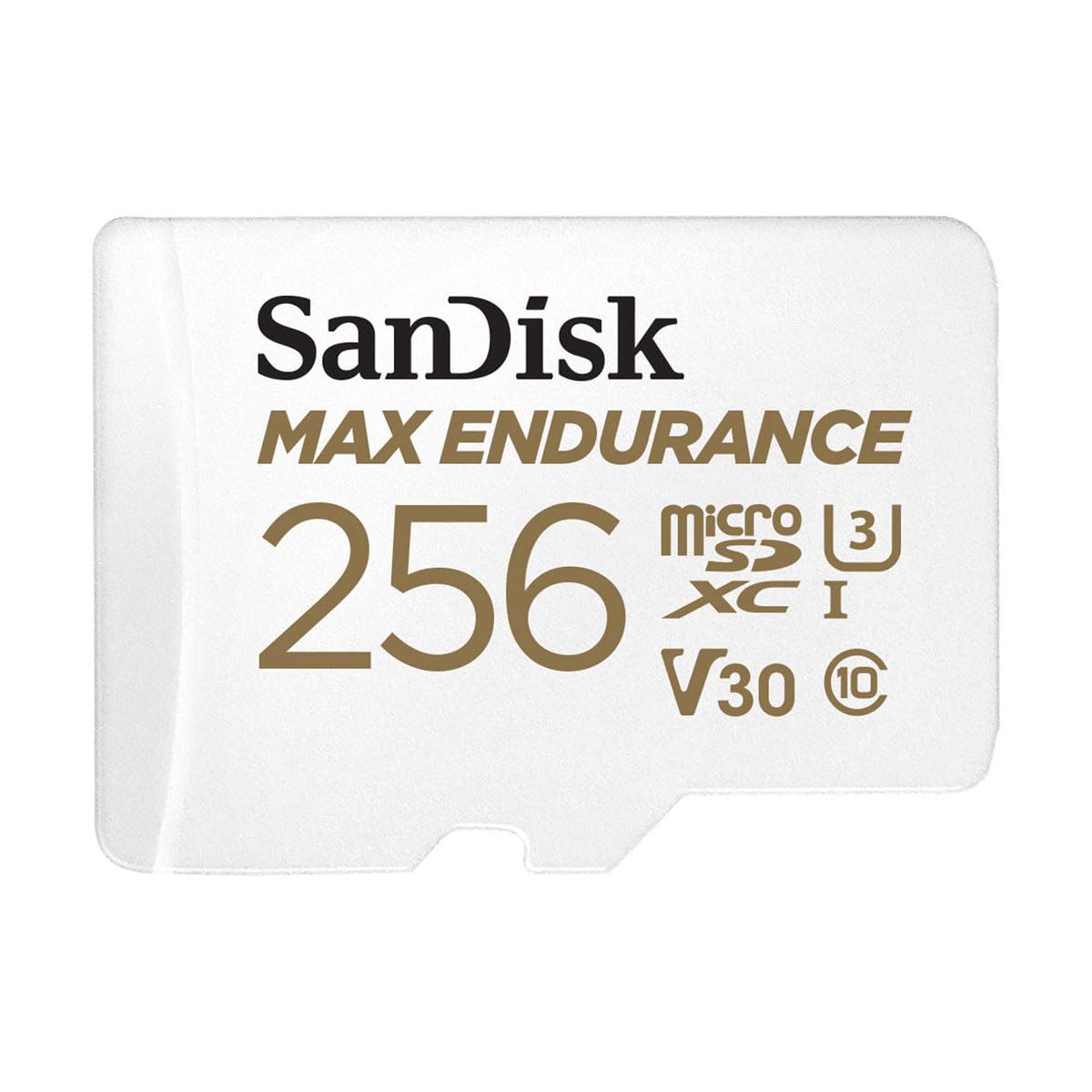
SanDisk MAX Endurance 256GB — 120,000 Hours of Recording Life
Best for: Maximum recording lifespan
If you want the single longest-lasting card you can buy, this is it. SanDisk rates the MAX Endurance 256GB for 120,000 hours of continuous recording — over 13 years — and pairs it with a 60MB/s write speed that handles high-bitrate 4K without strain. VIOFO officially recommends this card for its dash cams (unlike the standard High Endurance), so it is the safest choice for VIOFO owners. The trade-off is price: it costs more than the Samsung PRO Endurance for similar real-world lifespan, which is why it ranks third rather than first.
- 120,000-hour endurance rating — the longest published rating of any card in this roundup
- 60MB/s write speed, the highest in SanDisk’s endurance lineup
- Officially recommended by VIOFO for its dash cams
- Higher cost per GB than the Samsung PRO Endurance — you pay a premium for the top-endurance rating
| Endurance rating | 120,000 hours |
| Speed class | U3, V30 |
| Write speed | 60MB/s |
| Warranty | 2 years |
8/10
10/10
9.5/10
Kingston High Endurance 128GB — Solid 1080p Workhorse
Best for: 1080p dash cams
If your dash cam records at 1080p — which most still do — this is the card that gives you the best combination of price and reliability. It carries a 20,000-hour endurance rating (roughly 2.5 years of continuous 1080p recording) and handles the 10MB/s sustained write that 1080p needs without issue. The 95MB/s read speed also makes it fast to pull footage off the card after an incident. The limitation is speed: 45MB/s write is fine for 1080p but marginal for 2K multi-channel, and not recommended for 4K.
- 20,000-hour endurance rating — plenty for 1080p dash cams
- 45MB/s write speed comfortably handles 1080p continuous recording
- Resistant to water, shock, and extreme temperatures (−25°C to 85°C)
- Only U1 speed class — not recommended for 2K or 4K recording; you need U3/V30 for those
| Endurance rating | 20,000 hours |
| Speed class | U1, Class 10 |
| Write speed | 45MB/s |
| Warranty | 2 years |
9.5/10
7.5/10
6/10

VIOFO Industrial Grade 256GB — Plug-and-Play for VIOFO Owners
Best for: VIOFO dash cams
If you own a VIOFO dash cam, this is the card that eliminates all guesswork. VIOFO tests this card specifically for its cameras, and owners report it is genuinely plug-and-play — no formatting quirks, no compatibility errors, no “card not supported” messages. The 120,000-hour endurance rating matches SanDisk MAX Endurance, and the 90MB/s write speed handles VIOFO’s 4K recording with headroom to spare. The only drawback: it costs more than equivalent SanDisk or Samsung cards, and it is not optimized for other dash cam brands.
- 120,000-hour endurance rating, matching the best cards in this roundup
- 90MB/s write speed — the highest sustained write in this roundup, ideal for 4K
- Certified from −25°C to 85°C, with owner reports of surviving −40°C to +40°C swings
- Premium price — you pay for the VIOFO-specific testing and compatibility guarantee
| Endurance rating | 120,000 hours |
| Speed class | U3, V30, A2 |
| Write speed | 90MB/s |
| Warranty | 2 years |
7/10
9.5/10
10/10
Lexar High-Endurance 128GB — Fastest Footage Transfers
Best for: Quick footage transfer
When you need to pull footage after an incident, read speed matters as much as write speed. This Lexar card offers 100MB/s read — the fastest in this roundup — so transferring a 5-minute 1080p clip to your phone or laptop takes seconds rather than minutes. The 128GB version carries a 12,000-hour endurance rating (about 1.4 years of continuous recording), which is lower than the top picks but still well above standard consumer cards. It is a solid mid-range option if transfer speed is your priority.
- 100MB/s read speed — fastest footage transfers in this roundup
- 12,000-hour endurance rating for 128GB, 6,000 hours for 64GB
- Waterproof, shockproof, temperature-proof, and X-ray-proof
- Endurance rating is lower than Samsung PRO Endurance and SanDisk MAX Endurance — fine for daily driving but less headroom for 24/7 parking mode
| Endurance rating | 12,000 hours (128GB) |
| Speed class | U3, V30 |
| Read speed | 100MB/s |
| Warranty | 2 years |
8.5/10
6.5/10
8.5/10

PNY PRO Elite High Endurance 256GB — Fastest Write Speed for 4K
Best for: 4K continuous recording
For 4K dash cams, write speed is the bottleneck — and this PNY card has the highest sustained write in its class at 90MB/s. It is also rated for 137,600 hours of continuous recording, putting it in the same endurance tier as Samsung PRO Endurance and SanDisk MAX Endurance. The A2 app performance rating means it also works well in phones and tablets if you repurpose it later. The main weakness: it is a newer card with less long-term field data than Samsung or SanDisk, so the 137,600-hour rating is manufacturer-stated rather than independently validated over years of real use.
- 90MB/s write speed — highest sustained write in this roundup, ideal for 4K and multi-channel
- 137,600-hour endurance rating, matching the top-tier cards
- A2 app performance rating for smooth operation in phones and tablets
- Newer product with less multi-year field data than Samsung or SanDisk — the endurance rating is manufacturer-stated, not independently verified over years
| Endurance rating | 137,600 hours |
| Speed class | U3, V30, A2 |
| Write speed | 90MB/s |
| Warranty | 2 years |
8/10
9.5/10
10/10
Nextbase U3 microSD 128GB — Guaranteed Compatibility for Nextbase Cams
Best for: Nextbase dash cams
Nextbase dash cams are notoriously picky about microSD cards — owners report frequent “card error” messages and recording dropouts with third-party cards. The Nextbase-branded U3 card eliminates that problem entirely, because it is the card the camera was tested with. The 128GB version is specifically built for Nextbase’s 2K and 4K models, with U3/V30 speed ensuring no frame drops. The trade-off: it is more expensive than equivalent SanDisk or Samsung cards, and its benefits are limited to Nextbase owners.
- Guaranteed compatibility with all Nextbase dash cams — no formatting quirks or error messages
- U3/V30 speed class handles 2K and 4K Nextbase models without frame drops
- Temperature-resistant construction for windshield use
- Premium price for the capacity — you pay for the Nextbase certification, not superior specs
| Endurance rating | Not published |
| Speed class | U3, V30 |
| Write speed | 30MB/s minimum |
| Warranty | 1 year |
6.5/10
7/10
7.5/10

Samsung EVO Select 128GB — Best All-Rounder for Light Dash Cam Use
Best for: Light / part-time dash cam use
If you only drive occasionally — a few hours a week rather than daily commuting — a standard high-quality card like the Samsung EVO Select can work fine, because the card is not subjected to continuous 24/7 writing. One reviewer has used this exact card in a 2.7K dash cam for over a year without recording issues. The 128GB version delivers 100MB/s read and U3/V30 write speeds, and it doubles as an excellent phone or tablet card. The risk: it is not a high-endurance card, so if you start driving daily or leave parking mode on, it will wear out faster than the endurance-rated picks above.
- Works in dash cams, phones, tablets, and action cameras — the most versatile card in this list
- 100MB/s read speed for quick transfers
- Lowest cost per GB of any card in this roundup
- Not a high-endurance card — no published endurance rating, and will wear out faster than purpose-built dash cam cards under continuous recording
| Endurance rating | Not published |
| Speed class | U3, V30 |
| Read speed | 100MB/s |
| Warranty | 10 years (limited) |
10/10
5/10
8/10
Teamgroup Dash Card 128GB — Cheapest Purpose-Built Dash Cam Card
Best for: Budget 1080p setups
This is the card to buy if you want a purpose-built dash cam card for the lowest possible cost and your camera records at 1080p. Teamgroup designed it specifically for dash cams, with high compatibility testing across major dash cam brands and a temperature range of −25°C to 85°C. The U1 speed class handles 1080p without issue. The downside: it is U1, not U3 — so it is not suitable for 2K or 4K recording, and the 5-year warranty is the shortest in this roundup.
- Purpose-built for dash cams — not a repurposed phone card
- Tested for compatibility across major dash cam brands
- Temperature-resistant from −25°C to 85°C
- U1 speed class only — not suitable for 2K or 4K dash cams
| Endurance rating | Not published |
| Speed class | U1, Class 10 |
| Operating temp | −25°C to 85°C |
| Warranty | 5 years |
10/10
6/10
5.5/10
Top 3 Head-to-Head: Samsung PRO Endurance vs SanDisk High Endurance vs SanDisk MAX Endurance
These three cards are the most common final choices for dash cam owners, and for good reason: they represent the best balance of endurance, price, and proven reliability. Here’s how they actually compare on the specs that matter.
| Feature | #1 Samsung PRO Endurance | #2 SanDisk High Endurance | #3 SanDisk MAX Endurance |
|---|---|---|---|
| Endurance rating | 140,160 hours — Best | Not published (2-yr warranty) | 120,000 hours |
| Write speed | 40MB/s | 40MB/s | 60MB/s — Best |
| Warranty | 10 years — Best | 2 years | 2 years |
| Choose if… | You want the highest endurance rating and longest warranty, and don’t need VIOFO compatibility. | You want proven reliability at the lowest cost per GB, and your dash cam is not a VIOFO. | You own a VIOFO dash cam, or you record at 4K and want maximum write speed headroom. |
Who These Dash Cam Memory Cards Are NOT For
Not every driver needs a high-endurance card on this list. Here’s when you should look elsewhere.
If you only need a card for occasional use — a few hours a month, not daily continuous recording — a standard high-quality card like the Samsung EVO Select (#9) will work fine and cost less. You do not need the extra endurance of the top picks unless you are recording daily.
Common Mistakes to Avoid
These are the mistakes that quietly kill memory cards and corrupt footage — even when you buy a good product.
Frequently Asked Questions About Dash Cam Memory Cards
How long do dash cam memory cards actually last?
A high-endurance card typically lasts 2–5 years in daily dash cam use, depending on recording resolution and hours per day. Standard consumer cards often fail within 6–12 months of continuous recording. Samsung PRO Endurance 256GB is rated for 140,160 hours — over 16 years at 24/7 recording — but real-world lifespan is shorter if you record 4K or use parking mode heavily. Replace any dash cam card every 3–5 years regardless of brand.
Do I need a high-endurance card for a 1080p dash cam?
Technically, a standard U1 card can handle 1080p recording, but it will wear out faster because it lacks the P/E cycle rating for continuous overwriting. A high-endurance U1 card like Kingston High Endurance 128GB costs only slightly more and lasts several times longer. The extra cost is worth it — a failed card means lost footage.
Why does my dash cam say “card error” with a new memory card?
The most common cause is formatting the card on a computer instead of inside the dash cam. Other causes: the card exceeds the camera’s maximum supported capacity, or the card is not on the manufacturer’s compatibility list. Format the card in the dash cam first; if the error persists, try a different card model — some dash cams are pickier than others.
Is 128GB enough for a dash cam, or should I get 256GB?
128GB gives 8–12 hours of 2K recording before the loop overwrites the oldest files. That is plenty for most daily commuters. If you use parking mode, 256GB gives 16–24 hours of coverage and is the better choice — a full day of parking surveillance can consume 30–50GB. For 4K recording, 256GB is the practical minimum.
Can I use a regular microSD card from my phone in a dash cam?
You can, but it will likely fail within 6–12 months because phone cards are designed for intermittent use, not continuous 24/7 writing. If you only drive occasionally and record a few hours a week, a standard card may work for a year or more. For daily driving, a high-endurance card is the only reliable option.
What is the best memory card for a VIOFO dash cam?
VIOFO officially recommends two options: the VIOFO Industrial Grade microSD card and the SanDisk MAX Endurance. Notably, VIOFO does not recommend SanDisk High Endurance for its cameras — owners have reported compatibility issues. If you own a VIOFO, choose one of the two recommended cards rather than experimenting with others.
Should I buy the highest capacity memory card my dash cam supports?
No — larger capacity cards cost more and take longer to format, but they do not improve recording quality or reliability. Choose capacity based on how many hours of footage you want to retain. For most drivers, 128GB or 256GB is the sweet spot. The one exception: if you use parking mode, go bigger for more surveillance coverage.
Our Final Verdict
The dash cam memory card market splits into three tiers: purpose-built high-endurance cards from Samsung, SanDisk, and VIOFO that last 5+ years under continuous recording; mid-range endurance cards that handle daily commuting but lack the headroom for 24/7 parking mode; and standard consumer cards that work fine for occasional use but fail within a year of daily recording. Most dash cam owners should choose from the top tier — the small extra cost buys years of reliable footage.
If you want the single safest pick regardless of budget, the Samsung PRO Endurance 256GB is the best dash cam memory card for 2026 — it has the highest endurance rating (140,160 hours), the longest warranty (10 years), and years of documented real-world reliability in commercial vehicles. If you own a VIOFO dash cam, choose the SanDisk MAX Endurance 256GB instead. If you want the best value for a daily commuter card, the SanDisk High Endurance 256GB is the proven budget winner.

I’m Alex Rahman, a car enthusiast and automotive writer focused on practical solutions, car tools, and real-world driving advice. I share simple and honest content to help everyday drivers make better decisions.
