
Baseus VD1 Pro Solar Dash Cam Review: Honest Take
The Baseus VD1 Pro Solar Dash Cam Front and Rear, 4K+1080P Dash Camera for Cars, Battery Powered Parking Mode, Starvis Night Vision, 32 GB Card Included, 5GHz WiFi, GPS, Wide Angle,Voice Control is aimed at drivers who want strong front-and-rear coverage without hardwiring the parking mode.
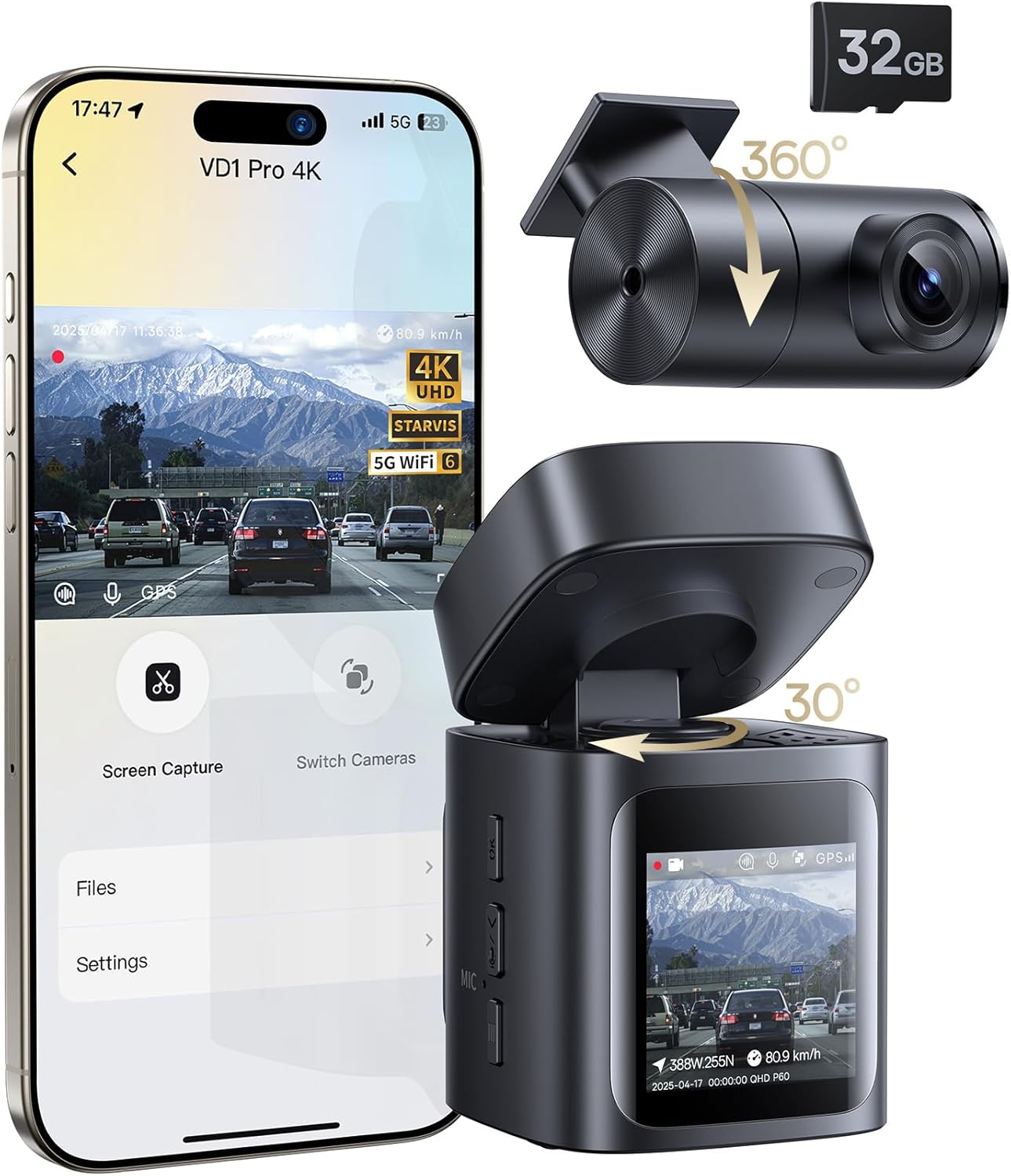
Its best idea is the solar-assisted internal battery for parked-car protection. The catch is important: while driving, the main camera still needs vehicle power, and the rear camera is wired. That makes it clever, but not truly cable-free.
| Overall: 4.0/5 | Performance: 4.2/5 |
| Value: 4.1/5 | Design: 4.0/5 |
|
✅ Best For: Drivers who want parking protection without a hardwire kit. | |
|
❌ Not Ideal For: Anyone expecting fully wireless driving or premium rear-camera detail. | |
|
Price: [confirm current Amazon price] | |
What Arrives in the Box
The package is more complete than many basic dash-cam kits. The confirmed bundle includes the front unit, rear camera with a long cable, car charger with USB-C cable, trim tool, 3M adhesive pad, static cling film, and a 32GB microSD card.
The front unit is compact at about 168 grams and includes a small 1.4-inch display. The adhesive-style windshield setup keeps the camera tidy, but placement matters because you also need the solar panel to see useful daylight. The first setup step I would pay attention to is cable routing, because the “solar” label can make the system sound more wireless than it really is.
How the VD1 Pro Performs
The main value here is not one headline spec. It is the mix of front 4K-class capture, 1080p rear coverage, GPS, Wi-Fi app access, loop recording, and battery-backed parking protection.
Daytime Highway Driving
The front camera is listed at 2160p and uses STARVIS-based imaging. In bright daylight, published testing found detailed, useful footage with good road visibility. Fast-moving plates can still depend on distance, angle, glare, and motion, so I would not treat “4K” as a guarantee that every plate will be readable.
Night City Driving
STARVIS night vision and HDR are the right features for streetlights, headlights, and dark side roads. Independent testing rated the video quality strongly, while owner feedback also praises low-light clarity. The rear camera is the weaker link, so expect the front channel to be the one you trust most for fine detail after dark.
Parking-Lot Protection
This is where the VD1 Pro is unusual. Solar charging supports the internal lithium battery used for parking mode, so the camera can watch for impacts without pulling power from the car battery. Baseus advertises up to 14 days of standby-style monitoring, with the G-sensor waking the camera for an event rather than recording continuously.
App and Footage Review
The camera supports 5GHz Wi-Fi and Baseus app control for viewing and downloading clips near the vehicle. That is useful when you want evidence on your phone quickly. It is not the same as a 4G cloud dash cam, so do not assume you can watch the car live from home just because Wi-Fi is listed.
Loop Recording and Storage
Loop recording is supported, and a 32GB card is included. That is enough to start using the camera, but higher-resolution front footage can fill small cards quickly. Current sources disagree on the maximum supported card capacity, so use [confirm exact capacity on Amazon listing] before buying a larger card.
Hot-Weather Use
Heat is worth watching with any battery-equipped dash cam. Baseus says the unit has high-temperature protection, yet some customer feedback reports overheating and shutdowns in hot cars. A windshield shade and sensible placement may help, but drivers in very hot climates should treat battery heat as a real buying consideration.
Daily Ownership Feel
On a normal drive, the routine is simple: power the front camera from the car, let it record automatically, and use the app only when you need settings or footage. GPS and voice control reduce the need to touch the unit while driving.
The biggest daily annoyance is expectation management. The solar panel does not make normal driving cable-free, and the rear camera still needs its cable. Some users also report app friction, occasional file issues, or heat-related shutdowns, so I would check important clips after installation instead of assuming everything is perfect.
Compact Design, Real Cables
The front unit is small enough to sit near the rear-view mirror without taking over the windshield. Its compact body, screen, GPS, battery, and solar-assisted mount pack a lot into a small footprint.
| Detail | What to Know |
| Weight | 168 g |
| Display | 1.4-inch LCD |
| Front view | 140° listed spec |
| Mount | Dashboard/windshield style |
| Power | Car power while driving |
The finish looks modern rather than bulky. Still, the rear cable and front power lead need careful routing for a clean install. I would also clean the windshield well before applying the adhesive so vibration and summer heat do not weaken the mount.
Video Quality After Dark
Daylight footage is the strongest part of the system. The front camera has enough resolution and dynamic range for general accident evidence, road signs, and surrounding traffic, while HDR helps when a bright sky and darker road appear in the same frame.
At night, STARVIS improves low-light usefulness, but glare, rain, dirty glass, and fast motion still matter. The rear 1080p camera cannot match the front for fine detail. If rear plate capture is a top priority, a higher-resolution rear system may suit you better.
Keeping It Reliable
Dash cams need small maintenance habits. A clean lens, healthy memory card, secure cables, and occasional footage checks matter more than fancy menu settings.
| Task | Practical Routine |
| Front lens | Wipe when dusty |
| Rear lens | Check after rain/dirt |
| microSD | Review and format regularly |
| Mount | Check adhesive in heat |
| Cables | Inspect bends and plugs |
The included 32GB card is convenient for setup. For long-term use, choose an endurance-rated card that matches the confirmed capacity limit. If you reposition the adhesive mount, use fresh adhesive rather than trusting a pad that has already been heated and removed.
VD1 Pro Pros and Cons
The VD1 Pro has a genuinely useful parking-power idea, but the marketing can make the wiring situation sound simpler than it is.
| Pros | Cons |
|
|
How It Compares
The VD1 Pro makes most sense against other premium connected dash cams, but its special advantage is parking mode without a hardwire kit.
VIOFO A229 Pro 2CH
VIOFO’s A229 Pro 2CH records 4K front plus 2K rear with dual STARVIS 2 sensors, 5GHz Wi-Fi, GPS, HDR, and buffered parking modes. Its rear footage is stronger on paper, but parking mode normally needs a separate hardwire kit.
Vantrue N4 Pro
The Vantrue N4 Pro adds a cabin camera, giving 4K front plus 1080p cabin and 1080p rear recording. It also offers 5GHz Wi-Fi, GPS, voice control, and several parking modes, but it is a larger, more complex setup.
| Model | Main Strength | Trade-Off |
| Baseus VD1 Pro | Hardwire-free parking | 1080p rear |
| VIOFO A229 Pro 2CH | 4K + 2K quality | Hardwire for parking |
| Vantrue N4 Pro | Three-channel coverage | Bigger setup |
Who Should Buy It?
The VD1 Pro fits drivers who value parked-car protection and easy installation more than maximum rear-camera resolution.
Buy This If
- You want parking mode without hardwiring.
- You want front and rear recording.
- You value GPS, Wi-Fi, and voice control.
- You prefer a compact front unit.
Avoid This If
- You expect fully wireless driving.
- You need 2K or 4K rear footage.
- You park in severe heat every day.
What About Long-Term Durability?
The camera uses a lithium battery, so heat management matters more than with a super-capacitor dash cam. Adhesive strength, cable condition, and memory-card health will also affect reliability over time.
Baseus includes temperature protection, but I would still avoid leaving the lens and battery module baking in direct sun when a shade is practical. Check saved files every few weeks. A dash cam can look normal while a failing card quietly creates missing or corrupted clips.
Power and Installation Reality
The headline benefit is simple: parking mode does not need a hardwire kit. The internal battery and solar panel handle standby parking protection, which avoids parasitic drain from the vehicle battery.
Driving is different. The front camera must stay connected to car power, and the rear camera uses a wired link. Installation is still easier than fuse-box hardwiring, but you should plan time for hiding the rear cable around trim and routing the front power lead cleanly.
Common Questions
These are the practical questions that matter most before buying the Baseus VD1 Pro.
Does the Baseus VD1 Pro need hardwiring?
No hardwire kit is required for its battery-backed parking mode. However, the front camera still needs car power while driving, and the rear camera is wired.
Does the solar panel power driving recording?
No. Baseus says solar and battery power support parking-mode operation, not normal driving recording. Keep the dash cam connected to vehicle power while you drive.
Can I view VD1 Pro footage on my phone?
Yes. The camera supports 5GHz Wi-Fi and Baseus app control for local viewing, playback, and downloads. Wi-Fi does not mean remote live viewing from anywhere.
What memory card comes with it?
A 32GB microSD card is included. The maximum supported expansion capacity is inconsistent across current sources, so confirm the exact Amazon listing or current manual before ordering a larger card.
Is the rear camera also 4K?
No. The system is listed as 4K-class/2160p front and 1080p rear. If rear detail is as important as front detail, compare it with a 2K rear-camera system.
|
Verdict: A smart choice for easy parking protection, as long as you understand the driving cables. |
|
Price: [confirm current Amazon price] |
|
Amazon rating snapshot: 3.8/5 from 387 customer reviews. |
Final Verdict on the VD1 Pro
The Baseus VD1 Pro stands out because it solves a real parking-mode problem. You can get impact-triggered protection without opening the fuse box or worrying about the dash cam slowly draining the car battery. The front video, GPS, 5GHz Wi-Fi, voice control, and included card make the package feel complete.
The trade-offs are just as clear. It is not fully wireless while driving, the rear camera is only 1080p, and battery heat deserves attention. If those limits do not bother you, the VD1 Pro is a practical, feature-rich option with a parking setup that is easier than most rivals.

I’m Alex Rahman, a car enthusiast and automotive writer focused on practical solutions, car tools, and real-world driving advice. I share simple and honest content to help everyday drivers make better decisions.
