Should I Have a Jump Starter in My Car?
Yes, you should have a portable jump starter in your car. A dead battery can strand you anywhere, anytime — even in a parking lot with no one around to help. A compact lithium jump starter fits in your glove box, works without another vehicle, and can get you back on the road in under two minutes. It is one of the most practical safety tools you can carry.
I am Alex Rahman, and I found out the hard way why every driver needs a portable jump starter. A few years ago, I walked out of a grocery store on a cold Tuesday evening to find my car completely dead. No warning, no slow crank — just silence. I had jumper cables in the trunk, but the parking lot was nearly empty, and the one person I flagged down had no idea how to use them safely. We sat there for 45 minutes waiting for roadside assistance.
That night cost me time, stress, and a $75 service call. A jump starter would have cost me less and saved all of it. Since then, I have tested and researched portable jump starters extensively. The question “should I have a jump starter in my car?” sounds simple, but the real answer involves understanding what these devices do, which type suits your vehicle, and how to use one correctly when it matters most.
Let me break all of that down for you in plain language.
- A portable jump starter lets you restart a dead battery without another vehicle or another person.
- Lithium-ion jump starters are compact, lightweight, and powerful enough for most cars and light trucks.
- Car batteries typically last 3 to 5 years; a jump starter is the cheapest insurance against a bad one stranding you.
- Modern units include spark-proof clamps, reverse polarity protection, and USB charging ports for everyday utility.
- You only need to recharge a quality jump starter every 3 to 6 months to keep it ready.
What Is a Portable Jump Starter and How Does It Work?
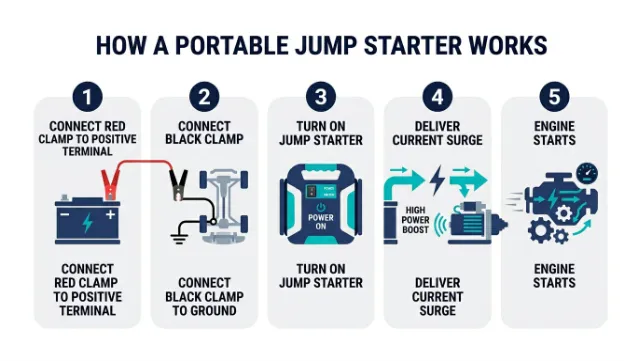
A portable jump starter is a self-contained battery pack with built-in jumper cables. You connect the clamps to your dead car battery — red to positive, black to negative — and the device delivers a surge of current powerful enough to start the engine. No second car needed.
Modern jump starters use lithium-ion battery technology, the same chemistry found in smartphones and laptops. This makes them dramatically lighter and more compact than the old lead-acid booster packs you may remember from gas stations. A lithium jump starter that fits in your jacket pocket can deliver 1,000 amps of starting power — enough to restart most passenger vehicles multiple times on a single charge.
NOCO (a Cleveland-based company founded in 1914) pioneered the consumer-grade lithium jump starter category and remains one of the most trusted names in this space. Their UltraSafe technology introduced spark-proof clamp connections that prevent accidental shorts — a major safety improvement over traditional jumper cables.
Lithium jump starters are sensitive to extreme heat. Store yours in the passenger compartment or trunk away from direct sun exposure, especially during summer months. Temperatures above 140°F can degrade battery life.
Why Your Car Battery Dies (And Why It Happens Without Warning)
Understanding why batteries fail helps you appreciate why a jump starter is so valuable. The short answer: car batteries degrade gradually, then fail suddenly.
Most automotive lead-acid batteries last between 3 and 5 years. Heat accelerates internal plate corrosion. Cold reduces the battery’s ability to deliver current — that is why dead batteries cluster in winter mornings. Each charge-discharge cycle slightly diminishes capacity, and once a battery drops below a threshold, a single accessory left on overnight can kill it completely.
Common causes of a dead car battery include:
- Leaving interior lights, headlights, or the radio on with the engine off
- Parasitic drain from aftermarket electronics or a faulty alternator
- Extreme cold reducing cranking capacity below the engine’s starting requirement
- An aging battery that simply reached the end of its service life
- Short trips that do not allow the alternator to fully recharge the battery
The frustrating part is that none of these give you obvious advance warning. A battery can test fine at 70°F and fail completely at 20°F two days later. That unpredictability is exactly why having a jump starter in your car makes sense, regardless of how new your vehicle is.
If your battery dies more than twice in a short period, a jump start is only a temporary fix. Get the battery tested at an auto parts store — most do it free. A failing battery that keeps depleting may also indicate an alternator problem that needs professional diagnosis.
Jump Starter vs. Jumper Cables: Which Should You Carry?
This is one of the most common questions people ask, and the honest answer is: a jump starter is better for most modern drivers, but jumper cables still have their place.
| Feature | Portable Jump Starter | Jumper Cables |
|---|---|---|
| Requires another vehicle | No | Yes |
| Works alone at night | Yes | No |
| Risk of sparks/short circuit | Very low (modern units) | Moderate if misused |
| Cost | $40–$150+ | $15–$40 |
| Additional uses | Phone charging, flashlight | None |
| Requires maintenance | Recharge every 3–6 months | None |
Jumper cables are cheaper and never need charging. But they are useless if you are stranded alone. A jump starter gives you complete independence — and that independence is worth the extra cost for most drivers.
If budget is tight, carry both. Jumper cables weigh almost nothing and can help someone else who needs a jump when your unit is depleted.
What to Look for When Choosing a Jump Starter
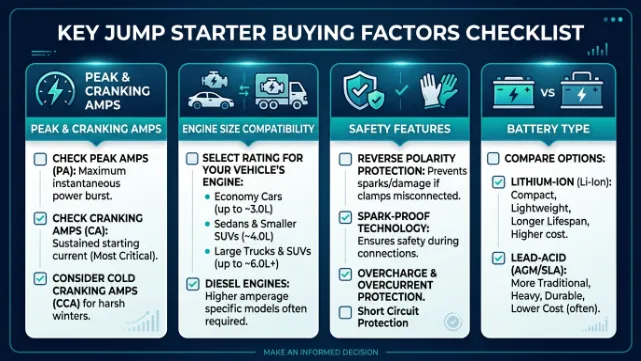
Not all jump starters are equal. Here is what actually matters when shopping for one.
Peak Amps vs. Cranking Amps
Peak amps is the maximum burst a unit can deliver. Cranking amps is the sustained current it maintains during a start. Cranking amps matter more for real-world performance. A unit advertising 2,000 peak amps may have mediocre cranking amps, while a quality 1,000-peak-amp unit from a reputable brand can outperform it consistently.
Engine Size Compatibility
As a general rule:
- Up to 4.0L gas engine: 400–600 amp unit
- Up to 6.0L gas engine: 1,000 amp unit
- Trucks and SUVs with 6.0L+ or diesel engines: 1,500–2,000 amp unit
Safety Features
Reverse polarity protection is non-negotiable. This prevents damage to your car’s electronics if you accidentally connect the clamps backward. Spark-proof technology, short-circuit protection, and over-voltage protection are also worth paying for. Budget units often skip these features to hit a low price point.
Battery Technology
Lithium-ion units are lighter and hold a charge longer in storage — typically 6 to 12 months between top-ups. Older lead-acid booster packs are heavier but more tolerant of temperature extremes. For most drivers, lithium is the better choice.
For a standard passenger car, a 1,000-amp lithium jump starter from a brand with built-in safety protections (like NOCO, Hulkman, or GOOLOO) is the sweet spot between size, power, and price. Truck and SUV owners should step up to a 1,500–2,000 amp unit.
The Best Jump Starter for Most Drivers
After testing and researching over a dozen models, the NOCO Boost GB40 consistently stands out as the best choice for everyday drivers. It delivers 1,000 amps of starting power in a package that weighs just 2.4 pounds. The IP65-rated enclosure means it is sealed against water and dust — important for something stored in a vehicle year-round.
What separates it from cheaper alternatives is the UltraSafe system: the clamps will not deliver current until they are properly connected, making it almost impossible to cause accidental damage. It also doubles as a USB power bank and includes a 100-lumen LED flashlight with an SOS strobe mode.
NOCO Boost GB40: 1000A UltraSafe Jump Starter – 12V Lithium Battery Booster Pack, Portable Jump Box, Power Bank & Jumper Cables – for 6.0L Gas and 3.0L Diesel Engines
This is the jump starter I personally recommend to friends and family — it is compact enough to keep in a glovebox, powerful enough to start most cars and light trucks, and built with safety features that make it nearly impossible to use incorrectly.
How to Use a Portable Jump Starter Safely
Using a jump starter incorrectly can damage your car’s electrical system or, in rare cases, cause a battery to rupture. Follow these steps every time.
- Make sure the jump starter is charged (most units show a battery indicator).
- Turn off the jump starter before connecting any clamps.
- Connect the red clamp to the positive (+) terminal of the dead battery.
- Connect the black clamp to an unpainted metal surface on the engine block — not the negative terminal of the dead battery (this reduces hydrogen gas ignition risk).
- Turn on the jump starter and wait 30 to 60 seconds.
- Attempt to start the vehicle. If it does not start within 3 tries, wait 2 minutes and try again.
- Once the vehicle starts, disconnect the black clamp first, then the red clamp.
- Drive for at least 15–20 minutes to let the alternator partially recharge the battery.
Never attempt to jump-start a frozen battery. A battery that has frozen solid can crack and leak sulfuric acid. If you suspect a frozen battery, bring the vehicle inside to thaw before attempting a jump start. Signs include a cracked or bulging battery case.
Does a Jump Starter Work in Cold Weather?
This is one of the most important questions for drivers in northern climates, and the answer depends on the type of jump starter you own.
Lithium-ion batteries lose capacity in cold temperatures. A jump starter that delivers full power at 70°F may deliver only 60–70% of rated power at 0°F. That said, modern lithium jump starters from quality brands like NOCO and Hulkman are engineered with cold-weather performance in mind. Most handle temperatures down to -4°F (-20°C) reliably.
Lead-acid booster packs actually perform better in cold weather relative to lithium units, but they are much heavier and bulkier. If you live in a region with sustained sub-zero winters, a lead-acid booster pack like the Clore Automotive Jump-N-Carry JNC660 may be worth the extra size and weight.
For most drivers in moderate climates, a quality lithium jump starter stored inside the vehicle (not in an outdoor shed or unheated garage) will handle winter emergencies without issue.
In very cold weather, warm your lithium jump starter inside the car for 10–15 minutes before connecting it to a dead battery. A warmer battery delivers significantly more starting current than a cold one.
How Long Does a Jump Starter Hold Its Charge?
This is the maintenance question most buyers overlook until they need the device and find it dead. Here is the realistic picture:
A quality lithium jump starter will hold 80–90% of its charge for 3 to 6 months in storage at room temperature. If stored in a hot car through summer or a cold garage through winter, self-discharge accelerates. Some units drain faster than others depending on the quality of their battery management system.
The practical rule: charge your jump starter every 3 months, or set a calendar reminder for the first day of each season. Most units fully recharge in 3–4 hours via a standard USB or wall adapter.
If you buy a unit and toss it in your trunk without ever charging it again, there is a real chance it will be dead when you need it most. Maintenance is minimal — a quick top-up four times a year — but it is essential.
A portable jump starter is not a set-it-and-forget-it tool. But with a simple quarterly charging habit, it becomes one of the most reliable pieces of emergency equipment you can carry. That 10-minute investment four times a year could save you hours of waiting and a significant tow bill.
Is a Jump Starter Worth It If I Have Roadside Assistance?
Roadside assistance from AAA, your insurance carrier, or your manufacturer is genuinely valuable — but it has a critical weakness: response time. In urban areas, a service truck may arrive in 30–45 minutes. In rural areas or during peak demand (cold mornings, holiday weekends), wait times of 2–3 hours are common.
A jump starter solves the problem in under two minutes, right now, wherever you are. It does not replace roadside assistance — it is a faster first option that costs you nothing per use once purchased. Most people who carry a jump starter still keep their roadside assistance membership for situations the jump starter cannot solve (flat tires, lockouts, fuel delivery).
For context: a single AAA Plus membership costs roughly $100 per year. A quality jump starter costs $40–$80 and lasts 5–7 years with basic care. The math strongly favors owning both.
Can a Jump Starter Damage My Car?
A quality jump starter with modern safety features will not damage your car when used correctly. The key protections to look for are reverse polarity protection (guards against incorrect clamp placement), over-voltage protection, and spark-proof clamp technology.
Where things go wrong is with cheap, unbranded jump starters that skip safety electronics. A poorly designed unit can send an unregulated voltage spike into your car’s electrical system, potentially damaging the ECU, alternator, or battery management module — especially on modern vehicles with complex electronics.
This is why brand and build quality matters more with jump starters than with many other car accessories. Spending $60 on a reputable unit from NOCO, Hulkman, or GOOLOO is genuinely safer than spending $20 on an unbranded unit from an unknown manufacturer.
According to the National Highway Traffic Safety Administration (NHTSA), improper jump-starting is a documented cause of vehicle electrical fires. Following the correct clamp sequence and using a unit with built-in protections dramatically reduces this risk.
Who Should Definitely Have a Jump Starter in Their Car?
While every driver benefits from carrying one, certain situations make a jump starter essentially mandatory:
- Drivers with older vehicles — batteries over 3 years old have meaningfully higher failure rates
- Drivers in cold climates — cold is the single biggest trigger for sudden battery failure
- Parents with teen drivers — new drivers leave lights on; give them a jump starter when they get their license
- People who drive alone frequently — you cannot rely on a stranger being available to help
- Drivers of older EVs or hybrids with 12V auxiliary batteries — these can die just like any other 12V battery
- Anyone who drives in remote or rural areas — roadside assistance wait times can be extreme
- Delivery drivers and rideshare drivers — a dead battery mid-shift means lost income
For AAA (the American Automobile Association), battery-related calls consistently represent one of the top reasons for roadside assistance requests — accounting for roughly one in three service calls in a typical year. That statistic alone makes the case clearly.
If you are buying a jump starter as a gift for a new driver or elderly family member, choose a model with spark-proof, mistake-proof clamp technology. The NOCO GB40’s UltraSafe system is ideal because the clamps simply will not spark even if connected incorrectly — it removes the biggest source of user error entirely.
What Else Can a Jump Starter Do?
Most modern lithium jump starters do more than start dead batteries. Here is what you typically get beyond the jump-start function:
- USB power bank — charge your phone, tablet, or other USB devices anywhere
- LED flashlight — useful for roadside work in the dark; many units include strobe and SOS modes
- 12V DC output — on larger units, power small appliances or run accessories
- Battery diagnostics — some models (like the TOPDON JS3000) include a built-in battery tester
- Air compressor — larger units like the DeWalt DXAEJ14 include built-in inflators for tire top-ups
The USB power bank function alone makes a jump starter useful every day, not just in emergencies. Many drivers use theirs regularly to charge devices on road trips, which also keeps the internal battery exercised and healthy.
For more guidance on vehicle emergency preparedness, the FEMA Ready.gov vehicle emergency kit guide provides a solid baseline checklist that pairs well with a jump starter.
The best emergency tool is the one you actually have with you. A jump starter is small enough to keep in a glovebox or center console — meaning it is there when you need it, unlike equipment stored at home.
A portable jump starter is a compact, multi-use emergency tool that solves a dead battery instantly, without needing another vehicle or waiting for help. For most drivers, a lithium unit in the 1,000-amp range from a reputable brand costs $40–$80 and lasts for years with minimal maintenance. Charge it quarterly and it will be ready when you need it.
Conclusion
The answer to “should I have a jump starter in my car?” is a straightforward yes. A dead battery is one of the most common and most preventable automotive headaches — and a quality portable jump starter makes it a five-minute inconvenience instead of a two-hour ordeal.
I am Alex Rahman, and after being stranded that cold Tuesday evening with useless jumper cables and no one to help, I have not driven a single mile without a jump starter in my car. The peace of mind alone is worth the modest investment.
You do not need to spend a lot. A reliable unit from NOCO, Hulkman, or GOOLOO in the $50–$80 range will serve most drivers for years. Charge it at the start of each season, store it inside the vehicle, and forget about it — until the one day it saves you completely.
Frequently Asked Questions
How long does a portable jump starter last before it needs replacing?
A quality lithium jump starter typically lasts 3 to 7 years with proper care. The internal battery degrades with each charge cycle, so a unit used frequently will have a shorter lifespan than one kept as an emergency backup. Most manufacturers rate their units for 500 to 1,000 charge cycles.
Can I leave a jump starter in a hot car?
Short term, yes. Long term, extreme heat above 104°F (40°C) will accelerate battery degradation and shorten the lifespan of a lithium jump starter. Avoid storing it in direct sunlight or against the back window. The trunk during summer in hot climates is also less ideal than the passenger compartment.
Will a jump starter work on a completely dead battery?
Yes, in most cases. A quality jump starter can revive a battery that has zero voltage and will not respond to traditional jumper cables. However, if the battery is physically damaged (cracked case, frozen cells, or internal short), no jump starter can fix that — the battery needs replacement.
Do jump starters work on diesel trucks?
Yes, but diesel engines require more cranking power. For a diesel truck, look for a jump starter rated at 1,500 to 2,000 peak amps minimum. The NOCO GB70 (2,000 amps) and NOCO GB150 (3,000 amps) are designed specifically for heavy-duty diesel applications.
How often should I charge my jump starter?
Every 3 months is the standard recommendation for lithium-ion jump starters kept in storage. If the unit sits in a hot car through summer, check the charge more frequently. Most units show a low-battery indicator — do not wait for that light before topping up.
Is a jump starter safe for modern cars with sensitive electronics?
Yes, provided you use a unit with reverse polarity protection and follow the correct connection sequence. Modern vehicles with advanced electronics and start-stop systems are more sensitive to voltage spikes, which is another reason to choose a jump starter with quality safety circuitry rather than the cheapest available option.
What size jump starter do I need for an SUV or truck?
For most SUVs and light trucks with gas engines up to 6.0 liters, a 1,000-amp lithium jump starter is sufficient. For full-size trucks with larger gas engines (6.2L+) or any diesel engine, step up to a 1,500–2,000 amp unit to ensure reliable cold-weather starts.

I’m Alex Rahman, a car enthusiast and automotive writer focused on practical solutions, car tools, and real-world driving advice. I share simple and honest content to help everyday drivers make better decisions.
